
We use cookies to ensure our website works properly and to personalise your experience. Cookies policy
Rajarambapu College of Pharmacy, Kasegaon, 415404, Maharashtra, India
A typical food spice, garlic (Allium sativum) has a variety of pharmacological characteristics. This study assessed the aqueous extract?s therapeutic potential with an emphasis on bioactivity against inflammatory illnesses mediated by 15-lipoxygenase (15- LOX). This study uses computational bioinformatics analysis to determine the main bioactive components of garlic. SWISS ADME is one among the in-silico technologies used to estimate their ADMET profiles, which include toxicity, metabolism, excretion, distribution, and absorption. In garlic, sulfur-containing compounds such as allicin, S-allyl cysteine, and ?-glutamyl derivatives. It discusses their influence on molecular pathways including 15-lipoxygenase (15-LOX) inhibition. This review aims to summarize current insights into the role of 15-LOX in inflammation and disease pathogenesis, with emphasis on its molecular mechanisms, regulatory pathways, and therapeutic potential. The enzyme 15-lipoxygenase (15-LOX) plays a pivotal role in the metabolism of polyunsaturated fatty acids to produce pro-inflammatory mediators, contributing to the pathogenesis of conditions such as atherosclerosis, asthma, arthritis, and cancer. Recent in vitro, in vivo, and computational studies suggest that garlic-derived compounds can modulate 15-LOX activity by inhibiting enzymatic oxidation of arachidonic acid and linoleic acid, thereby reducing leukotriene and hydroperoxide formation.
The perennial bulb-producing plant known as garlic (Allium sativum) is a member of the Liliaceae family's genus Allium [1]. Garlic has been cultivated extensively throughout the world since antiquity and has been utilized extensively as a growth enhancer and feed ingredient. In addition to its therapeutic qualities in alternative medicine, it has a distinct flavour and scent [2]. This plant's use and knowledge date back thousands of years. [3] It has been shown to have potential benefits for preventing cancer [ 4]. There are several studies in the literature that show eating garlic lowers the risk of stomach cancer [5,6]. This study also looks into the best bioactive chemicals found in garlic in order to assist researchers working on drug design. As previously mentioned, garlic contains 0.1–0.36% volatile oil; these volatile chemicals are thought to be the primary cause of the majority of garlic’s pharmacological characteristics. Allin, allicin, ajoene, allyl propyl, diallyl, trisulfide, s- S-allyl cysteine, vinyl dithiines, S-allyl mercaptan cysteine, and other sulphur compounds are among the 36 sulphur compounds found in garlic [7-13]. In this study, we used a bioinformatics technique to examine the primary bioactive ingredients in garlic. In fact, bioinformatics has advanced to the point where it is possible to forecast medical data. The early prediction of the absorption, distribution, metabolism, excretion, and toxicity (ADMET) profiles of the chemically engineered and environmentally friendly next-generation medications has transformed illness treatment through approaches using open-access in silico technologies [14,15]. The aromatic spice known as garlic (Allium sativum) is widely utilized as a culinary addition because of its unique flavour and possible medical uses. In various civilizations, it has long been used for both culinary and medicinal purposes [16]. With a broad range of pharmacological effects, including antiatherosclerosis, anti-inflammatory, hypolipidemic, hypo glycaemic, anticoagulation, anticancer, chemo preventive, antimicrobial, and hepatoprotective properties, it is currently recognized as one of the most effective disease-preventive dietary ingredients [17,18,19] It is regarded as the second most widely used Allium species, along with onions (Allium cepa L.), and is used to treat a number of common illnesses, including the common cold, flu, snake bites, and high blood pressure [20]. On the other hand, aged garlic extract (AGE), which is made from aged garlic, is a traditional herbal medicine that has been demonstrated to boost immunity and hence prevent heart disease and cancer. Numerous sulphur compounds have been found in raw garlic and its processed products, and these compounds have been used in a variety of preparations [21]. Garlic's most physiologically active sulphur-containing component, allicin [S-(2-propenyl)-2- -2-propene-1-sulfinothioate], is what gives it its flavour and aroma [22,23]. Compared to cooked garlic, raw garlic exhibited greater antioxidant activity [24]. The oxidation of free polyunsaturated fatty acids (PUFAs) to produce hydroperoxides is catalysed by oxidative enzymes such as lipoxygenases (LOXs), which are activated by elevated ROS levels. These hydroperoxides are implicated in the molecular. pathophysiology of numerous chronic inflammatory illnesses [25]. Low-density lipoproteins' (LDLs') oxidative alteration is modulated by 15-LOX, which also produces pro-inflammatory leukotrienes that in turn cause atherosclerotic lesions to form [26].

Fig- 1 Chemical constituents in garlic
Table -1 Showing anti – inflammatory activity organosulfur compound in garlic
|
Chemical constituents |
Role |
|
Allicin |
Responsible for distinctive odour and contribute to its anti-inflammatory effect |
|
Ajoene |
Organosulfur compound which inhibits production of pro- inflammatory mediators like nitric oxide, prostaglandins |
|
Allin |
Precursor to allicin also possessing anti- inflammatory properties |
METHODOLOGY:
A. ADME (http://www.swissadme.ch/index.php)
B. PDB database (https://share.google/s5Us4Ugp73FFufJEY)
A. ADME: Swiss ADME (for ligand/drug-like molecule evaluation) Swiss ADME is used to predict ADME (Absorption, Distribution, Metabolism, Excretion) and drug-likeness of small molecules.
Steps:
1. Open Swiss ADME:
Go to ???? http://www.swissadme.ch
2. Input molecules: You can draw a chemical structure using the molecular editor, or Paste SMILES notation (can be obtained from PubChem, Chem Spider, etc.). Multiple molecules can be pasted (one per line).
3. Submit query:
Click on “Run” after entering the molecule(s).
4. Results provided:
You will get various predictions like physio chemical properties: molecular weight, Log P, H-bond donors/acceptors. Lipinski’s rule of five (drug-likeness check). Pharmacokinetics: GI absorption, BBB penetration, P-g p substrate, CYP450 inhibition. Water solubility predictions. BOILED-Egg model for passive absorption and brain penetration.
5. Export results: You can download results as a PDF or copy the data.
B. PDB database: (Protein Data Bank – structural data for macromolecules) PDB is used to obtain 3D structures of target proteins, nucleic acids, and complexes.
Steps:
1. Open PDB: Go to ???? https://www.rcsb.org
2. Search protein/target: Enter protein name, PDB ID, or keywords (e.g., COX-2, PDE4).
3. Select suitable structure: Check resolution (lower Å = better quality). Prefer structures with ligands or cofactors if docking studies are planned.
4. Download structure: Download in PDB format (needed for docking). Additional files like FASTA sequence, ligand information also available.
5. Visualize structure: Use visualization tools like pie MOL, Discovery Studio, or UCSF Chimera to explore protein-ligand interactions. --- Connecting Both:
Use PDB to get the protein structure. Use Swiss ADME to evaluate your ligand properties. Together, they prepare you for molecular docking and in-silico ADMET studies.
By using vina docking method, we have calculated the affinity of 36 allicin derivatives against 15- lox enzyme for anti- inflammatory properties:
|
Sr. No. |
Names Of Derivatives |
Calculated Affinity |
|
1 |
Dimethyl disulfide |
-2.225 |
|
2 |
Dimethyl trisulfide |
-2.419 |
|
3 |
Allyl mercaptan |
-2.478 |
|
4 |
Allyl methyl sulphide |
-2.834 |
|
5 |
Methyl propyl disulfide |
-2.97 |
|
6 |
Dimethyl sulphide |
-3.007 |
|
7 |
Allyl methyl disulfide |
-3.045 |
|
8 |
Allyl methyl trisulfide |
-3.187 |
|
9 |
Dipropyl disulfide |
-3.213 |
|
10 |
Methyl propyl trisulfide |
-3.231 |
|
11 |
Allyl propyl sulphide |
-3.356 |
|
12 |
Diallyl sulphide |
-3.409 |
|
13 |
Allyl propyl disulfide |
-3.466 |
|
14 |
S- allyl -l- cysteine |
-3.547 |
|
15 |
Diallyl disulfide |
-3.59 |
|
16 |
Allyl propyl trisulfide |
-3.618 |
|
17 |
S- methyl -l- cysteine |
-3.62 |
|
18 |
Allicin |
-3.702 |
|
19 |
Diallyl trisulfide |
-3.735 |
|
20 |
Dipropyl trisulfide |
-3.742 |
|
21 |
Diallyl tetra sulphide |
-3.851 |
|
22 |
Allyl Thio sulfinate |
-3.974 |
|
23 |
Ajoene |
-4.243 |
|
24 |
2-vinyl -4H – 1,3- dithiin |
-4.334 |
|
25 |
S- ethyl – l- cysteine |
-4.453 |
|
26 |
S- propyl -l- cysteine |
-4.496 |
|
27 |
S- allyl -l- cysteine sulfoxide |
-4.897 |
|
28 |
E-ajoene |
-4.902 |
|
29 |
Z- ajoene |
-4.974 |
|
30 |
S- propyl -l- cysteine sulfoxide |
-5.096 |
|
31 |
Gamma – glutamyl - S- methyl -L- cysteine |
-5.223 |
|
32 |
N- acetyl – S- allyl – L – cysteine |
-5.238 |
|
33 |
S-benzyl –l - cysteine sulfoxide |
-6.141 |
|
34 |
Gamma -glutamyl - S- propyl -L-cysteine |
-6.277 |
|
35 |
Gamma – glutamyl - S- ethyl -L- cysteine |
-6.389 |
|
36 |
Gamma -L- glutamyl - S- allyl- L- cysteine |
-6.587 |
From above observation table we have observed that Gamma –L- glutamyl – S – allyl -L – cysteine shows higher affinity towards the receptors for anti- inflammatory activity than the other derivatives mentioned in this table.
Gamma- L-glutamyl - S- allyl - L –cysteine
Boiled Egg:
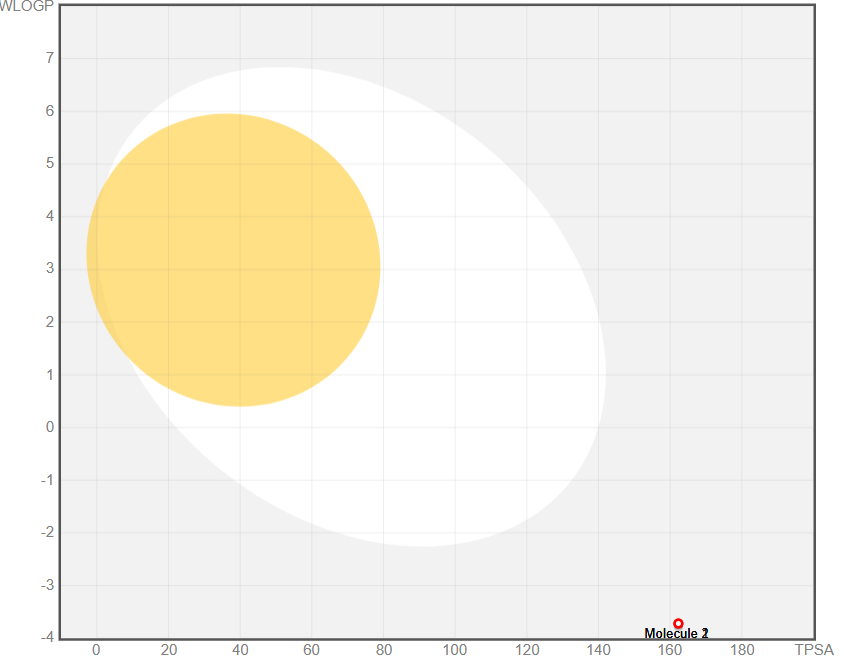
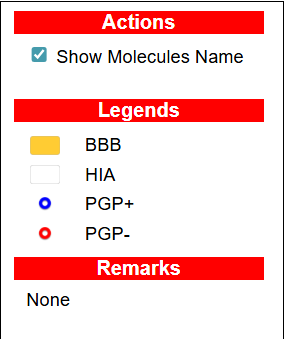
Fig – 2 Boiled egg of Gamma – glutamyl – S- allyl - L – cysteine
This figure is called the “BOILED-Egg model” (Brain or Intestinal Estimated permeation method), a graphical representation used in drug discovery and medicinal chemistry. It predicts whether a small molecule can likely be absorbed in the human intestine (HIA) and/or penetrate the blood–brain barrier (BBB) based only on two key physicochemical descriptors:
WLOGP (lipophilicity) → plotted on the X-axis
Topological Polar Surface Area (TPSA) → plotted on the Y-axis.
1. The “white” region (egg white)
Molecules falling in this region are predicted to have high probability of human intestinal absorption (HIA). These compound

Pratiksha Partil, Saloni Pawar, Shital Vadar, Tushar Kawale, Pankaj Kore*, Experimental and Computational Evaluation of Garlic (Allium Sativum) For Its Potential Activity Against 15-Lipoxygenase?Driven Inflammatory Disorders, Int. J. Med. Pharm. Sci., 2025, 1 (11), 48-55. https://doi.org/10.5281/zenodo.17519647
 10.5281/zenodo.17519647