

We use cookies to ensure our website works properly and to personalise your experience. Cookies policy
1United College of Pharmacy, Periyanaickenpalayam, Coimbatore -641020,
2Jainee College of Pharmacy, Dindigul
Nanocrystal technology offers a versatile and effective strategy to overcome the persistent challenge of poor water solubility in many contemporary drug candidates, a problem that undermines bioavailability and therapeutic performance. By reducing drug particles to the nanometer scale and stabilizing them with appropriate surfactants or polymers, nanocrystals and their aqueous dispersions markedly increase surface area, saturation solubility, and dissolution rate-factors that together accelerate absorption and raise systemic drug concentrations. The approach is broadly applicable oral, intravenous, pulmonary, ocular, and transdermal routes of administration and can be tailored for targeted delivery by modifying surface properties and stabilizers. Nanocrystals retain the drug’s crystalline character, though amorphous or partially amorphous forms can arise depending on preparation, and they avoid carrier-related limitations because they are composed entirely of the active pharmaceutical ingredient plus stabilizer. Preparation methods fall into bottom-up, top down and combination technologies, each with distinct advantages for particle size control, scalability, and stability. Characterization techniques such as XRD, SEM/TEM, DSC/TGA, Raman, FT IR, particle sizing, ssNMR, and zeta potential measurement are essential to confirm crystallinity, morphology, thermal behaviour, dissolution performance, and colloidal stability. While nanocrystals improve dissolution, permeability, adhesiveness, and often bioavailability, challenges remain. Physical stability (aggregation, Ostwald ripening), dosing uniformity, potential long term toxicity, manufacturing cost, regulatory hurdles, and incomplete understanding of in vivo interactions. Overall, nanocrystal formulations represent a powerful, adaptable platform to enhance the performance of poorly soluble drugs, but their development requires careful selection of production method, stabilizers, and thorough physicochemical and biological evaluation to balance efficacy, safety, and manufacturability.
Formulating poorly water-soluble pharmacological moieties is currently the most arduous task for formulation experts. An even greater number of recently identified medications with poor water solubility are mostly the result of advancements in high throughput screening techniques. Over 40% of the medications being added to the formulation development pipeline have poor water solubility. Inadequate water solubility of drugs leads to poor bioavailability impacting their therapeutic effect. In order to increase these medications bioavailability, methods for increasing their water solubility are being investigated [1]. In order to improve bioavailability, numerous strategies have been studied. In addition, the majority of these techniques are limited to medications with a certain chemistry (e.g., solubility in particular organic solvents) or a specified molecular size, shape, or conformation (e.g., for molecules to be incorporated into cyclodextrin ring structure). Additionally, the use of surfactants offers a workable substitute, even though their toxicity can be a problem. The bioavailability issues of many poorly water-soluble medications in BCS Classes 2 and 4 have been addressed by the development of the drug into nanosized formulations [2].
"Nanocrystals" are a type of nanosized formulation that consists of nanoscaled drug particles stabilized by an appropriate stabilizer or surfactant. Crystals in the nanometer range, often between a few nanometers and 1000 nm, are referred to as drug nanocrystals. "Nanosuspensions" are drug nanocrystals distributed in an aqueous media. Another feature of the nanocrystals is that, unlike polymeric/lipidic nanoparticles, they are made entirely of medicine and do not contain any carrier component [3]. They are usually prepared by precipitation of the drug from its organic solvent after addition of an aqueous surfactant/stabilizer solution or by using intense particle size reduction techniques tothe drug's macro-sized dispersion while a surfactant/stabilizer is present [5].
Nano Crystals
The early 1980s saw the beginning of modern nanoscience, which is believed to have been sparked by nanocrystals and continues to this day. Solid, pure medication particles with a size in the nanometer range are called nanocrystals. Drug nanocrystals are nanoparticles with a crystal-line character that are crystals in the nanometer range. The definition of a nanoparticle, which refers to the size of a particle to be classified as such, varies depending on the subject [1]. For example, in colloid chemistry, particles are only classified as nanoparticles if their size is less than 100 nm or even less than 20 nm. According to the size unit, nanoparticles in the pharmaceutical industry should be defined as being between a few nanometers and (1000 nm =1 μm); microparticles, on the other hand, have a size of 1–1000 μm.Another feature is that, unlike polymeric nanoparticles, drug nanocrystals are made entirely of the drug; no carrier material is present. These substances are entirely medicinal and are stabilized with polymeric steric stabilizers or surfactants [5] Some of the unique properties of nanocrystals that enable them to overcome barriers are improved saturation solubility, faster rate of dissolution and improved cohesiveness to surface and cell membranes. [6] Nanocrystalline drug technology increases the solubility of hydrophobic medications due to the higher surface area to volume ratio and quicker dissolving rates caused by nanosizing. They are crystallized, as their name would imply, but they may also be partially or completely amorphous depending on how they are made. Drug nanocrystals are scattered in liquid medium to create "nanosuspensions."[8]. To prevent the dispersed particles from settling out of suspension, stabilizers like surfactants or polymeric stabilizers are usually required. The dispersion medium can be water, aqueous solutions, or nonaqueous substances. Depending on the manufacturing procedure, the end product of turning drug microcrystals into drug nanoparticles could be either crystalline or amorphous, especially if precipitation is employed [7]. By reducing the active drug substance's particle size to the nanoscale range while maintaining the drug's crystal form, nanocrystal technology increases the rate of dissolution based on the area. Increased stability: Because a stabilizer is used to stop active medicinal ingredients from re-aggregating during manufacture, these systems are stable [5]. It is possible to stabilize medication nanocrystal suspension in liquid by adding polymers or surface-active-compounds. All poorly soluble medications can be directly broken down into nanometer-sized particles, making them applicable.
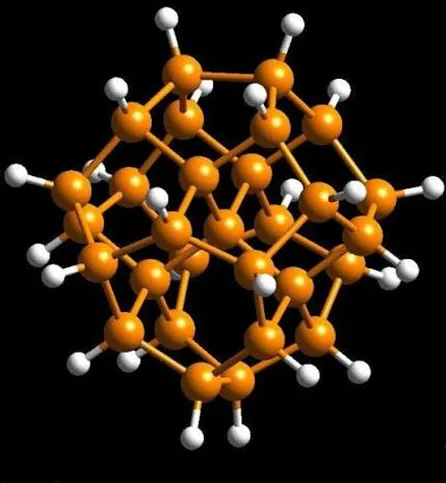
Figure: Nano crystal
Characteristics of Nanocrystals
QDs, or quantum dots: Quantum dots are semiconductor nanocrystals with diameters ranging from 2 to 10 nanometers that display size-dependent optical characteristics like photoluminescence and absorbance. When exposed to light, these organic NCs with a zinc sulfide coating and an inorganic semiconductor core (cadmium selenide) illuminate. Their optical qualities are enhanced by the zinc sulfide coating. When a cap is inserted, QDs dissolve more readily in aqueous buffers. Quantum dots glow in a variety of colors because of their extraordinarily high surface-to-volume ratios. The inner structure of quantum dots controls the color that is created, in contrast to the outside aqueous shell, which can be used to join biomolecules like peptides, proteins, and DNA [9].
Ultra-High Surface-to-Volume Ratio: The large surface area in comparison to bulk materials increases reactivity, which is especially advantageous for drug delivery, sensing, and catalysis.
Enhanced Mechanical Strength: Dislocation pile-ups cannot form due to their extremely small grain sizes. As a result, nanocrystalline metals and alloys have far greater strength and hardness [8].
Better Dissolution and Bioavailability: Drugs are more successful in pharmaceutical applications when they are reduced to nanocrystals since this boosts the drugs' saturation solubility and dissolving velocity.
High Density of Grain Boundaries: Over 30-50% of the atoms in nanocrystalline materials lie on grain boundaries. This promotes super plasticity at lower temperatures and allows for the alloying of materials that are typically insoluble.
MERITS
Improved dissolution rate: The drug particle’s size must be reduced in order to improve its surface area. Following the Noyes-Whitney equation, increased surface area speeds up the drug's dissolving rate [4].
Increased saturation solubility: The saturation solubility is a fixed quantity based on the composition of the component, the media used for dissolving, and the ambient temperature. This statement holds true for powder medications with a µm/nm size range. Particle size has an inverse relationship with the saturation solubility. The rate of dissolution of pharmaceuticals containing nanocrystals is strongly correlated with their saturation solubility and surface area. For instance, increasing surface area (A) and saturation solubility increases the dissolving
Stability: Because the particles didn't aggregate and the Ostwald ripening mechanism wasn't present, the nanocrystals suspension was discovered to be stable. Stability can be obtained by utilising a variety of stabilisers, surfactants, and amphiphilic copolymers, as well as by adding a suitable stabiliser [9].
Permeability: Improved skin adhesion is a characteristic of nanocrystals that makes skin delivery easier. Delivery of drug through skin uses two different mechanisms: (1) concentration difference between skin and nanocrystals formulation, and (2) hair follicles. Nanocrystals within the size range of 200-300 nm helps to improved absorption through the skin.
Adhesiveness: One of the distinguishing characteristics of nanocrystals is their improved adhesiveness; which is caused by their nano size range. The improved oral absorption is a result of the greater adhesiveness. A potential method for analysing adhesion properties is to use kinetics and adsorption isotherms. The particle size affects the adsorption kinetics process [11].
DEMIRITS
Toxicity: Since the application of nanoparticles in medicine is still in its infancy, nothing is known about their long-term toxicity. Some nanoparticles may build up in the body and damage tissue and organs, according to studies [4].
Cost: The manufacture and creation of nanoparticles could be expensive and this could impact on their availability and affordability. Regulatory hurdles: The use of nanomedicine in humans requires strict regulatory approval which could slow down the development and use of novel therapies [10].
Ethical issues: The application of nanomedicine raises ethical issues as well, especially in fields like genetic engineering and enhancement.
Limited understanding: The relationship between nanoparticles and the human body is yet largely unknown. To completely comprehend the possible advantages and dangers of nanomedicine, more research is required.
Properties of Nano Crystals
For therapeutic efficacy, oral drug solubility is essential, particularly for hydrophobic BCS Class II medications with low water solubility. medicines that dissolve in ≤250 ml of aqueous solution spanning pH 1–7.5 are deemed highly soluble; less soluble medicines fail this test, resulting in delayed absorption. By improving bioavailability, speeding up absorption, and lowering variability between fed and fasted states, nanocrystals (NCs) get around these restrictions. Higher drug concentrations in the systemic circulation are guaranteed by their processes, which include enhanced saturation solubility, dissolution rate, and bio attachment. Additionally, NCs are useful for targeted drug delivery systems due to their distinct physiochemical characteristics [11].
Increased Dissolution Rate
The Noyes-Whitney equation, which connects increased surface area to quicker breakdown, explains how reducing particle size increases drug surface area. When dissolution restricts absorption, micronization increases bioavailability; nanotechnology expands this by producing nanoparticles with even greater solubility rates and improved therapeutic efficacy [20].
Enhanced Saturated Solubility
Saturation solubility depends on temperature, medium, and drug chemistry, remaining constant for powders sized micrometres to nanometres. Below 1–2 μm, particle size and crystalline structure influence solubility, which inversely correlates with size. The Noyes‑Whitney equation explains nanocrystal dissolution behavior.The dissolving velocity of nanocrystal medications is strongly proportional to their saturation solubility (C) and surface area (A). For instance, the dissolving velocity (dx/dt) increases as the surface area (A) and saturation solubility (C) rise.
DA/h * (Cs-Ct) = dx/dt.
Studies have shown that some nanoparticles can accumulate in the body and damage tissues and organs.Where A is the surface area, h the diffusional distance, Cs the saturation solubility, Ct the particle concentration, D the diffusion coefficient and dx/dt the velocity of dissolving. In the Prandtl equation diffusional distance h appears to be an integral part of the hydrodynamic boundary layer and to have a significant impact on the particle size [13].
Stability
Nanocrystal suspensions remain stable by resisting Ostwald ripening and particle agglomeration. Stability is achieved through suitable stabilizers, surfactants, or copolymers that adsorb onto crystal surfaces, forming protective barriers. Effective stabilization requires proper surfactant affinity, diffusion rates, and balanced coverage. Cationic polymers like polyethyleneimine, chitosan, and N‑trimethyl chitosan significantly enhance stability. Paclitaxel studies showed Pluronic F127 binds strongly below the critical micelle concentration but detaches above it, with higher temperatures promoting micellization. Thus, selecting the right surfactant is essential for maintaining nanocrystal quality and long‑term stability [8].
Permeability
Nanocrystals (NCs) improve cutaneous drug delivery by adhering to skin and penetrating epidermal membranes, especially at 200–300 nm. Acting as depot formulations, they release drugs gradually and enhance follicular penetration. Particle size strongly influences permeability: <40 nm penetrates via follicles, 500–750 nm shows strong follicular absorption, while >5 μm barely cross the stratum corneum. Lipophilicity limits release, but studies, such as atenolol NCs tested with Franz diffusion cells, confirm enhanced intestinal permeability compared to pure drugs, highlighting NCs’ potential in both transdermal and intraduodenal delivery systems [14].
Adhesiveness
Nanocrystals exhibit strong adhesiveness due to their nanoscale size, improving absorption in oral delivery. Adhesion properties can be studied through kinetics and adsorption isotherms, which vary with particle size. Smaller particles, such as polystyrene latexes (230–670 nm), show unique adsorption behavior with saturation plateaus, while larger particles follow Langmuirian adsorption, forming monolayers that mimic smooth surfaces. This particle‑size dependent adhesion enhances drug absorption efficiency and highlights the importance of nanoscale engineering in optimizing pharmaceutical performance [13].
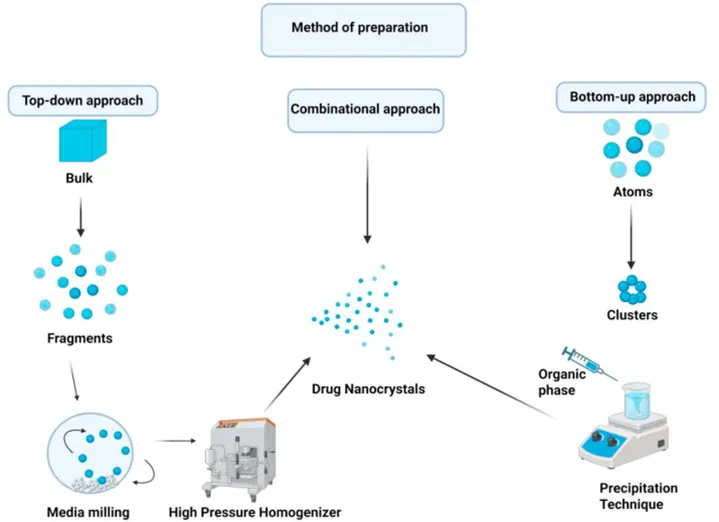
Figure: Formulation of nano crystals
Formulation Of Nanocrystals:
Bottom-up technology
Top-down Technology
Combination technology
Other methods
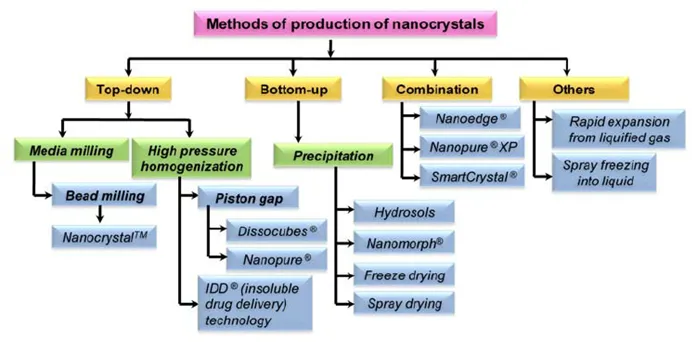
Figure: Method of production of nano crystals
Bottom-Up Technology:
This technology's basic idea is based on precipitation by the drug is dissolved in a solvent, and the solvent is then added to a non-solvent, causing the precipitation of the small drug particle.
Anti-solvent precipitation
The antisolvent precipitation method dissolves a drug in an organic solvent, then rapidly mixes it with a miscible antisolvent and stabilizer to induce precipitation. Combining high shear or homogenization enhances fragmentation. Baxter’s patented NANOEDGE technology applies shear or thermal energy for friable materials. Rapid supersaturation forms crystalline or amorphous solids stabilized in an O/W system. X‑ray analysis after lyophilization showed 90% carotenoids remained amorphous, highlighting the method’s effectiveness in producing stable nanocrystals [16].
Supercritical fluids Nanoparticles can be produced using supercritical antisolvent, rapid expansion of supercritical solution (RESS), and precipitation with compressed antisolvent (PCA) processes. In RESS, drug solution expands into supercritical fluid, precipitating particles due to reduced solvent power, as shown by cyclosporine nanoparticles (400–700 nm). PCA atomizes drug solution into compressed CO₂, causing oversaturation and precipitation. The supercritical antisolvent method introduces drug solution into supercritical fluid, extracting solvent and inducing supersaturation. However, this approach requires hazardous solvents and more stabilizers or surfactants, limiting its practicality compared to other techniques [19].
Spray-drying: Spray drying is widely used to dry liquids and suspensions by atomizing solution droplets into a cyclone chamber, where hot air rapidly evaporates moisture, forming spherical particles. An atomizer disperses the solution via centrifugal force, while a peristaltic pump controls flow and nitrogen or air maintains pressure. Droplet size reduction increases surface area, accelerating drying. Parameters like concentration, viscosity, spray rate, and temperature can be adjusted to influence particle size, fluidity, and drying speed. This technique has successfully enhanced bioavailability and dissolution rates of drugs such as hydrocortisone and COX‑2 inhibitor BMS‑347070 [19].
Top down: The "Top-down Technologies" are the ways of disintegration and are favoured over the methods of precipitation.
Media Milling: The medication, stabilizer, dispersion medium (often water), and milling media (beads or rods) are all added to a chamber during this process. The movement of the milling media creates shear forces that reduce the size of the drug particles. As the effective surface area of the milling media increases, the number of contact sites available for grinding and dispersing increases exponentially, improving the size reduction capacity.
Bead Milling: Liversidge et al. is a key technique for producing nanosuspensions. It uses high‑shear media mills or pearl mills composed of a milling chamber, shaft, and recirculation system. Drug particles are reduced to nanoscale through impact and shear forces generated by rotating milling media such as glass, zirconium oxide, or polystyrene resin Stabilizers are used to prevent aggregation during the temperature-controlled process. Both micronized and non‑micronized drug crystals can be processed. Coated milling beads minimize contamination. Milling efficiency depends on surfactant type, drug hardness, viscosity, temperature, energy input, and bead size, with milling times ranging from 30 minutes to several days [2].
Dry co-grind
Dry co‑grinding disperses poorly soluble drugs with soluble polymers or copolymers to form stable nanosuspensions. Examples include griseofulvin, glibenclamide, and nifedipine ground with SDS and PVP, producing colloidal particles. Polymers like PVP, PEG, HPMC, and cyclodextrin derivatives enhance solubility by increasing surface polarity and inducing amorphous transformation. This method is fast, cost‑effective, and solvent‑free, improving physicochemical properties and water solubility of poorly soluble pharmaceuticals [25].
High pressure homogenizations
Three key technologies are used when homogenization procedures are used to produce nanocrystals: Microfluidizer technology (Nanojet technology), Piston gap homogenization in aqueous media (Dissocubes® technology), and in water mixes or nonaqueous media (Nanopure® technology) [11].
Homogenization in Aqueous media (Disso cubes) High‑pressure homogenization, developed by R.H. Muller in 1999 and patented by DDS GmbH before transfer to Skye Pharmaceuticals, reduces drug microparticles to nanocrystals using cavitation forces. In this process, drug–surfactant suspensions are forced under pressure through nanosized apertures of piston‑gap homogenizers, such as the APVMicron Lab 40. As liquid flows from a 3 cm cylinder through a 25 μm gap, Bernoulli’s law causes dynamic pressure to rise and static pressure to drop below water’s boiling point. Cavitation occurs when gas bubbles implode, fragmenting particles into nanoparticles [5]. Final particle size depends on homogenizer power density, homogenization cycles, pressure, and temperature [7].
Homogenization in Non-Aqueous Media (Nanopure)
Non‑aqueous homogenization methods, such as Dissocubes and Nanopure, use water‑free media or water mixtures to process suspensions. Oils and fatty acids, with higher boiling points and lower vapor pressures than water, prevent cavitation in Dissocubes. Patents note polymer disintegration at ~80 °C, unsuitable for thermo‑labile drugs. Nanopure technology instead applies “deep‑freeze” homogenization at 0 °C or below, producing results comparable to Dissocubes. Both approaches successfully generate stable nanocrystals, offering alternatives for drugs incompatible with aqueous systems [17].
Nanojet technology
Nanojet, or opposing stream technology, uses a microfluidizer chamber where suspension streams collide under high pressure, generating particle collision, shear, and cavitation forces that reduce particle size. Equipment like M110L and M110S microfluidizers apply this principle. Dearn successfully produced atovaquone nanosuspensions with this method. However, its main limitation is the need for multiple passes through the microfluidizer, which increases microparticle content in the final product [18].
Emulsion solvent diffusion method
The emulsion technique creates nanosuspensions by using volatile or partially water‑miscible organic solvents as the dispersed phase. Drug‑containing solvents are emulsified in an aqueous surfactant solution, then homogenized under high pressure. Dilution with water and further homogenization disperses the solvent, solidifying droplets into particles [6]. Particle size is controlled by emulsion droplet size, while optimized surfactant composition increases drug loading. Though solvents like methanol, ethanol, ethyl acetate, and chloroform were initially used, environmental and safety concerns limit their application. This method has successfully produced nanosuspensions of ibuprofen, diclofenac, and acyclovir [17].
Combination Technology
NANOEDGE® Technology
NANOEDGE technology combines precipitation and homogenization to produce smaller, more stable particles efficiently. It addresses precipitation drawbacks like crystal growth and poor long‑term stability by further homogenizing the suspension to reduce particle size and prevent crystallization [10]. Water‑miscible solvents such as methanol, ethanol, and isopropanol are used for precipitation, though complete removal is preferred for safety. An evaporation stage can eliminate residual solvents, creating a modified starting material. This is then processed via high‑pressure homogenization, ensuring nanosuspensions with enhanced stability, reproducibility, and suitability for pharmaceutical applications [14].
Smart Crystal Technology
This technology was initially developed by PharmaSol GmbH, which Abbott later acquired. It is a group of diverse combination methods from which different iterations can be chosen according on the physical characteristics of the drug (e.g., hardness). The method H42 combines HPH and spray-drying [18] It simply requires a few homogenization cycles to prepare the nanocrystals. The methods H69 (precipitation and HPH) and H96 (lyophilization and HPH) provide amphotericin B nanocrystals with a size range of around 50 nm. S. Kobierski et al. (2008) employed two methods to produce nanocrystals: pre-milling and high-pressure homogenization (HPH). Ball milling and another method were used to make hesperidin nanosuspensions for use in cosmetics [8].
Other Methods
Solvent Evaporation
The emulsion–solvent evaporation method produces nanoparticles by dissolving polymers in volatile solvents and forming emulsions Because of toxicity concerns, safer solvents like ethyl acetate have taken the role of dichloromethane and chloroform. As the solvent diffuses and evaporates, emulsions transform into nanoparticle suspensions. Single (o/w) or double (w/o/w) emulsions are prepared using high‑speed homogenization or ultrasonication, followed by continuous stirring at ambient or reduced pressure. Solidified nanoparticles are recovered via ultracentrifugation, washed, and lyophilized [23]. Particle size is influenced by polymer concentration, stabilizer levels, and homogenizer speed, making this technique versatile for controlled nanosuspension production with improved safety and efficiency [10].
Sono crystallization
Sono crystallization is a cutting-edge technique that uses ultrasonic crystallization to reduce particle size. Sono crystallization is caused by ultrasonic radiation with a frequency range of 20–100 kHz [6]. In addition to increasing the nucleation rate, it is an effective method for controlling the active pharmaceutical ingredient's (API) size distribution and decreasing its size. Ultrasound in the 20 kHz to 5 MHz range was used in most applications [11]. The unfavorable characteristics of NSAIDs, such as their poor solubility and dissolution rate and, consequently, their poor bioavailability, have also been studied.
Melt emulsification
Melt emulsification is the fundamental method for producing solid lipid nanoparticles. Kipp and associates first used the melt emulsification method to create ibuprofen nanosuspensions. It involves four steps. The medication is introduced after the stabilizer-containing aqueous solution [1]. The solution is heated above the drug's melting point and then homogenized using a high-speed homogenizer to produce an emulsion. The temperature is maintained above the drug's melting point during the entire process. In order to precipitate the particles, the emulsion is ultimately chilled. The main factors influencing nanosuspension particle size are the drug concentration, the type and quantity of stabilizers used, the cooling temperature, and the homogenization procedure [23].
Bottom-Up NanoCrySP Technology
Hesperetin nanocrystalline solid dispersions (NSD) can be produced using a contemporary bottom-up method called NanoCrySP technology, which was developed by NIPER researchers like G. Shete and Y. Pawar. Hesperetin and mannitol are mixed in a 1:1 ratio during the spray drying process. Mannitol facilitates hesperetin crystallization by acting as a plasticizer, crystallization inducer, and heterogeneous nucleation site, according to classical nucleation theory. The resultant NSD has nanocrystals with an average crystallite size of 137 nm that are embedded in a mannitol matrix. This technique provides a scalable, solvent-free method for stable pharmaceutical nanocrystals while improving oral bioavailability and pharmacological activity [13].
Characterization Techniques of Nanocrystals
X – Ray Diffraction (XRD): X‑ray diffraction (XRD) is widely used to determine drug crystallinity. Changes in polymorphic form confirm nanocrystal formation. Each crystalline compound produces a distinct XRD pattern, correlated with its pure substance, creating a unique fingerprint that identifies particle structure and composition [8].
Morphological Analysis: Nanocrystals (NCs) are characterized using SEM and TEM to assess size, structure, and morphology. TEM requires wet samples, while SEM needs dried nanosuspensions via lyophilisation or spray drying, which can cause aggregation. Cryoprotectants like mannitol are added to reduce agglomeration during drying. The surface properties like friction, magnetic properties and height are investigated by atomic force microscopy. Additionally, surface plasmon resonance (SPR), a label‑free technique, evaluates nanocrystal surface changes, film dispersion, and particle adhesion, providing deeper insights into NC stability and performance [3].
Thermal Analysis DSC is a crucial method for analysing the thermodynamic characteristics of medicinal nanocrystals. To assess the thermal behavior, the drug's crystallinity and the creation of nanocrystals using different polymers are examined. This discovery is particularly significant for medications with several polymorphic variants.When a solvent or hydrate is heated, thermogravimetric analysis (TGA) helps determine its structure and assess the quality of the sample [6].
Raman Spectroscopy Raman spectroscopy relies on the inelastic scattering of monochromatic laser light, known as the Raman Effect, were photon frequencies shift upon interaction with materials. These shifts reveal low‑frequency rotational, vibrational, and transitional details of compounds. The technique is widely used to characterize nanoparticles and nanostructured materials, including nanocrystals, distinguishing crystalline from amorphous phases and identifying structural transitions. It provides a powerful, non‑destructive fingerprinting method for nanoscale materials, offering insights into their composition, phase behavior, and surface properties critical for drug delivery and advanced nanotechnology applications [25].
FT-IR Analysis:
FT‑IR spectroscopy is used to evaluate drug chemical properties and interactions with excipients. In 2015, Liandong et al. tested spray‑dried curcumin nanocrystals for pulmonary delivery. FT‑IR analysis compared pure curcumin, nanocrystals, and spray‑dried powders, showing that spray drying and milling did not alter curcumin’s chemical properties. The consistency of peak positions relative to the pure drug confirmed structural integrity, indicating that curcumin nanocrystals maintained their chemical characteristics despite processing. This highlights FT‑IR’s value in verifying stability and compatibility of nanocrystal formulations [11].
Particle Size and Polydispersity Index: Particle size and distribution are vital for evaluating dissolution rate, solubility, stability, and therapeutic effectiveness. Microscopy, static, and dynamic light scattering are common methods. Photon correlation spectroscopy (PCS) measures average nanosuspension size but cannot analyze particles above 6 μm. Larger particles are better assessed using low‑angle static light scattering techniques like laser diffractometry (LD) and optical microscopy. LD is particularly reliable for examining mixtures of small and large particles, offering advantages over other approaches in detecting broader particle size ranges and ensuring accurate characterization of nanocrystal suspensions [18].
Solid-State NMR (ssNMR) Spectroscopy:
ssNMR spectroscopy can be used to investigate the kinetic behavior and chemical organization of molecules in crystals. As a result, ssNMR spectroscopy is an essential method for assessing and determining the crystal patterns. Pinon (2015) investigated the effects of three polymorphs and one hydrated condition on samples of the asthma drug theophylline using the NMR technique [17].
Dissolution of nanocrystals
Thermodynamic solubility reflects the drug’s most stable crystalline form in a medium under specific conditions. Nanocrystals, amorphous forms, or metastable polymorphs can temporarily exceed this limit, described as kinetic or perceived solubility. Compared to bulk drugs, nanocrystals show significantly higher solubility and dissolution rates, influenced by particle size and stabilizers. For example, indomethacin nanocrystals dissolved faster than bulk drug, with stabilizers like poloxamers enhancing rates. UV imaging confirmed drug interactions with container materials and filters [1]. Polymers such as PVP and HPMC further improve solubility through co‑solvency and drug‑polymer interactions, reducing supersaturation and crystallization. This “polymer parachute effect” enhances water solubility via electrostatic, van der Waals, or hydrogen bonding, making nanocrystals more effective for drug delivery [6].
Permeation Study
Nanocrystal‑based drug delivery enhances cutaneous and ocular bioavailability for poorly soluble drugs. Because of their increased solubility and dissolution rates, their adhesiveness enhances cutaneous distribution. Skin delivery occurs via concentration gradients and follicular deposition, with ~700 nm particles acting as depots for sustained release. In ocular delivery, nanocrystals increase solubility in lachrymal fluid and improve retention through surfactant‑mediated adhesion. Non‑ionic surfactants are preferred for reduced irritation. Franz diffusion cells are typically used for permeation studies [12].
Particle surface charge
Particle surface charge is a key factor in nanosuspension stability, with higher electrical repulsion improving physical stability. Zeta potential, measured via electrophoretic mobility in an electric field, is the standard quantification method. Colloid titration also assesses charge per unit. In electrolyte solutions, ions adsorb onto particle surfaces, forming the Helmholtz layer. Electrophoresis with laser Doppler scattering calculates particle velocity, typically at 20 V/cm. The Helmholtz–Smoluchowski equation converts mobility into zeta potential, where multiplying observed mobility by 12.8 yields millivolt values under standard conditions, providing reliable stability assessment [11].
Application Of Nano Crystals
The NC method has a lot to offer in the area of pharmaceutical medication delivery in a number of different areas. As a result, examples of the already marketed NC products are given after a presentation of the broad adaptability of NCs to various administration routes and biological applications [1].
Oral drug delivery
The oral route remains the most preferred and safest method for drug delivery, with dissolution being the rate‑determining step for absorption. Nanocrystals enhance dissolution by increasing surface area and saturation solubility, thereby improving drug absorption. Muller et al. refined oral delivery of thermo‑stable drugs using melted PEG (melting point 60 °C), embedding nanocrystals in a solid PEG matrix [21]. These dispersions were milled into powder and compressed into tablets or filled into capsules. This innovative system enables poorly soluble drugs to be incorporated directly into solid dosage forms, significantly improving oral bioavailability and therapeutic effectiveness [17].
Intravenous drug delivery
Administering a drug via intravenous route provides numerous benefits such as immediate action, reduced dosing and 100% bioavailability. The use of intravenous route is limited because harmful solvent and excipients, which are used during formulation development, are also co-administered with the drug and they can cause serious side effects other than the drug itself. Nanocrystals could be considered as the ideal candidates for intravenous delivery because their developmental processes do not employ excess use of such harmful excipients [24].
Pulmonary drug delivery
The lungs, with a surface area equal to three football fields, enable rapid systemic drug absorption due to lack of hepatic portal drainage. Pulmonary nanocrystals have shown pharmacokinetics comparable to intravenous baicalin, making this route highly effective. However, constant environmental exposure makes lungs vulnerable to pathogens and allergens [4]. Tailoring nanocrystal size improves deep lung deposition. Administration typically requires a nebulizer, which incorporates nanocrystals into inhalable droplets sized 1–5 μm, ensuring efficient delivery and enhanced therapeutic potential [6].
Ocular drug delivery
Ophthalmic drug delivery faces challenges due to the eye’s pharmacokinetic barriers and rapid clearance from blinking and lacrimation, which reduce drug availability and require repeated dosing. Conventional solutions and suspensions often cause poor compliance and side effects. Alternatives like ocular inserts and gels have drawbacks such as irritation and blurred vision. Colloidal systems offered improvements, with Piloplex being the first, binding pilocarpine to nanoparticles [8]. Nanocrystal technology further advanced ocular therapy, enhancing dispersibility of poorly soluble drugs like budesonide, dexamethasone, and hydrocortisone. Ali et al. developed hydrocortisone nanocrystals using microfluidic nanoprecipitation and wet milling, showing extended action and improved bioavailability in rabbits. Forskolin nanocrystals incorporated into an in‑situ gelling system lowered intraocular pressure for up to 12 hours, outperforming conventional suspensions. This demonstrates nanocrystals’ potential to revolutionize ophthalmic drug delivery [22].
Bioavailability Enhancement
Some recently created compounds suffer from low water solubility, which leads to low permeability. By resolving the twin issues of weak solubility and poor permeability across the membrane, nanosuspensions address the issue of low bioavailability [17]. When naproxen nanoparticles are taken orally, the area under the curve (AUC) (0-24 h) is 97.5 mg-h/l, compared to just 44.7 mg-h/l for naproxen suspensions and 32.7 mg-h/l for anaprox tablets. When the gonadotropin inhibitor is administered orally in a traditional dispersion (Danocrine), its absolute bioavailability is just 5.2%; however, when it is administered as a nanosuspension (Danazol), it is around 82.3%. When compared to the traditional commercial formulation, Kayser et al.'s Nanosuspension Amphotericin B shown a notable improvement in oral absorption [25].
Targeted Drug Delivery
Because nanosuspensions' surface characteristics and in-vivo behavior may be readily changed by altering the stabilizer or milieu, they can be employed for targeted administration. The future of targeted drug delivery systems lies in the engineering of stealth Nanoosuspensions (similar to stealth liposomes) using different surface coatings for active or passive targeting of the desired spot. Aphidicolin nanosuspension was developed by Kayser et al. to enhance medication targeting against leishmania-infected macrophages. With an EC (50) of 0.003 mcg/ml, which is roughly 0.16 mcg/ml in the conventional form, he claimed that the nanosuspension formulation had improved activity [16].
CONCLUSIONS
Nanocrystal technology represents a pragmatic and broadly applicable solution to the pervasive problem of poor water solubility in modern drug candidates. By reducing active pharmaceutical ingredients to the nanometer scale and stabilizing them with carefully chosen surfactants or polymers, nanocrystals markedly increase surface area, saturation solubility, and dissolution rate—parameters that directly improve absorption and systemic exposure. A diverse toolbox of manufacturing approaches (bottom‑up precipitation and supercritical methods, top‑down milling and high‑pressure homogenization, and hybrid platforms such as nanoedge® and Smart Crystal®) allows formulation scientists to tailor particle size, crystallinity, and stability to the drug’s physicochemical profile and production constraints. Robust characterization—XRD, electron microscopy, thermal analysis, spectroscopy, particle sizing, and zeta potential—ensures control over polymorphism, morphology, and colloidal behavior, while permeation and dissolution testing link these attributes to in‑vitro and in‑vivo performance. Despite clear advantages in dissolution, permeability, and adhesiveness, nanocrystal development must address challenges including physical instability (aggregation, Ostwald ripening), dose uniformity, potential long‑term toxicity, regulatory complexity, and cost. Successful translation therefore depends on judicious stabilizer selection, scalable process design, and comprehensive safety and stability evaluation. In summary, nanocrystals offer a powerful, adaptable platform to rescue poorly soluble drugs and enhance therapeutic outcomes, but their promise will be realized only through integrated formulation science, rigorous characterization, and careful risk‑benefit assessment.
REFERENCES

Sinthan S., Christopher Vimalson D.*, Alagarraja M., Kadalselvi S., Sivabal R., Naveenyadav J. K., Vasunthra Devi M., Nano Crystal Technology for Novel Drug Delivery Systems: A Review, Int. J. Med. Pharm. Sci., 2026, 2 (7), 883-895. https://doi.org/10.5281/zenodo.21439229
 10.5281/zenodo.21439229