

We use cookies to ensure our website works properly and to personalise your experience. Cookies policy
1Department of Pharmacy Practices, Mahendra Institute of Medical and Pharmaceutical Sciences, Namakkal.
2Sree Abirami College of Pharmacy, Coimbatore
Introduction: Asthma is a chronic respiratory disorder characterized by airway inflammation, hyperresponsiveness, and reversible airflow obstruction. It remains one of the most common non-communicable diseases globally, affecting people of all ages. According to the World Health Organization (WHO), asthma affects more than 260 million individuals worldwide and is responsible for substantial morbidity, reduced quality of life, and, in some cases, mortality. Methods: This was a cross-sectional, observational prescription-audit study conducted in the outpatient departments (OPDs) of a tertiary care teaching hospital. Data were collected from consecutive patients attending the OPD clinics that provide care to patients with asthma (general medicine, pulmonology/respiratory medicine, and pediatrics/adult chest clinic where applicable). Results: The prescribing pattern of anti-asthmatic drugs among outpatients revealed a predominance of methylxanthines, combination inhalers, and short-acting β₂-agonists. Among the drugs prescribed, Deriphyllin, a methylxanthine derivative, was the most frequently used agent, accounting for 125 prescriptions (42%). This indicates a continued reliance on oral bronchodilators, possibly due to their affordability, availability, or patient preference, despite the shift in modern guidelines toward inhaled therapy. Discussion: The present cross-sectional study analyzed the prescribing pattern of anti-asthmatic and supportive drugs in the outpatient departments of a tertiary care hospital. The findings revealed that Deriphyllin (a methylxanthine derivative) was the most frequently prescribed anti-asthmatic drug (42%), indicating a continued preference for oral bronchodilators. This may be attributed to their easy availability, affordability, and patient familiarity. However, such reliance contrasts with current GINA guidelines, which emphasize inhaled corticosteroids and combination therapy as the cornerstone of long-term asthma management. Conclusion: This cross-sectional study assessed the prescribing patterns of anti-asthmatic drugs among outpatients in a tertiary care hospital and provided important insights into current clinical practices. The analysis revealed that inhaled corticosteroids (ICS) and combination therapies containing ICS with long-acting β₂-agonists (LABA) were the most frequently prescribed medications, reflecting adherence to standard asthma management guidelines.
Asthma is a chronic respiratory disorder characterized by airway inflammation, hyperresponsiveness, and reversible airflow obstruction. It remains one of the most common non-communicable diseases globally, affecting people of all ages. According to the World Health Organization (WHO), asthma affects more than 260 million individuals worldwide and is responsible for substantial morbidity, reduced quality of life, and, in some cases, mortality. Effective management of asthma requires both pharmacological and non-pharmacological approaches, with pharmacotherapy being the cornerstone of treatment. The main goals of asthma therapy are to achieve long-term control, minimize symptoms, prevent exacerbations, and maintain normal pulmonary function. Commonly prescribed medications include inhaled corticosteroids (ICS), β₂-agonists (short-acting and long-acting), leukotriene receptor antagonists (LTRA), methylxanthines, and anticholinergics. The Global Initiative for Asthma (GINA) provides evidence-based guidelines for asthma management and emphasizes a stepwise approach to optimize therapy according to disease severity and control level. However, despite the availability of such guidelines, variations in prescribing patterns are often observed due to differences in physician practices, patient factors, socioeconomic status, and drug availability. Studying the prescribing pattern of anti-asthmatic drugs helps assess the rationality of prescriptions, adherence to clinical guidelines, and the extent of polypharmacy. It also aids in identifying areas where prescribing practices can be improved to enhance therapeutic outcomes and ensure cost-effective patient care. Therefore, this cross-sectional, observational study aims to evaluate the prescribing trends and patterns of anti-asthmatic drugs among patients attending the outpatient departments of a tertiary care hospital. The findings of this study will provide valuable insights into current clinical practices and contribute to promoting rational drug use in asthma management.
METHODS
Study design and setting
This was a cross-sectional, observational prescription-audit study conducted in the outpatient departments (OPDs) of a tertiary care teaching hospital. Data were collected from consecutive patients attending the OPD clinics that provide care to patients with asthma (general medicine, pulmonology/respiratory medicine, and pediatrics/adult chest clinic where applicable).
Study period
The study was carried out over a 3-month period
Sample size and sampling
A final sample of 300 patients/prescriptions was used for the study.
* Sample size rationale (practical): A conservative prevalence estimate for prescription pattern studies is often taken as 50% when exact prior estimates are unavailable; however, for feasibility and to obtain a reasonably precise description of prescribing trends in the OPD setting, 300 prescriptions were targeted as an achievable and informative sample for cross- sectional analysis.
* Sampling method: Systematic/consecutive sampling of eligible asthma patients attending the OPD during data-collection days. On each data collection day, every eligible patient meeting the inclusion criteria who attended the OPD was invited to participate until the daily quota (or overall sample) was met.
Inclusion and exclusion criteria Inclusion criteria
Exclusion criteria
Data collection tool and variables
Data were collected using a structured data collection proforma designed for the study. The proforma was pilot tested and then used to record the following:
A. Patient / demographic data
* Unique study ID, age, sex, weight (if available), residence, education (optional), smoking status, and comorbidities.
B. Clinical data
* Duration of asthma, severity classification (intermittent, mild persistent, moderate persistent, severe persistent) as per clinical records or clinician’s assessment / GINA step if available, history of recent exacerbations, and co-morbid allergic rhinitis/COPD overlap (if applicable).
C. Prescription / drug data (primary focus)
D. Additional information
* Any written instruction on inhaler technique recorded, patient counseling noted (yes/no), and whether follow-up appointment was scheduled.
Pilot testing
The proforma and data collection procedure were pilot tested on 20–30 prescriptions/patients in the same OPD (not included in the final sample) to check clarity, timing, completeness, and inter-rater agreement. Necessary modifications were made before the main data collection.
Data collection procedure
Operational definitions
* Prescribing pattern: the distribution and frequency of anti-asthmatic drugs/classes prescribed in the OPD prescriptions.
* Adherence to guideline: defined as prescription of an appropriate controller based on recorded severity/GINA recommendations (where severity data were available).
* Generic prescribing: drug prescribed using the generic/INN name. Data management and statistical analysis
* Data from proformas were entered into Microsoft Excel and exported to SPSS version 21 (or later) for analysis.
* Descriptive statistics: continuous variables described by mean ± standard deviation (or median with interquartile range if not normally distributed); categorical variables presented as frequencies and percentages.
* Key indicators reported:
* Percentage of prescriptions containing each major drug class (ICS, SABA, LABA, ICS/LABA, LTRA, oral steroids, methylxanthine).
* Device distribution (pMDI, DPI, nebulizer).
* Percentage of drugs prescribed by generic name.
* Average number of drugs per prescription.
* Inferential statistics: associations between categorical variables (e.g., severity category vs prescription of ICS) were tested using Chi-square test or Fisher’s exact test where cell counts were small. For continuous comparisons (e.g., number of drugs across groups) t-test or Mann-Whitney U test was used as appropriate. A p-value < 0.05 was considered statistically significant.
* If relevant, multivariable logistic regression may be used to identify predictors of prescribing a controller (ICS) versus not, adjusting for age, sex, severity, and comorbidity.
Ethical considerations
Quality control
Limitations
RESULTS
Table 1: Prescribing pattern of anti-asthmatic drugs in patients of asthma attending out-patient department of our tertiary care hospital.
|
Drugs |
Therapeutic Class |
Route of Administration |
Number of Prescriptions |
Percentage |
|
Deriphylline |
Methylxanthine |
Oral |
125 |
42% |
|
Formoterol + Steroid Combination |
Long-Acting Beta2 Agonist + Glucocorticoid |
Inhalation |
44 |
15% |
|
Salbutamol |
Short-Acting Beta2 Agonist |
Oral |
19 |
6% |
|
Inhalation |
10 |
3% |
||
|
Oral + Inhalation Both |
6 |
2% |
||
|
Beclomethasone |
Glucocorticoid |
Inhalation |
17 |
6% |
|
Budesonide |
Glucocorticoid |
Inhalation |
32 |
11% |
|
Fluticasone |
Glucocorticoid |
Inhalation |
40 |
13% |
|
Formoterol |
Long-Acting Beta2 Agonist |
Inhalation |
4 |
1% |
|
Dexamethasone |
Glucocorticoid |
Oral |
3 |
1% |
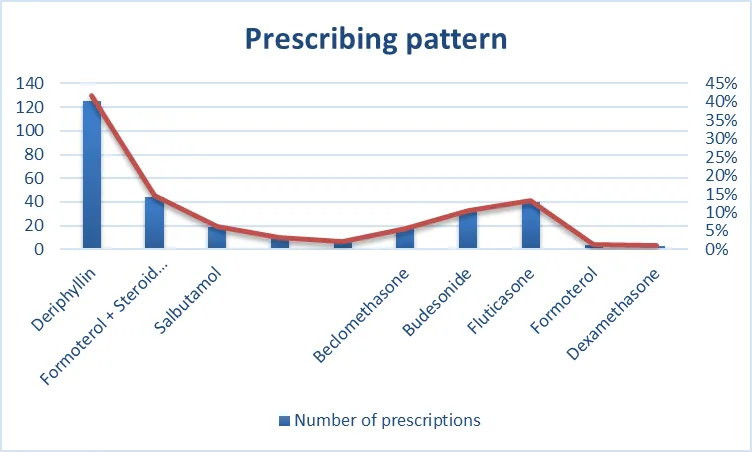
Prescribing Pattern of Anti-Asthmatic Drugs
The prescribing pattern of drugs used in the management of respiratory disorders was analyzed and is summarized in the table. A total number of prescriptions were evaluated to assess the commonly prescribed drugs, their therapeutic classes, routes of administration, and percentage distribution. Deriphylline, a methylxanthine bronchodilator, was the most frequently prescribed drug, accounting for 125 prescriptions (42%), predominantly administered via the oral route. This indicates a preference for oral bronchodilators in routine clinical practice. Among inhalational therapies, the Formoterol + steroid combination, belonging to the class of long-acting β₂-agonists combined with glucocorticoids, constituted 44 prescriptions (15%). The high usage of this combination reflects adherence to guideline-based management of chronic respiratory conditions such as asthma and COPD, where combination therapy improves symptom control and reduces exacerbations. Salbutamol, a short-acting β₂-agonist, was prescribed through multiple routes. Oral administration accounted for 19 prescriptions (6%), inhalational route for 10 prescriptions (3%), and both oral and inhalational routes for 6 prescriptions (2%), indicating its use for both acute relief and maintenance therapy. Inhaled corticosteroids were widely prescribed. Beclomethasone was used in 17 prescriptions (6%), Budesonide in 32 prescriptions (11%), and Fluticasone in 40 prescriptions (13%), all administered via the inhalational route. This highlights the importance of inhaled glucocorticoids in reducing airway inflammation and achieving long-term disease control. Additionally, Formoterol alone, a long-acting β₂-agonist administered by inhalation, was prescribed in 4 cases (1%), indicating limited use as monotherapy. Dexamethasone, a systemic glucocorticoid, was prescribed orally in 3 cases (1%), likely for acute exacerbations requiring short-term systemic steroid therapy. Overall, the data demonstrate a predominant use of oral bronchodilators and inhalational corticosteroids, with inhalation being the preferred route for long-term management due to better efficacy and reduced systemic side effects.
Table 2: Other drugs prescribed along with anti-asthmatic medications
|
Drugs |
Therapeutic Class |
Number of Prescriptions (n = 112) |
Percentage |
|
Chlorpheniramine |
Anti-histaminic |
43 |
38% |
|
Famotidine |
H2 blocker |
28 |
25% |
|
Omeprazole |
Proton pump inhibitor |
9 |
8% |
|
Multivitamin |
Vitamin supplements |
21 |
19% |
|
Iron + Folic acid |
Haematinics |
1 |
1% |
|
Cetirizine |
Anti-histaminic |
4 |
4% |
|
Codeine |
Anti-tussive |
1 |
1% |
|
Diclofenac |
NSAIDs |
2 |
2% |
|
Domperidone |
Anti-emetic |
1 |
1% |
|
Enalapril |
ACE inhibitors |
2 |
2% |
The analysis of drug prescriptions revealed the pattern of commonly prescribed medications along with their therapeutic classes and percentage distribution. A total of 112 prescriptions were evaluated in the study.
Chlorpheniramine, an anti-histaminic agent, was the most frequently prescribed drug, accounting for 43 prescriptions (38%). This indicates a high prevalence of allergic conditions and upper respiratory symptoms among the study population.
Famotidine, an H₂ receptor blocker, was the second most commonly prescribed drug with 28 prescriptions (25%), reflecting the routine use of acid-suppressive therapy to prevent or manage gastrointestinal irritation.
Multivitamin supplements were prescribed in 21 cases (19%), suggesting a supportive role in general health maintenance and nutritional supplementation.
Among gastroprotective agents, Omeprazole, a proton pump inhibitor, accounted for 9 prescriptions (8%), indicating its use in conditions requiring stronger acid suppression.
Other anti-histaminic drugs such as Cetirizine were prescribed in 4 cases (4%), complementing the overall use of antihistamines in allergic disorders.
Drugs with lower prescription frequency included Diclofenac, a non-steroidal anti-inflammatory drug, and Enalapril, an ACE inhibitor, each prescribed in 2 cases (2%), indicating limited use for pain management and hypertension, respectively.
Iron with folic acid, Codeine, and Domperidone were each prescribed in 1 case (1%), reflecting their selective use for anemia, cough suppression, and anti-emetic therapy. Overall, the data demonstrate a predominance of anti-histaminic and gastroprotective drugs, highlighting the common clinical conditions encountered and the prescribing preferences observed in the study setting.
DISCUSSION
The current study assessed the prescribing trend of commonly prescribed medications, with a special focus on respiratory drugs, among a specified patient population. The assessment of 112 general prescriptions showed that anti-histaminic and gastroprotective medications were predominantly prescribed, thus establishing the high incidence of allergic and gastrointestinal disorders among the patient population. Chlorpheniramine (38%) and Famotidine (25%) were the most commonly prescribed medications. Moreover, the use of supportive therapies like multivitamins (19%) and proton pump inhibitors, such as Omeprazole (8%), is also quite common, which indicates the preventive measures taken by the prescribers to avoid gastric irritation and nutritional deficiencies caused by drugs. The low use of cardiovascular, hematinic, and analgesic drugs indicates selective prescribing. The utilization pattern of respiratory drugs also showed a strong preference for bronchodilators and inhalational corticosteroids. Deriphylline, an oral drug, was the most commonly prescribed respiratory drug (125 prescriptions; 42%), reflecting its continued use as a bronchodilator, possibly in resource-limited settings. The high usage of oral therapy might also be due to ease of administration and compliance. Inhalation therapy became common, especially for the long-term management of diseases. The Formoterol + steroid combination contributed 15% to the prescriptions, which was in line with the guidelines that emphasized the combination of inhalation therapy for the management of asthma and chronic obstructive pulmonary disease (COPD). Inhaled steroids such as Fluticasone (13%), Budesonide (11%), and Beclomethasone (6%) were also common.The prescription of short-acting β₂-agonists such as Salbutamol through various routes, including oral and inhalational routes, indicates their use in both relieving and maintaining the condition. The restricted use of systemic corticosteroids such as Dexamethasone (1%) indicates rational prescription practices, which reserve systemic steroids for acute exacerbations.In general, the results indicate a balanced prescribing trend with an increasing preference for inhalational therapy, which is in line with the prevailing treatment recommendations for respiratory diseases.
CONCLUSION
The current study offers a detailed insight into the prescribing trend of commonly prescribed medications, with a special focus on respiratory drugs. The results reveal that anti-histaminic drugs, gastroprotective medications, and bronchodilators account for the principal portion of the prescriptions, which is a reflection of the common clinical conditions observed in daily practice. Amongst respiratory medications, the common use of Deriphylline indicates its continued relevance in bronchodilator treatment, particularly in outpatient care where oral medications are preferred due to ease of use and patient compliance. Nevertheless, the high use of inhalational therapies, such as inhaled corticosteroids and long-acting β₂-agonists, indicates a positive trend towards the recommended management of chronic respiratory conditions such as asthma and COPD. The prescription rate of high usage of inhaled corticosteroids such as Fluticasone, Budesonide, and Beclomethasone emphasizes the importance of these drugs in the management of airway inflammation. The selective prescription rate of systemic corticosteroids indicates rational prescription, which reduces the risk of adverse reactions. In general, the conclusion of the study is that the prescribing trend seen is mostly rational, safe, and appropriate. However, there is still a need to further promote the use of inhalational therapy instead of oral bronchodilators when indicated, as well as educate patients on proper inhaler technique. This will help improve treatment outcomes and reduce complications associated with the long-term management of respiratory diseases.
REFERENCES


Karan A. S.*, Mukesh V., Celcia S., Mohanapandiyan S., Fathimathul Nusaira T., Harshad M. K., A Cross-Sectional Study on the Prescribing Pattern of Anti-Asthmatic Drugs in Outpatient Departments of a Tertiary Care Hospital, Int. J. Med. Pharm. Sci., 2026, 2 (10), 241-248. https://doi.org/10.5281/zenodo.23267838
 10.5281/zenodo.23267838