

We use cookies to ensure our website works properly and to personalise your experience. Cookies policy
1Nova chem drugs pvt ltd. Chinchwad MIDC, Pune, Maharashtra, India
2G. H. Raisoni Skill tech university, Nagpur
3Bajiraoji Karanjekar College of Pharmacy, Sakoli, Bhandara Maharashtra, India
4Bajiraoji Karanjekar College of Pharmacy, Sakoli, Bhandara Maharashtra, India
Aim: The aim of the present investigation is preparation, characterization of polymorphic form, their relative equilibrium solubility and dissolution profile, also to check the stability of polymorphic form under different experimental condition. Materials and Methods: To study the drug excipient interaction both the fourier transform infrared spectroscopy (FT-IR) and differential scanning calorimetry (DSC) studies are carried out to detect physical as well as chemical incompatibility and X-ray diffraction pattern (X-RD) study for polymorphic changes. Formulation of immediate release tablet of metastable polymorph of mefloquine hydrochloride by direct compression method. The polymorphs were evaluated by Differential scanning colorimetric analysis of pure drug and prepared polymorph. Mefloquine hydrochloride polymorphs were assessed for crystallinity using an X- ray diffractometer. Results: The polymorph prepared by saturation method using methanol as solvent showed differential scanning calorimetry (DSC) principle peak at 263.210C (table 5). The dissolution study shows 86.14 % drug release in 160 minutes. The polymorph prepared by supersaturation method using ethanol:water (2:1)as solvent showed differential scanning calorimetry (DSC) principle peak at 260.420C , 264.980C, 291.060C. (table 5). The X-ray diffraction pattern (X-RD) pattern shows principle peak at 4,6,9,10,11,12,16,17,18,19,23,27,33, (2θ value) (table 5). The dissolution study shows 93.13 % drug release in 40 minutes. Conclusion: Metastable polymorph of mefloquine hydrochloride was successfully formulated and evaluated and then immediate release tablet of that metastable polymorph were prepared by employing direct compression method.
Several pharmaceutical compounds can occur in a variety of physical states. Polymorphism is commonly defined as a pharmacological substance's ability to exist as two or more crystalline phases with distinct layouts and/or conformations of the molecules in the crystal lattice. Melting point, chemical reactivity, apparent solubility, dissolving rate, optical and electrical characteristics, vapor pressure, and density can all vary in polymorphs and/or solvates of a pharmaceutical solid. These characteristics, such as stability, solubility, and bioavailability, can have a direct influence on the processability of medicinal ingredients and the quality/performance of drug products. In reaction to changes in ambient conditions, processing, and so on, a metastable pharmaceutical solid form can alter crystalline structure or solvate/desolvate [1]. The significance of polymorphism in medication therapeutic efficacy and the pharmaceutical implications of the occurrence of metastable crystalline form in bulk powder is well recognized. It was also demonstrated that the polymorph (crystal structure) might influence the porosity and elastic characteristics of solid dose tablets. Over the years, the FDA has authorized a large number of generic drug products that are based on a drug substance that has a different physical shape from the drug substance in the corresponding reference listed medication (e.g., warfarin sodium, famotidine, and ranitidine). In addition, several ANDAs have been approved with pharmaceutical ingredients that differed from those in the relevant reference listed medicines in terms of solvation or hydration state (e.g., terazosin hydrochloride, ampicillin, and cefadroxil). Because polymorphs differ in physical (e.g., powder flow and compatibility, apparent solubility and dissolution rate) and solid-state chemistry (reactivity) characteristics related to stability and bioavailability, it is critical that product development and the FDA review process pay close attention to this issue. This examination is required to guarantee that polymorphism variations (where existent) are addressed by formulation and process control to maintain physical and chemical stability of the product over the desired shelf-life, as well as bioavailability/bioequivalence [1-3]. The aim of the present investigation is preparation, characterization of polymorphic form, their relative equilibrium solubility and dissolution profile, also to check the stability of polymorphic form under different experimental condition and to investigate the tendency of structural changes under compression and tableting condition [1-3].
MATERIALS AND METHODS
MATERIALS
Mefloquine hydrochloride were procured from Cipla Pharmaceutical Ltd. Mumbai. Emcure Pharmaceuticals, Pune. PVP K-30 from S.D. Fine Chem. Ltd. Mumbai. Micro crystalline cellulose PH (112) from Glenmark Pharmaceuticals Mumbai. Differential Scanning Calorimetry (DSC) of Shimadzu, DSC Q20 V24.4, Japan, Tablet compression machine (10 station) of Rimek RSB-4, minipress, Karnavati Engineering, Ahmedabad, X- ray diffractometer of Bruker AXS Inc., USA, UV Spectrophotometer of Shimadzu 1800, Japan and FTIR Spectrophotometer of Nicolet IR 66.66, Thermo, USA were used in the study.
METHODS:
In the preliminary study of drugs, the Mefloquine hydrochloride standardization was carried out by UV spectroscopy [4].
Drug - excipient compatibility studies:
To study the drug excipient interaction both the fourier transform infrared spectroscopy (FT-IR) and differential scanning calorimetry (DSC) studies are carried out to detect physical as well as chemical incompatibility and X-ray diffraction pattern (X-RD) study for polymorphic changes. [5-7].
Preparation of polymorph by crystallization from different solvent (ethanol, methanol):
The samples of mefloquine hydrochloride were prepared by crystallization either by evaporation of the solvent or by lowering the temperature (Table 1).
Table 1: Methods of preparation of polymorph by crystallization method
|
Sample |
Solvent |
Procedure |
Drying |
|
A |
Methanol at 500C |
Evaporation of the solvent at 200C |
1000C for 60min |
|
B |
Ethanol/water (2:1, v/v) at 600C |
Crystallization at 200C |
1000C for 60min |
The resulting samples were characterized by differential scanning calorimetry (DSC), X-ray diffraction pattern (X-RD) and dissolution [3].
Preparation of polymorph by exposure to temperature (400C) and humidity (75 % RH):
The required number of samples were placed in petri dish subjected for 1 month at 40°C temperature and 75% RH humidity. Then samples were withdrawn at 6, 13 and 30 days of time interval and finally characterized them by differential scanning calorimetry (DSC), X-ray diffraction pattern (X-RD) and dissolution. [8]
Method of preparation of immediate release tablet of mefloquine hydrochloride (Metastable polymorph).
Direct compression method for design of immediate release tablet of mefloquine hydrochloride (Metastable polymorph) is depicted in fig. 1
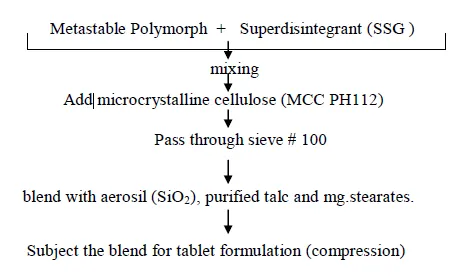
Figure 1: Schematics representation of direct compression technique for design of immediate release tablet of mefloquine hydrochloride (Metastable polymorph)
Formulation design
Formulation of immediate release tablet of metastable polymorph of mefloquine hydrochloride by direct compression method. (Total tablet weight =350mg) (Table 2)
Table 2: Formulation of immediate release tablet of metastable polymorph of mefloquine hydrochloride
|
Sr. No |
Ingredients |
Quantity |
|
1. |
Metastable polymorph equivalent to 250 mg of mefloquine HCL. |
250 mg |
|
2. |
Microcrystalline Cellulose (PH112) |
63.6 mg |
|
3. |
Sodium starch glycollate (5%) |
17.5 mg |
|
4. |
Talc (5%) |
17.5 mg |
|
5. |
Mg. stearates (0.1%) |
0.35 mg |
|
6. |
Aerosil (0.3 %) |
1.05 mg |
|
Total tablet weight 350 mg |
||
Evaluation of mefloquine hydrochloride metastable polymorph
The polymorphs were evaluated by Differential scanning colorimetric analysis of pure drug and prepared polymorph. Mefloquine hydrochloride polymorphs were assessed for crystallinity using an X- ray diffractometer [9].
In vitro drug release studies were carried out using tablet USP XXIII dissolution test apparatus. [10-12]. The various parameters related to dissolution which was evaluated in the present work was Drug release, Cumulative percentage drug release, Cumulative percentage drug retained. [10-12]
RESULTS AND DISCUSSION
Polymorphism is often characterized as the ability of a drug substance to exist as two or more crystalline phases that have different arrangements and/or conformations of the molecules in the crystal lattice. In the present investigation an attempt has been made to improve the solubility and dissolution of mefloquine hydrochloride by preparing metastable polymorph and characterized them by differential scanning calorimetry (DSC), X-ray diffraction pattern (X-RD), and dissolution, after that immediate release tablet of metastable polymorph were prepared by direct compression technique. Oral drug delivery system represents one of the frontier areas of drug delivery system. Such a dosage forms are having a major advantage of patient compliance. The UV scanning of mefloquine hydrochloride was recorded using UV 1800 Shimadzu taking methanol as reagent blank which showed λmax at 283 nm.
Compatibility study:
Physical mixture of drug and excipients (Sodium starch glycollate, Microcrystalline cellulose (PH112), Aerosil, Magnesium stearate, Talc, Polyvinyl pyrrolidone K30) were exposed to accelerated stability condition at 400C / 75% RH for three months and samples were analysed for infrared spectral analysis (non-tharmal), differential scanning calorimetry(thermal) and X-ray diffraction pattern (X-RD) studies. The infrared (IR) spectra of mefloquine hydrochloride exhibited principal peaks at 3235.65 cm-1(N-H Stretching), 2958.14 cm-1 (C-H Stretching), 3235.65 cm-1(-OH Stretching). The infrared (IR) spectra of mefloquine hydrochloride and all excipients exhibited principal peaks at 3274.98 cm-1(N-H Stretching), 2940.91 cm-1(C-H Stretching), 1592.01 (C=O Stretching), 3274.98 cm-1 (-OH Stretching). From the results, it was concluded that principle functional groups of mefloquine hydrochloride were found to be unaltered in the spectra of the drug-excipients physical mixture after stability testing.
The differential scanning calorimetry (DSC) thermogram of mefloquine hydrochloride showed principal peaks at 260.520C, and after stress testing (at 400C / 75% RH for three month) the principal peaks at 247.090C. In all drug excipients blends, the melting endotherms of mefloquine hydrochloride was well preserved with little change in terms of sharpening, broadening or shifting towards a lower temperature. These minor changes in the melting endotherm of the drug may be attributed to mixing process, which lowers the purity of each component in the mixture, thus resulting in slightly lower melting points. (Table 3).
The X-ray diffraction pattern (X-RD) study were carried out for drug-excipients physical mixture to check crystalline nature and any polymorphic changes in drug substances, after stability testing it was inferred that in mefloquine hydrochloride there is a smaller number of peak and 2θ value, where as in case of mefloquine hydrochloride and excipients physical mixture there is a greater number of peak and 2θ value. Hence, it was concluded that the drug-excipients physical mixture having more crystalline nature and certain polymorphic changes than mefloquine hydrochloride (pure drug). (Table 3).
Table 3. Data obtained from compatibility study (temperature 40 oC and humidity 75 %RH for 3 months) of pure drug and excipients by differential scanning calorimetry (DSC) and X-ray diffraction pattern (X-RD).
|
Drug/Polymer |
DSC Peaks (0C) |
Peaks at 2θ |
|
Mefloquine hydrochloride (pure drug) |
274.32 |
2,3,4,5,6,7,10,11,16,17,22. |
|
Mefloquine hydrochloride (after compatibility study) |
260.52 |
6,10,12,15,19,21,22,24,27,28,31,32,49,50,51,60. |
|
Mefloquine hydrochloride + All excipients (after compatibility study) |
247.09 |
3,4,5,6,7,15,18,19,20,23,26,28,29,33,34,35,43,54,55. |
Pre-compression parameters:
Powder ready for compression containing polymorph and various excipients were subjected for pre-compression parameters (micromeritic properties) to study the flow properties of granules, to achieve uniformity of tablet weight.
Angle of repose (θ):
The values of angle of repose were found to be in the range of 22o10’+ 0.11 and 27o40’ + 0.54. The formulations prepared by direct compression methods showed the angle of repose less than 300, which reveals good flow property. The data obtained for angle of repose for the formulations were tabulated (table 4).
Bulk density:
The loose bulk density and tapped bulk density for the entire formulation blend varied from 0.321 + 0.004 gm/cm3 to 0.543 + 0.006 gm/cm3. Loose bulk density (LBD) and tapped bulk density (TBD) for the blend (table 4).
Carr’s consolidation index:
The results of Carr’s consolidation index or compressibility index (%) for the entire formulation blend ranged from 12.92 + 1.10 to 26.06 + 0.57%. The directly compressible powder had shown good to excellent flow properties (table 4).
Table 4. Micromeritic properties of mefloquine HCL metastable polymorph
|
Formulation code |
Bulk density (gm/cm3) + SD, n=3 |
Tapped density (gm/cm3) + SD, n=3 |
Hausner’s ratio (+ SD, n=3) |
Angle of repose (θ) + SD, n=3 |
Compressibility (%) + SD, n=3 |
|
P1 |
0.5430 (0.006) |
0.640 (0.02) |
1.170 (0.02) |
22.1 (0.11) |
23.67 (0.40) |
Formulation design of mefloquine hydrochloride polymorph.
The present study was carried out to develop metastable polymorph of mefloquine hydrochloride by different method to improve the solubility and dissolution of the drug. The metastable polymorph of mefloquine hydrochloride prepared by-
a) Crystallization from different solvent (ethanol, methanol).
b) Exposure to temperature (40oC) and humidity (75 % RH).
c) Photostability method.
Characterization and evaluation of polymorph prepared by different method:
The prepared polymorphs were characterized by various techniques such as: Differential scanning calorimetry (DSC), X-ray diffraction pattern (X-RD) and Dissolution.
Crystallization from different solvent (ethanol, methanol): The polymorph prepared by saturation method using methanol as solvent showed differential scanning calorimetry (DSC) principle peak at 263.210C (table 5). The dissolution study shows 86.14 % drug release in 160 minutes (fig 2).
The polymorph prepared by supersaturation method using ethanol: water (2:1) as solvent showed differential scanning calorimetry (DSC) principle peak at 260.420C, 264.980C, 291.060C. (table 5). The X-ray diffraction pattern (X-RD) pattern shows principle peak at 4,6,9,10,11,12,16,17,18,19,23,27,33, (2θ value) (table 5). The dissolution study shows 93.13 % drug release in 40 minutes (fig 2).
Exposure to temperature (400C) and humidity (75 % RH):
The polymorph prepared after 6 days’ time interval showed differential scanning calorimetry (DSC) principle peak at 274.410C (table 5). and dissolution study shows 86.98 % drug release in 140 minutes (fig 3).
The polymorph prepared after 13 days’ time interval showed differential scanning calorimetry (DSC) principle peak at 274.770C (table 5) and dissolution study shows 85.30 % drug release in 140 minutes (fig 3).
The polymorph prepared after 30 days’ time interval showed differential scanning calorimetry (DSC) principle peak at 274.280C. (table 5) and dissolution study shows 87.54 % drug release in 140 minutes (fig 3).
Table 5. Data obtained by differential scanning calorimetry (DSC) and X-ray diffraction pattern (X-RD) of polymorph prepared by different method.
|
SN |
Method |
DSC Peaks (0C) |
X-RD Peaks at 2θ |
|
1. |
Mefloquine hydrochloride (pure drug) |
274.32 |
2,3,4,5,6,7,10,11,16,17,22. |
|
2. |
Polymorph prepared by saturation method (methanol solvent). |
263.21 |
- |
|
3. |
Polymorph prepared by supersaturation method (ethanol:water solvent) |
260.42, 264.98, 291.06 |
3,4,6,9,10,11,12,16,17,18,19,23,27,33, 36,40,43,46. |
|
4.
a) |
Polymorph prepared by exposure to temperature 400C&humidity75% RH. (30days) 6 day’s time interval |
274.41 |
- |
|
b) |
13 day’s time interval |
274.77 |
- |
|
c) |
30 days’ time interval |
274.28 |
- |
|
5. |
Polymorph prepared by photostability method. |
260.11 |
3,4,5,6,7,10,11,14,17,18,21,23,25,26,29,30,31,43,44,56. |
Figure 2: Drug release profile of mefloquine hydrochloride (pure drug) and polymorph prepared by saturation and supersaturation method.
Figure 3: Drug release profile of pure drug and polymorph prepared by exposure to temperature (400C) and humidity (75%).
Photostability Method.
The polymorph prepared by photostability method showed differential scanning calorimetry (DSC) principle peak at 260.110C (table 5). The X-RD pattern shows principle peak at 3,4,5,6,7,10,11,14,17,18,21,23,25,26,29,30,31,43,44,56 (2θ value). The dissolution study shows 84.74 % drug release in 140 minutes.
The data obtained from the above technique, polymorph prepared by supersaturation method ie. ethanol: water (2:1) shows considerable decrease in melting point by differential scanning calorimetry (DSC) better crystalline nature by X-ray diffraction pattern (X-RD) (table 5) and maximum drug release profile by dissolution process ie. 93.13% in 40 minutes, (fig 2) as compared to pure drug ie 88.94 % in 330 minutes, (fig 2), Hence, it is regarded as metastable polymorph and this method is selected as optimized one and was further selected for the formulation of immediate release dosage form.
Formulation design.
The present study was carried out to develop immediate release tablet of metastable polymorph of mefloquine hydrochloride in order to improve patient compliance and also to prepare user-friendly formulation. In this case, formulation of immediate release tablets was prepared by direct compression technique. The detailed composition of formulation is given (table 2).
Characterization and evaluation of mefloquine hydrochloride immediate release tablet.
Post-compression parameters
The tablets prepared by direct compression technique were subjected for evaluation according to various official specifications and other parameters like, hardness, friability, weight variation, in-vitro disintegration time, wetting time, water absorption ratio, drug content, in- vitro dissolution studies.
Hardness
The hardness of all the tablets prepared by direct compression methods was maintained within the 2.93 + 0.02 kg/cm2 to 3.69 + 0.03 kg/cm2.
Friability test
The friability of all the tablets prepared by direct compression methods using co-grinding process was within 0.71 + 0.01% to 0.96 + 0.04%. The values were found to be within the limit (<1%), thus tablets possess good mechanical strength.
Weight variation test
All the tablets passed weight variation test as the average percentage weight variation of 20 tablets of each formulation was within the pharmacopoeial limits of 5% which provides good uniformity. The weight variation of all the tablet was found to be 345 mg to 355 mg.
Drug content
The drugs content of the tablets were found to be between 97.58 + 0.8 % to 99.72 + 0.9 % of mefloquine hydrochloride. The results were within the range and that indicated uniformity of mixing.
Wetting time
The wetting time of the tablets were found to be between 30.00 + 1.12sec. to 48.69 + 0.56 sec. Which showed that wetting process was very rapid in formulations. This may be due to ability of swelling and also capacity of water absorption and cause swelling.
Water absorption ratio
Water absorption ratio, which is important criteria for understanding the capacity of disintegrants to swell in presence of little amount of water, was calculated. It was found to be in the range of 29.92 + 2.636 to 70.11+ 1.752%. The water absorption ratio also decrease due to less swelling property.
In-vitro disintegration time
The internal structure of tablets which are having pore size distribution; water penetration into tablets and swelling of disintegrating ingredients are suggested to be the mechanism of disintegration. These formulations showed disintegration time less than 60 seconds due to wicking and swelling mechanism of super disintegrants. Another ingredient which is included in the formulations is MCC PH 112, which is also responsible for disintegration of tablet and is highly soluble in water. Which was determined as per Indian pharmacopoeial specifications for developed formulations.
In-vitro dissolution studies
Formulations were subjected for in-vitro dissolution studies using tablet dissolution tester USP XXIII. The dissolution medium 1.2 pH acidic buffer was used to study the drug release. The samples were withdrawn at different intervals of time and analysed at 283nm using UV spectrophotometer. Cumulative percentage drug release a was calculated on the basis of average amount of mefloquine hydrochloride metastable polymorph present in the respective formulations (fig 4).
Figure 4. Percentage drug release profile of mefloquine HCL metastable polymorph immediate release tablet prepared by direct compression method.
Rapid drug dissolution was noticed in formulations, which released 98.71% at the end of 40 minutes, (fig 4) as compared to pure mefloquine hydrochloride tablet, which is having release 86.14% in 330 minutes. (fig 5). The fast dissolution might be due to metastable polymorph, lowest hardness and disintegrating property of SSG and MCC (PH 112), which leads to faster water uptake hence it facilitates faster disintegration and dissolution. The plot shows cumulative percentage of mefloquine hydrochloride released as a function of time (t) for formulations prepared by direct compression method (fig 4).
Figure 5: Drug release profile of pure drug tablet and metastable polymorph tablet.
CONCLUSION
From this study it was concluded that metastable polymorph prepared by supersaturation method in ethanol: water (2:1) shows better solubility and dissolution rate than other polymorph prepared by different method and immediate release formulation of that metastable polymorph shows better percentage drug release as compared to pure drug formulation. Polymorphs have different stabilities and may spontaneously convert from a metastable form (unstable form) to the stable form at a particular temperature. They also exhibit different melting points, solubilities (which affect the dissolution rate of drug and consequently its bioavailability in the body). Therefore, selection of metastable polymorph which exhibit greater solubility and is more bioavailable is an important step in the preformulation stage. Metastable polymorph of mefloquine hydrochloride was successfully formulated and evaluated and then immediate release tablet of that metastable polymorph were prepared by employing direct compression method.
REFERENCES




Prashil Kute, Jayashree Patil, Chitrangana Ramteke*, Sanjay Akare, Preparation and Characterization of Different Polymorph and Formulation of Immediate Release Tablet of Mefloquine HCL, Int. J. Med. Pharm. Sci., 2026, 2 (7), 718-726. https://doi.org/10.5281/zenodo.21378633
 10.5281/zenodo.21378633