
We use cookies to ensure our website works properly and to personalise your experience. Cookies policy
Rajarshi Shahu College of Pharmacy, Buldhana, Dist-Buldana, M.S, India 443001
Artificial intelligence (AI) is a field of mathematical science that focuses on giving robots the ability to think and learn, two functions that belong to the brain of humans. It emphasizes how artificial intelligence (AI) is transforming the health care industry by helping with data analysis, drug toxicity or efficacy prediction, curative chemical identification, and drug repurposing all with the ultimate goal of speeding up and lowering the cost of the drug development process.
The discipline of computer science known as artificial intelligence (AI) is concerned with creating techniques that enable computers to carry out operations that are generally associated with human intelligence, like thinking and learning. Artificial intelligence is revolutionizing many aspects of our lives and affecting many different industries. The pharmaceutical industry is not an exception to this trend. [1] Additionally, machine learning methods in the medical area accurately define lung cancer, and artificial intelligence (AI) tackles the difficulties of processing constant streams of large data from medical devices. [2,3] When applied correctly, artificial intelligence (AI) technology can assist in the analysis of enormous volumes of data, including chemical, proteomic, and genomic data, in order to forecast the toxicity or efficacy of drugs and identify possible therapeutic compounds.[4] Machine learning (ML) or deep learning (DL) algorithms can discover new targets linked to various types of omics data and assist in the hunt for new chemical entities with biological activities by examining intricate sets of data and uncovering hidden patterns. They have not only made it easier to find possible medication candidates, but they have also been quite helpful when it comes to repurposing existing drugs. The ability of AI to forecast possible new applications for currently available medications is a breakthrough that could speed up the drug development process and lower related expenses. [5] The task of finding new drugs is time-consuming, expensive, and fraught with uncertainty. Even with the newest experimental tools, many discovery projects still face difficulties. Programs frequently take years to finish, even if they are effective. This is especially true for novel small compounds, which usually take four to six years to find. [6] By performing many of the most complex, costly, and manual processes in silico and by significantly expanding the scope of investigation, artificial intelligence (AI) holds the potential to completely transform drug discovery. [7] Knowledge graphs to mine OMICs and other data to comprehend disease biology and find therapeutic targets and biorhythms are notable examples of AI approaches applied in drug discovery. Designing tiny compounds with generative artificial intelligence. [8] Since these methods were introduced ten years ago, there has been a significant increase in the number of therapeutic and vaccine compounds found by AI. We demonstrated in 2022 that the number of AI-found tiny molecules was increasing exponentially and was starting to catch up to the number of small molecules discovered conventionally. [9] The application of AI in R&D has been welcomed by the health care industry. Each of the top 20 pharmaceutical companies had made announcements about their activity in the sector by the beginning of 2024. A significant amount of these efforts is conducted as joint ventures between pharmaceutical corporations and AI-focused biotechnology companies, also known as "AI-native biotech." As a result, over the previous five years, the quantity and value of partnership deals in the AI field have significantly expanded. [10] The development of ML schemes and the expansion of chemical and pharmacological data have led to the emergence of AI paradigms, which have created a space for data-driven computation in the field of drug discovery. The transformation of massive biomedical big data into new knowledge and valid expertise is given more weight by ML-facilitated approaches, an offshoot of AI, than by conventional approaches, which rely on the theoretical advancement of complex and well-established physicochemical principles. Logistic Regression (LR), Naive Bayesian Classification (NBC), k Nearest Neighbour (KNN), Multiple Linear Regression (MLR), Support Vector Machine (SVM), Probabilistic Neural Network (PNN), Binary Kernel Discrimination (BKD), Linear Discriminant Analysis (LDA), Random Forest (RF), Artificial Neural Network (ANN), and Partial Least-Squares (PLS) are examples of common algorithms that are associated with machine learning. [11,12]
Table 1: Applications of Artificial Intelligence in Pharmacy
|
Aspect |
Description |
Example / Application |
|
Definition |
AI refers to computer systems that simulate human intelligence to perform tasks like learning and decision-making. |
Machine learning models predicting drug interactions |
|
Use in Drug Discovery |
Speeds up identification of potential drug molecules. |
DeepMind’s AlphaFold predicting protein structures |
|
Use in Clinical Trials |
Optimizes trial design and patient selection. |
AI-based recruitment using patient data |
|
Pharmacovigilance |
Detects adverse drug reactions from medical reports. |
NLP models analyzing patient feedback |
|
Quality Control |
Ensures precision in formulation and manufacturing. |
AI-driven visual inspection systems |
|
Personalized Medicine |
Tailors treatment based on patient genetics. |
AI recommending dosage adjustments |
AI in the search for new drugs.
With over 1060 compounds, the enormous chemical space encourages the creation of numerous pharmacological molecules. However, the medication development process is limited by a lack of sophisticated technologies, which makes it a costly and time-consuming operation that AI can help with. AI is able to identify hit and lead compounds, validate drug targets more quickly, and optimize drug structure design. [13-15] The intended chemical structure of a product can be predicted using a number of factors, including prediction models, molecular similarity, the molecule synthesis process, and the usage of in silico techniques. Pereira et al. introduced Deep VS, a novel docking method for 40 receptors and 2950 ligands that demonstrated outstanding accomplishment when evaluated against 95,000 decoys. Another method evaluated the shape similarity, biochemical activity, and physicochemical characteristics of a cyclin-dependent kinase-2 inhibitor in order to optimize its potency profile using a Mult precise automated replacement algorithm. [15,18]
Table 2: Role of Artificial Intelligence in the Search for New Drugs
|
Stage |
AI Role |
Example / Application |
|
Target Identification |
AI analyzes biological data to find potential drug targets. |
Deep learning identifies disease-related proteins. |
|
Drug Design |
AI generates new molecular structures with desired properties. |
Generative AI models like MolGAN design novel compounds. |
|
Lead Optimization |
AI predicts activity, toxicity, and stability to refine leads. |
QSAR and ML algorithms improve molecule efficiency. |
|
Preclinical Testing |
AI models simulate drug–body interactions to reduce lab tests. |
Virtual screening and toxicity prediction tools. |
|
Clinical Trials |
AI helps in patient selection, monitoring, and data analysis. |
Predictive analytics for faster approval. |
|
Drug Repurposing |
AI finds new uses for existing drugs. |
IBM Watson identifies old drugs for new diseases. |
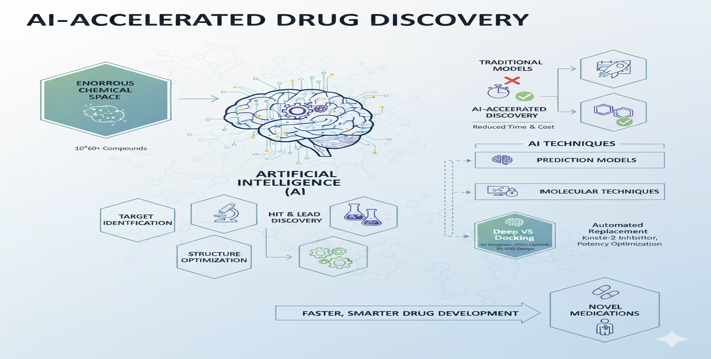
Figure1: AI- in new medication.
Future-Proof AI Use in Drug Development
For chemical scientists and pharmaceutical businesses, drug design and development are a crucial area of research. A molecule needs to be "druggable" in order to have any chance of being a drug target. Drug discovery has changed in the post-genomic era to use new design principles for molecules or new techniques to bind, modify, or break down difficult biological targets for novel medications in the future.
Table 3: Future-Proof Applications of AI in Drug Development
|
Area |
Future AI Application |
Expected Benefit |
|
Predictive Modeling |
Use of advanced AI algorithms to predict drug behavior and efficacy. |
Faster, cost-effective drug discovery. |
|
Generative Drug Design |
AI creates novel drug molecules using deep learning. |
Expands chemical space and innovation. |
|
Automated Synthesis |
Robotic AI systems for rapid compound synthesis. |
Reduces human error and increases throughput. |
|
Digital Twins |
Virtual patient models for personalized drug testing. |
Improves precision and reduces trial risks. |
|
Real-World Data Integration |
AI analyzes global healthcare and genomic data. |
Enhances decision-making and safety monitoring. |
|
Ethical & Transparent AI |
Ensuring explainable, bias-free AI systems. |
Builds regulatory trust and public confidence. |
Discovery of Hits
Reusable Pharmaceuticals
Drug reuse, also sometimes referred to as drug repositioning, is the process of finding novel therapeutic uses for existing medications, which can reduce the time and risks associated with drug development. Since many medications may have several targets and those targets may elicit their various activities, drug repurposing is possible, illustrating the significant variety of drug-disease connection. For instance, metformin, which was approved for the treatment of type 2 diabetes, may increase longevity. [19-24]
Evaluation Virtually (EV)
Virtual evaluation, which uses software and algorithms to find bioactive molecules (hits) from commercial chemical libraries or in-house compound assemblages, provides a very effective way to find new hits and weed out molecules with unfavourable scaffolds early in the process of developing drugs. [25]
The Structure and Function of Proteins
Protein Assembly Prognosis from Sequence (Estimating a Target Protein's 3D Structure)
Protein malfunctioning is linked to the majority of illnesses. The structure-based drug design blueprints can be used to create the active small molecules for the protein targets by closely examining protein structures. However, calculating the proteins' three-dimensional (3D) structures would currently take a significant amount of time and money, therefore developing algorithms to predict a protein's 3D structure is advantageous. Even though practically all proteins have available sequence data, accurate de novo presaging of their three-dimensional structures cannot yet be inferred. These days, DL techniques are still used to predict the secondary structure, backbone torsion angle, and residue interactions of proteins because of the remarkable capacity of attribute extraction. [26-28]
Analysis of AI-discovered molecules in clinical trials
We used publicly accessible databases to examine the pipelines of AI-native biotech companies in order to comprehend AI-discovered compounds in clinical trials. Since a significant percentage of the AI-powered drug discovery effort is conducted by these businesses, we think that focusing on artificially intelligent companies is a suitable proxy for the sector as a whole. [29-31]
AI for drug testing.
The average cost of the medication discovery and development process is US$2.8 billion, and it can take more than ten years. Even in those cases, nine out of ten medicinal compounds do not pass regulatory approval or Phase II clinical trials [32, 33]. Based on synthesis feasibility, algorithms such deep neural networks (DNNs), RF, extreme learning machines, SVMs, and nearest-neighbour classifiers (NSCs) are employed for VS. They can also forecast in vivo activity and toxicity. [34] A number of chemical firms, including Bayer, Roche, and Pfizer, have partnered with IT firms to create a software system for the development of treatments in fields including cardiology and immune-oncology. [35] Forecasting the physical and chemical characteristics When creating a new medicine, physical and chemical properties including the drug's solubility, partition coefficient (logP), degree of ionization, and intrinsic permeability must be taken into account because they have an indirect impact on the drug's pharmacokinetics and target receptor family [36]. Physicochemical qualities can be predicted using a variety of AI-based methods. For instance, ML trains the software using sizable data sets generated over previously completed compound selection [37]. Molecular descriptors, such as SMILES strings, potential energy measurements, electron density surrounding the molecule, and atom coordinates in three dimensions, are used in drug design algorithms to create viable compounds using DNN and forecast their characteristics. [38] To identify the six physiological characteristics of environmental chemicals sourced from the government's Environmental Protection Agency (EPA), Zang et al. developed a quantitative structure–property relationship (QSPR) workflow known as the Estimation Program Interface (EPI) Suite [39]. Numerous substances' liquid state and dispersion have been predicted using neural networks built on the ALGOPS software and ADMET prediction [40]. The solubility of compounds has been predicted using DL techniques, including graph-based convolutional neural networks (CVNN) and undirected graph recursive neural networks. [41]
AI in the production of pharmaceuticals
Modern manufacturing systems are attempting to impart human knowledge to systems in response to the growing complexity of production processes and the growing need for efficiency and higher-quality products, which is constantly altering manufacturing practices [42]. The pharmaceutical business may benefit from the application of AI in manufacturing. Tools like CFD take advantage of the automation of many pharmaceutical processes by using Reynolds-Averaged Navier-Stoked solver technology to examine the effects of agitation and stress levels in various equipment (such as stirred tanks). Similar methods, including big flow simulations and direct numerical simulations, use sophisticated techniques to address complex flow issues in manufacturing [43]
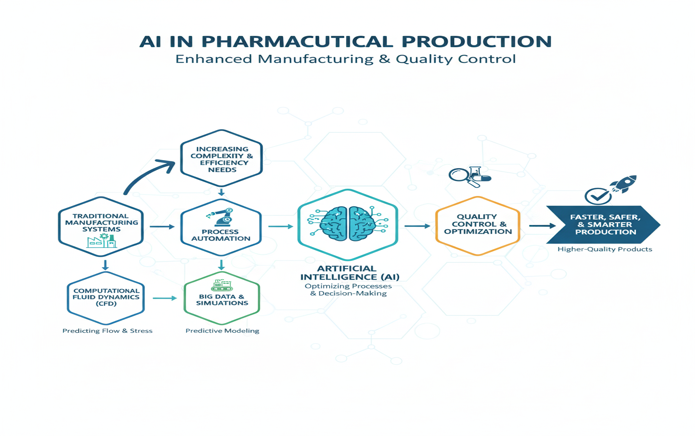
Figure 2 AI in pharma production
SUMMARY
If used appropriately, artificial intelligence (AI) tools can analyze enormous volumes of chemical, proteomic, and genomic data to predict the toxicity or efficacy of drugs and to find possible therapeutic molecules. This includes helping to find novel drug ideas, repurposing existing pharmaceuticals for new uses—a breakthrough that can speed up the creation of medications and lower costs—and utilizing machine learning (ML) and deep learning (DL) algorithms to find hidden patterns in complicated datasets. New AI concepts have been spawned by the development of machine learning (ML) algorithms and the expansion of chemical and pharmacological data, giving data-driven computation precedence over more conventional, theory-based methods in drug discovery. Drug discovery applications frequently use a number of machines learning methods, including Random Forest, k-Nearest Neighbour, Support Vector Machines, which Logistic Regression, Naive Bayesian Classification, and Artificial Neural Networks. With the growing participation of AI-native biotech businesses in pharmaceutical research and development, the study of AI-discovered compounds in clinical trials is becoming a significant field.
CONCLUSION
Artificial intelligence is set to continually transform drug design and discovery, making the process more efficient, data-driven, and foundational to clinical research. Its use enables comprehensive analysis of vast chemical, proteomic, and genomic datasets, improves prediction accuracy for drug efficacy and toxicity, and accelerates drug development through in silico modeling and advanced machine learning approaches. The ongoing integration of AI technologies in pharmaceutical research, clinical trials, and manufacturing highlights a future where drug creation is optimized for speed, cost, and effectiveness.
REFERENCES

Vaishnavi Murhe, Vaibhav Shikhare*, Gayatri Thakre, Renuka Mehasare, Ankita Sonune, Kalyani Warade, Prajakta Chondekar, Sushma Kabra, Artificial Intelligence in Drug Discovery: Research with Updated Ways, Int. J. Med. Pharm. Sci., 2025, 1 (10), 36-42. https://doi.org/10.5281/zenodo.17341646
 10.5281/zenodo.17341646