
We use cookies to ensure our website works properly and to personalise your experience. Cookies policy
Hanagal Shri Kumareshwar College of Pharmacy, Bagalkot, Karnataka, India
The herbal cream was formulated by adding the extracts of Cassia auriculata, Glycyrrhiza glabra and Camellia sinensis, different proportion to a water, extracts were employed, Methyl paraben, Propyl paraben, Propylene glycol were added and dissolved. To oil, Stearic acid, Cetyl alcohol, and Liquid paraffin were employed.To oil phase, aqueous phase is added. Triethanolamine was stirred properly with it. The evaluation parameters such as physical appearance such as homogeneity, type of smear and dye test, extrudability and spreadability. The formulations passes all the evaluation parameters with the pH ranged from 6.45-6.92 and physical apperance was good. Poly-Herbal glowing cream was successfully formulated by using extracts of Cassia auriculata, Glycyrrhiza glabra and Camellia sinensis at different concentration. Formulation F3 showed enhanced glowing effect.
The definition of fair skin is given as “not dark and free from spots, specks, dirt or imperfection; unblemished; clean; pure.” The booming cosmetics industry in recent decades can be partly attributed to the elusive search for fair and flawless skin. With the vast information that is accessible in the 21st century, one has an option to choose methods ranging from that of Cleopatra (soaking in donkey milk that is rich in AHA) to recent advances in skin-lightening procedures such as derm abrasion, ultrasound, and laser therapies, to name a few. Skin-lightening agents are any ingredient or combination of ingredients that interfere in any step of the melanogenesis pathway, melanin transfer, or desquamation that results in lowering pigmentation on the surface of the skin. Skin-lightening cosmetics are in big demand across the world, and this review serves to list the ingredients that are commercially available for that purpose and the modes of action through which the lightening is affected. There are many reports of skin-lightening agents obtained from both natural and synthetic sources. However, many ingredients in their original form may not be compatible in cosmetic formulations for application to the skin due to various factors such as cytotoxicity, insolubility, instability, and their sensitive nature to external conditions. However, consistent efforts are being made by industry to arrive at compatible, minimally toxic, and highly efficacious ingredients that serve the purpose [1]. India’s fairness cream market is evolving at rapid speed, filled by television advertisement by the celebrities and the rapidly changing lifestyles. India’s proactive FMCG market has been the significant growth in the cosmetic market in last two decades and fairness cream accounts for the major part of the cosmetic market with an average growth rate 20% per annum. Indians are witnessing a paradigm shift from traditional methods of using home products to modern methods of using branded cosmetics and fairness cream to become fair. The concept of preferring the people with “fair-skin” has long been recognized socially and it has been the psychological and social impact on women to be fair. But in the recent years, men to have started giving importance on personal grooming, beginning with fair skin. The market for fairness cream was restricted to woman only till 2005; but Emami catered to men with its product fair and handsome. Till then fairness cream market dominates the cosmetic market covering male and female segments. It is clear from television and matrimonial advertisements that the market for fairness creams in India is huge. The growth in consumerism and changing lifestyle of Indian youth has led to strong demand for fairness creams. India’s swelling middle class is redefining lifestyle pattern with adoption of western values and growing brand consciousness; creating opportunity for the global players in fairness cream market [2]. Creams are the topical preparations which can be applied on the skin. Creams are defined as “viscous liquid or semi-solid emulsions of either the oil in water type” dosage forms which consistency varies by oil and water. Creams are used for cosmetic purposes such as cleansing, beatifying, improving appearances, protective or for the therapeutic function. These topical formulations are used for the localized effect for the delivery of the drug into underlying layer of the skin or the mucous membrane. These products are designed to be used topically for the better site-specific delivery of the drug into the skin for skin disorders. Creams are considered as a pharmaceutical product as they are prepared based on techniques developed in the pharmaceutical industry; unmediated and medicated creams are highly used for the treatment of various skin conditions or dermsatoses. Creams can be Ayurvedic, herbal or allopathic which are used by people according to their needs for their skin conditions. They contain one or more drugs substances dissolved or dispersed in suitable base. Creams may be classified as o/w or w/o type of emulsion on the basis of phases. The term ‘cream’ has been traditionally applied to semisolid formulated as either water-in-oil (e.g : cold cream) or oil-in-water. (e.g: vanishing cream) [3]. There is an increased interest for plant based natural skin whitening ingredients and several plant species such as Carica aromaticum[4], licorice[5]. Tyrosine enzyme is one of the essential components that can be initiated melanin formation on the skin (melanogenesis). Thus, cassia auriculata [4], glycyrrhiza glabra [5], and camellia sinensis [6] are used to inhibit tyrosinekinase activity.
MATERIAL AND METHODS:
Preparation of plant extract [7]
Cassia auriculata: In a separate conical flask 5gms of cassia auriculata leaves powder was weighed and placed in each conical flask, to this 100ml of 70% ethanol was added and covered with aluminium foil and these flask were placed in cool and dark place for 24 hours.After 24 hours, Filtrate was collected using muslin cloth. These filtrates were poured in different petri dish and placed in hot- air oven at 50°C to get dry extract.
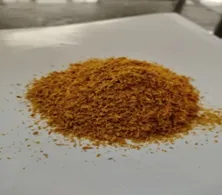
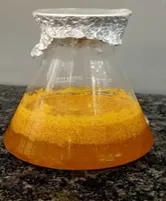
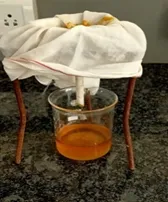
Figure 3: Filtration process
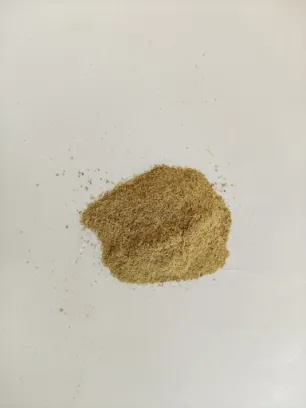
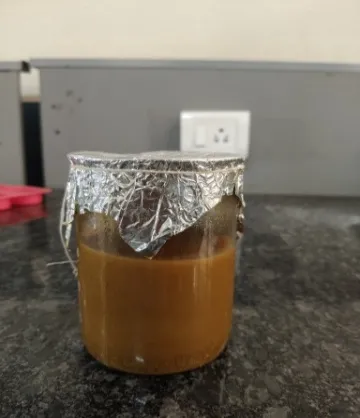
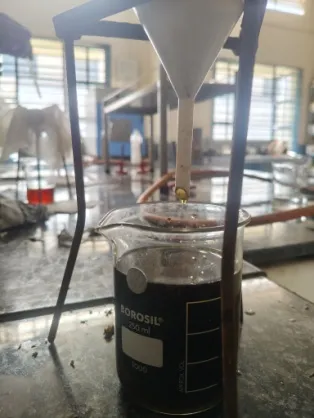
Figure 6: Filtration process
Green tea [9]: In a separate conical flask 10gms of licorice root powder was weighed and placed in each conical flask, to this 100ml of 70% ethanol was added and covered with aluminium foil and these flask were placed in cool and dark place for 48 hours.After 2 days, Filtrate was collected using muslin cloth. These filtrates were poured in different petri dish and placed in hot- air oven at 50°C to get dry extract
Preparation of glow cream [2]: The appropriate base was selected from table and 3 different creams were formulated. The emulsifier (stearic acid) and other oil soluble components (cetyl alcohol, liquid paraffin) were dissolved in the oil phase (Part A) and heated to 75℃. The preservatives and other water-soluble components (methyl paraben, propyl paraben, triethanolamine, propylene glycol, all extracts) were dissolved in the aqueous phase (Part B) and heated to 75℃. After heating, the aqueous phase was added in portions to the oil phase with continuous stirring until cooling of emulsifier took place.
Formulation table:
Table 1: Different formula of glow cream: For (30 gm)
|
Sl. No |
Ingredients in gms |
F1 |
F2 |
F3 |
|
01. |
Cassia auriculata(extract) |
0.01% |
0.01% |
0.01% |
|
02. |
Glycyrrhiza glabra (extract) |
1% |
- |
1% |
|
03. |
Camellia sinensis(extract) |
- |
1% |
1% |
|
04. |
Stearic acid |
11 |
11 |
11 |
|
05. |
Cetyl alcohol |
4 |
4 |
4 |
|
06. |
Liquid paraffin |
4 |
4 |
4 |
|
07. |
Glycerol |
3 |
3 |
3 |
|
08. |
Methyl paraben |
0.02 |
0.02 |
0.02 |
|
09. |
Propylene glycol |
2% |
2% |
2% |
|
10. |
Triethanlamine |
qs |
qs |
qs |
|
11. |
Water |
qs |
qs |
qs |
Evaluation of Glow Cream:
1. Physical appearance [10]:
The physical appearance was simply checked by colour, odour. In this a homogeneity and texture of prepared cream was also determined.
2. Determination of pH:
The pH meter was calibrated using standard buffer solution about 0.5g of the cream was weighed and dissolved in 50ml distilled water and kits pH was measured.
3. Homogeneity [2]:
The formulations were tested for the homogeneity by visual appearance and touch.
4. Type of smear [2]:
After application of cream, the type of film or smear formed on the skin were checked.
5. Dye test [2]:
The scarlet red dye is mixed with the cream. Place a drop of the cream on a microscopic slide covers it with a cover slip, and examines it under a microscope. If the disperse globules appear red the ground colourless. The cream is o/w type. The reverse condition occurs in w/o type cream i.e. the disperse globules appear colourless in the red ground.
6. Measurement of viscosity [12]:
Viscosity of the formulation was determined by Brookfield Viscometer at 100 rpm, using spindle no 7.
7. Spredability [13]:
Adequate amount of sample is taken between two glass slides and a weight of 10gm is applied on the slides for 5 minutes. Spreadability can be expressed as,
S=m*l/t
Where, m=weight applied to upper slide.
L=length moved on the glass slide.
T=time taken.
8. Extrudability test [14]:
In present study, the method adopted for evaluating cream formulation for extrudability based upon the quantity in percentage cream extruded from the tube on application of finger pressure. More quantity extruded better was extrudability. The formulation under study was filled in the clean, lacquered aluminium collapsible 5gm tube with a nasal tip of 5mm opening and applied the pressure on the tube by the help of finger. Tube extrudability was then determined by measuring the amount of cream extruded through the tip when a pressure was applied on a tube.
RESULT:
1. Physical Apperance
Table 2: Test for Homogeneity, Type of smear, Dye test
|
Physical Apperance |
F1 |
F2 |
F3 |
|
Homogeneity |
Good |
Good |
Good |
|
Type of smear |
Good |
Good |
Good |
|
Dye test |
O/W |
O/W |
O/W |
2. pH:
Table 3: pH
|
pH |
F1 |
F2 |
F3 |
|
6.56 |
6.92 |
6.45 |
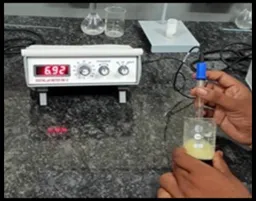
F2
Figure 7: Determination of pH
3. Extrudabulity:
Table 4: Extrudability
|
Extrudability |
F1 |
F2 |
F3 |
|
90.6% |
90% |
89.8% |
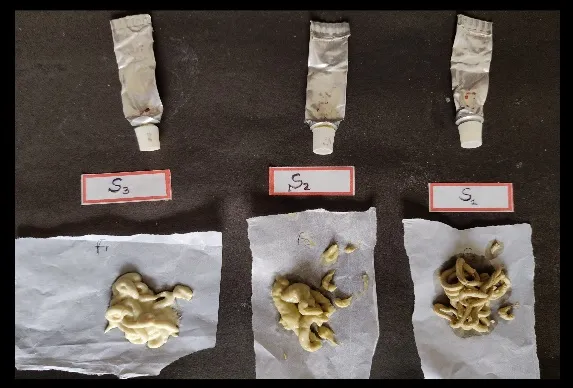
Figure 8: Extrudability test
4. Spreadability:
Table 5: Spreadability
|
Spreadability in gm.cm/sec |
F1 |
F2 |
F3 |
|
40.54 |
38.46 |
37.5 |
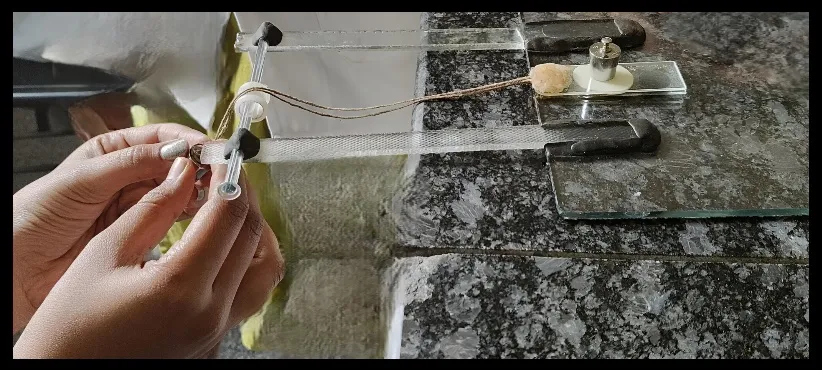
Figure 9: Extrudability test
5. Dye test:
Table 6: Dye test
|
Dye test |
F1 |
F2 |
F3 |
|
O/W |
O/W |
O/W |
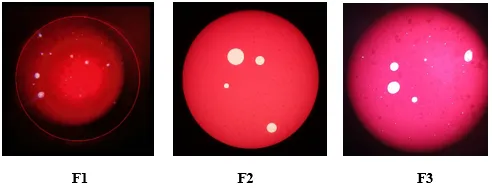
Figure 10: Dye test
6. Reology Studies:
Viscosity parameters are studied by using Brookfeild viscometer:
Table 7: Reology Studies
|
viscosity |
F1 |
F2 |
F3 |
|
5753 |
5885 |
5987 |
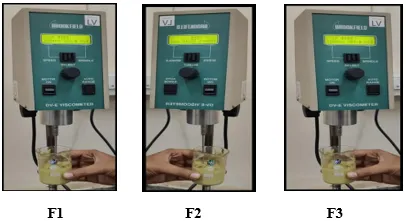
Figure 11: Rheological studies
7.0 Extrudability:
Table 8: Extrudability test results
|
Formulations |
F1 |
F2 |
F3 |
|
Extrudability in percentage |
90.06% |
90% |
89.8% |
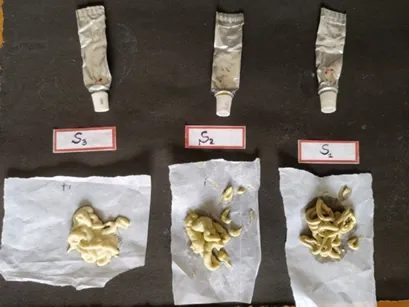
Figure 12: Extrudability test
DISCUSSION:
1. Physical Apperence:
Prepared polyherbal glow cream F1, F2and F3 is brown and viscous in nature. Formulated cream was brown in colour.
2. pH:
pH level of prepared three polyherbal glow cream was observed in the range of 6 to 7, hence the prepared creams are almost near to skin pH.
3. Dye test:
The three formulations has shown O/W type of emulsion. Hence, they can easily washed with water.
4. Extrudability:
All the three formulations has good extrudability. Hence they can easily extruded out of the container filled in it by applying little pressure.
5. Reology Studies:
Viscosity of glow cream is determined using "Brookfield Viscometer”. Product viscosity plays an important role in defining and controlling many attributes such as shelf life stability and product aesthetics such as clarity case of flow on removal from packing and spreading on application to skin and product consistency in the package. The flow characteristics of non-Newtonian materials are usually not measured with a single data point, because their viscosity is dependent on the shear rate.
6. Spreadability:
All the three formulations has shown good spreadability. Hence, they can easily apply on to the skin by applying little pressure.
CONCLUSION:
Poly-Herbal Glow cream successfully formulated by using Cassia auriculata, Licorice, Green tea extracts. Formulation F3 showed enhanced glowing property to skin compare to F1, and F2. The Ph of the cream formulation was in the range of 6-7 which lies within BIS range. All the cream formulations showed good Physical appearance, viscosity, Spreadability and Extrudability. All the prepared formulation are safe and good for application.
REFERENCES


Sushma Awati*, Shantaveer Irappanavar, Soumya Mullur, Megharaj Sulikeri, Nandeshwar Mahadev, Ravishankar Wakade, Shilpa Mudhol, Laxman Vijapur, Formulation and Evaluation of Poly-Herbal Skin Glowing Cream, Int. J. Med. Pharm. Sci., 2026, 2 (9), 645-652. https://doi.org/10.5281/zenodo.23020220
 10.5281/zenodo.23020220