
We use cookies to ensure our website works properly and to personalise your experience. Cookies policy
1Shantha College of Pharmacy, Peresandra, Chikkaballapur, Karnataka-562104 India
2Professor, Department of Pharmacology, Shantha College of Pharmacy, Peresandra, Chikkaballapur, Karnataka-562104 India
3Principal, Department of Pharmaceutics, Shantha College of Pharmacy, Peresandra, Chikkaballapur, Karnataka-562104 India
Background: Herbal cosmetics have gained considerable attention due to their safety and therapeutic benefits compared to formulations containing synthetic ingredients. Vanishing creams are widely used topical preparations because of their rapid absorption, non-greasy nature, and moisturizing properties. Cashew nut oil and aloe vera possess antioxidant, emollient, moisturizing, and soothing activities, making them promising ingredients for herbal skincare formulations. Objective: To formulate and evaluate an herbal vanishing cream containing cashew nut oil and aloe vera gel for its physicochemical properties, stability, and skin compatibility. Materials and Methods: The vanishing cream was prepared using the conventional oil-in-water (O/W) emulsion method with stearic acid, potassium hydroxide, glycerin, aloe vera gel, cashew nut oil, preservatives, and purified water. The prepared formulation was evaluated for appearance, pH, homogeneity, spreadability, dye test, washability, smear type, emolliency, skin irritation, and stability. Results: The formulated cream exhibited a smooth texture, good homogeneity, a spreadability of 620 g·cm/s, good washability, and the pH was found to be within the range of 6.0–6.4, indicating suitability for topical application. The dye test confirmed an oil-in-water emulsion, while the formulation remained stable without phase separation or significant changes during the stability study. No signs of skin irritation were observed. Conclusion: The developed herbal vanishing cream demonstrated satisfactory physicochemical characteristics, good cosmetic acceptability, and skin compatibility. The combination of cashew nut oil and aloe vera gel demonstrated potential as a natural alternative for topical skincare formulations. Further long-term stability studies and clinical evaluation are recommended to confirm its therapeutic potential.
The increasing demand for the herbal cosmetics has encouraged the development of skincare products containing natural ingredients with improved safety and therapeutic benefits.1 Vanishing creams are widely used topical emulsions that absorb rapidly into the skin, leaving a smooth, non-greasy, matte finish, which have remained widely used in daily skincare because of their rapid absorption and non-greasy feel.1,2 The typical formulation is built on stearic acid, neutralized with an alkali to form a soap-like base, then rounded out with synthetic emollients and preservatives. Some of these synthetic additives have raised safety concerns over repeated use, and this has driven a shift in formulation research toward plant-derived alternatives.2 Cashew nut oil comes from Anacardium occidentale and is rich in oleic and linoleic acid, plus tocopherols that give it antioxidant activity. It has been used in traditional medicine for skin conditions and wound care in several regions. Despite its traditional use, cashew nut oil has received limited attention in modern cosmetic formulation, particularly when compared with almond and coconut oils.8 Aloe vera gel, obtained from the leaves of Aloe barbadensis Miller, contributes moisturizing, anti-inflammatory, and wound-healing properties to the formulation. These effects are primarily attributed to bioactive constituents such as acemannan, vitamins, enzymes, amino acids, and phenolic compounds present in the gel.9 Aloe vera-based topical formulation has demonstrated good skin compatibility and are widely used in cosmetic and dermatological products for their soothing and hydrating effects.10,11 This study combines cashew nut oil and aloe vera gel in a vanishing cream base. The present study aimed to formulate and evaluate a herbal vanishing cream containing cashew nut oil and Aloe vera gel for its physicochemical characteristics, stability, and skin compatibility, The study also sought to investigate its potential as a natural alternative for topical skincare applications.
MATERIALS AND METHODS
MATERIALS
Fresh Aloe barbadensis Miller leaves were collected from a local herbal garden. Cold-pressed cashew nut oil (Anacardium occidentale L.) was procured from a local commercial supplier. Stearic acid, potassium hydroxide, glycerin, methyl paraben, propyl paraben, and rose water were obtained from the laboratory. All chemicals and reagents used were of analytical grade. Purified water was used throughout the study.
Preparation of Aloe Vera Gel
Fresh Aloe barbadensis leaves were washed thoroughly with distilled water. The outer rind was removed, and the transparent inner gel was collected aseptically. The gel was homogenized using a blender and filtered through muslin cloth to remove fibrous material. The fresh gel was stored at 4°C until incorporation into the formulation.12
Formulation of Vanishing Cream
Table 1. Composition of Vanishing Cream Formulation2,4
|
Ingredients |
Quantity (% w/w) |
Function |
|
Stearic acid |
15.0% |
Emulsifying agent and cream base |
|
Cashew nut oil |
3.0% |
Emollient and antioxidant |
|
Aloe vera gel |
10.0% |
Moisturizer and soothing agent |
|
Glycerin |
5.0% |
Humectant |
|
Potassium hydroxide |
0.8% |
Neutralizing |
|
Methyl paraben |
0.02% |
Preservative |
|
Propyl paraben |
0.05% |
Preservative |
|
Rose water |
5.0% |
Fragrance and skin refresher |
|
Purified water |
q.s. to 100% |
Vehicle |
Preparation of Vanishing Cream
Step 1: Preparation of Oil Phase
Step 2: Preparation of Aqueous Phase
Step 3: Emulsification
Step 4: Incorporation of Herbal Ingredients
Step 5: Final Adjustment
Evaluation of the Formulation
Organoleptic Evaluation
The prepared vanishing cream was visually examined for colour, odour, texture, consistency, phase separation and overall appearance.
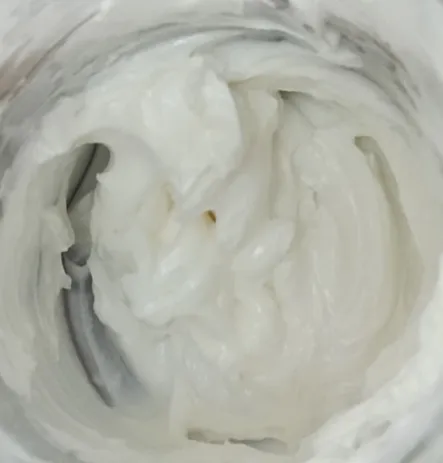
Figure 1. Photograph of the prepared vanishing cream
Table 2. Physicochemical Evaluation of the Formulated Vanishing Cream.
|
Parameter |
Observation |
|
Colour |
White |
|
Odour |
Slightly aromatic |
|
Texture |
Smooth |
|
Homogeneity |
Homogeneous |
|
pH |
6.0-6.4 |
|
Spreadability |
620 g·cm/s |
|
Washability |
Good |
|
Smear type |
Non-greasy |
|
Emolliency |
Good emollient property with no noticeable residue after application. |
|
Dye test |
Uniform distribution of scarlet red dye indicating an oil-in-water (O/W) emulsion |
|
Irritancy |
No redness or oedema |
|
Stability |
Stable |
pH Determination
The pH of the formulation cream was estimated using universal pH indicator paper. A small quantity of the cream was dispersed in distilled water (approximately 1g in 10ml), and the pH paper was immersed in the dispersion. The colour change was compared with the standard colour chart supplied with the pH paper, and the corresponding pH value was recorded.5
Homogeneity
Homogeneity was evaluated by visual inspection and by gently rubbing a small quantity of cream between the fingertips to assess its uniformity and smoothness.6
Spreadability
Spreadability was determined using the glass slide method. A known quantity of cream was placed between two glass slides, and a standard weight was applied2. The time required for the upper slide to move a specified distance was recorded, and spreadability was calculated using the appropriate formula.14

M=500g
L=6.2cm
T=5s
Where:
S = Spreadability (g·cm/s)
M = Weight tied to the upper slide (g)
L = Length moved by the slide (cm)
T = Time taken (s)
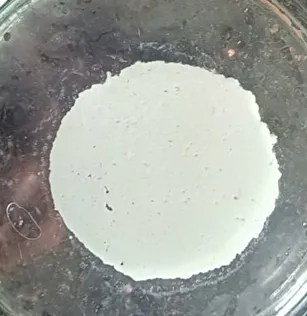
Figure 2. Spreadability test
Dye Test
The dye test was carried out using scarlet red dye to determine the emulsion type. A small quantity of cream was mixed with the dye and observed under a microscope. Uniform distribution of the dye confirmed that the formulation was an oil-in-water (O/W) emulsion.3,4
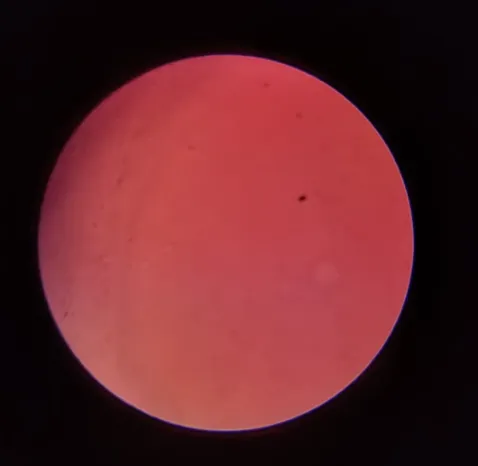
Figure 3. Dye test showing the O/W emulsion
Washability
Washability was assessed by applying a small quantity of cream to the skin and washing it with tap water. The ease of removal was recorded.6
Smear Test
The cream was applied to the skin, and the nature of the film left after application was observed to determine whether it was greasy or non-greasy.6
Emolliency
The emollient property of the cream was evaluated by applying a fixed amount to the skin and observing its softness, smoothness, and moisturization after application.6
Skin Irritation Test
The formulation was applied to a small area of intact skin and observed for 24 h for signs of erythema, oedema, itching or irritation.1
Stability Study
The formulated cream was stored under room temperature and accelerated storage conditions. The formulation was evaluated over 30 days for changes in colour, odour, pH, consistency, phase separation, and overall stability.15
RESULTS AND DISCUSSION
Physical Appearance
The formulated vanishing cream exhibited a smooth, homogeneous texture with a white appearance and a slightly aromatic odour. No phase separation or grittiness was observed, indicating that the formulation possessed good physical stability. The cream spread uniformly over the skin and produced a pleasant, non-greasy feel, which is desirable for topical cosmetic applications.
pH
The pH of the formulated vanishing cream was found to be range of 6.0-6.4, which is within the acceptable range for topical formulations. A pH close to that of the skin minimizes the risk of irritation and helps maintain the skin's natural protective barrier. Therefore, the prepared formulation is considered suitable for topical application.
Homogeneity
The cream showed excellent homogeneity when evaluated by visual inspection and touch. The formulation was smooth, free from lumps, and exhibited uniform distribution of all ingredients, indicating proper emulsification and mixing during preparation.
Spreadability
The spreadability of the formulated cream was 620 g·cm/s, indicating that it could be easily applied over the skin with minimal effort. Good spreadability enhances patient compliance by ensuring uniform application and better coverage of the skin surface.
Dye Test
The dye test confirmed that the prepared formulation was an oil-in-water (O/W) emulsion. This type of emulsion is preferred for vanishing creams because it spreads easily, is non-greasy, and can be washed off readily with water.
Washability and Smear Test
The cream exhibited good washability and was easily removed with water. The smear formed after application was non-greasy, providing a smooth matte finish without leaving an oily residue on the skin.
Emolliency
The formulated cream showed satisfactory emollient properties by softening the skin and leaving the skin soft and smooth without noticeable residue after application. The presence of cashew nut oil and aloe vera gel likely contributed to the moisturizing effect of the formulation.
Skin Irritation Test
No signs of redness, oedema, itching, or irritation were observed during the patch test. These findings suggest that the formulated vanishing cream is safe for topical application under the test conditions.
Stability Study
The formulation remained physically stable throughout the study period. No significant changes in colour, odour, pH, consistency, or phase separation were observed, indicating good stability under the storage conditions employed.
CONCLUSION
The present study successfully formulated and evaluated a herbal vanishing cream containing cashew nut oil and aloe vera gel. The formulated cream exhibited satisfactory physicochemical characteristics, including good homogeneity, appropriate spreadability, good washability, and a skin-compatible pH range. The dye test confirmed the formation of an oil-in-water (O/W) emulsion, while the stability study demonstrated that the formulation remained physically stable without noticeable changes in appearance, consistency, or phase separation during the study period. Furthermore, the cream showed no signs of skin irritation, indicating its suitability for topical application. The incorporation of cashew nut oil and aloe vera gel provided emollient, moisturizing, and soothing properties, highlighting their potential as natural alternatives to synthetic ingredients in cosmetic formulations. Overall, the developed vanishing cream demonstrated satisfactory physicochemical characteristics, cosmetic acceptability, and stability, indicating its potential as a natural topical skincare formulation
REFERENCES


Abhishek A. B.*, Sridhar S. M., Mukthiyar Ahamed, Chandan T. N., E. Gopinath, Formulation and Evaluation of a Vanishing Cream Containing Cashew Nut Oil and Aloe Vera Gel, Int. J. Med. Pharm. Sci., 2026, 2 (8), 359-364. https://doi.org/10.5281/zenodo.21859948
 10.5281/zenodo.21859948