

We use cookies to ensure our website works properly and to personalise your experience. Cookies policy
1Institute of Pharmacy, SAGE University, Indore
2Swami Vivekanand College of Pharmacy, Indore
A simple, Accurate, precise method was developed for the simultaneous estimation of the Nirmatrelvir and Ritonavir in dosage form. Chromatogram was run through Acquity UPLC STD HSS C18 (100 x2.8mm, 2µ. Mobile phase containing Buffer Na2HPO4: Methanol was taken in the ratio of 35:65 was pumped through column at a flow rate of 0.3 ml/min. Buffer used in this method was 0.01N Kh2po4. Temperature was maintained at 30°C. Optimized wavelength selected was 245 nm. Retention time of Nirmatrelvir and Ritonavir were found to be 0.787 min and 1.058 min. %RSD of the Nirmatrelvir and Ritonavir were and found to be 0.5 and 0.4 respectively. %Recovery was obtained as 100.29% and 100.34% for Nirmatrelvir and Ritonavir respectively. LOD, LOQ values obtained from regression equations of Nirmatrelvir and Ritonavir were 0.33ppm, 0.03ppm and 1.02ppm, 0.08ppm respectively. of Nirmatrelvir is y = 114686x + 13045, and of Ritonavir is y = 112957x + 6810.8, Retention times were decreased and that run time was decreased, so the method developed was simple and economical that can be adopted in regular Quality control test in Industries.
The use of new or updated analytical processes used for stability and to enable testing of commercial pharmaceutical substances and products is known as analytical method development, and it is governed by the ICH Q14 standards. The oral combination drug nirmatrelvir/ritonavir, commonly known as ritonavir-boosted nirmatrelvir, is used to treat corona virus disease 2019 (COVID-19). It is made up of ritonavir, an inhibitor of cytochrome P450 (CYP) 3A, and nirmatrelvir, a protease inhibitor that targets the primary protease of the severe acute respiratory syndrome corona virus 2 (SARS-CoV-2). Nirmatrelvir is scientifically defined as (1R,2S,5S)-N-[(1S)-1-cyano-2-[(3S)-2- oxopyrrolidin-3-yl]ethyl]-3-[(2S)-3,3-dimethyl-2-(2,2,2 trifluoroacetamido)butanoyl]-6,6-dimethyl-3- azabicyclo[3.1.0]hexane-2-carboxamide and Ritonavir is defined as (1,3-thiazol-5-yl)methyl N- [(2S,3S,5S)-3-hydroxy-5-[(2S)-3-methyl-2-{[methyl({[2-(propan-2-yl)-1,3-thiazol-4- yl]methyl})carbamoyl]amino} butanamido]-1,6-diphenylhexan-2-yl]carbamate. The US Food and Drug Administration (FDA) approved nirmatrelvir /ritonavir's usage in the treatment of COVID-19 on December 22, 2021, under an Emergency usage Authorization (EUA). An examination of the literature reveals that there are few ways available that use UV spectroscopic techniques to produce nirmatrelvir. Many of the methods are mainly concerned with estimating bulk and pharmaceutical dosage forms of ritonavir and nirmatrelvir. There aren't many techniques for quantifying Ritonavir and Nirmatrelvir at the same time using HPLC-DAD, HPTLC, and LC-MS/MS, respectively. Additionally, certain techniques have been created that make use of acids, highly concentrated buffers, extended run times, elevated temperatures, and a wide number of solvents. As a result, the techniques created are straightforward, affordable, and tailored for Nirmatrelvir. The pharmacological profile and chemical structure of Nirmatrelvir Ritonavir are displayed in Figure no 1, 2 and table 1 and 2. The literature survey5-13 reveals that a few analytical methods for the determination of combination of Nirmatrelvir and Ritonavir in dosage forms by HPLC, UPLC.
Nirmatrelvir:
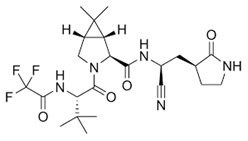
Figure 1. Structure of Nirmatrelvir
Table 1. Drug Profile of Nirmatrelvir
|
CAS Number |
: |
2628280-40-8 |
|
IUPAC Name : (1R,2S,5S)-N-[(1S)-1-cyano-2-[(3S)-2- oxopyrrolidin-3-yl] ethyl]-3-[(2S)-3,3-dimethyl-2-(2,2,2-trifluoroacetamido) butanoyl]-6,6- dimethyl-3-azabicyclo [3.1.0] hexane-2-carboxamide |
||
|
Molecular Weight |
: |
Average: 499.535 |
|
Molecular Formula |
: |
C23H32F3N5O4 |
|
Category |
: |
Anti-viral Medication |
Ritonavir
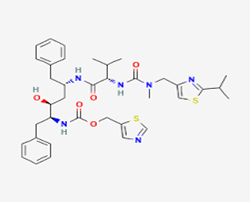
Figure 2: Structure of Ritonavir
Table 2. Drug profile of Ritonavir
|
CAS Number |
: |
155213-67-5 |
|
IUPAC Name : (1,3-thiazol-5-yl) methyl N-[(2S,3S,5S)-3-hydroxy-5- [(2S)-3-methyl-2-{[methyl({[2-(propan-2-yl)-1,3-thiazol-4- yl] methyl}) carbamoyl] amino} butanamido]-1,6-diphenylhexan-2-yl] carbamate |
||
|
Molecular Weight |
: |
Average: 720.944 |
|
Molecular Formula |
: |
C37H48N6O5S2 |
|
Category |
: |
Protease Inhibitors |
MATERIALS AND METHODS
2.1 Chemicals:
Nirmatrelvir and Ritonavir pure drugs (API), Combination Nirmatrelvir and Ritonavir tablets (Paxlovid), Distilled water, Acetonitrile, Phosphate buffer, Methanol, Potassium dehydrogenate ortho phosphate buffer, Ortho-phosphoric acid. All the above chemicals and solvents are from Rankem
2.2 Instrument:
Electronics Balance-Denver, pH meter -BVK enterprises, India, Ultrasonicator-BVK enterprises, UPLC instrument used was of WATERS Acquity UPLC SYSTEM with Auto Injector and Acquity TUV detector. Software used is Empower 3, UV-VIS spectrophotometer PG Instruments T60 with special bandwidth of 2mm and 10mm and matched quartz was be used for measuring absorbance of Nirmatrelvi and Ritonavir solutions.
3. Preparation
Diluent: Based up on the solubility of the drugs, diluent was selected, Acetonitrile and Water taken in the ratio of 50:50
Buffer: 0.01N Potassium dihyrogen Ortho phosphate
Accurately weighed 1.36gm of Potassium dihyrogen Ortho phosphate in a 1000ml of Volumetric flask add about 900ml of milli-Q water added and degas to sonicate and finally make up the volume with water then added 1ml of Triethylamine then PH adjusted to 3.5 with dil. Orthophosphoric acid solution.
Preparation of Standard stock solutions: Accurately weighed 7.5mg of Nirmatrelvir, 5mg of Ritonavir and transferred to 50ml flasks and 3/4 th of diluents was added to these flasks and sonicated for 10 minutes. Flask was made up with diluents and labeled as Standard stock solution. (150µg/ml of Nirmatrelvir and 100µg/ml Ritonavir)
Preparation of Standard working solutions (100% solution): 1ml from each stock solution was pipetted out and taken into a 10ml volumetric flask and made up with diluent. (15µg/ml of Nirmatrelvir and 10µg/ml of Ritonavir)
Preparation of Sample stock solutions: 10 tablets were taken and calculated each tablet average tablet and equivalent to 150 mg and 100mg was taken, then 20ml acetonitrile was added, sonicated for 25 min and made up to mark to yield 1100 & 500μg/ml. It was centrifuged for 20 min. Then the supernatant was collected and filtered using 0.45 μm filters using (Millipore, Milford, PVDF) (300µg/ml of Nirmatrelvir and 200µg/ml of Ritonavir).
Preparation of Sample working solutions (100% solution): 0.5ml of filtered sample stock solution was transferred to 10ml volumetric flask and made up with diluent. (15µg/ml of Nirmatrelvir and 10µg/ml of Ritonavir).
3.1 Validation
System suitability parameters: The system suitability parameters were determined by preparing standard solutions of Nirmatrelvir (300ppm) and Ritonavir (100ppm) and the solutions were injected six times and the parameters like peak tailing, resolution and USP plate count were determined. The % RSD for the area of six standard injections results should not be more than 2%.
Specificity: Checking of the interference in the optimized method. We should not find interfering peaks in blank and placebo at retention times of these drugs in this method. So this method was said to be specific.
3.2 Precision:
Preparation of Sample stock solutions: 10 tablets were taken and calculated each tablet average tablet and equivalent to 150 mg and 100mg was taken, then 20ml acetonitrile was added, sonicated for 25 min and made up to mark to yield 1100 & 500μg/ml. It was centrifuged for 20 min. Then the supernatant was collected and filtered using 0.45 μm filters using (Millipore, Milford, PVDF) (300µg/ml of Nirmatrelvir and 200µg/ml of Ritonavir).
Preparation of Sample working solutions (100% solution): 0.5ml of filtered sample stock solution was transferred to 10ml volumetric flask and made up with diluent. (15µg/ml of Nirmatrelvir and 10µg/ml of Ritonavir). The Precision were determined by preparing Sample solutions of Nirmatrelvir (15) and Ritonavir (10ppm) and the solutions were injected six times and The % RSD for the area of six standard injections results should not be more than 2%.
3.3 Linearity:
Preparation of Standard stock solutions: Accurately weighed 7.5mg of Nirmatrelvir, 5mg of Ritonavir and transferred to 50ml flasks and 3/4 th of diluents was added to these flask and sonicated for 10 minutes. Flask was made up with diluents and labeled as Standard stock solution. (150µg/ml of Nirmatrelvir and 100µg/ml Ritonavir)
|
Level |
ml |
|
25 % |
0.25 ml from Pipette |
|
50 % |
0.5 ml from Pipette |
|
75 % |
0.75 ml from Pipette |
|
100 % |
1.0 ml from Pipette |
|
125 % |
1.25 ml from Pipette |
|
150 % |
1.5 ml from Pipette |
3.4 Accuracy:
Preparation of Sample stock solutions: 10 tablets were taken and calculated each tablet average tablet and equivalent to 150 mg and 100mg was taken, then 20ml acetonitrile was added, sonicated for 25 min and made up to mark to yield 1100 & 500μg/ml. It was centrifuged for 20 min. Then the supernatant was collected and filtered using 0.45 μm filters using (Millipore, Milford, PVDF) (300µg/ml of Nirmatrelvir and 200µg/ml of Ritonavir
Preparation of Standard working solutions (100% solution): 1ml from each stock solution was pipetted out and taken into a 10ml volumetric flask and made up with diluent. (15µg/ml of Nirmatrelvir and 10µg/ml of Ritonavir)
|
Level |
ml |
|
50 % |
1.5 ml from Pipette |
|
100 % |
2.0 ml from Pipette |
|
150 % |
2.5 ml from Pipette |
3.5 Forced Degradation Oxidation:
To 1 ml of stock solution of Nirmatrelvir and Ritonavir, 1 ml of 20% hydrogen peroxide (H2O2) was added separately. The solutions were kept for 30 min at 600c. For HPLC study, the resultant solution was diluted to obtain 15µg/ml& 10µg/ mlsolutionand10µlwereinjected into the system and the chromatograms were recorded to assess the stability of sample.
Acid Degradation Studies:
To 1 ml of stock solution Nirmatrelvir and Ritonavir, 1 ml of 2N Hydrochloric acid was added and refluxed for 30mins at 600c. The resultant solution was diluted to obtain 15µg/ml& 10µg/ml solution and 10µl solutions were injected into the system and the chromatograms were recorded to assess the stability of sample.
Alkali Degradation Studies:
To 1 ml of stock solution Nirmatrelvir and Ritonavir, 1 ml of 2N sodium hydroxide was added and refluxed for 30mins at 600c. The resultant solution was diluted to obtain 15µg/ml& 10µg/ml solution and 10µl were injected into the system and the chromatograms were recorded to assess the stability of sample.
Dry Heat Degradation Studies:
The standard drug solution was placedinovenat105°C for1h to study dry heat degradation For UPLC study, the resultant solution was diluted to 15µg/ml& 10µg/ml solution and 10µl were injected into the system and the chromatograms were recorded to assess the Stability of the sample.
Photo Stability studies:
The photochemical stability of the drug was also studied by exposing the 312.5µg/ml Nirmatrelvir & 125µg/ml Ritonavir solution to UV Light by keeping the beaker in UV Chamber for 1days or 200- Watt hours/m2 in photo stability chamber. For UPLC study, the resultant solution was diluted to obtain 15µg/ml& 10µg/ml solutions and 10µl were injected into the system and the chromatograms were recorded to assess the stability of sample.
Neutral Degradation Studies:

Shivanee Patidar*, Rajat Pawar, Vagisha Pandey, Rinky Chouhan, Ashish Kumar Yadav, Estimation of Nirmatrelvir and Ritonavir using Stability Indicating RP- HPLC Method, Int. J. Med. Pharm. Sci., 2026, 2 (2), 1-11. https://doi.org/10.5281/zenodo.18447472
 10.5281/zenodo.18447472