

We use cookies to ensure our website works properly and to personalise your experience. Cookies policy
Dattakala College of Pharmacy (University- Savitribai Phule Pune University)
Forced degradation testing plays a foundational role in modern pharmaceutical development, serving as an indispensable analytical paradigm to establish the intrinsic stability profiles of Active Pharmaceutical Ingredients (APIs) and drug products. By exposing candidate drug molecules to deliberate stress conditions exceeding accelerated storage environments—including acidic, alkaline, oxidative, thermal, photolytic, and humidity challenges—forced degradation studies elucidate chemical degradation pathways, identify degradation products (DPs) and potential process impurities, and facilitate the development of robust Stability-Indicating Analytical Methods (SIAMs). Reversed-Phase High-Performance Liquid Chromatography (RP-HPLC), coupled with ultraviolet-visible (UV/Vis), photodiode array (PDA), or mass spectrometry (MS) detection, remains the golden standard for stability-indicating assays due to its exceptional resolving power, sensitivity, reproducibility, and versatility. This comprehensive review systematically explores the fundamental concepts, regulatory frameworks (ICH Q1A(R2), ICH Q1B, ICH Q2(R2), ICH Q14, and FDA guidance), and technical execution of forced degradation studies. Special emphasis is devoted to stress chemistry mechanisms, practical protocols for stress testing, systematic chromatographic method development strategies, and comprehensive validation parameters according to updated ICH guidelines. Furthermore, recent technological advances between 2021 and 2026—including ultra-high-performance liquid chromatography (UHPLC), Quality by Design (QbD) enabled method optimization, high-resolution mass spectrometry (HRMS) impurity profiling, green analytical chemistry integration, and modern computational degradation predictions —are critically critically critically examined. Finally, current analytical challenges and future perspectives in pharmaceutical stability analysis are discussed to provide a complete guide for researchers, M.Pharm scholars, and industry professionals.
The safety, efficacy, and therapeutic quality of pharmaceutical dosage forms are fundamentally dependent upon the chemical and physical stability of the Active Pharmaceutical Ingredient (API) throughout its intended shelf-life. During synthesis, processing, formulation, packaging, transportation, and storage, pharmaceutical substances are continually exposed to environmental stressors such as light, temperature, moisture, oxygen, and pH extremes. Exposure to these factors can induce molecular chemical transformation, generating degradation products (DPs) that may attenuate the therapeutic activity of the drug or, more dangerously, introduce toxicological risks to patients [1,2]. To ensure pharmaceutical safety and efficacy, regulatory bodies globally—including the International Council for Harmonisation (ICH), the United States Food and Drug Administration (US FDA), and the European Medicines Agency (EMA)—mandate rigorous stability testing protocols. Among these requirements, forced degradation studies (often designated as stress testing) hold a pivotal position during the early and late stages of drug development [3]. Forced degradation involves exposing the active drug substance or finished formulation to conditions vastly more severe than standard accelerated testing. This process rapidly induces chemical decomposition, exposing vulnerable functional groups and establishing the intrinsic chemical stability characteristics of the drug molecule [4]. The analytical capability to accurately quantify the remaining active drug in the presence of its degradation products, synthesis impurities, matrix excipients, and interaction products defines a Stability-Indicating Analytical Method (SIAM) [5]. Reversed-Phase High-Performance Liquid Chromatography (RP-HPLC) has emerged as the premier analytical methodology for stability-indicating testing due to its unmatched efficiency, versatility, resolution of polar and non-polar moieties, and seamless compatibility with various detection modalities such as UV-Photodiode Array (PDA) and Mass Spectrometry (MS) [6]. This review provides a comprehensive, state-of-the-art overview of forced degradation methodologies and stability-indicating RP-HPLC method development. It integrates updated regulatory expectations (including ICH Q14 and revised ICH Q2(R2) guidelines) alongside modern Analytical Quality by Design (AQbD) strategies and recent high-impact analytical advancements published between 2021 and 2026.
4. Pharmaceutical Stability and Stability Testing
Pharmaceutical stability is defined as the capability of a specific formulation in a specific container/ closure system to remain within its physical, chemical, microbiological, toxicological, and therapeutic specifications over a specified duration [7]. Stability testing provides evidence on how the quality of a drug substance or drug product varies under the influence of environmental factors such as temperature, humidity, and light.
Pharmaceutical stability testing can be broadly categorized into three distinct operational domains:
Chemical instability typically manifests through primary reaction pathways including hydrolysis, oxidation, photolysis, thermal cleavage, and isomerisation or polymerization. Physical instability involves polymorph transformation, precipitation, aggregation, loss of volatile components, or sorption to packaging materials. A comprehensive analytical evaluation must distinguish between pure physical changes and true chemical degradation.
5. Concept of Forced Degradation Studies
Forced degradation is an analytical process wherein a drug substance or drug product is subjected to severe stress conditions to accelerate chemical decomposition. Unlike routine stability testing, which aims to establish an expiration date under nominal storage conditions, forced degradation aims to proactively probe the chemical reactivity of the molecule [10]. The primary goal is to achieve moderate degradation—ideally between 10% and 20% decomposition of the active drug substance. Degrading the sample beyond 20% is generally discouraged because it often leads to secondary and tertiary degradation products that do not represent realistic long-term degradation pathways, potentially complicating method development [11]. Conversely, degradation below 5% may fail to generate sufficient levels of degradation products to confirm peak purity and specificity.
Forced degradation studies are conducted across several critical phases of pharmaceutical development:
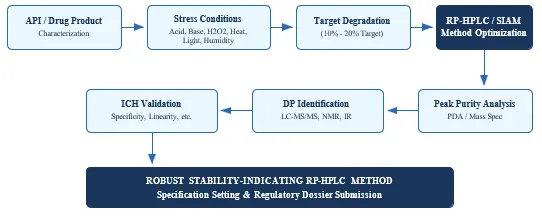
Figure 1: Systematic conceptual workflow for forced degradation studies and stability-indicating RP-HPLC method development and validation.
6. Regulatory Guidelines
Pharmaceutical stability evaluation and method validation are strictly regulated by harmonized guidelines established by international agencies. Key regulatory frameworks governing forced degradation and analytical validation include:
6.1 ICH Q1A(R2): Stability Testing of New Drug Substances and Products
ICH Q1A(R2) outlines core requirements for stress testing of active ingredients and formulations. It explicitly mandates that stress testing should be conducted on a single batch of drug substance to elucidate intrinsic stability characteristics, establish degradation pathways, and validate the stability-indicating capability of analytical procedures [13]. It specifies evaluation under temperature (in 10°C increments above accelerated testing, e.g., 50°C, 60°C), humidity (e.g., 75% RH or greater), oxidation, and susceptibility to hydrolysis across a wide pH spectrum.
6.2 ICH Q1B: Photostability Testing of New Drug Substances and Products
ICH Q1B provides standardized protocols for evaluating light sensitivity. Samples must be exposed to an illumination level of not less than 1.2 million lux hours and an integrated near-ultraviolet energy of not less than 200 watt hours per square meter (W·h/m²) [14]. Testing is performed systematically in three phases: exposed direct API, fully exposed immediate drug product, and drug product in commercial marketing pack.
6.3 ICH Q2(R2) and ICH Q14: Validation and Analytical Procedure Development
Recently modernized in late 2023, ICH Q2(R2) governs analytical method validation parameters, emphasizing analytical specificity in forced degradation matrixes [15]. Simultaneously, ICH Q14 introduces formal regulatory concepts for Analytical Procedure Development, encouraging Analytical Quality by Design (AQbD), risk assessment (e.g., Ishigawa diagrams and FMEA), Design of Experiments (DoE), and establishment of an Analytical Target Profile (ATP) alongside a Method Operational Design Region (MODR) [16].
6.4 FDA and Regional Guidance
The US FDA guidance on analytical procedures and stability testing emphasizes that chromatographic methods must demonstrate absolute specificity. Analytical resolution (Rs) between active drug peaks, degradation products, and excipient peaks must be superior to 1.5. Peak purity must be rigorously verified using diode array spectral homogeneities or LC-MS identification [17].
Table 1: Summary of key ICH guidelines governing pharmaceutical stability, stress testing, and analytical validation.
|
Guideline |
Title / Focus Area |
Core Regulatory Objective & Mandate |
|
ICH Q1A(R2) |
Stability Testing of New Drug Substances & Products |
Defines core stability parameters, accelerated/long-term storage protocols, and stress testing requirements to identify intrinsic degradation pathways. |
|
ICH Q1B |
Photostability Testing |
Mandates standard light exposure parameters (≥ 1.2M lux h, ≥ 200 W·h/ m² UV energy) to evaluate light-induced degradation. |
|
ICH Q1C–Q1E |
Stability Evaluation & New Dosage Forms |
Provides statistical rules for shelf-life estimation, extrapolation of stability data, and specific requirements for novel delivery systems. |
|
ICH Q2(R2) |
Validation of Analytical Procedures |
Defines validation characteristics (specificity, accuracy, precision, linearity, LOD/LOQ, robustness) for analytical method approval. |
|
ICH Q14 |
Analytical Procedure Development |
Introduces systematic AQbD principles, Analytical Target Profiles (ATP), risk assessment, and Method Operational Design Regions (MODR). |
7. Objectives and Importance Of Forced Degradation Studies
Forced degradation testing serves crucial scientific and regulatory objectives during pharmaceutical commercialization:
8. Types Of Stress Conditions
A robust forced degradation study involves subjecting active drug substances and formulation matrices to six primary environmental stress vectors. Standard parameters, chemical mechanisms, and illustrative reactions are detailed below:
8.1Acidic Degradation
Acid-catalyzed hydrolysis is evaluated by exposing the API solution to mineral acid, typically 0.1 N to 1.0 N Hydrochloric Acid (HCl), at room temperature or elevated temperatures (40°C to 80°C) for durations ranging from 1 to 24 hours. Acidic media promote protonation of functional groups, accelerating the cleavage of esters, amides, lactams, carbamates, imines, and glycosidic linkages [19].
8.2 Alkaline Degradation
Base-catalyzed hydrolysis is evaluated using 0.1 N to 1.0 N Sodium Hydroxide (NaOH) under controlled thermal conditions. Nucleophilic attack by hydroxyl ions (OH−) rapidly hydrolyzes carboxylic acid derivatives, lactones, cyclic imides, and halogenated moieties. Neutralization with stoichiometric amounts of acid or base prior to HPLC injection is required to protect silica-based chromatographic columns [20].
8.3 Oxidative Degradation
Oxidative susceptibility is routinely screened using 3% to 30% Hydrogen Peroxide (H2O2) at room temperature. Hydrogen peroxide generates reactive oxygen species (ROS) and hydroxyl radicals, promoting oxidation of electron-rich functional groups such as thioethers (to sulfoxides/sulfones), aliphatic and aromatic amines (to N-oxides), aldehydes (to carboxylic acids), and phenolic rings (to quinones) [21]. Free radical initiators such as 2,2'-azobis(2-amidinopropane) dihydrochloride (AAPH) may also be employed for radical-mediated pathways.
8.4 Thermal Degradation
Dry and moist thermal stress studies are conducted by exposing solid-state and liquid-state drug samples to elevated temperatures (typically 60°C to 105°C) in temperature-controlled ovens. Thermal energy increases molecular kinetic collision rates, driving thermolysis, dehydration, decarboxylation, and solid-state polymorph transformations [22].
8.5 Photolytic Degradation
Photolytic stress exposes solid and liquid samples to visible and ultraviolet light in accordance with ICH Q1B guidelines using a photostability chamber equipped with cool white fluorescent and near-UV lamps (> 1.2M lux hours, > 200 W·h/m²). Photons absorb energy, promoting electrons to excited singlet/ triplet state configurations, inducing bond cleavage, photo-isomerization, photo-dimerization, and photo-oxidation [23].
8.6 Humidity Degradation
Humidity stress testing evaluates solid API and drug product matrices exposed to elevated relative humidity (typically 75% RH to 90% RH at 40°C or 60°C) using saturated salt solutions or environmental chambers. Absorbed moisture acts as a plasticizer, enhancing solid-state molecular mobility, accelerating solid-state hydrolysis, and triggering hydrate formation, deliquescence, or crystalline-to-amorphous phase transformations [24].
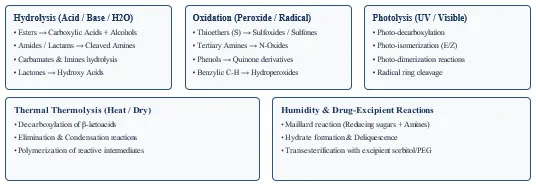
Figure 2: Primary chemical degradation pathways and associated reactive functional groups encountered during pharmaceutical stress testing.
Table 2: Summary of standard stress testing conditions, experimental parameters, and target degradation thresholds.
|
Stress Vector |
Standard Reagents / Conditions |
Temperature & Duration |
Target % Degradation |
|
Acid Hydrolysis |
0.1 N to 1.0 N HCl |
25°C to 80°C; 1 h to 24 h |
10% – 20% |
|
Base Hydrolysis |
0.1 N to 1.0 N NaOH |
25°C to 80°C; 1 h to 24 h |
10% – 20% |
|
Oxidative Degradation |
3% to 30% H2O2, AAPH |
25°C to 60°C; 2 h to 48 h |
10% – 20% |
|
Thermal Degradation |
Dry Heat (Oven) |
60°C to 105°C; 1 to 7 days |
10% – 20% |
|
Photolytic Degradation |
ICH Q1B Photostability Chamber |
≥ 1.2M lux h (Vis); ≥ 200 W·h/ m² (UV) |
10% – 20% |
|
Humidity Degradation |
75% RH to 90% RH (Desiccator/ Chamber) |
40°C to 60°C; 5 to 14 days |
Physical/ Chemical Change |
9. Stability-Indicating Analytical Methods
A Stability-Indicating Analytical Method (SIAM) is a validated quantitative analytical procedure that can accurately and precisely measure the active pharmaceutical ingredient (API) without interference from degradation products, synthetic impurities, process contaminants, or excipients [25]. Developing a SIAM requires demonstrating that all degradation products generated during stress testing are completely baseline resolved from the parent analyte peak and from each other. Furthermore, peak purity analysis must confirm that the analyte chromatographic peak contains no co-eluting degradants or silent impurities.
Table 3: Comparison of major analytical techniques utilized for stability-indicating method development.
|
Analytical Technique |
Resolving Power |
Sensitivity / LOD |
Identification Capability |
Routine QA/QC Feasibility |
|
RP-HPLC-UV/PDA |
Very High |
High (ng/mL) |
Moderate (UV spectra spectral matching) |
Excellent (Gold Standard) |
|
UHPLC / UPLC |
Ultra-High |
Very High (pg/ mL) |
Moderate (UV spectral matching) |
Excellent (High Throughput) |
|
LC-MS/MS / HRMS |
Exceptional |
Ultra-High (fg/ mL) |
Outstanding (Structural Elucidation) |
Moderate (High Cost) |
|
HPTLC |
Moderate |
Moderate (µg/ mL) |
Low to Moderate |
Good (Parallel Screening) |
|
Capillary Electrophoresis |
High |
Moderate |
Moderate |
Moderate (Capillary Sensitivity) |
10. RP-HPLC As A Stability-Indicating Technique
Reversed-Phase High-Performance Liquid Chromatography (RP-HPLC) is the premier technique for stability-indicating assays. The primary advantages of RP-HPLC include:
11. Method Development Strategy For RP-HPLC
Developing a stability-indicating RP-HPLC method requires a structured, stepwise experimental approach. Figure 3 illustrates the systematic strategy for SIAM development:
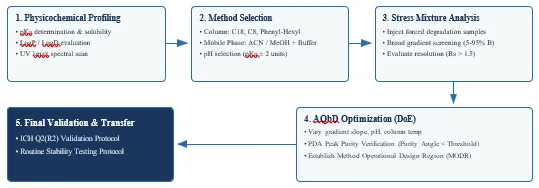
Figure 3: Stepwise chromatographic development strategy for stability-indicating RP-HPLC method design utilizing Analytical Quality by Design (AQbD) principles.
Key decision parameters in RP-HPLC method development include:
12. Method Validation According To Ich Guidelines
Once an optimal chromatographic separation is achieved, the stability-indicating RP-HPLC procedure must be thoroughly validated according to ICH Q2(R2) requirements. Validation proves that the method is suitable for its intended purpose.
12.1 Specificity
Specificity is the ability to assess unequivocally the analyte in the presence of components that may be expected to be present (degradants, impurities, excipients). For a SIAM, specificity is established by demonstrating that forced degradation samples exhibit complete resolution (Rs > 1.5) between the API peak and all degradation product peaks. Peak purity must be confirmed using PDA spectral homogeneity
(Purity Angle < Purity Threshold) or mass spectral analysis [30].
12.2 Accuracy
Accuracy expresses the closeness of agreement between the accepted reference value and the value found. It is evaluated across the analytical range (typically 80%, 100%, and 120% of nominal concentration) by performing recovery studies in spiked sample matrices. Mean percentage recovery must fall within 98.0% to 102.0% for API quantification.
12.3 Precision
Precision evaluates the agreement among series of measurements obtained from multiple sampling of the same homogeneous sample. It is evaluated at two levels:
12.4 Linearity and Range
Linearity is the ability (within a given range) to obtain test results directly proportional to the concentration of analyte in the sample. It is established across a minimum of 5 concentration levels (typically 50% to 150% of nominal target concentration). Linear regression analysis must yield a
correlation coefficient (r2) ≥ 0.999, with y-intercept statistical insignificance.
12.5 Robustness
Robustness measures the method's capacity to remain unaffected by small, deliberate variations in method parameters. Tested variations include mobile phase pH (±0.2 units), organic modifier percentage (±2% to 5%), column temperature (±2°C to 5°C), flow rate (±0.1 to 0.2 mL/min), and wavelength (±2 nm). System suitability parameters (retention time, theoretical plates, tailing factor, resolution) must remain within acceptable limits.
12.6 Ruggedness
Ruggedness assesses method reproducibility under normal, variable operational conditions across different laboratories, instruments, columns (lot-to-lot variations), and environmental conditions.
12.7 Limit of Detection (LOD) and Limit of Quantification (LOQ)
LOD and LOQ define the sensitivity of the analytical method for degradation impurities. They are routinely calculated using the standard deviation of response (σ) and slope of the calibration curve (S):
LOD = 3.3 × (σ / S) LOQ = 10 × (σ / S)
Alternatively, LOD and LOQ are determined experimentally using Signal-to-Noise (S/N) ratios of 3:1 and 10:1, respectively [32].
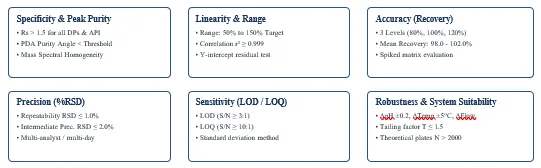
Figure 4: Comprehensive ICH Q2(R2) method validation parameters and typical acceptance criteria for stability-indicating assays.
13. Applications of Forced Degradation Studies In Pharmaceutical Analysis
Forced degradation studies coupled with stability-indicating RP-HPLC methods find extensive applications across the entire pharmaceutical life cycle:
14. Recent Advances in Stability-Indicating RP-HPLC Methods (2021–2026)
The period between 2021 and 2026 has witnessed transformative technological advancements in liquid chromatography and pharmaceutical analysis:
Table 4: Selected recent published stability-indicating RP-HPLC and UHPLC methods for diverse therapeutic agents (2021–2026).
|
Drug Analyte(s) |
Stationary Phase / Column |
Mobile Phase Composition |
Detection & Mode |
Major Stress Degradation Pathways Identified |
Ref. |
|
Remdesivir |
C18 Core-Shell (100 × 2.1 mm, 1.7 µm) |
0.1% Formic Acid: Acetonitrile Gradient |
UV (245nm) & ESI-Q-ToF |
Rapid ester and phosphoramidate hydrolysis under acidic and basic conditions. |
[39] |
|
Empagliflozin & Linagliptin |
C18 (150 × 4.6 mm, 3.5 µm) |
Phosphate Buffer (pH 3.2): Methanol (40:60 v/v) |
PDA (225nm) |
Oxidative cleavage of linagliptin amine group; empagliflozin stable to photolysis. |
[40] |
|
Molnupiravir |
C18 (250 × 4.6 mm, 5 µm) |
10 mM Ammonium Acetate (pH 4.5): ACN Gradient |
UV (235nm) |
Base-catalyzed ester hydrolysis yielding active nucleoside analog metabolite. |
[41] |
|
Paxlovid (Nirmatrelvir & Ritonavir) |
UHPLC C18 (50 × 2.1 mm, 1.8µm) |
Water (0.05% TFA): Acetonitrile (Gradient) |
PDA & Orbitrap HRMS |
Nirmatrelvir amide bond cleavage under acid stress; ritonavir oxidative N dealkylation. |
[42] |
|
Apixaban & Impurities |
Phenyl-Hexyl (150 × 4.6 mm, 3µm) |
0.02 M Acetate Buffer (pH 4.8): ACN (55:45) |
UV (280 nm) |
Base-catalyzed lactam ring opening; light-induced photo-dimerization products. |
[43] |
|
Rybelsus (Oral Semaglutide) |
Wide-Pore C4 (150 × 3.0 mm, 2.6 µm) |
0.1% TFA Water: 0.1% TFA CAN Gradient |
UV (214 nm) & LC-MS |
Peptide backbone thermal cleavage and oxidation of methionine residue. |
[44] |
Table 5: Summary of standard ICH Q2(R2) method validation parameters, recommended experimental protocols, and general acceptance criteria.
|
Validation Parameter |
ICH Q2(R2) Recommended Protocol |
Typical Acceptance Criteria |
|
Specificity / Selectivity |
Inject individual DPs, blanks, excipients, and stress-degraded samples. Evaluate resolution and peak purity. |
Resolution (Rs) > 1.5 for all adjacent peaks; Purity Angle < Purity Threshold; no baseline co-elution. |
|
Linearity |
Minimum 5 concentration levels spanning 50% to 150% of nominal assay concentration. |
Correlation coefficient (r2) ≥ 0.999; y-intercept statistical insignificance. |
|
Accuracy (Recovery) |
Spike API at 3 concentration levels (80%, 100%, 120%) in triplicate across placebo matrix. |
Mean recovery within 98.0% – 102.0%; %RSD ≤ 1.5%. |
|
Repeatability |
Minimum 6 replicate injections of 100% target test concentration. |
Peak area %RSD ≤ 1.0%; retention time %RSD ≤ 0.5%. |
|
Intermediate Precision |
Analyze samples across 3 different days, 2 analysts, and 2 HPLC instruments. |
Overall chromatographic %RSD ≤ 2.0%. |
|
Limit of Detection (LOD) |
Based on S/N ratio (3:1) or standard deviation of response (3.3 × σ / S). |
Consistently detectable peak response. |
|
Limit of Quantitation (LOQ) |
Based on S/N ratio (10:1) or standard deviation of response (10 × σ / S). |
%RSD ≤ 5.0% and accuracy within 90%–110% at LOQ level. |
|
Robustness |
Deliberate minor changes in pH (±0.2), Temp (±5°C), Flow (±0.1 mL/min), Organic ratio (±2%). |
System suitability parameters remain valid (Tailing < 1.5, Plates > 2000, %RSD < 2.0%). |
CHALLENGES AND FUTURE PERSPECTIVES
Despite major analytical advancements, forced degradation testing and stability-indicating RP-HPLC method development face several ongoing technical challenges:
CONCLUSION
Forced degradation studies are an essential component of modern pharmaceutical development and Quality by Design (QbD) frameworks. By subjecting drug substances and products to severe environmental stress conditions, these studies elucidate intrinsic degradation pathways, identify potential impurities, and guide formulation and packaging strategies. Reversed-Phase High-Performance Liquid Chromatography (RP-HPLC), coupled with Photodiode Array (PDA) and Mass Spectrometry (MS) detection, remains the gold standard for developing stability-indicating analytical methods. Systematic method development aligned with updated ICH Q14 and ICH Q2(R2) guidelines ensures method specificity, accuracy, precision, and robustness. Looking forward, the integration of UHPLC, high-resolution LC-MS/MS, 2D-LC, green analytical chemistry, and AI-driven computational predictions will continue to advance stability testing, ensuring the quality, safety, and efficacy of pharmaceutical products worldwide.
ACKNOWLEDGEMENT
The author, Shubham Kailas Harihar, gratefully expresses sincere gratitude and deep sense of indebtedness to research guides Dr. Vishal Babar, Dr. Sudarshan Nagrale, and Prof. Amit Pondkule for their valuable guidance, continuous encouragement, constructive criticisms, and scholarly feedback throughout the preparation of this comprehensive review paper. The author also acknowledges the institutional facilities and academic support provided for completing this M.Pharm research initiative.
CONFLICT OF INTEREST
The authors declare that there are no financial, personal, or professional conflicts of interest that could inappropriately influence or bias the content, research findings, or conclusions presented in this publication.
REFERENCES


Shubham Harihar*, Vishal Babar, Sudarshan Nagrale, Amit Pondkule, Forced Degradation Studies and Stability-Indicating RP-HPLC Methods: A Comprehensive Review, Int. J. Med. Pharm. Sci., 2026, 2 (8), 335-347. https://doi.org/10.5281/zenodo.21837757
 10.5281/zenodo.21837757