

We use cookies to ensure our website works properly and to personalise your experience. Cookies policy
1Department of Pharmaceutical Regulatory Affairs, A.U. College of Pharmaceutical Sciences, Andhra University, Visakhapatnam – 530003, Andhra Pradesh, India.
2Research Scholar, Department of Pharmaceutical Regulatory Affairs, A.U. College of Pharmaceutical Sciences, Andhra University, Visakhapatnam – 530003, Andhra Pradesh, India
India's pharmaceutical regulatory system divides authority between the Central Drugs Standard Control Organisation (CDSCO), which approves new drugs, and the State Licensing Authorities (SLAs), which issue manufacturing and sale licences. This division, largely unchanged since the Drugs and Cosmetics Act, 1940, has repeatedly allowed fixed-dose combinations (FDCs) that qualify legally as “new drugs” to reach the market through state-level licensing without the scientific scrutiny required of the central regulator. The result has been the persistent proliferation of irrational FDCs, which lack pharmacokinetic compatibility, pharmacodynamic synergy or a demonstrable therapeutic advantage over their constituent monotherapies. Drawing on peer-reviewed literature, government notifications and expert committee reports, this review synthesises the regulatory framework governing FDC approval in India, identifies its principal loopholes and examines four regulatory interventions as case studies of recurring systemic failure: the 2016 ban on 344 FDCs, the 2018 ban on 328 FDCs, the 2024 ban on 156 FDCs and the 2025 directive against 35 unapproved FDCs, which included antidiabetic combinations. Available estimates indicate that FDCs account for nearly 40% of marketed formulations in India, of which up to 70% may lack adequate scientific justification, with attendant risks of adverse drug reactions, therapeutic failure and antimicrobial resistance. The review concludes with recommendations for centralised FDC approval under the CDSCO, mandatory synergy and pharmacokinetic evidence, a public FDC registry and stronger Centre–State coordination, so as to align India’s regulation with international standards of rational drug use.
India’s pharmaceutical regulatory framework is intended to safeguard public health by overseeing the quality, safety and efficacy of medicines marketed within the country.1 Its dual structure, which divides oversight between the Central Licensing Authority, exercised through the Central Drugs Standard Control Organisation (CDSCO), and the State Licensing Authorities (SLAs), has historically constituted a significant systemic vulnerability. Under this arrangement, state regulators have frequently granted manufacturing licences for new fixed-dose combinations (FDCs) without the clinical trial review and safety clearance that the central authority requires. Fixed-dose combinations are formulations that combine two or more active pharmaceutical ingredients (APIs) in a fixed ratio within a single dosage form. World Health Organization (WHO) guidance regards an FDC as a distinct medicinal product whose safety, efficacy and bioavailability may differ materially from those of its individual components, and which therefore warrants the same rigour of evaluation as any new drug.2 Manufacturers have been able to use this jurisdictional gap to avoid the more stringent central approval mechanism by applying to state regulators for licences. As a result, a large number of “irrational” FDCs, that is, combinations lacking sound therapeutic justification, adequate pharmacological data or an established clinical safety profile, have entered the commercial market. This has undermined unified drug enforcement in India, has led to the wide availability of unscientific formulations and has heightened the risk of drug–drug interactions. Central authorities have spent more than a decade attempting to identify, ban and defend in court such products retrospectively. Despite the existence of the central approval requirement, gaps in the oversight of FDC approval have recurred in India, giving rise to sustained concern about regulatory fragmentation and patient safety. In a recurring pattern, individual SLAs have licensed the manufacture of FDCs without prior approval from the central regulator, and this practice has, on several occasions, led to the retrospective banning of large numbers of such products once their lack of scientific justification was established. The objective of this review is to consolidate current understanding of India’s FDC regulatory landscape, to examine its structural loopholes and the recurring regulatory interventions that have followed from them, and to propose evidence-based recommendations for reform. The review draws on peer-reviewed literature, government notifications and expert committee reports.
2. Fixed-Dose Combinations: Rationale and Risk
FDCs have gained prominence as the burden of chronic and infectious disease has increased, chiefly because of their potential to improve medication adherence, reduce pill burden and simplify complex therapeutic regimens.2,3 A rationally designed FDC combines agents with complementary mechanisms of action, compatible pharmacokinetics and demonstrable additive or synergistic efficacy, and offers a safety profile that is favourable relative to the equivalent free-drug combination. When these criteria are not met, FDCs may pose considerable health risks. Mismatched half-lives can result in under-dosing or over-dosing of one component, overlapping toxicity profiles increase the likelihood of adverse drug reactions (ADRs), and irrational antimicrobial pairings accelerate the emergence of drug resistance.4,5 Hospital-based prescription audits in India have reported that a majority of dispensed FDCs, exceeding 60% in some series, fail basic rationality criteria, such as inclusion in the WHO Model List of Essential Medicines or the National List of Essential Medicines (NLEM).4,6
3. Regulatory Framework for Drug Approval in India
The regulation of pharmaceuticals in India rests on a division of responsibility between the Central and State Governments, established under the Drugs and Cosmetics Act, 1940, and the Drugs and Cosmetics Rules, 1945.7,8 Subsequent amendments have not altered this basic distribution of functions. Under the current arrangement:
This fragmented structure has been a major contributor to the unchecked proliferation of irrational FDCs in India. In practice, SLAs have on numerous occasions licensed the manufacture of FDCs without any CDSCO involvement, treating combinations of already-marketed single ingredients as falling outside the statutory definition of a “new drug”, even where the Rules expressly classify such combinations as new drugs.7,9,10
4. Indian FDC Policy Framework: Regulatory Loopholes
The Indian pharmaceutical industry is widely recognised for its manufacturing capability and cost-effective drug supply. Its regulatory framework for FDCs, however, has long been criticised for inconsistent enforcement.7,8,11 Although policy guidelines exist to ensure scientific and clinical rigour in FDC approval, their implementation across states has been markedly uneven. This gap between regulation on paper and regulation in practice has allowed irrational combinations to enter the market and to remain in circulation for years, and sometimes decades, before corrective action is taken.9,11 This dichotomy between central approval and state-level licensing autonomy has enabled manufacturers to introduce FDCs without central review or compliance with scientific standards, allowing commercial considerations to outweigh evidentiary ones.
5. The 2013 CDSCO Policy Guidelines: Scientific and Regulatory Requirements
In 2013, the CDSCO issued detailed guidelines setting out the scientific and procedural requirements for FDC approval in India.12 The guidelines require applicants to establish:
Taken together, these requirements provide a reasonably robust framework for rational FDC development. Their application, however, has been inconsistent, particularly at the level of state licensing, where the technical capacity to evaluate PK/PD compatibility is often limited.12,13
6. Case Studies In Regulatory Intervention
6.1 The 2016 Ban on 344 FDCs
In March 2016, on the recommendation of the Kokate Committee, the Government of India prohibited the manufacture, sale and distribution of 344 FDCs, including 35 systemic antibiotic combinations, citing the absence of therapeutic justification and the risk of accelerating antimicrobial resistance. Affected manufacturers subsequently challenged the decision in court, which delayed full implementation and illustrated the legal friction that accompanies the retrospective banning of long-marketed products.1
6.2 The 2018 Ban on 328 FDCs
In September 2018, following review by the Drugs Technical Advisory Board (DTAB), a further 328 FDCs were banned on the grounds that there was “no therapeutic justification” for their constituent ingredients and that they “may involve a risk to human beings”.11 Contemporary reviews described the decision as a potential landmark in the development of stronger pharmaceutical policy in India, while noting persistent gaps in prescriber awareness of which combinations were unsafe or banned.11
6.3 The 2024 Ban on 156 FDCs
In August 2024, the Ministry of Health and Family Welfare banned 156 FDCs used for fever, pain, cold and allergies, acting under Section 26A of the Drugs and Cosmetics Act, 1940.14–16 The action followed review by an expert committee and the DTAB, both of which concluded that the combinations lacked therapeutic justification and posed risks that outweighed any clinical benefit.15 The decision was significant in reinforcing the need for stronger, centralised oversight of legacy FDCs that had remained on the market for years without adequate re-evaluation.17
6.4 The 2025 CDSCO Directive on 35 Unapproved FDCs
On 11 April 2025, the CDSCO issued a directive (File No. 4-01/2023-DC (Misc. 3)) instructing all State and Union Territory Drug Controllers to stop the manufacture, sale and distribution of 35 unapproved FDCs, which included antidiabetic combinations. The core regulatory failure identified was that several of these products had been licensed by SLAs without the mandatory prior approval of the DCGI/CDSCO, despite qualifying as “new drugs” under the New Drugs and Clinical Trials Rules, 2019.3,10 The failures identified included the bypassing of central approval procedures, the absence of pharmacodynamic synergy or of safety and efficacy data, and a resulting risk of adverse reactions and treatment failure.3 This case reinforced the continuing nature of Centre–State regulatory fragmentation and underscored the need for uniform, evidence-based national oversight to protect patient safety.3,11
The four interventions are summarised in Table 1.
Table 1: Summary Of Four Regulatory Interventions On Irrational Fixed-Dose Combinations In India
|
Sr. No. |
Year |
Regulatory action |
Number of FDCs |
Basis / authority |
Principal rationale |
|
1 |
March 2016 |
Prohibition of manufacture, sale and distribution1 |
344 (including 35 systemic antibiotic combinations) |
Recommendations of the Kokate Committee |
No therapeutic justification; risk of accelerating antimicrobial resistance |
|
2 |
September 2018 |
Prohibition following review11 |
328 |
Drugs Technical Advisory Board (DTAB) |
No therapeutic justification; possible risk to human beings |
|
3 |
August 2024 |
Prohibition under Section 26A of the Drugs and Cosmetics Act, 194014–16 |
156 (fever, pain, cold and allergy) |
Expert committee and DTAB review15 |
Lack of therapeutic justification; risks outweighing clinical benefit |
|
4 |
April 2025 |
CDSCO directive to State and Union Territory Drug Controllers to stop manufacture, sale and distribution3,10 |
35 (including antidiabetic combinations) |
CDSCO File No. 4-01/2023-DC (Misc. 3); NDCT Rules, 2019 |
Licensed by SLAs without prior DCGI/CDSCO approval; no evidence of synergy, safety or efficacy |
7. Magnitude Of The Irrational FDC Problem In India
FDCs are estimated to constitute nearly 40% of marketed drug formulations in India, a proportion considerably higher than in most regulated pharmaceutical markets.1,9 Of these, up to 70% have been judged irrational or inadequately justified in various market and prescription audits.1,4,6 Hospital-based prescribing studies support this finding: audits of tertiary-care prescriptions have repeatedly shown that most prescribed FDCs are not listed in the WHO Model List of Essential Medicines or the NLEM of India, and that prescriber awareness of banned or irrational combinations remains inconsistent, even among specialists.4,6,11 The wide availability of irrational FDCs both reflects and reinforces persistent gaps in regulatory oversight. Longitudinal data for 2008–2020 illustrate the effect of changing regulatory enforcement.7 Over this twelve-year period, the number of unapproved systemic antibiotic FDC formulations on the market fell by half, from 488 to 239, and their share of sales by volume declined from 63.3% to 15.7%.7 Nevertheless, in every year of the study period, the majority of distinct FDC formulations on the market remained unapproved by the central authority (Figure 1). This persistence indicates that, although regulatory action has curbed the mass production and sale of unauthorised combinations, a fragmented tail of unapproved formulations continues to resist elimination. The problem also carries a specific public health cost in relation to antimicrobial resistance. Analyses of antimicrobial FDCs show that, despite periodic bans, a substantial number of irrational antibacterial combinations remain available (Figure 1), and that banned products are sometimes reformulated with minor modifications and re-enter the market, which partly undermines the intended effect of regulatory action.5,18
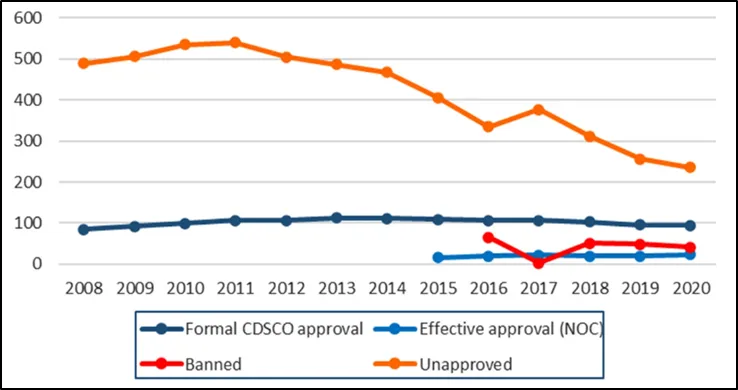
Figure 1. Number of systemic antibiotic FDC formulations marketed in India by approval and ban status, 2008–2020. Source: adapted from Brhlikova et al.7 (reproduced under a Creative Commons Attribution 4.0 licence).
Commercial factors compound the problem. Physician prescribing studies indicate that a meaningful share of irrational FDC prescriptions, particularly in cardiovascular and antidiabetic therapy, is written by specialists and not only by less-trained practitioners. This suggests that irrational prescribing is driven not merely by prescriber ignorance but also by commercial promotion and entrenched clinical habit.9 Despite a series of regulatory initiatives and enforcement measures since 2007 to restrict their sale, unapproved antibiotic FDCs retain a substantial presence in the Indian market. In 2020, hundreds of such unauthorised formulations remained on sale, accounting for more than 700 million of the 4.5 billion standard units of antibiotic FDCs sold that year.7 A further divergence exists between domestic approvals and global public health standards. An additional one-third of the total volume, equivalent to 1.5 billion standard units, consisted of antibiotic FDCs that, although formally approved by Indian regulators, are not recommended by the WHO. Taken together, these figures indicate that nearly half of all antibiotic FDC standard units consumed in India in 2020 either lacked central regulatory validation or ran counter to international clinical guidance, both of which complicate national efforts to contain antimicrobial resistance.7
8. Actionable Recommendations for Rational FDC Regulation
8.1 For Regulatory Authorities (CDSCO)
8.2 For Researchers and Industry
8.3 For Prescribers and Professional Bodies
CONCLUSION
Fragmented drug regulation, arising from the persistent division of authority between the CDSCO and the SLAs, has enabled the proliferation of irrational FDCs in India over several decades, compromising patient safety and rational prescribing. The recurring cycle of retrospective interventions, in 2016, 2018, 2024 and 2025, reflects both a welcome shift towards stronger scientific scrutiny and centralised oversight, and the limitations of a reactive regulatory model that acts only after irrational products have caused harm or attracted attention. The significance of the problem extends beyond India’s domestic market. India has earned its reputation as the “pharmacy of the world” by manufacturing large quantities of high-quality, affordable generic medicines, on which many low- and middle-income countries (LMICs) depend for access to essential treatment. This reputation may be placed at risk by the continued availability of irrational FDCs. Given the complexity of India’s multi-drug combination market, and the lack of rigorous therapeutic justification for many products within it, there is a potential risk that such combinations could be exported to vulnerable LMICs. The export of combinations without robust safety and efficacy data could undermine public health in recipient countries, potentially aggravating antimicrobial resistance, and could damage India’s credibility by shifting the global perception of Indian pharmaceuticals from “affordable and reliable” to “poorly regulated”. Sustainable reform requires genuine harmonisation between the CDSCO and the SLAs, rigorous evidence-based evaluation of both new and legacy FDCs, and clear accountability in the approval process. India should not only eliminate irrational combinations but also foster innovation in rational, clinically justified FDCs that address genuine unmet public health needs, without compromising the scientific standards that protect patients.
ACKNOWLEDGEMENT
The authors thank the Department of Pharmaceutical Regulatory Affairs, A.U. College of Pharmaceutical Sciences, Andhra University, Visakhapatnam, for institutional support.
CONFLICTS OF INTEREST
The authors declare that they have no conflicts of interest.
REFERENCES




Ramu Nadapana*, G. Snehalatha, Emmanuel Thota, Gopi Kumar Gorapalli, Fragmented Drug Regulation and the Persistence of Irrational Fixed-Dose Combinations in India: A Regulatory Review, Int. J. Med. Pharm. Sci., 2026, 2 (9), 586-592. https://doi.org/10.5281/zenodo.22999629
 10.5281/zenodo.22999629