

We use cookies to ensure our website works properly and to personalise your experience. Cookies policy
Department of Pharmacognosy, Malti Memorial Trust CSM Group of Institutions, Faculty of B. Pharmacy, 8th Mile stone Rewa Road, Iradatganj, Prayagraj 212111, U.P., India
Ficus racemosa is an evergreen tree commonly referred to goolar and used in various traditional systems, is a member of the Moraceae family. The objective of this study is to gain comprehensive pharmacognostic, physicochemical characteristics, and phytochemical analysis of the leaves. The pharmacognostic criteria were assessed, including macroscopic and microscopic evaluations, transverse sections of the leaf, powder microscopy, fluorescence analysis, and physicochemical properties (Total Ash 13.24%, acid-insoluble ash 0.878%), water-soluble ash 1.74%; alcohol-soluble extractive value 3.9%; water-soluble extractive value 10.70%; moisture content 12%. Phytochemical screening of ethanolic leaf extracts indicates the presence of flavonoids, saponins, tannins, steroids and alkaloids. The Rf values determined were 0.20, 0.70, and 0.90. TPC and TFC were found to be 16.60 mg GAE/g and 8.24 mg quercetin equivalent/g respectively. In the DPPH scavenging assay IC50 were determined to be 90.36µg/ml. The standardized parameters for pharmacognostics, physicochemical parameters, phytochemical properties, and chromatographic analyses, and DPPH assay of Ficus racemosa leaves are revealed in this work.
Within the Moraceae family, the genus Ficus comprises around 900 species of trees, shrubs, and vines, many of which are generally referred to as figs. They are found in all of the world's tropical regions; however they are mainly native to East Asian tropical regions. Some are planted as ornamentals, but many are towering forest trees supported by massive spreading roots. In nontropical regions, a small number of Ficus species are deciduous, although the majority is evergreen. When damaged, the majority of the simple, waxy leaves release white or yellow latex. Numerous species are epiphytic, and many have aerial roots. A hollow fruit structure called a syconium surrounds an inflorescence that has tiny male and female flowers along the inside.1 Ficus racemosa is an evergreen or deciduous tree that can reach heights of 20 to 30 meters. It frequently has an uneven crown. Southeast Asia, Australia, and India are home to the significant medicinal plant Ficus racemosa. It is commonly referred to as "gular." Antidiabetic, antioxidant, antidiarrheal, anti-inflammatory, antipyretic, antifungal, antibacterial, hypolipidemic, and hepatoprotective properties are among the many pharmacological activity of this plant.2, 3
MATERIALS AND METHODS
Plant collection:
Fresh Plants of F. racemosa were collected from local area of Prayagraj, U.P., India. The plant material identified and authenticated by Botanical Survey of India (BSI), Prayagraj, Authentication No.11/81/2025-26/Tech/849 on dated 11/03/2026.
Macroscopic studies: In these studies, properties like color, taste, texture, shape, and size have been used for organoleptic evaluation4, 5, 6.
Microscopic studies: 4, 5, 6
Transverse section of the midrib of leaf was cut using potato pith. T.S. was submerged in glycerine -water solution for further observations and the detection of specific microscopic diagnostic characteristics. Fluorescence analysis and powder properties were also carried out in these studies.
Physicochemical parameters 7, 8
Various physicochemical parameters of powdered F. racemosa leaves were analyzed such as total ash, foreign matter, loss on drying, and extractive value.
Phytochemical screening 9, 10, 11
Ethanolic extract were obtained by soxhlation of 100g of F. racemosa leaf powder and many qualitative chemical analysis were performed.
Thin layer chromatography 12, 13
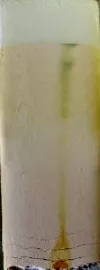
Thin layer chromatography studies were performed by using an activated silica gel G plate as the stationary phase, n-Hexane: Ethyl acetate: Glacial Acetic acid (5:4:1) used as the mobile phase, and an iodine solution or chamber as the detecting reagent.
Total Flavonoids Content
First, take 50 ml of the extract in a graduated test tube, add 1ml of methanol, and mix well: then, add 4 ml of distilled water and 5% sodium nitrite, and let it incubate for 5 minutes. Now, add the 10% w/v aluminum chloride solution and let it stand for 10 minutes. Then, add 2 ml of 1M sodium hydroxide and adjust the volume to 10 ml using distilled water. Absorbance is measured at 765 nm using a UV visible spectrophotometer. Same method is applied for the determination of standard quercetin absorbance. Total flavonoid content was determined by calibration curve.14
Total Phenolic Content
The quantity of Total phenolic content has been determined using the FC method. 1mg/ml of the extract was placed in a test tube, and 3ml of water was added to it; then, 0.5 ml of FC reagent (Folin- Ciocalteu) was thoroughly mixed in. Subsequently, 20% sodium carbonate was added, and the mixture was kept in the dark for approximately 10 minutes, Finally, the absorbance was measured at 650 nm using a UV – Visible spectrophotometer. The absorbance of gallic acid was also determined using the same method. The total phenolic content was determined relative to mg of GAE using a calibration curve.14
DPPH scavenging activity
In a 96 well plate, mix 5µL of test solution for 10, 50, 100, 250, 500, and 1000 µg/ml and 5µL of standard stock solution for 0.78, 1.56, 3.125, 6.25, 12.5, 25, and 50 µg/ml with 0.1ml of DPPH solution. Duplicate blanks were prepared with 0.2 ml methanol and 10µL of different concentrations of test/ standards. The untreated well was used as the control and the DPPPH untreated well was used as the blank. After incubation of the well plates for 30 minutes, at 517 NM decolorization was determined using a microreader. Scavenging activity was determined as % inhibition relative to the control.15

RESULTS AND DISCUSSION
Macroscopic study: The organoleptic and macroscopic characters of the fruits as colour, odour, taste, shape, size, and surface were evaluated botanically.
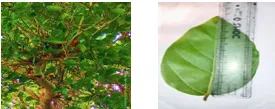
Figure 1: F. racemosa plant
Table 1: Macroscopic study of F. racemosa leaf
|
Diagnostic parameters |
Leaf |
|
Colour |
Upper surface darkish green and lower surface light green |
|
Odour |
Pleasant |
|
Taste |
Astringent, bitter |
|
Size |
6-15 cm long, 3.5- 6 cm width |
|
Shape |
Opposite, Elliptic, ovate, decussate |
|
Margin |
Wavy, entire |
|
Apex |
Acute |
|
Venation |
Pinnate |
|
Surface |
Pubescent |
|
Base |
Symmetric , petiolate |
Microscopic study:
Transverse section of F. racemosa leaf shows single layered epidermis with thick cuticle. 1-2 layered dense palisade cells. Vascular bundles have xylem followed by phloem. Covering glandular trichomes were present.
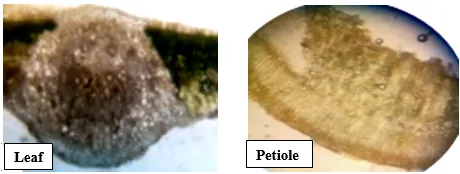
Figure 2: Transverse Section of F. racemosa
Powder characteristics
It is greenish coarse powder with bitter taste. The powder microscopic study reveals the presence of trichomes, parenchymal cells, lignin, calcium oxalate crystal & volatile oil sac.
Table 2: Fluorescence analysis of F. racemosa leaf powder
|
Treatment |
Visible |
Long U.V. 254 nm |
Short U.V. 365 nm |
|
Powder |
Brown |
Dark |
Green |
|
Powder + % KOH |
Brown |
Dark |
Green |
|
Powder + 5%NaOH |
Brown |
Dark |
Dark green |
|
Powder + FeCl3 |
Reddish |
Dark |
Light green |
|
Powder + con. H2SO4 |
Voilet |
Dark |
Green |
|
Powder + dil. H2SO4 |
Brown |
Black |
Green |
|
Powder + con. HCl |
Brown |
Dark |
Dark green |
|
Powder + dil. HCl |
Brown |
Dark |
Light green |
|
Powder + con. HNO3 |
Brown |
Dark |
Dark green |
|
Powder + dil. HNO3 |
Brown |
Dark |
Green |
|
Powder + dil. NH3 |
Brown |
Dark |
Light green |
|
Powder + Iodine soln |
Reddish |
Black |
Light green |
Table 3: Physicochemical data of F. racemosa leaf
|
S.N. |
Physicochemical Parameter |
Values (% w/w) |
|
1. |
Foreign matter |
Nil |
|
2. |
Moisture Content |
12% |
|
3. |
Total Ash |
13.24% |
|
4. |
Acid- Insoluble ash |
0.878% |
|
5. |
Water soluble ash |
1.74% |
|
6. |
Alcohol soluble extractive |
3.9% |
|
7. |
Water soluble extractive |
10.70% |
Table 4: Percentage yield and physical characteristics of ethanolic extract of F. racemosa leaf
|
Solvent extract |
%w/w |
Consistency |
Fluorescence analysis |
||
|
Visible |
Long U.V. |
Short U. V |
|||
|
Ethanol (95%) |
8.04 |
Dry |
brown |
Reddish brown |
Greenish |
Qualitative phytochemical screening
Phytochemical screening of ethanolic extract of F. racemosa shows the presence of several secondary metaboilites. Various tests show the presence for carbohydrate, alkaloids, tannins, flavonoids, saponin, steroids, triterpenoids while cardiac glycosides were absent. In the aqueous extract tannin, Saponins were present and remaining was absent.
Table 5: Qualitative Phytochemical screening of F. racemosa leaf
|
|
Phytochemical test |
Ethanolic extract |
Extractive |
|
|
Ethanolic soluble |
Water soluble |
|||
|
1. |
Carbohydrates i) Molisch ii) Fehling Reagent |
+ + |
+ + |
- - |
|
2. |
Alkaloids i) Dragondroff’s reagent ii) Mayer’s reagent iii) Wagner reagent iv) Hager reagent |
+ + + - |
+ + + - |
- - - - |
|
3. |
Tannins i) Lead acetate ii) FeCl3 |
+ + |
+ + |
+ + |
|
4. |
Flavonoids i) Shinoda test ii) Zinc- HCl reduction test iii) Alkaline reagent test |
+ + + |
+ + |
- - |
|
5. |
Saponins
|
+ + |
+ + |
+ + |
|
6. |
Steroids i) Libermann – Burchard test |
+ |
+ |
- |
|
7. |
Cardiac glycosides Keller-Kiliani |
- |
- |
- |
|
8. |
Triterpens Salkowaski’s test |
+ |
+ |
- |
+ Present More, - absent
Table 6: TLC Profile: Thin layer chromatography of alcoholic extract of F. racemosa
|
Solvent system |
No. of spots |
Rf value |
|
|
n-hexane: Ethyl acetate: Glacial Acetic acid (5:4:1)
Spraying agent/Detection : Iodine chamber |
3 |
0.20, 0.70, 0.90 |
Table 7: Total Phenolic Content and Total Flavonoid content
|
Extract |
Total Phenolic content GAE/g |
Total Flavonoid content Quercetin equivalent/g |
|
Ethanolic extract F. racemosa leaves |
16.60 |
8.24 |
DPPH scavenging activity
|
Sample |
IC50 µg/ml |
|
Ascorbic acid |
19.34 |
|
F. racemosa |
90.36 |
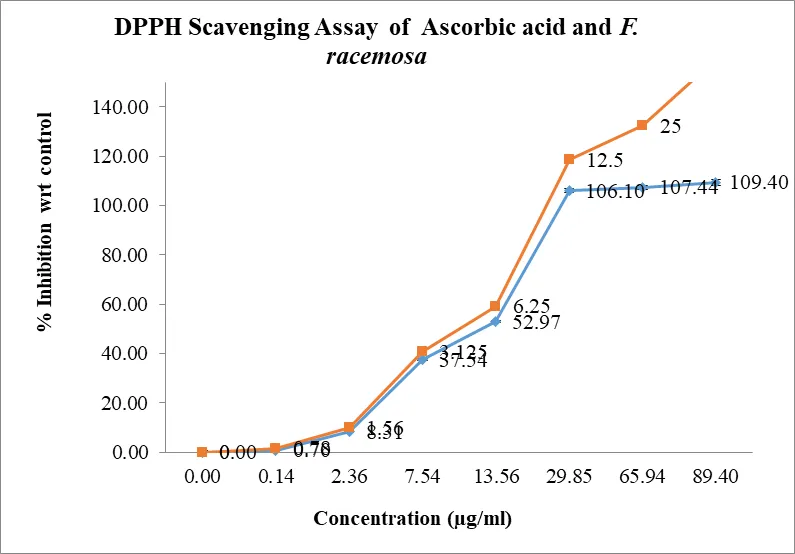
Fig. 3: DPPH assay of ascorbic acid and F. racemosa leaf extract
DISCUSSION:
T.S. of F. racemosa shows single layered epidermis with thin cuticle, mesocarp have 1-2 layers of palisade cells. Vascular bundles have xylem followed by phloem. Powder microscopy reveals the presence of parenchymal cells, trichomes, & calcium oxalate crystals. Qualitative phytochemical screening indicates presence of alkaloids, tannins, tritepenes, steroids and flavonoids, carbohydrates, thin layer chromatography of Ethanolic extracts indicates presence of many compounds. Total phenolic content and total flavonoid content were found to be 16.60 mg GAE/g and 8.24 mg quercetin equivalent/g respectively. In the DPPH scavenging assay IC50 were determined to be 90.36µg/ml.
CONCLUSION:
The plant F. racemosa is a common species that has been used traditionally. The above pharmacognostic, physicochemical, phytochemical, and chromatographic, and antioxidants assay studies will give approaches for identification, safety & quality parameters as well as new incentive to natural system of medicine in the research & in the treatment of other diseases.
REFERENCES

Brij Raj Singh*, Pharmacognostic, Phytochemical Evaluation & DPPH Scavenging Activity of Ficus Racemosa Leaves, Int. J. Med. Pharm. Sci., 2026, 2 (7), 478-483. https://doi.org/10.5281/zenodo.21274147
 10.5281/zenodo.21274147