

We use cookies to ensure our website works properly and to personalise your experience. Cookies policy
1MS, Mch (Plastic Surgery), Assistant Professor, Department of General Surgery, Ananta Institute of Medical Sciences and Research Centre
2Resident, Department of General Surgery, Ananta Institute of Medical Sciences and Research Centre
Marcus Gunn jaw-winking synkinesis (MGJWS) is a rare congenital trigemino-oculomotor synkinesis characterized by involuntary upper eyelid retraction during jaw movements, often complicating congenital ptosis. Surgical management is challenging due to the risk of exacerbating synkinesis or causing overcorrection. This case series evaluates the efficacy of levator excision combined with frontalis suspension using autologous fascia lata or palmaris longus tendon grafts in achieving functional and cosmetic outcomes. We present a retrospective case series of five patients (ages 7–55 years) with severe congenital MGJWS and ptosis. All patients underwent levator excision or aponeurosis resection followed by frontalis suspension using either fascia lata (harvested from the thigh) or palmaris longus tendon (harvested from the forearm). Postoperative outcomes, including synkinesis resolution, lid height, symmetry, and complications, were assessed. Complete abolition of jaw-winking synkinesis was achieved in all cases. Postoperative lid symmetry and height were satisfactory, with no major complications such as exposure keratopathy or donor-site morbidity. Adjustments for postoperative edema were performed in one pediatric case, ensuring optimal lid positioning. At follow-up (ranging from discharge to 3 months), all patients demonstrated stable lid contours and improved functional and cosmetic outcomes. Levator excision combined with frontalis suspension using autologous grafts is an effective and adaptable surgical approach for severe MGJWS across age groups. This technique minimizes residual synkinesis and reoperation risks while optimizing functional and aesthetic results. Further studies with long-term follow-up are warranted to validate these findings.
Marcus Gunn jaw-winking synkinesis (MGJWS), first described in 1883, represents a rare form of congenital trigemino-oculomotor synkinesis wherein aberrant innervation from the pterygoid branch of the trigeminal nerve (CN V) to the superior division of the oculomotor nerve (CN III) causes involuntary upper eyelid retraction during jaw excursion, such as chewing or mouth opening. This condition complicates approximately 4-11% of congenital ptosis cases, with unilateral involvement predominant (95%) and a slight female predilection. The clinical relevance lies in its impact on visual development, psychosocial well-being, and amblyopia risk due to severe ptosis occluding the visual axis. Untreated, it can lead to anisometropic amblyopia or facial asymmetry from compensatory head postures. [1-6] Surgical management is deferred until age 3-5 years to allow for facial growth and amblyopia treatment, but challenges persist: simple levator resection exacerbates synkinesis, while frontalis slings risk overcorrection or exposure keratopathy. Super-maximal levator excision combined with frontalis suspension using autologous fascia lata or palmaris longus tendon graft remains a gold standard for severe cases (>8 mm excursion), yet these procedures often yield residual winking in 20-50% of patients. Operative approaches, involving initial excision and sling placement followed by adjustment, are proposed to mitigate edema-related malposition but lack extensive documentation. [3,7,8] We report 5 cases (series) of severe congenital left-sided MGJWS managed with levator excision and fascia lata or palmaris longus frontalis suspension to highlight the efficacy of adaptive, operative techniques in optimizing cosmetic and functional outcomes while minimizing reoperation risks. [4]
Case Presentation
Case 1
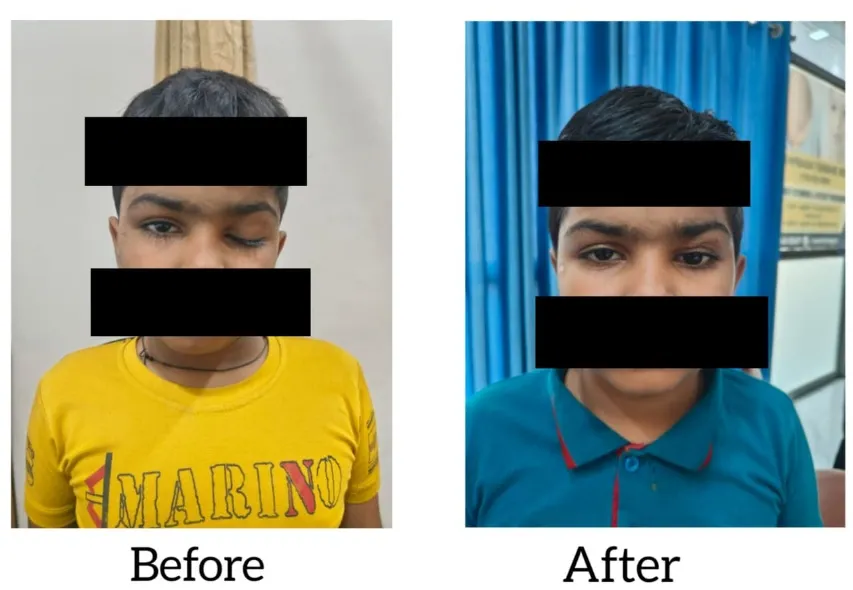
A 7-year-old boy presented with congenital severe left upper eyelid ptosis since birth associated with marked upper lid retraction during chewing and contralateral jaw movement. The ptosis had progressively worsened and completely obscured the visual axis. Examination revealed visual acuity of 6/9 in B/L eyes. Levator excursion was 1 mm, lid crease was absent, and prominent jaw-winking was present. Bell’s phenomenon was preserved. Orbital MRI and routine investigations were normal. Levator excision with staged autologous fascia lata frontalis suspension was performed. Fascia lata harvested from the right thigh was fashioned into a pentagonal sling. Because postoperative edema interfered with lid assessment, sling adjustment was performed on postoperative day 4. At discharge on day 8, jaw-winking had completely disappeared, lid position was satisfactory with mild undercorrection, and donor-site healing was uneventful.
Case 2
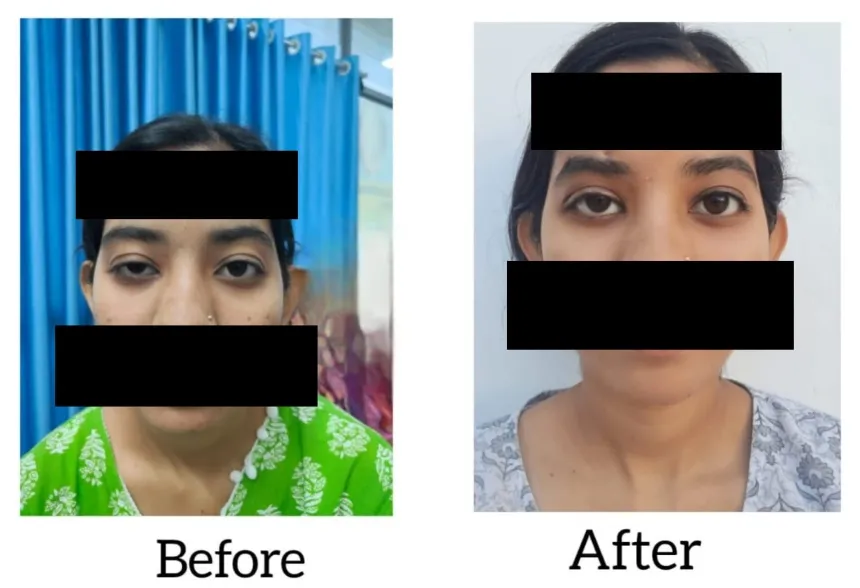
An 18-year-old female presented with congenital right upper eyelid ptosis associated with visible lid elevation during chewing and mouth opening since childhood, becoming cosmetically more concerning over the previous few years. Examination showed mild-to-moderate ptosis, levator excursion approximately 3 mm, MRD1 of 2 mm, preserved Bell’s phenomenon, and 3 mm jaw-winking excursion. Levator disinsertion was performed through an upper lid crease incision, followed by frontalis suspension using autologous palmaris longus tendon harvested from the left forearm in pentagonal configuration. Postoperatively, complete abolition of jaw-winking and satisfactory lid symmetry were achieved without complication.
Case 3
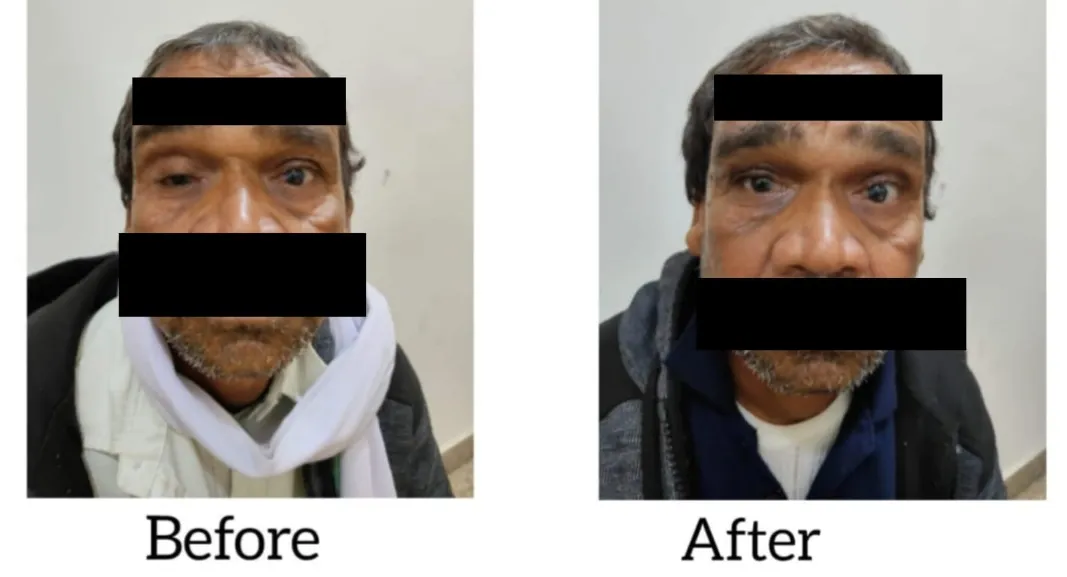
A 48-year-old male presented with congenital right upper eyelid ptosis and longstanding jaw-winking since childhood, which became functionally bothersome after prior blunt orbital trauma. Examination demonstrated moderate ptosis, levator excursion below 3 mm, intact Bell’s phenomenon, preserved ocular movements, and obvious jaw-winking during lateral mandibular movement. Levator excision was performed followed by palmaris longus tendon frontalis suspension harvested from the left forearm. Postoperative recovery was uneventful with complete synkinesis abolition and stable lid contour.
Case 4
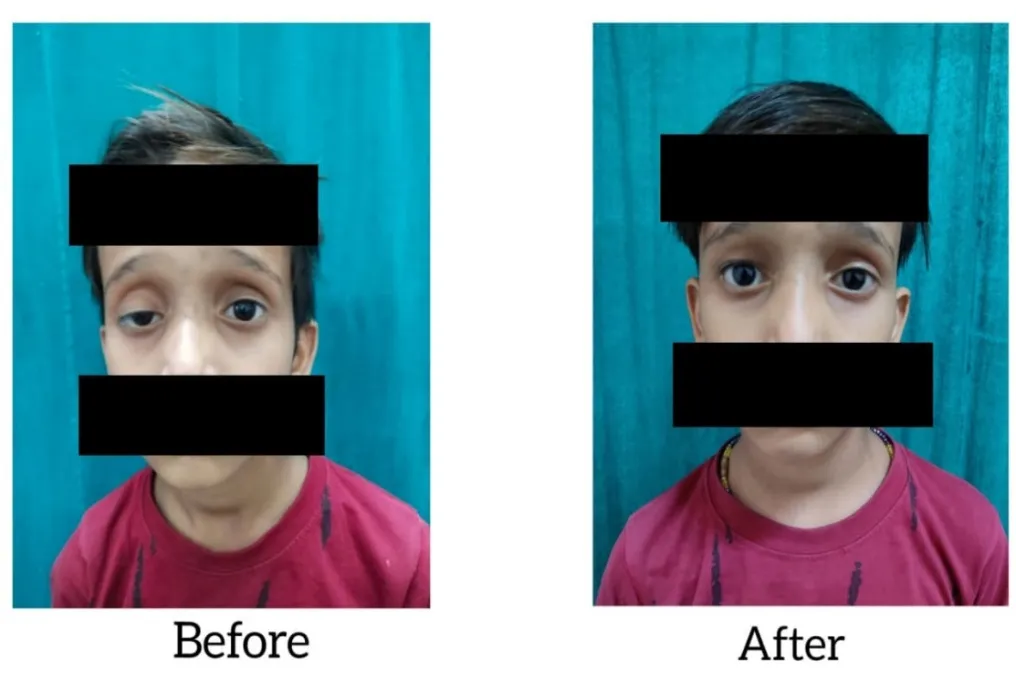
A 12-year-old boy presented with congenital right upper eyelid ptosis associated with pronounced lid elevation during chewing, speaking, and mouth opening. Levator function was approximately 2 mm with jaw-winking excursion near 5 mm. Bell’s phenomenon was good and visual acuity was 6/6 bilaterally. Levator excision followed by autologous fascia lata frontalis suspension was performed using pentagonal sling technique. By postoperative day 3, lid symmetry was satisfactory, jaw-winking had disappeared completely, and no complications were observed.
Case 5
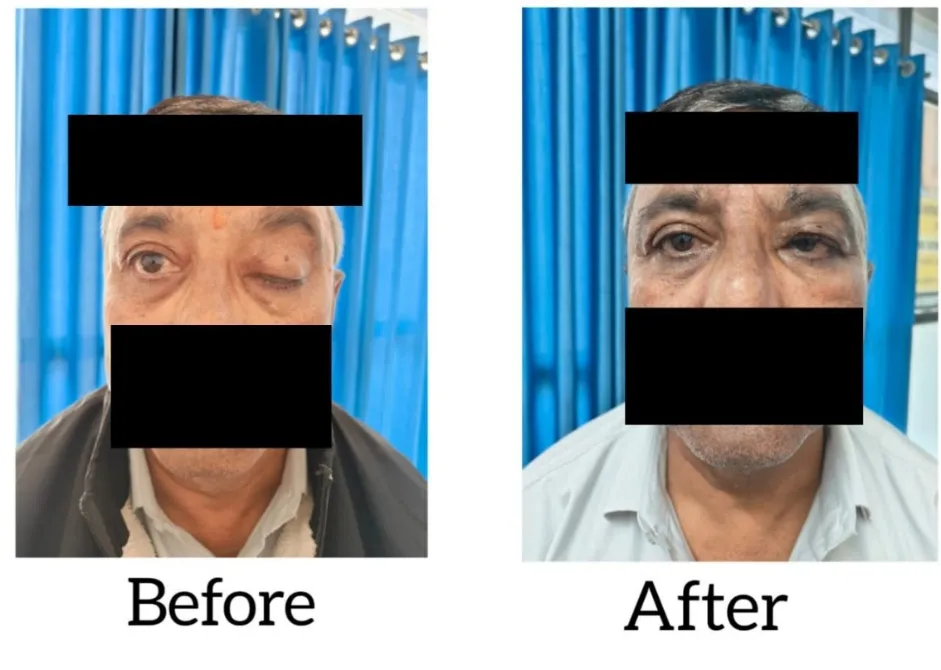
A 55-year-old male presented with a lifelong history of left upper eyelid ptosis and intermittent jaw-winking, which had progressively worsened over the past decade, leading to visual field obstruction and cosmetic concern. He reported no history of trauma but noted increased fatigue and compensatory head tilt. On examination, he exhibited severe ptosis with levator function measuring 2 mm, intact Bell’s phenomenon, full extraocular movements, and pronounced synkinesis during mastication. Surgical intervention involved levator aponeurosis resection combined with a frontalis suspension using a harvested fascia lata graft from the right thigh. Postoperatively, the patient demonstrated complete resolution of synkinesis, improved lid height, and symmetrical palpebral fissures at 3-month follow-up.
DISCUSSION
The cases illustrate the diverse spectrum of blepharoptosis management tailored to etiology, severity, patient age, and specific functional and cosmetic requirements. In severe congenital Marcus Gunn jaw-winking synkinesis (Case 1), levator excision with autologous fascia lata frontalis sling effectively abolished synkinesis and achieved optimal lid height through edema-accommodating adjustment, highlighting its utility in pediatric cases with poor levator function. Similarly, in the 12-year-old boy with congenital right upper eyelid ptosis and pronounced jaw-winking (Case 4), levator excision followed by autologous fascia lata frontalis suspension using the pentagonal sling technique provided excellent early postoperative symmetry, complete elimination of synkinesis, and preservation of good Bell’s phenomenon without complications. This approach reinforces the value of extirpative surgery combined with reliable autologous sling material in young patients, where robust long-term lid elevation and prevention of aberrant movements are critical for visual development and facial symmetry. In the 55-year-old male with lifelong left upper eyelid ptosis and progressively worsening intermittent jaw-winking (Case 5), levator aponeurosis resection combined with frontalis suspension using harvested fascia lata effectively resolved synkinesis, improved lid height, and restored symmetrical palpebral fissures at 3-month follow-up. This intervention addressed both the mechanical ptosis and synkinetic component in an older adult with visual field obstruction and compensatory head tilt, demonstrating that similar extirpative and suspensory principles remain effective across age groups when tailored to disease chronicity and patient-reported fatigue. In contrast, severe post-traumatic non-synkinetic ptosis in an adult (Case 3) was successfully corrected using a palmaris longus tendon sling, demonstrating its advantages of simpler forearm harvest, reduced donor morbidity, and reliability when Bell’s phenomenon is intact. Mild acquired ptosis with preserved levator function (Case 2) was appropriately managed conservatively, prioritizing observation or minor procedures for cosmetic concerns without functional impairment. Together, these cases emphasize individualized approaches—extirpative strategies in synkinetic congenital or longstanding disease (Cases 1, 4, and 5), sling material selection guided by morbidity, patient age, and staging feasibility, and restraint in mild presentations—while underscoring the importance of multidisciplinary care for optimal functional, cosmetic, and long-term outcomes across age groups and etiologies.[1] The pathophysiology of MGJWS involves congenital miswiring during ocular motor development, where axons from the lateral pterygoid nerve (CN V3) aberrantly innervate the levator palpebrae superioris, bypassing CN III. This synkinesis manifests as eyelid retraction proportional to jaw excursion amplitude (typically 2-15 mm), exacerbated in severe ptosis (>7 mm) due to levator hypoplasia. Supporting evidence from histopathological studies shows normal levator histology, underscoring the neural rather than myopathic basis. Genetic factors, including incomplete penetrance in autosomal dominant patterns, contribute in 6-10% of familial cases, though most are sporadic. Differential diagnoses include Duane retraction syndrome or third nerve palsy, but the pathognomonic jaw trigger distinguishes MGJWS. [2,3,5,6,10,11]
Table.1 summarizes 10 published cases or series of Marcus Gunn jaw-winking synkinesis with ptosis, spanning 1987–2024, and reveals predominantly unilateral congenital presentations (90%) in pediatric patients (mean ages 5–12 years where specified), with surgical interventions like levator excision and frontalis sling achieving 84–92% success in reducing synkinesis and improving lid height, though residual winking persisted in severe cases; non-surgical or observational approaches were common in mild, bilateral, or diagnostic-focused reports, emphasizing variability in management and outcomes.
Table 1: Comparison of Similar Published Cases
|
Author/Year |
Age/Sex |
Key Feature |
Outcome |
|
Ziga/2019 |
6 mo/F |
Unilateral left mild ptosis, diagnostic |
Stable |
|
Yoshikata/1999 |
33/M |
Severe unilateral, levator excision |
Satisfactory |
|
Salema/2024 |
45/M |
Unilateral right, no surgery |
Symptom relief |
|
Shah/2012 |
18/M |
Bilateral asymmetric, no intervention |
Observational |
|
Khwarg/1999 |
Mean 12 (series) |
Moderate-severe unilateral, excision + sling |
92% success |
|
Bowyer/2004 |
Mean 8 (series) |
Variable, retractor disinsertion |
84% reduced winking |
|
David/2020 |
Newborn/M |
Severe left, neonatal dx |
Early recognition |
|
Banerjee/1987 |
Child/NS |
Bilateral, descriptive |
N/A |
|
Lee/2019 |
Mean 6 (series) |
Severe, excision + suspension |
Residual in severe |
|
Shah/2020 |
Mean 5 (series) |
Moderate-severe, sling no excision |
Good height |
Diagnostic challenges include distinguishing from acquired synkinesis (e.g., post-trauma), necessitating MRI to exclude masses. Therapeutically, edema post-harvest complicated initial positioning, underscoring the need for adjustable slings. Limitations of this case include short-term follow-up (precluding growth-related recurrence data), single-center experience, and lack of quantitative excursion measurement pre/postoperatively. Future implications involve prospective trials of bioengineered slings to reduce donor-site morbidity and genetic screening for CCDD subtypes. The take-home message: In severe pediatric MGJWS, levator excision with fascia lata frontalis suspension facilitates precise adjustment and superior synkinesis resolution.
CONCLUSION
These four cases confirm that levator excision or disinsertion combined with frontalis suspension remains an effective strategy for management of Marcus Gunn jaw-winking syndrome. Autologous fascia lata offers durable pediatric correction, whereas palmaris longus tendon serves as a valuable autologous alternative in adolescents and adults. Careful surgical customization produces excellent functional and cosmetic outcomes while minimizing morbidity.
REFERENCES


Bharat Aggarwa, Bhavya Maheshwari*, Prapti Patel, Tailored Surgical Management of Marcus Gunn Jaw-Winking Syndrome with Congenital Ptosis Using Autologous Fascia Lata and Palmaris Longus Sling: A Five-Case Series, Int. J. Med. Pharm. Sci., 2026, 2 (7), 931-936. https://doi.org/10.5281/zenodo.21451296
 10.5281/zenodo.21451296
Severity: 8192
Message: substr(): Passing null to parameter #1 ($string) of type string is deprecated
Filename: frontend/article.php
Line Number: 889
Severity: 8192
Message: substr(): Passing null to parameter #1 ($string) of type string is deprecated
Filename: frontend/article.php
Line Number: 889