

We use cookies to ensure our website works properly and to personalise your experience. Cookies policy
Faculty of Pharmacy, Mansarovar Global University, Sehore (M.P)
Pyrrole, a nitrogen-containing heteroaromatic ring, has emerged as a central scaffold in medicinal chemistry owing to its presence in numerous natural products and clinically approved drugs. Its aromaticity, electronic richness, and structural adaptability allow diverse chemical modifications that translate into wide pharmacological applications. Pyrrole derivatives occur naturally in tetrapyrrolic systems such as heme, chlorophyll, and vitamin B12, and synthetically they are accessible through classical and modern strategies including the Paal–Knorr reaction and multicomponent approaches. Their chemical versatility has enabled the development of agents with anticancer, antimicrobial, antitubercular, antimalarial, anti-inflammatory, and cardiovascular activities. Recent advances in sustainable synthesis and structure–activity relationship (SAR) optimization continue to strengthen pyrrole’s role as a privileged scaffold for drug discovery. This review highlights the natural occurrence, synthetic methodologies, pharmacological significance, and future opportunities of pyrrole-based therapeutics, bridging the gap from traditional natural frameworks to modern clinical applications.
Heterocyclic compounds represent one of the most important classes of molecules in medicinal chemistry due to their role in structural diversity, bioavailability, and pharmacological effects. Among these, pyrrole a five-membered aromatic heterocycle with one nitrogen atom has attracted significant attention as a privileged scaffold in drug discovery [1]. Pyrrole is electron-rich because the nitrogen lone pair contributes to the aromatic π-system, conferring unique chemical reactivity and enabling multiple substitution patterns [2]. Naturally occurring pyrroles form the foundation of tetrapyrrolic systems such as heme, chlorophyll, and cobalamins, which are essential for oxygen transport, photosynthesis, and enzymatic reactions [3,4]. Microorganisms also produce pyrrole-containing metabolites such as pyrrolnitrin, a halogenated compound with notable antifungal properties [5]. These examples highlight pyrrole’s evolutionary and biological significance.
Clinically, pyrrole derivatives have been incorporated into a range of therapeutics, including tolmetin (an NSAID), sunitinib (a tyrosine kinase inhibitor for cancer), and losartan (an antihypertensive agent) [6–8]. Synthetic analogues are also under development as anticancer, antitubercular, antimalarial, and antifungal agents [9,10]. The Paal–Knorr condensation remains the classical method for pyrrole synthesis, while modern approaches such as multicomponent reactions, mechanochemistry, and organocatalysis have expanded sustainable and high-throughput access to pyrrole libraries [11,12]. This review discusses the chemical features, natural occurrence, synthetic methods, pharmacological applications, structure–activity relationships (SAR), and future opportunities of pyrrole derivatives in medicinal chemistry.
Pyrrole is an electron-rich heteroaromatic ring susceptible to electrophilic substitution at the C-2 and C-5 positions. The nitrogen atom can be functionalized, altering hydrogen-bonding patterns, lipophilicity, and metabolic stability [13].
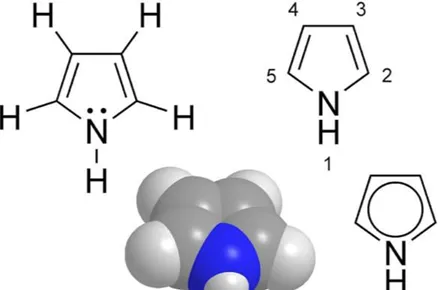
Fig 1: Structure of Pyrrole
The substituents at C-2 and C-5 provide orthogonal vectors for structural growth, enabling medicinal chemists to introduce groups that enhance protein binding or pharmacokinetics [14]. Fused derivatives such as indoles and thienopyrroles improve planarity and extend aromatic conjugation, often enhancing kinase and enzyme binding [15]. One of the challenges in pyrrole medicinal chemistry is metabolic liability. Pyrroles are prone to oxidative degradation and N-dealkylation, producing reactive intermediates. Introduction of electron-withdrawing groups at C-2 or C-5, steric shielding, or N-acylation can mitigate these risks [16].
Nature offers some of the most striking examples of pyrrole functionality, particularly within tetrapyrrolic macrocycles. These assemblies consist of four pyrrole units linked through methine bridges, forming large aromatic frameworks that underpin life-sustaining processes. Heme, for instance, resides in haemoglobin and myoglobin where the central iron atom is coordinated within the porphyrin ring, enabling reversible oxygen binding and transport in vertebrates [17]. Chlorophyll, another porphyritic pigment, incorporates a magnesium ion within a similar tetrapyrrolic framework to capture solar energy and drive photosynthesis in plants and algae [18]. Cobalamin (vitamin B12), a cobalt-containing corrin macrocycle, illustrates further functional diversity by catalysing radical-mediated enzymatic reactions essential in DNA synthesis and methyl transfer [17,18]. Collectively, these macrocycles highlight how pyrrole subunits serve as evolutionary templates for bioenergetics, oxygenation, and enzymatic catalysis. Beyond these macromolecular systems, smaller pyrrole derivatives of microbial origin also display potent bioactivity. Pyrrolnitrin, a halogenated pyrrole produced by Pseudomonas species, exerts antifungal activity by disrupting the respiratory electron transport chain [5,19]. Its structural features—most notably chloro- and nitrile substituents—have guided the design of synthetic fungicides such as fludioxonil. These derivatives are widely employed in agriculture to prevent crop loss caused by soil-borne fungal pathogens [19]. The discovery of pyrrolnitrin exemplifies how nature-inspired small molecules can be harnessed as chemical leads in medicinal and agrochemical innovation.
The chemical accessibility of pyrrole is one of the primary reasons for its dominance in drug discovery. Multiple synthetic routes have been established, each allowing structural tailoring for pharmacological optimization.
Paal–Knorr Condensation
The Paal–Knorr condensation, first reported in the late 19th century, is the classical method for pyrrole construction. It involves the acid- or base-catalysed cyclization of a 1,4-dicarbonyl compound with a primary amine to yield a substituted pyrrole [20]. This reaction is highly versatile, tolerating a range of substituents and thereby enabling medicinal chemists to introduce structural diversity at the 2- and 5- positions of the ring. Recent efforts have focused on rendering this transformation more sustainable. Mechanochemical protocols employing solvent-free ball milling conditions significantly reduce waste generation while improving yields [11]. Similarly, proline-catalysed variants offer a mild, environmentally benign alternative to traditional mineral acid conditions [12]. The robustness and adaptability of the Paal– Knorr route continue to make it indispensable for both academic and industrial synthesis of pyrrole-based libraries.
Multicomponent Reactions (MCRs)
Multicomponent reactions provide another efficient strategy for pyrrole synthesis. Three-component condensations involving α-hydroxyketones, oxoacetonitriles, and anilines have proven especially valuable in generating highly functionalized pyrroles [21]. The major advantage of MCRs lies in their step economy and atom efficiency, where multiple bonds are formed in a single synthetic operation. This feature not only accelerates library generation for high-throughput screening but also enables late-stage functionalization for medicinal chemistry optimization. The compatibility of these reactions with diverse functional groups makes them attractive for rapid drug discovery campaigns.
Alternative Approaches
Beyond classical condensation and MCRs, alternative synthetic methods continue to expand the pyrrole toolbox. Annulation reactions involving alkynes and isocyanides can efficiently construct pyrrole skeletons with unusual substitution patterns [22]. The Vilsmeier–Haack formylation provides a direct means to introduce formyl groups at the 2-position of pyrroles, creating intermediates for further derivatization in drug design. Cycloaddition-based strategies, including [3+2] azomethine ylide cycloadditions, allow access to densely substituted frameworks that are otherwise difficult to obtain. These emerging methods not only broaden the structural diversity of pyrrole derivatives but also allow chemists to mimic complex substitution motifs often found in bioactive natural products.
Pyrrole as a Privileged Scaffold in Medicinal Chemistry
The concept of privileged scaffolds refers to structural motifs recurrently observed across multiple classes of bioactive compounds. Pyrrole fits this description exceptionally well due to its favourable electronic and steric characteristics. The nitrogen atom in the ring serves as a hydrogen-bond donor or acceptor, enabling key interactions with enzyme active sites and receptor pockets [1]. Its aromatic surface area also allows for π–π stacking and hydrophobic contacts, which are essential in binding nucleic acids and aromatic amino acid residues. Moreover, the polarity of pyrrole can be tuned by N-substitution, granting medicinal chemists the ability to optimize solubility and membrane permeability in drug candidates [23].
These structural features translate into a wide therapeutic scope. Review studies confirm pyrrole derivatives exhibit antimicrobial, antiviral, anticancer, anti-inflammatory, antimalarial, and antiparasitic activities [24]. For example, pyrrole-based inhibitors targeting dihydroorotate dehydrogenase (DHODH) have shown promise in malaria treatment [6]. Similarly, the pyrrole BM212 selectively inhibits MmpL3, an essential transporter in Mycobacterium tuberculosis, making it a lead compound for new anti-tuberculosis agents [8]. In oncology, pyrrole substructures are incorporated into kinase inhibitors such as sunitinib, which targets VEGFR and PDGFR pathways [7]. Collectively, these examples reinforce pyrrole’s status as a versatile and indispensable pharmacophore in drug discovery.
Pharmacological Applications
Anticancer Agents
Pyrrole scaffolds have gained considerable importance in the design of anticancer therapeutics owing to their ability to interact with multiple cellular targets. Several pyrrole derivatives act as tubulin polymerization inhibitors, thereby blocking mitotic spindle formation and leading to cell cycle arrest. For example, 3-aroyl-1-arylpyrroles (ARAPs) are potent ligands of the colchicine binding site of tubulin and have shown promising activity against cancer cell lines resistant to standard agents [25]. In addition to tubulin inhibition, tetrasubstituted pyrroles have emerged as efficient protein–protein interaction disruptors. Notably, pyrrole-based scaffolds capable of blocking the p53–MDM2 interaction can restore p53 tumor suppressor activity, representing an important avenue in oncology [26]. Even clinically approved drugs with related scaffolds highlight pyrrole’s adaptability. Sunitinib, while formally an indolinone, contains a pyrrole-like pharmacophore that contributes significantly to hinge binding in kinases, underscoring how this heterocycle can be integrated into privileged kinase inhibitor structures [7].
Antitubercular Agents
The global rise of drug-resistant tuberculosis has accelerated interest in pyrrole-based anti-TB agents. BM212, a 1,5-diarylpyrrole, has been extensively studied for its activity against Mycobacterium tuberculosis. Its mechanism involves selective inhibition of MmpL3, a transporter critical for trehalose monomycolate export during cell wall biosynthesis [9,10]. Genetic studies have confirmed resistance mutations mapping to MmpL3, validating it as the molecular target of BM212. Analogue development has further demonstrated that this scaffold can penetrate the complex mycobacterial cell wall while retaining efficacy in intracellular infection models.
Systematic SAR studies have established that minor modifications in the pyrrole core profoundly influence biological outcomes:
These findings highlight pyrrole as a “tunable” pharmacophore, where specific substitutions can balance potency, selectivity, and pharmacokinetic behaviour.
Pharmacokinetic evaluations reveal that pyrrole derivatives generally possess favourable absorption and permeability profiles due to their moderate polarity. N-substituted and fused systems often show improved oral bioavailability compared to unsubstituted analogues [28]. Metabolically, pyrrole rings can undergo oxidative cleavage or N-dealkylation, producing potentially reactive intermediates. Rational design strategies, such as substitution at metabolically labile positions, can enhance stability and mitigate toxicity [16]. Additionally, N-acyl pyrroles are prone to hydrolysis, which may compromise bioactivity. In such cases, medicinal chemists frequently employ bio isosteric replacements like tetrazoles or sulfonamides to maintain potency while reducing liability [29]. Overall, while pyrrole-based drugs generally show good ADME characteristics, careful design is required to balance efficacy and safety.
ARAP Tubulin Inhibitors
The 3-aroyl-1-arylpyrrole (ARAP) series exemplifies pyrrole’s application in anticancer therapy. Substitutions at N-1 and C-3 positions allow deep engagement with the colchicine site of tubulin. Optimized analogues demonstrate strong cytotoxicity against multidrug-resistant cancer lines, highlighting pyrrole’s ability to circumvent efflux-mediated resistance [25].
BM212 and Analogues
BM212 and its derivatives have become paradigmatic in antitubercular drug discovery. Resistance profiling, docking studies, and biochemical validation confirm MmpL3 as the target. The capacity of pyrrole scaffolds to traverse the lipid-rich mycobacterial cell envelope underscores their suitability for infectious disease drug design [9,10].
Pyrrolnitrin
As a natural metabolite, pyrrolnitrin remains a cornerstone example of pyrrole bioactivity. Its halogenated framework not only confers antifungal potency but also serves as inspiration for biocatalytic approaches, where engineered enzymes from its biosynthetic pathway can generate novel analogues [19]. This biotechnological integration of pyrrole chemistry provides a sustainable route for future antimicrobial discovery.
The continuing importance of pyrrole in medicinal chemistry is underscored by several cutting-edge research directions:
Together, these frontiers demonstrate that pyrrole chemistry is not only historically significant but also poised to drive future innovations in drug discovery and therapeutic applications.
CONCLUSION
From their role in fundamental biology to their modern use as drug scaffolds, pyrroles remain indispensable in medicinal chemistry. Advances in synthetic chemistry, SAR optimization, and biological validation have secured pyrrole’s place as a privileged scaffold across therapeutic areas. Future research will focus on greener synthesis, improved pharmacokinetics, and exploration of new biological targets, ensuring pyrrole derivatives continue to contribute to drug discovery.
REFERENCES

Bargaje Goraksh*, Rajeev Kumar Malviya, A Review on Some Novel Pyrrole Derivatives as Antitubercular Agent, Int. J. Med. Pharm. Sci., 2026, 2 (8), 720-725. https://doi.org/10.5281/zenodo.22094242
 10.5281/zenodo.22094242