

We use cookies to ensure our website works properly and to personalise your experience. Cookies policy
Shantha College of Pharmacy, Peresandra, Chikkaballapur-562104, Karnataka, India
Rice bran, the outer layer obtained during rice milling, is a valuable source of phenolic acids, flavonoids, tocopherols, tocotrienols, γ-oryzanol and other biologically active constituents. The present study was designed to investigate the phytochemical composition of rice bran and to evaluate selected reported rice-bran constituents for their potential interaction with human pancreatic α-amylase using molecular docking and in silico ADME analysis. Qualitative phytochemical screening of the rice bran extract was performed for major classes of secondary metabolites. The extract showed the presence of alkaloids, flavonoids, phenolics, tannins, saponins and terpenoids, while glycosides were not detected. Ten rice-bran-associated compounds, namely ferulic acid, p-coumaric acid, vanillic acid, caffeic acid, protocatechuic acid, gallic acid, quercetin, kaempferol, catechin and epicatechin, were considered for molecular docking. Human pancreatic α-amylase (PDB ID: 1HNY) was selected as the target receptor. Docking was performed using AutoDock Vina through the PyRx platform. Among the investigated compounds, quercetin and epicatechin exhibited the most favorable binding affinity of −8.6 kcal/mol, followed by kaempferol and catechin with −8.5 kcal/mol. Caffeic acid, gallic acid, ferulic acid and protocatechuic acid showed binding affinities of −6.4, −5.8, −6.3 and −5.5 kcal/mol, respectively, while p-coumaric acid and vanillic acid showed −6.0 and −5.3 kcal/mol. Interaction analysis using Discovery Studio Visualizer indicated hydrogen bonding and aromatic interactions involving important active-site residues such as Asp197, Glu233, Asp300, Tyr62, Gln63 and Trp59. SwissADME analysis of the four strongest docked compounds demonstrated high predicted gastrointestinal absorption, no predicted blood-brain barrier permeation and zero Lipinski rule violations. The findings suggest that flavonoid constituents of rice bran, particularly quercetin, epicatechin, kaempferol and catechin, may have potential as α-amylase-interacting bioactive compounds. However, experimental enzyme inhibition and biological validation are required to confirm the predicted activity.
Rice (Oryza sativa L.) is one of the major cereal crops consumed worldwide. During rice milling, the outer layers of the grain are removed to obtain polished rice. These outer layers, collectively referred to as rice bran, contain a diverse range of nutritional and bioactive constituents. Rice bran contains phenolic acids, flavonoids, tocopherols, tocotrienols, γ-oryzanol, phytosterols and other compounds associated with antioxidant and other biological activities. [1,2] Phenolic acids reported in rice bran include ferulic acid, p-coumaric acid, caffeic acid, vanillic acid, gallic acid and related compounds. Flavonoids such as catechin, quercetin and other flavonoid derivatives have also been reported in different rice-bran varieties. Rice bran additionally contains vitamin E derivatives and γ-oryzanol, a mixture of ferulic acid esters of sterols and triterpene alcohols. [3] The biological importance of rice bran is partly attributed to its phenolic and flavonoid constituents. Phenolic compounds possess hydroxyl groups capable of donating hydrogen atoms and may therefore contribute to antioxidant activity. Rice bran has been reported to possess considerable antioxidant potential, and its bioactive constituents have been investigated for several biological activities. [4,5] α-Amylase is an important digestive enzyme responsible for the hydrolysis of dietary starch into smaller carbohydrate fragments. Inhibition of α-amylase can reduce the rate of starch digestion and may consequently help moderate postprandial carbohydrate availability. Therefore, α-amylase has been widely investigated as a target in the search for potential antidiabetic agents. [6] Molecular docking is a computational technique used to predict the preferred orientation of a small molecule within a protein binding site and to estimate its relative binding affinity. AutoDock Vina is widely used for molecular docking and virtual screening because of its computational efficiency and scoring approach. [10]
The present investigation combines preliminary phytochemical screening with structure-based molecular docking and ADME prediction to explore selected rice-bran-associated compounds against human pancreatic α-amylase. [18] SwissADME provides computational predictions of physicochemical properties, pharmacokinetics, drug-likeness and medicinal-chemistry characteristics and was therefore used to further evaluate the leading docked compounds. [12,20]
MATERIALS AND METHODS
Preparation of rice bran extract
The collected rice bran was cleaned to remove foreign matter and dried under suitable conditions. The dried material was powdered and subjected to extraction using ethanol and water in 70:30 ratio by maceration process. The resulting extract was filtered and concentrated under reduced pressure or at a controlled temperature. The concentrated extract was stored in a suitable container until further investigation.
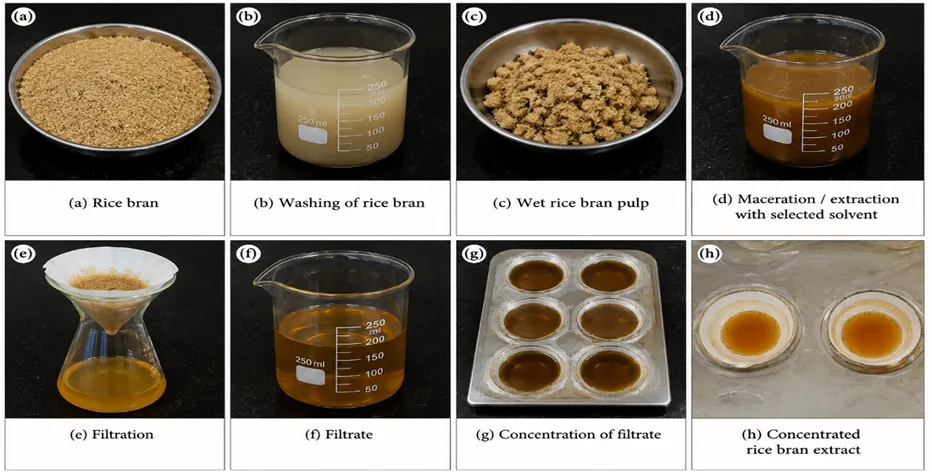
Figure 1. Steps involved in the preparation of Rice bran extract: (a) Rice bran; (b) Washing of rice bran; (c) wet rice bran pulp; (d) Maceration using 70:30 ethanol:water; (e) Filtration; (f) Filtrate; (g) Concentration of filtrate; and (h) Concentrated rice bran extract.
Preliminary phytochemical screening
The prepared rice bran extract was subjected to qualitative phytochemical screening for major classes of secondary metabolites using standard pharmacognostic/phytochemical procedures.
Table 1. Preliminary phytochemical screening of rice bran extract
|
Phytochemical |
Test performed |
Observation |
Result |
|
Alkaloids |
Mayer’s test |
Pale precipitate |
+ |
|
Flavonoids |
Alkaline reagent |
Intense yellow colour |
+ |
|
Phenolic |
Ferric chloride test |
Dark blue |
+ |
|
Tannins |
Ferric chloride test |
Blue-black |
+ |
|
Saponins |
Froth test |
Foam |
+ |
|
Terpenoids |
Salkowski test |
Reddish brown colour |
+ |
|
Glycosides |
Kaller-killiani test |
No reddish-brown ring |
- |
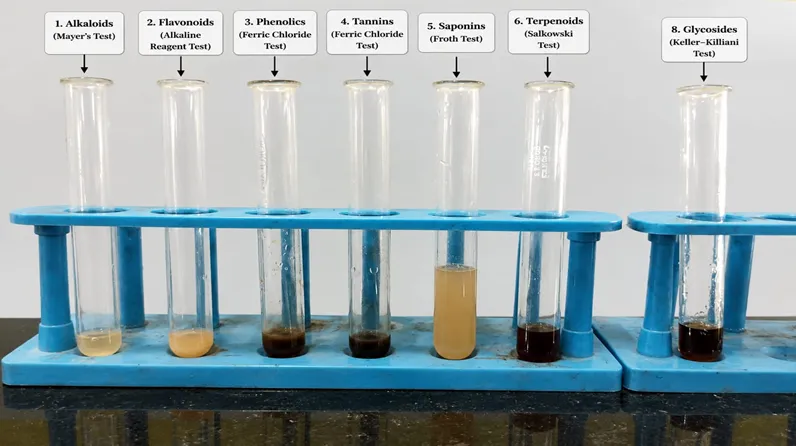
Figure 2. Phytochemical screening of rice bran
Selection of Bioactive Compounds
Ten phenolic acid and flavonoid constituents reported in rice bran or rice-derived materials were selected for the computational investigation based on their reported occurrence and potential biological relevance. [2,3]
Table 2. Selected rice-bran-associated compounds used for molecular docking
|
Sl. No. |
Compounds |
PubChem CID |
|
1 |
Ferulic acid |
445858 |
|
2 |
p-coumaric acid |
637542 |
|
3 |
Vanillic acid |
8468 |
|
4 |
Caffeic acid |
689043 |
|
5 |
Protocatechuic acid |
72 |
|
6 |
Gallic acid |
370 |
|
7 |
Quercetin |
5280343 |
|
8 |
Kaempferol |
5280863 |
|
9 |
Catechin |
9064 |
|
10 |
Epicatechin |
72276 |
Molecular Docking Study
Target protein preparation
The crystal structure of human pancreatic α-amylase was selected from the Protein Data Bank using PDB ID 1HNY. The structure was determined by X-ray diffraction at 1.8 Å resolution. Human pancreatic α-amylase contains an active site involving important catalytic residues including Asp197, Glu233 and Asp300. [9]
The receptor structure was prepared for docking by removing unnecessary components and preparing the protein in a docking-compatible format. Hydrogen atoms and appropriate charges were assigned before docking.
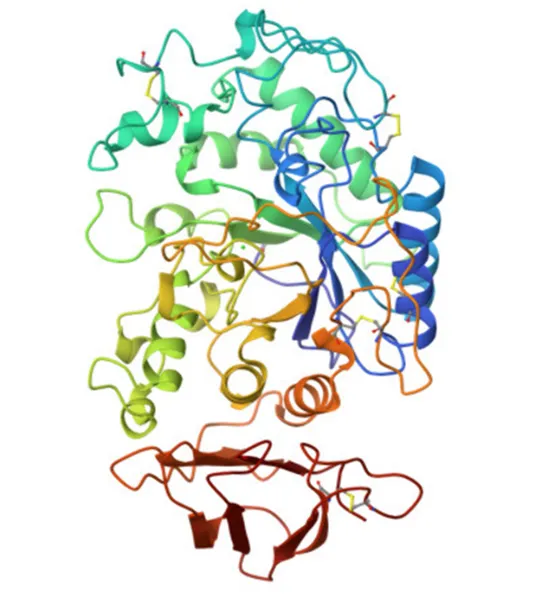
Figure 3. Three-dimensional structure of human pancreatic α-amylase (PDB ID: 1HNY) used as the target receptor.
Ligand preparation
The selected compounds were obtained from PubChem and their corresponding structures were downloaded in suitable formats. [16] The ligands were converted/prepared for docking using the PyRx/AutoDock workflow.[10,11]
Docking procedure
Molecular docking was carried out using AutoDock Vina through the PyRx Virtual Screening Tool. The prepared ligands were docked against the prepared human pancreatic α-amylase structure. The docking poses were ranked according to predicted binding affinity expressed in kcal/mol. More negative docking scores were considered indicative of more favorable predicted binding within the applied docking protocol. [10,11] AutoDock Vina is a commonly used molecular docking program for predicting ligand binding modes and estimating relative binding affinity.
Molecular Docking Results
The docking results obtained from the computational analysis are presented in Table 3.
Table 3. Molecular docking results of selected rice-bran-associated compounds against human pancreatic α-amylase (PDB ID: 1HNY)
|
Rank |
Compound |
PubChem CID |
Binding affinity (kcal/mol) |
|
1 |
Quercetin |
5280343 |
-8.6 |
|
2 |
Epicatechin |
72276 |
-8.6 |
|
3 |
Kaempferol |
5280863 |
-8.5 |
|
4 |
Catechin |
9064 |
-8.5 |
|
5 |
Caffeic acid |
689043 |
-6.4 |
|
6 |
Ferulic acid |
445858 |
-6.3 |
|
7 |
p-coumaric acid |
637542 |
-6.0 |
|
8 |
Gallic acid |
370 |
-5.8 |
|
9 |
Protocatechuic acid |
72 |
-5.5 |
|
10 |
Vanillic acid |
8468 |
-5.3 |
The results demonstrated that the flavonoid compounds showed the strongest predicted binding among the selected compounds. Quercetin and epicatechin produced the lowest docking score of -8.6 kcal/mol, followed by kaempferol and catechin at -8.5 kcal/mol. Caffeic acid and ferulic acid showed intermediate binding affinities of -6.4 and -6.3 kcal/mol, respectively. The stronger docking scores of the flavonoids may be associated with their multiple hydroxyl groups and aromatic ring systems, which provide opportunities for hydrogen bonding and aromatic interactions within the α-amylase binding region. [19,20]
Protein-Ligand Interaction Analysis
The highest-ranking compounds were subjected to interaction analysis using Discovery Studio Visualizer.
Quercetin
Quercetin exhibited a docking score of -8.6 kcal/mol. The two-dimensional interaction analysis demonstrated conventional hydrogen-bond interactions involving residues in the α-amylase binding region, together with aromatic interactions involving Trp59. Interactions were also observed around Tyr62, Gln63 and Asp300. The presence of multiple hydroxyl groups in quercetin provides several potential hydrogen-bonding sites, which may contribute to its favorable predicted binding.
Epicatechin
Epicatechin showed a binding affinity of -8.6 kcal/mol. The interaction diagram demonstrated hydrogen-bond interactions involving Gln63 and Glu233, together with a π–π interaction involving Trp59 and an interaction involving Asp300. The interaction pattern suggests that epicatechin can occupy the α-amylase binding region through a combination of hydrogen-bonding and aromatic interactions.
Catechin
Catechin exhibited a binding affinity of -8.5 kcal/mol. The interaction diagram demonstrated hydrogen-bond interactions involving residues including Gln63, Tyr62, Asp197 and Glu233. Aromatic interactions involving Trp59 and an interaction with Asp300 were also observed. The presence of several hydroxyl groups in catechin may facilitate hydrogen-bond interactions within the binding region.
Kaempferol
Kaempferol produced a docking score of -8.5 kcal/mol. The interaction analysis demonstrated hydrogen-bond interactions involving residues including Asp197, Gln63 and Tyr62, together with aromatic interactions involving Tyr62/Trp59. The observed interactions support the favorable docking score obtained for kaempferol.
Table 4. Major interactions observed for the leading compounds
|
Compound |
Binding affinity |
Important interacting residues |
Major interaction types |
|
Quercetin |
-8.6 |
Tyr62, Gln63, Asp300, Trp59 |
H-bond, π-π/aromatic |
|
Epicatechin |
-8.6 |
Gln63, Glu233, Asp300, Trp59 |
H-bond, π-π, aromatic |
|
Catechin |
-8.5 |
Tyr62, Gln63, Asp197, Glu233, Asp300, Trp59 |
H-bond, π-π, π-anion |
|
Kaempferol |
-8.5 |
Tyr62, Gln63, Asp197, Trp59 |
H-bond, π-π/aromatic |
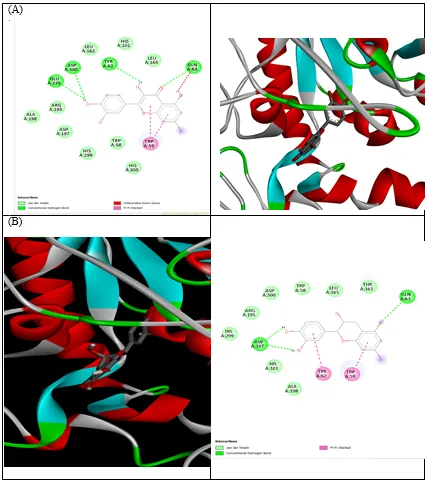
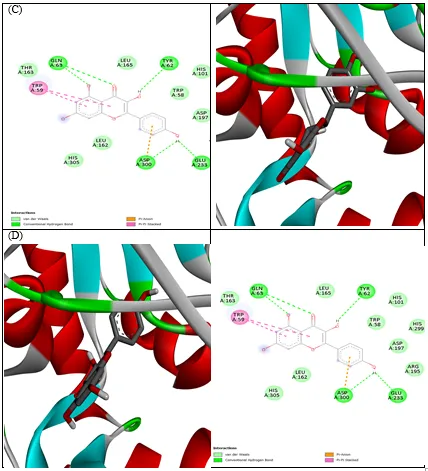
Figure 4. Molecular docking and protein–ligand interaction analysis of selected rice-bran phytochemicals with human pancreatic α-amylase (PDB ID: 1HNY): (A) quercetin, (B) epicatechin, (C) catechin, and (D) kaempferol. Each panel presents the three-dimensional docking pose and corresponding two-dimensional interaction diagram of the ligand within the α-amylase binding site.
ADME and Drug-Likeness Analysis
The four compounds showing the strongest docking scores—quercetin, epicatechin, kaempferol and catechin—were further evaluated using the SwissADME web tool. SwissADME provides computational predictions of physicochemical characteristics, pharmacokinetic properties, drug-likeness and medicinal-chemistry parameters.[12,13]
Table 5. Physicochemical and ADME properties of the leading docked compounds
|
Parameter |
Quercetin |
Kaempferol |
Catechin |
Epicatechin |
|
Molecular formula |
C15H10O7 |
C15H10O6 |
C15H14O6 |
C15H14O6 |
|
Molecular weight (g/mol) |
302.24 |
286.24 |
290.27 |
290.27 |
|
H-bond acceptors |
7 |
6 |
6 |
6 |
|
H-bond donors |
5 |
4 |
5 |
5 |
|
TPSA (Å2) |
131.36 |
111.13 |
110.38 |
110.38 |
|
WLOGP |
1.59 |
1.94 |
0.36 |
0.36 |
|
GI absorption |
High |
High |
High |
High |
|
BBB penetration |
No |
No |
No |
No |
|
P-gp substrate |
No |
No |
Yes |
Yes |
|
Lipinski violations |
0 |
0 |
0 |
0 |
|
Bioavailability score |
0.55 |
0.55 |
0.55 |
0.55 |
no predicted blood-brain barrier permeation. They also showed zero Lipinski rule violations. Quercetin and kaempferol were predicted not to be P-glycoprotein substrates, whereas catechin and epicatechin were predicted to be P-glycoprotein substrates. [13] These computational findings indicate predicted favorable drug-likeness characteristics under the applied prediction models; however, they should not be interpreted as experimental evidence of oral bioavailability.
DISCUSSION
Rice bran is a chemically diverse plant-derived material containing phenolic acids, flavonoids, tocols, γ-oryzanol and phytosterols. Previous studies have documented ferulic acid, p-coumaric acid, vanillic acid, caffeic acid and other phenolic compounds in rice bran, while flavonoids including catechin and quercetin have also been reported. [2,3] The present investigation combined preliminary phytochemical screening with computational evaluation of selected rice-bran-associated compounds. The qualitative phytochemical screening indicated the presence of alkaloids, flavonoids, phenolics, tannins, saponins and terpenoids, whereas glycosides were not detected. These findings provide preliminary evidence for the presence of diverse phytochemical classes in the prepared rice bran extract. Molecular docking against human pancreatic α-amylase showed that flavonoid compounds generally produced stronger predicted binding than the selected phenolic acids. Quercetin and epicatechin produced the most favorable binding affinity of -8.6 kcal/mol, while kaempferol and catechin showed -8.5 kcal/mol. The interaction analysis provides additional structural support for the docking results. The leading compounds interacted with several residues located within or around the α-amylase catalytic region. In particular, Asp197, Glu233 and Asp300 are recognized catalytic residues of human pancreatic α-amylase. [9] Quercetin demonstrated interactions involving Tyr62, Gln63, Asp300 and Trp59. Epicatechin demonstrated interactions involving Gln63, Glu233, Asp300 and Trp59. Catechin showed interactions involving Tyr62, Gln63, Asp197, Glu233, Asp300 and Trp59. Kaempferol also demonstrated interactions involving residues around the catalytic binding region. The comparable docking scores of catechin and epicatechin are noteworthy because these compounds possess closely related flavan-3-ol structures. Their hydroxyl-rich structures can provide multiple hydrogen-bonding opportunities, while their aromatic rings can participate in π-related interactions. ADME prediction further indicated that the four leading compounds possessed high predicted gastrointestinal absorption and zero Lipinski violations. Their predicted absence of blood-brain barrier permeation may also be consistent with their relatively polar structures and high topological polar surface areas. However, computational ADME results represent predictions rather than experimental pharmacokinetic measurements. [12,13] The present findings therefore provide a preliminary computational basis for considering rice-bran flavonoids as potential α-amylase-interacting compounds. Nevertheless, molecular docking alone cannot establish enzyme inhibition or therapeutic efficacy. The predicted interactions require confirmation through in vitro α-amylase inhibition assays, followed by appropriate experimental validation.
CONCLUSION
The present study investigated selected bioactive constituents associated with rice bran using preliminary phytochemical screening, molecular docking and in silico ADME analysis. Molecular docking against human pancreatic α-amylase identified quercetin and epicatechin as the compounds with the most favorable predicted binding affinities, each showing a predicted binding affinity of −8.6 kcal/mol, followed by kaempferol and catechin at -8.5 kcal/mol. Interaction analysis indicated that the leading compounds formed hydrogen-bonding and aromatic interactions with residues located within the α-amylase binding region, including important catalytic residues such as Asp197, Glu233 and Asp300. SwissADME analysis of the four leading compounds showed high predicted gastrointestinal absorption, no predicted BBB permeation and zero Lipinski rule violations. Overall, the results suggest that rice-bran flavonoids, particularly quercetin, epicatechin, kaempferol and catechin, are promising candidates for further investigation as potential α-amylase-interacting natural compounds. However, the findings are computational and should be validated experimentally through α-amylase inhibition assays and further pharmacological studies.
Declarations
Funding
No external funding was received for this study.
Conflict of Interest
The author declares that there is no conflict of interest associated with this study.
REFERENCES


Mukthiyar Ahamed*, Sahana C. A., Manohar K. M., Phytochemical Profiling, Molecular Docking and ADME Evaluation of Bioactive Constituents of Rice Bran (Oryza sativa L.) Against Human Pancreatic α-Amylase, Int. J. Med. Pharm. Sci., 2026, 2 (9), 151-159. https://doi.org/10.5281/zenodo.22316218
 10.5281/zenodo.22316218