

We use cookies to ensure our website works properly and to personalise your experience. Cookies policy
Millennium College of Pharmacy, Bhopal, Madhya Pradesh, India
This study compared the antidiabetic activity and safety of hydroalcoholic leaf extracts of Neomarica gracilis and Codiaeum variegatum, formulated individually and as a 1:1 polyherbal suspension. Leaves were extracted with 70% ethanol by Soxhlet extraction, and the extracts were evaluated for yield, phytochemical constituents, total phenolic and flavonoid contents, and suspension quality. Acute oral toxicity was assessed according to OECD 423, while diabetes was induced in male Wistar rats using streptozotocin (50 mg/kg), followed by 21 days of treatment with glibenclamide or herbal formulations at 200 mg/kg. The extract yields were 8.06% and 8.50% for N. gracilis and C. variegatum, respectively. C. variegatum showed higher total phenolic (44.92 mg GAE/g) and flavonoid (44.25 mg RE/g) contents than N. gracilis. All formulations remained physically stable during the 30-day observation period, and no mortality was observed up to 2000 mg/kg in the acute toxicity study. Among the tested preparations, the polyherbal suspension demonstrated the most favourable overall response, particularly with respect to blood glucose, lipid parameters and pancreatic histopathological changes. These findings suggest that combining N. gracilis and C. variegatum may provide enhanced antidiabetic potential compared with their individual formulations.
Diabetes mellitus is a chronic metabolic disorder in which persistent hyperglycaemia is accompanied by disturbances in lipid and protein metabolism. Oxidative stress and progressive tissue injury contribute to the complications associated with prolonged metabolic dysregulation. The supplied thesis identifies herbal preparations as a research area of interest and emphasizes simultaneous assessment of efficacy, safety and formulation quality. [1,2] N. gracilis and C. variegatum were selected for comparative investigation. Preliminary screening in the thesis detected alkaloids, glycosides, carbohydrates, proteins/amino acids, flavonoids and phenolic compounds in both extracts; saponins, triterpenoids and steroids were additionally detected in C. variegatum. [3,4] The study therefore moved from extract preparation and phytochemical characterization to pharmaceutical suspension development and evaluation, acute oral toxicity, streptozotocin-induced diabetes, 21-day treatment and pancreatic histopathology. The stated objective was to compare the two individual formulations and their combined preparation against a standard antidiabetic drug. [3,5]
2. MATERIALS AND METHODS
2.1 Ethical approval, animals and housing
Animal experiments were reported as approved by the Institutional Animal Ethics Committee (CCSEA approval PBRI/IAEC/21042026/008). Male Wistar albino rats aged 2–3 months were maintained under standard conditions with a 12-h light/dark cycle, standard chow and water, after acclimatization.
2.2 Extraction and phytochemical analysis
Leaves were dried, powdered and extracted separately in a Soxhlet apparatus using 70% ethanol (ethanol:water 70:30) for approximately 6–8 h or until the siphoning solvent became colourless. Filtrates were concentrated under reduced pressure below 50°C, dried and stored at 4–8°C. Yield was calculated as extract weight divided by starting plant-material weight ×100. [5] Qualitative screening covered alkaloids, glycosides, carbohydrates, proteins/amino acids, flavonoids, tannins/phenolics, saponins, triterpenoids and steroids using standard colour/precipitation reactions. [6] TPC was determined by the Folin–Ciocalteu method using gallic acid standards (10–100 µg/mL), 10% Folin–Ciocalteu reagent and 7.5% sodium carbonate; absorbance was measured at 765 nm and expressed as mg GAE/g extract. TFC used rutin standards (10–100 µg/mL), 2% aluminium chloride and absorbance at 415 nm, expressed as mg RE/g. [6,7]
2.3 Suspension formulation and evaluation
Table 1: Composition of Herbal Suspensions Formulation
|
Name of Ingredient |
Formulation I (Neomarica gracilis) |
Formulation II (Codiaeum variegatum) |
Formulation III (Polyherbal suspension) |
|
Neomarica gracilis Leaf Extract |
4.0 g |
— |
2.0 g |
|
Codiaeum variegatum Leaf Extract |
— |
4.0 g |
2.0 g |
|
Sodium Carboxymethyl Cellulose (CMC) |
2.0 g |
2.0 g |
2.0 g |
|
Tween 80 (Wetting Agent) |
0.1% |
0.1% |
0.1% |
|
Methyl Paraben (Preservative) |
0.2% |
0.2% |
0.2% |
|
Sucrose |
10 g |
10 g |
10 g |
|
Sorbitol |
5 g |
5 g |
5 g |
|
Distilled Water |
q.s. to 100 mL |
q.s. to 100 mL |
q.s. to 100 mL |
The thesis formulation table specifies the above composition; the polyherbal formulation contains equal extract quantities. Physical stability was followed for 30 days at 25 ± 2°C. pH, viscosity and sedimentation volume were measured using the procedures described in the thesis. [8,9]
2.4 Acute toxicity and diabetes induction
OECD 423 acute oral toxicity testing used doses of 5, 50, 300 and 2000 mg/kg, with clinical observations during the first 30 min, first 24 h and daily for 14 days. Diabetes was induced by freshly prepared STZ (50 mg/kg) in 0.1 M citrate buffer, pH 4.5, after overnight fasting; fasting blood glucose was checked after 72 h. [10]
2.5 Experimental groups and outcomes
|
Group |
Treatment |
Dose |
|
I |
Normal control |
1 mL distilled water, oral |
|
II |
Diabetic control |
STZ 50 mg/kg |
|
III |
Glibenclamide |
10 mg/kg/day, oral |
|
IV |
F-I: N. gracilis |
200 mg/kg, oral |
|
V |
F-II: C. variegatum |
200 mg/kg, oral |
|
VI |
F-III: polyherbal |
200 mg/kg, oral; 1:1 extracts |
Treatment continued for 21 days. Body weight and blood glucose were assessed on days 1, 3, 7, 14 and 21. Serum was obtained by centrifugation at 2500 rpm for 10 min at 25°C. TG, TC and HDL were measured; VLDL was calculated as TG/5 and LDL as TC − (HDL + VLDL). Pancreas was fixed in 10% neutral buffered formalin, processed through graded ethanol/xylene, embedded in paraffin, sectioned at 4–5 µm and stained with H&E. Islet architecture, β-cell preservation, degeneration, necrosis and inflammatory changes were evaluated microscopically. The available thesis does not state group-wise sample size, exact inferential statistical test or p-values. Accordingly, this manuscript retains the reported mean ± variability values but does not invent statistical tests or significance levels.
3. RESULTS
3.1 Extract yield and phytochemical profile
Table 2: Percentage Yield of plant material
|
Plant |
Material |
Extract |
Yield |
|
N. gracilis |
300 g |
24.18 g |
8.06% |
|
C. variegatum |
350 g |
29.75 g |
8.50% |
Table 3: Phytochemical analysis of hydroalcoholic leaf extracts of N. gracilis C. variegatum
|
Constituent group |
N. gracilis |
C. variegatum |
|
Alkaloids |
+ |
+ |
|
Glycosides |
+ |
+ |
|
Carbohydrates |
+ |
+ |
|
Proteins/amino acids |
+ |
+ |
|
Flavonoids |
+ |
+ |
|
Tannins/phenolics |
+ |
+ |
|
Saponins |
− |
+ |
|
Triterpenoids/steroids |
− |
+ |
C. variegatum yielded slightly more extract. Both extracts shared the major screened constituent groups, whereas saponins and triterpenoid/steroidal reactions were additionally positive in C. variegatum.
3.2 Quantitative phytochemicals and formulation quality
Table 4: Total Phenolic Content (TPC) and Total Flavonoids content (TFC) estimation in hydroalcoholic leaf extracts of N. gracilis and C. variegatum
|
Extract |
TPC (mg GAE/g) |
TFC (mg RE/g) |
|
N. gracilis |
26.52 |
25.25 |
|
C. variegatum |
44.92 |
44.25 |
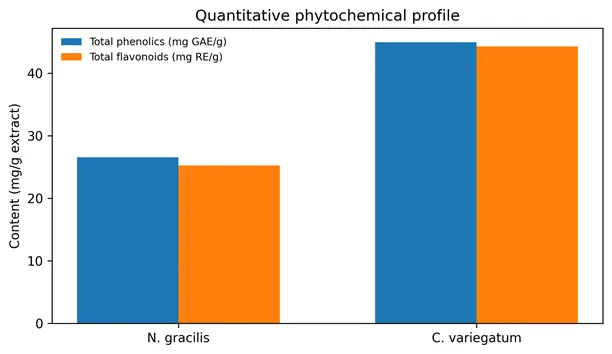
Figure 1. Total phenolic and flavonoid contents.
The gallic-acid calibration curve reported in the thesis was y = 0.0025x + 0.1107 (R² = 0.9884). C. variegatum showed the higher phenolic and flavonoid values.
Table 5: pH, Viscosity, Sedimentation volume and Spreadability test
|
Parameter |
F-I |
F-II |
F-III |
|
Stability |
Stable, 30 d |
Stable, 30 d |
Highly stable, 30 d |
|
pH |
6.4 ± 0.03 |
6.5 ± 0.02 |
6.3 ± 0.04 |
|
Viscosity (cP) |
850 ± 15 |
780 ± 12 |
880 ± 18 |
|
Sedimentation F |
0.78 ± 0.02 |
0.74 ± 0.03 |
0.82 ± 0.02 |
All formulations remained stable for 30 days; F-III had the highest sedimentation-volume value and viscosity.
3.3 Acute toxicity and in-vivo response
|
Dose |
Observed outcome in all formulations |
|
5 mg/kg |
No mortality; general observations normal |
|
50 mg/kg |
No mortality; general observations normal |
|
300 mg/kg |
No mortality; mild changes in selected observations |
|
2000 mg/kg |
No mortality; mild changes in selected observations |
No mortality was observed at any tested dose. The thesis interpreted the findings as an LD50 greater than 2000 mg/kg, while noting mild changes at the two higher doses.
Table 6: Effect of Formulation I (Neomarica gracilis) Formulation II (Codiaeum variegatum) and Formulation III (polyherbal combination) on Body weight (gm) of the rats
|
Body weight (gm) |
||||||
|
Groups |
Treatments |
1 day |
3 days |
7 days |
14 days |
21 days |
|
Group 1 |
Normal control |
244.10 ± 0.251 |
246.05 ± 0.243 |
241.20 ± 0.219 |
239.10 ± 0.205 |
238.05 ± 0.238 |
|
Group II |
Diabetic control (Streptozocin) 50 mg/kg |
253.85 ± 0.198 |
258.10 ± 0.176 |
263.25 ± 0.185 |
268.60 ± 0.220 |
272.45 ± 0.240 |
|
Group III |
Glibenclamide (10 mg/kg) |
246.80 ± 0.230 |
248.45 ± 0.215 |
245.10 ± 0.190 |
245.75 ± 0.200 |
242.20 ± 0.210 |
|
Group IV |
Formulation I (Neomarica gracilis) |
259.75 ± 0.220 |
263.30 ± 0.250 |
258.90 ± 0.310 |
263.20 ± 0.180 |
261.00 ± 0.230 |
|
Group V |
Formulation II (Codiaeum variegatum) |
253.60 ± 0.240 |
257.80 ± 0.200 |
253.50 ± 0.160 |
256.40 ± 0.150 |
255.10 ± 0.210 |
|
Group VI |
Formulation III (Polyherbal suspension) |
249.90 ± 0.230 |
253.40 ± 0.210 |
249.00 ± 0.180 |
251.60 ± 0.190 |
248.20 ± 0.250 |
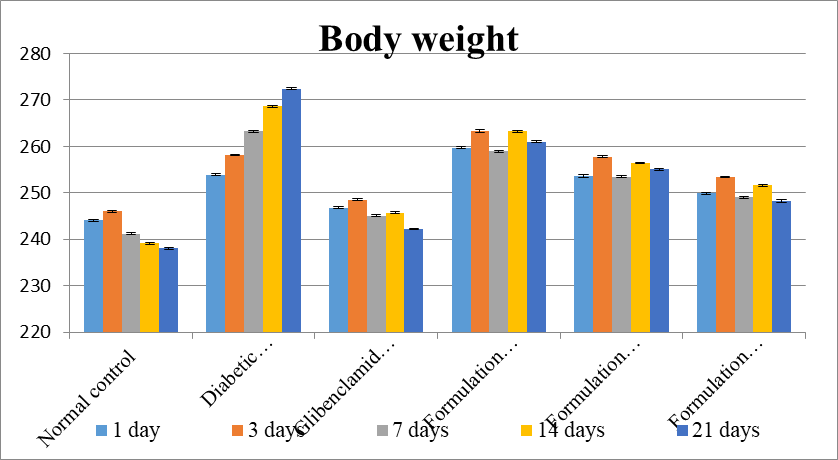
Figure 2. Effect of Formulation I (Neomarica Gracilis) Formulation II (Codiaeum Variegatum) And Formulation III (Polyherbal Combination) On Body Weight of The Rats
The diabetic control showed a progressive increase in body weight. F-III remained closer to the normal and standard groups than the individual herbal formulations. [11,12]
Table 7: Effect of test samples of Formulations on Blood Glucose Level in experimental rats
|
Blood Glucose Level (gms) |
||||||
|
Groups |
Treatments |
1 day |
3 days |
7 days |
14 days |
21 days |
|
Group 1 |
Normal control |
87.09 ± 0.194 |
86.47 ± 0.210 |
88.99 ± 0.336 |
87.99 ± 0.196 |
89.78 ± 0.271 |
|
Group II |
Diabetic control (Streptozocin) 50 mg/kg |
156.89 ± 0.181 |
179.89 ± 0.262 |
199.78 ± 0.240 |
239.67 ± 0.308 |
258.91 ± 0.230 |
|
Group III |
Glibenclamide (10 mg/kg) |
94.07 ± 0.228 |
93.78 ± 0.106 |
95.89 ± 0.498 |
92.91 ± 0.289 |
95.80 ± 0.095 |
|
Group IV |
Formulation I (Neomarica gracilis) |
105.69 ± 0.097 |
103.91 ± 0.603 |
108.99 ± 0.203 |
112.91 ± 0.237 |
109.47 ± 0.210 |
|
Group V |
Formulation II (Codiaeum variegatum) |
110.99 ± 0.371 |
112.79 ± 0.275 |
109.45 ± 0.222 |
118.23 ± 0.258 |
116.79 ± 0.360 |
|
Group VI |
Formulation III (Polyherbal suspension) |
99.85 ± 0.220 |
98.10 ± 0.200 |
99.05 ± 0.180 |
98.20 ± 0.250 |
102.05 ± 0.210 |
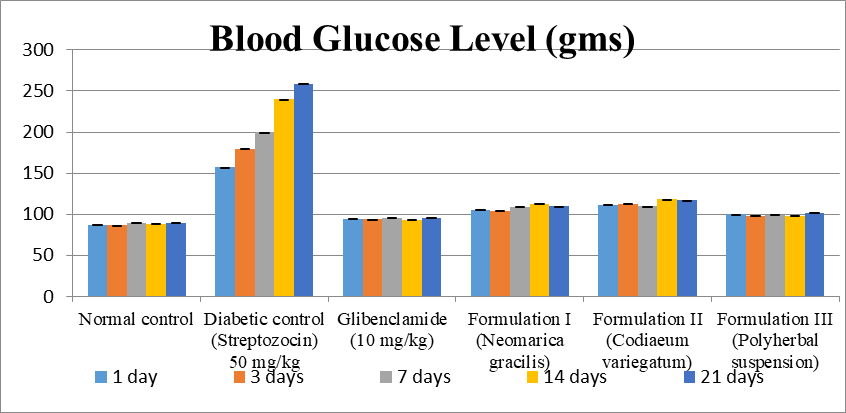
Fig 3: Effect of Formulations on Blood Glucose Level of the rats
The diabetic control increased progressively, whereas all herbal treatments restrained the rise. F-III showed the lowest herbal values across the reported time points and remained comparatively close to glibenclamide. The source table labels the unit as “gms”; this manuscript deliberately does not substitute a conventional unit without source confirmation.
3.4 Biochemical and histological findings
Table 8: Effect of test samples of Formulations on Biochemical Parameters in experimental rats
|
Treatment Groups |
TG (g/L) |
TC (g/L) |
HDL (g/L) |
LDL (g/L) |
|
Normal control |
58.90 ± 1.18 |
80.45 ± 0.92 |
46.10 ± 0.30 |
22.90 ± 0.78 |
|
Diabetic control (Streptozocin) 50 mg/kg |
172.80 ± 2.10 |
183.90 ± 2.65 |
19.85 ± 0.58 |
118.40 ± 1.70 |
|
Glibenclamide (10 mg/kg) |
63.20 ± 1.50 |
84.10 ± 1.45 |
41.10 ± 0.35 |
27.40 ± 0.92 |
|
Formulation I (Neomarica gracilis) |
79.40 ± 1.88 |
99.20 ± 2.02 |
22.20 ± 0.44 |
46.10 ± 1.20 |
|
Formulation II (Codiaeum variegatum) |
74.60 ± 1.92 |
96.10 ± 2.08 |
27.80 ± 0.50 |
39.10 ± 1.22 |
|
Formulation III (Polyherbal suspension) |
68.80 ± 1.55 |
91.20 ± 1.48 |
34.90 ± 0.40 |
36.20 ± 1.05 |
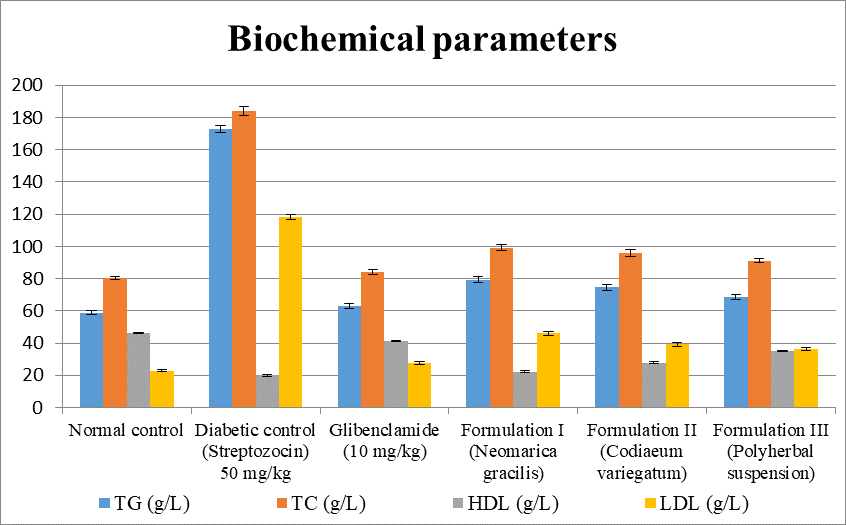
Fig4: Graphical representation of effect of Formulations on Biochemical Parameters of the rats
Diabetes produced an adverse lipid pattern. F-III showed the strongest overall improvement among the herbal groups, with lower TG, TC and LDL and higher HDL than the individual formulations.
3.4 Histopathological Examination of Pancreas
Pancreatic microscopy showed preserved islets in the normal group, marked degeneration in the diabetic control, substantial restoration after glibenclamide, moderate improvement with F-I, better preservation with F-II and the most prominent herbal architectural recovery with F-III.
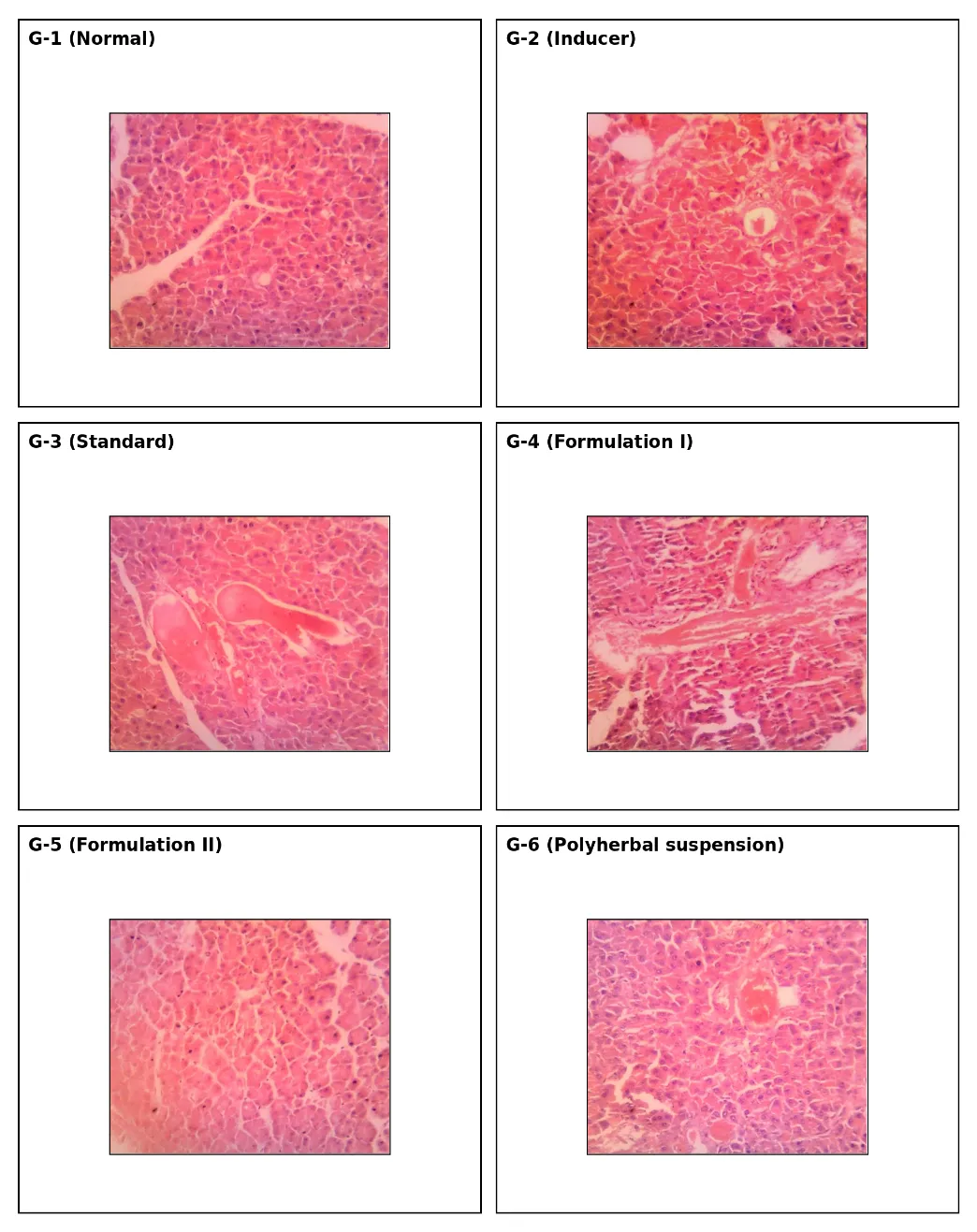
Figure 5: Histopathological Examination of Pancreas
Pancreatic microscopy showed preserved islets in the normal group, marked degeneration in the diabetic control, substantial restoration after glibenclamide, moderate improvement with F-I, better preservation with F-II and the most prominent herbal architectural recovery with F-III.
G-1 (Normal): Normal pancreatic architecture with well-defined and intact islets of Langerhans and normal cellular arrangement.
G-2 (Inducer): Marked degeneration and disorganization of the islets of Langerhans with noticeable pancreatic tissue alterations.
G-3 (Standard): Considerable restoration of pancreatic architecture with improved organization of the islets and reduced degenerative changes.
G-4 (Formulation I): Moderate improvement in islet structure with reduced cellular degeneration compared with the inducer group.
G-5 (Formulation II): Improved pancreatic architecture with better preservation and organization of the islets.
G-6 (Polyherbal suspension): Greater preservation of pancreatic architecture and islet organization, showing the most prominent improvement among the herbal treatment groups.
Overall, the histological findings indicate that the treatments, particularly the polyherbal suspension, provided protective effects against diabetes-induced pancreatic damage
DISCUSSION
The findings form a consistent comparative pattern. C. variegatum had both a slightly higher extraction yield and substantially greater measured phenolic/flavonoid content. This does not by itself establish causality, but it provides a plausible compositional distinction between the two extracts. The broader qualitative profile of C. variegatum, including saponins and triterpenoid/steroidal reactions, further differentiates it from N. gracilis. [3,4,6,7] Formulation performance was satisfactory across all preparations. The polyherbal suspension did not show evidence of impaired physical stability and had the highest reported sedimentation volume and viscosity. The combination therefore retained acceptable pharmaceutical characteristics while allowing the pharmacological effects of the two extracts to be evaluated together. [8,9] The in-vivo data provide the strongest evidence for the comparative advantage of F-III. The diabetic-control glucose value increased from 156.89 to 258.91 across the study, while F-III remained close to 100–102 in the reported numerical scale. F-I and F-II also showed clear improvement but were less consistent with the standard group. The lipid findings followed the same direction, with F-III showing the best herbal HDL value and lower TG, TC and LDL than the individual preparations. [11,12,13] The pancreatic findings provide structural support for the biochemical pattern. Greater preservation of islet organization in F-III suggests that the combined preparation was associated with less apparent STZ-related pancreatic damage than the individual herbal formulations. The thesis attributes the stronger combined effect to complementary or synergistic phytoconstituent actions; this remains a hypothesis because the present work did not directly measure molecular mechanisms, insulin secretion or individual active constituents. [12,13] The findings demonstrate that all tested formulations possessed antidiabetic potential, with Formulation III (polyherbal suspension) showing superior overall activity. Its better performance in controlling body weight, reducing hyperglycemia, and improving lipid abnormalities suggests a possible synergistic or complementary effect of Neomarica gracilis and Codiaeum variegatum. These findings support the potential use of the combined formulation for further investigation as a herbal antidiabetic preparation.
CONCLUSION
N. gracilis and C. variegatum hydroalcoholic leaf extracts were successfully formulated as individual and combined suspensions. C. variegatum showed higher phenolic and flavonoid contents, while all formulations demonstrated acceptable short-term physical stability and no mortality during acute toxicity testing up to 2000 mg/kg. In streptozotocin-induced diabetic rats, all herbal preparations improved glucose and lipid outcomes, with the 1:1 polyherbal suspension showing the strongest overall response and the most favourable pancreatic histological appearance. Overall, the study supports the potential of the Neomarica gracilis–Codiaeum variegatum polyherbal formulation as a promising herbal antidiabetic preparation. However, further studies involving detailed mechanistic investigations, long-term toxicity assessment, dose optimization, and clinical evaluation are required to establish its therapeutic efficacy and safety.
REFERENCES

Mrityunjay Kumar*, Nitendra Sahu, Comparative Antidiabetic Activity of Neomarica Gracilis and Codiaeum Variegatum Leaf Extracts in Streptozotocin-Induced Diabetic Rats, Int. J. Med. Pharm. Sci., 2026, 2 (9), 242-250. https://doi.org/10.5281/zenodo.22661426
 10.5281/zenodo.22661426