

We use cookies to ensure our website works properly and to personalise your experience. Cookies policy
Sant Gajanan Maharaj College of Pharmacy, Mahagaon, Chinchewadi - 416503, Maharashtra, India
Oxidative stress caused by excessive production of free radicals is associated with the development of several chronic diseases. The present study was conducted to evaluate and compare the antioxidant activity of ethanolic and ethyl acetate extracts of Argyreia nervosa, a medicinal plant known for its rich phytochemical composition and therapeutic potential. The plant material was extracted using the Soxhlet extraction method with ethanol and ethyl acetate as solvents. Preliminary phytochemical screening was performed to identify major bioactive constituents. Antioxidant activity was assessed using the DPPH free radical scavenging assay, while total phenolic content (TPC) and total flavonoid content (TFC) were determined using standard spectrophotometric methods. The results revealed the presence of flavonoids, phenolic compounds, tannins, and alkaloids in both extracts. Both extracts exhibited concentration-dependent antioxidant activity; however, the ethanolic extract demonstrated significantly higher free radical scavenging activity than the ethyl acetate extract. The ethanolic extract also showed higher total phenolic content (88.72 ± 3.05 mg GAE/g) and total flavonoid content (37.81 ± 0.47 mg QE/g) compared to the ethyl acetate extract. The study concludes that Argyreia nervosa possesses considerable antioxidant potential, with the ethanolic extract exhibiting superior activity due to its higher phenolic and flavonoid content. These findings support the potential use of Argyreia nervosa as a natural source of antioxidants for herbal and pharmaceutical applications.
Oxidative stress is a physiological condition that arises when the generation of reactive oxygen species (ROS) exceeds the antioxidant defense capacity of the body. Excessive free radicals can damage cellular components such as lipids, proteins, and DNA, leading to the development of various chronic diseases including cancer, diabetes mellitus, cardiovascular disorders, and neurodegenerative diseases [1,2]. Therefore, the search for effective antioxidants has become an important area of pharmaceutical and biomedical research. Synthetic antioxidants are widely used to combat oxidative damage; however, concerns regarding their long-term safety and potential adverse effects have stimulated interest in natural antioxidants obtained from medicinal plants. Plant-derived antioxidants, particularly phenolic compounds and flavonoids, are known for their ability to neutralize free radicals and protect biological systems from oxidative stress [3,4]. Argyreia nervosa (Burm. f.) Bojer, commonly known as Vidhara, is a medicinal plant belonging to the family Convolvulaceae. It has been traditionally used in Ayurveda for its rejuvenating, anti-inflammatory, adaptogenic, and neuroprotective properties. These pharmacological activities are mainly attributed to the presence of bioactive phytoconstituents such as flavonoids, phenolics, alkaloids, tannins, and glycosides [5,6]. Previous studies have reported the antioxidant potential of Argyreia nervosa and highlighted the role of phenolic and flavonoid compounds in free radical scavenging activity. Researchers have also demonstrated that the extraction solvent significantly influences the yield and composition of phytochemicals [7,8]. However, limited information is available regarding the comparative antioxidant activity of ethanolic and ethyl acetate extracts of Argyreia nervosa. Therefore, the present study was undertaken to evaluate and compare the antioxidant potential of ethanolic and ethyl acetate extracts of Argyreia nervosa through phytochemical screening, determination of total phenolic and flavonoid contents, and DPPH free radical scavenging assay. The study aims to identify the most effective extraction solvent and provide scientific evidence supporting the use of Argyreia nervosa as a natural antioxidant source.
MATERIALS AND METHODS:
Leaves of Argyreia nervosa were collected from the local region of Gadhinglaj, Maharashtra, India. The collected plant material was authenticated by a qualified botanist from the Department of Botany, Shivraj College, Gadhinglaj. The authenticated sample was thoroughly cleaned to remove adhering dust and foreign matter before further processing [5,6].
The collected leaves were washed with distilled water and shade-dried at room temperature to preserve thermolabile phytoconstituents. The dried material was pulverized using a mechanical grinder to obtain a coarse powder and stored in airtight containers until extraction [6,9].
The powdered plant material was extracted separately using ethanol and ethyl acetate as extraction solvents. Soxhlet extraction was employed to obtain the crude extracts. A known quantity of powdered drug was packed in a thimble and extracted continuously with the respective solvents until complete exhaustion. The extracts were concentrated by evaporating the solvents under controlled conditions and stored in airtight containers for further analysis [6,13].
The ethanolic and ethyl acetate extracts were subjected to qualitative phytochemical analysis for the detection of major secondary metabolites, including alkaloids, flavonoids, phenolic compounds, tannins, glycosides, saponins, carbohydrates, proteins, steroids, and terpenoids, using standard phytochemical screening procedures [6,9].
The antioxidant potential of the ethanolic and ethyl acetate extracts of Argyreia nervosa was assessed using DPPH free radical scavenging assay, Total Phenolic Content (TPC), and Total Flavonoid Content (TFC) estimation.
The DPPH assay was performed to evaluate the free radical scavenging ability of the extracts. Different concentrations (50–350 µg/mL) of each extract were prepared in methanol. One milliliter of the sample solution was mixed with DPPH solution and incubated in the dark at room temperature for 30 minutes. The absorbance was measured at 517 nm using a UV–Visible spectrophotometer. Ascorbic acid was used as the reference standard. The percentage inhibition of DPPH radicals was calculated, with higher inhibition indicating stronger antioxidant activity [7,10].
The total phenolic content was determined using the Folin–Ciocalteu colorimetric method. Briefly, 0.5 mL of extract solution was mixed with diluted Folin–Ciocalteu reagent, followed by the addition of sodium carbonate solution. The reaction mixture was incubated for 30 minutes at room temperature, and the absorbance was recorded at 765 nm. Gallic acid was used to construct the calibration curve, and the results were expressed as milligrams of gallic acid equivalents per gram of extract (mg GAE/g) [8,11].
The total flavonoid content was estimated using the aluminium chloride colorimetric method. The extract solution was treated with aluminium chloride, potassium acetate, methanol, and distilled water, followed by incubation at room temperature for 30 minutes. Absorbance was measured at 415 nm using a UV–Visible spectrophotometer. Quercetin served as the reference standard, and the flavonoid content was expressed as milligrams of quercetin equivalents per gram of extract (mg QE/g). All analyses were carried out in triplicate, and the results were expressed as mean ± standard deviation. [12]
All experiments were carried out in triplicate and the results were expressed as mean ± standard deviation (Mean ± SD). Statistical analysis was performed using appropriate statistical methods, and graphical representation of the data was prepared using Microsoft Excel [14].
RESULT AND DISCUSSION:
The present study investigated the antioxidant potential of ethanolic and ethyl acetate extracts of Argyreia nervosa through phytochemical screening, DPPH free radical scavenging assay, total phenolic content (TPC), and total flavonoid content (TFC) determination.
Qualitative phytochemical analysis revealed the presence of several bioactive constituents, including alkaloids, flavonoids, phenolic compounds, and tannins in both extracts. However, the ethanolic extract exhibited a broader phytochemical profile, containing additional constituents such as glycosides, saponins, carbohydrates, proteins, steroids, and terpenoids. These findings indicate that ethanol was more effective in extracting polar phytoconstituents from Argyreia nervosa.
Both extracts demonstrated concentration-dependent antioxidant activity, with radical scavenging activity increasing as extract concentration increased. The ethanolic extract exhibited higher DPPH inhibition (50.17–75.41%) compared to the ethyl acetate extract (39.45–62.01%) across all tested concentrations. The enhanced antioxidant activity of the ethanolic extract may be attributed to its higher concentration of phenolic and flavonoid compounds, which are known to act as effective free radical scavengers.
Table 1: %inhibition of DPPH radical
|
Concentration (µg) |
Ascorbic acid |
Ethanol |
Ethyl Acetate |
|
control |
|||
|
50 |
55.1449 |
50.1705 |
39.4542 |
|
100 |
59.2666 |
55.3723 |
43.9169 |
|
150 |
64.2836 |
57.1773 |
45.9920 |
|
200 |
67.7942 |
62.2939 |
50.7816 |
|
250 |
70.3524 |
68.0784 |
55.2870 |
|
300 |
72.8112 |
70.6367 |
58.3570 |
|
350 |
78.0699 |
75.4121 |
62.0096 |
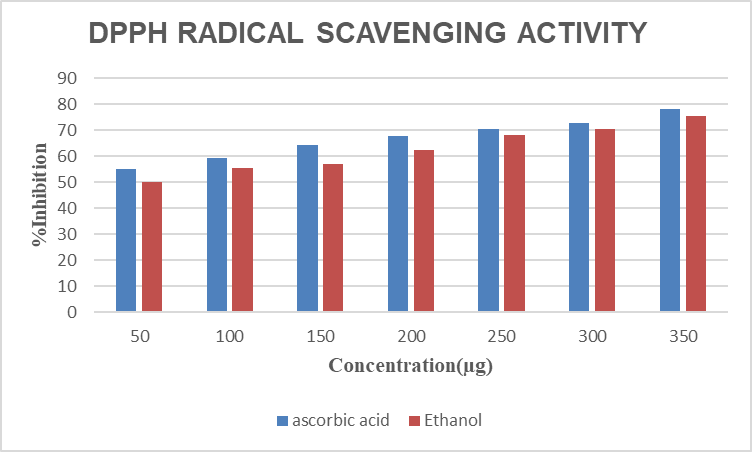
Fig 1: % inhibition of DPPH Radical of Ethanol

Fig 2: % inhibition of DPPH Radical of Ethyl Acetate
The total flavonoid content of the ethanolic extract was found to be 37.81 ± 0.47 mg QE/g extract, whereas the ethyl acetate extract showed 27.77 ± 0.22 mg QE/g extract. The higher flavonoid content in the ethanolic extract suggests improved extraction efficiency of flavonoid compounds by the polar solvent.
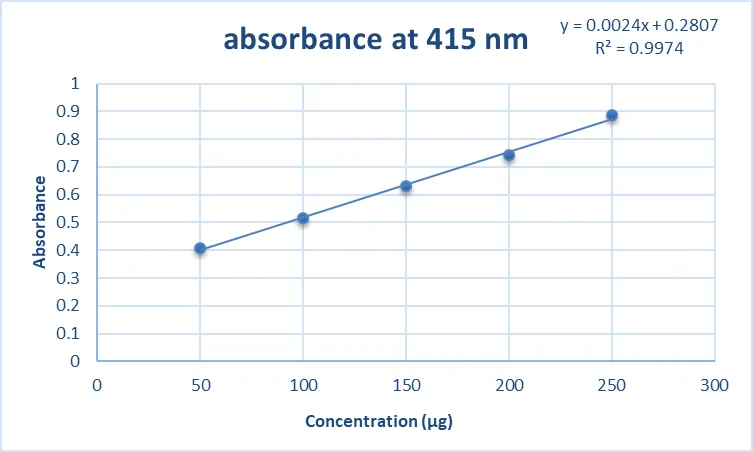
Fig 3: Absorbance of quercetin samples
Table 2: Total flavonoid Content.
|
Sample
|
Absorbance (nm) |
x=(y-c)m
|
x/1000
|
A=cv/m
|
Mean
|
SD
|
Mean±SD
|
|
Ethyl acetate |
0.796 |
56.011 |
0.05601 |
28.00543 |
27.76993 |
0.21964 |
27.7699 ± 0.2196 |
|
Ethyl acetate |
0.791 |
55.467 |
0.05547 |
27.7337 |
|||
|
Ethyl acetate |
0.788 |
55.141 |
0.05514 |
27.57065 |
|||
|
Ethanol |
0.978 |
75.793 |
0.07579 |
37.89674 |
37.80616 |
0.46857 |
37.8062 ± 0.4686 |
|
Ethanol |
0.984 |
76.446 |
0.07645 |
38.22283 |
|||
|
Ethanol |
0.967 |
74.598 |
0.0746 |
37.29891 |
The flavonoid content was found to be:
Ethanolic extract: 37.8061 mg QE/g of extract
Ethyl acetate extract: 27.7699 mg QE/g of extract
The total phenolic content was determined as 88.72 ± 3.05 mg GAE/g extract for the ethanolic extract and 66.90 ± 3.62 mg GAE/g extract for the ethyl acetate extract. The higher phenolic content observed in the ethanolic extract contributes significantly to its antioxidant activity due to the strong reducing and free radical scavenging properties of phenolic compounds.
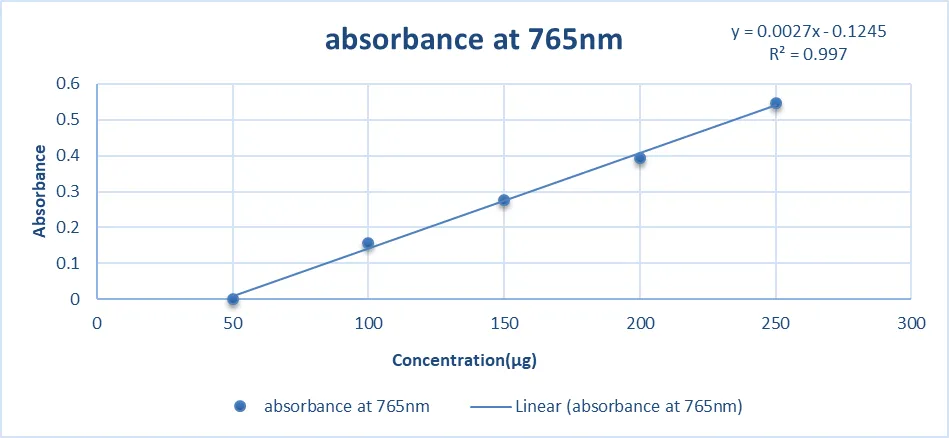
Fig 4: Absorbance of Gallic acid samples
Table 3: Total Phenolic Content
|
Sample
|
Absorbance (nm) |
x=(y-c)m
|
x/1000
|
A=cv/m
|
Mean
|
SD
|
Mean±SD
|
|
Ethyl acetate |
0.325 |
140.4688 |
0.1404 |
70.2343 |
66.9010 |
3.6219 |
66.90 ± 3.62 |
|
Ethyl acetate |
0.279 |
126.0938 |
0.1260 |
63.0468 |
|||
|
Ethyl acetate |
0.307 |
134.8438 |
0.1348 |
67.4218 |
|||
|
Ethanol |
0.463 |
183.5938 |
0.1835 |
91.7968 |
88.7239 |
3.0472 |
88.72 ± 3.05 |
|
Ethanol |
0.424 |
171.4063 |
0.1714 |
85.7031 |
|||
|
Ethanol |
0.443 |
177.3438 |
0.1773 |
88.6718 |
The total phenolic content was found to be:
A comparative evaluation of the ethanolic and ethyl acetate extracts of Argyreia nervosa was performed based on phytochemical composition, total phenolic content (TPC), total flavonoid content (TFC), and antioxidant activity. The phytochemical screening results demonstrated that both extracts contained important bioactive constituents such as alkaloids, flavonoids, phenolic compounds, and tannins. However, the ethanolic extract exhibited a wider range of phytoconstituents, including glycosides, saponins, carbohydrates, proteins, steroids, and terpenoids, indicating superior extraction efficiency.
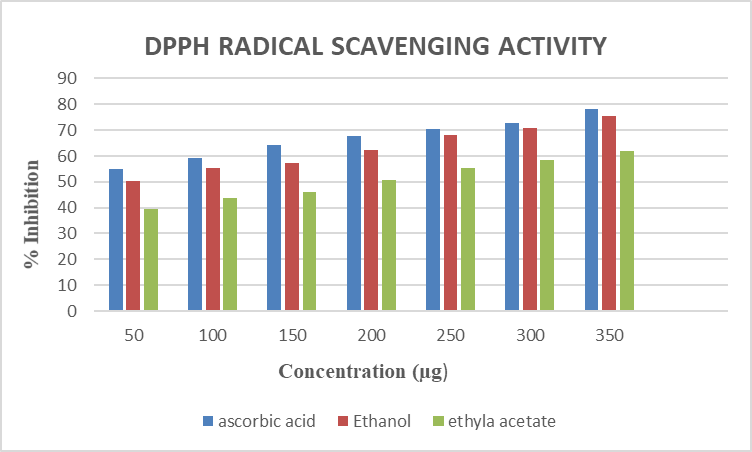
Fig no 5: Comparisons of % inhibition of DPPH Radical of Ethanol and Ethyl Acetate
The DPPH free radical scavenging assay revealed that the antioxidant activity of both extracts increased with concentration. Nevertheless, the ethanolic extract consistently showed greater percentage inhibition than the ethyl acetate extract at all tested concentrations. At 350 µg/mL, the ethanolic extract exhibited 75.41% inhibition, whereas the ethyl acetate extract showed 62.01% inhibition, demonstrating the stronger antioxidant potential of the ethanolic extract. Similarly, the total phenolic content of the ethanolic extract (88.72 ± 3.05 mg GAE/g extract) was significantly higher than that of the ethyl acetate extract (66.90 ± 3.62 mg GAE/g extract). The total flavonoid content also followed a similar trend, with values of 37.81 ± 0.47 mg QE/g extract and 27.77 ± 0.22 mg QE/g extract for ethanolic and ethyl acetate extracts, respectively. The superior performance of the ethanolic extract can be attributed to the higher polarity of ethanol, which facilitates efficient extraction of phenolic and flavonoid compounds. Since these phytochemicals are primarily responsible for antioxidant activity, their increased concentration directly contributes to enhanced free radical scavenging effects. [15,16,17,18] Overall, the comparative study demonstrates that the ethanolic extract of Argyreia nervosa possesses greater phytochemical richness and antioxidant potential than the ethyl acetate extract, suggesting that ethanol is the more suitable solvent for the extraction of antioxidant constituents from this plant.
CONCLUSION:
The present study successfully evaluated and compared the antioxidant potential of ethanolic and ethyl acetate extracts of Argyreia nervosa. Phytochemical screening confirmed the presence of several bioactive constituents, including flavonoids, phenolic compounds, tannins, and alkaloids, which are known to contribute to antioxidant activity. Both extracts exhibited concentration-dependent free radical scavenging activity in the DPPH assay. However, the ethanolic extract demonstrated significantly greater antioxidant activity compared to the ethyl acetate extract. This enhanced activity was supported by its higher total phenolic content (88.72 ± 3.05 mg GAE/g extract) and total flavonoid content (37.81 ± 0.47 mg QE/g extract). The findings indicate a strong relationship between the phenolic and flavonoid content of the extracts and their antioxidant potential. The superior performance of the ethanolic extract suggests that ethanol is a more effective solvent for extracting antioxidant phytoconstituents from Argyreia nervosa. In conclusion, Argyreia nervosa represents a promising natural source of antioxidants and may have potential applications in the development of herbal formulations aimed at managing oxidative stress-related disorders. Further studies involving isolation of active constituents and in vivo investigations are recommended to validate its therapeutic potential.
REFERENCES



Sumit Joshi*, Disha Magdum, Ratan Sagar, Ankita Temkar, Srushti Sutar, Dhanashri Patil, Prithviraj Palkar, Evaluation of Antioxidant Activity of Vidhara (Argyereia Nervosa): A Medicinal Plant, Int. J. Med. Pharm. Sci., 2026, 2 (7), 782-788. https://doi.org/10.5281/zenodo.21397198
 10.5281/zenodo.21397198