
We use cookies to ensure our website works properly and to personalise your experience. Cookies policy
1Shri Ganpati Institute of Pharmaceutical Sciences and Research, Tembhurni
2Professor, Shri Ganpati Institute of Pharmaceutical Sciences and Research, Tembhurni
3Principal, Shri Ganpati Institute of Pharmaceutical Sciences and Research, Tembhurni
Resistance of microorganisms against antibiotics is increasing rapidly and creating difficulty in Treatment of infectious diseases. Due to this increasing resistance, researchers are exploring Medicinal plants as safer and natural alternatives for antimicrobial treatment. The present study was Conducted to investigate the antibacterial potential of hydroalcoholic extracts of Neem, Turmeric, And Raktchandan towards Staphylococcus aureus and Escherichia coli. The antibacterial activity Was evaluated using the agar well diffusion technique. The powdered plant materials were extracted By the cold maceration process with 70 % hydroalcoholic solvent. Different concentrations of the Prepared extracts were then tested against the selected bacterial strains. Antibiotic Assay Medium And Mueller Hinton Agar were used for antimicrobial testing. Streptomycin was used as the Standard drug, while DMSO was used as the solvent control. The antibacterial effect of the extracts Was determined by measuring the clear zone of inhibition formed around each well. The findings Revealed that all three plant extracts showed antibacterial activity against Staphylococcus aureus, With greater activity observed at higher concentrations. Among all the extracts tested, Turmeric Demonstrated the strongest antibacterial effect, followed by Neem and Raktchandan. The Hydroalcoholic extract of Turmeric also showed noticeable antibacterial activity against Escherichia Coli. However, the standard drug Streptomycin produced a greater zone of inhibition than all the Herbal extracts.The results of the study indicate that the hydroalcoholic extracts of Neem, Turmeric, And Raktchandan exhibit mild to moderate antibacterial activity and could serve as potential natural Antimicrobial agents. The study supports the traditional medicinal use of these plants and indicates Their potential in the development of herbal antimicrobial formulations. Further studies involving Isolation of active phytoconstituents and advanced antimicrobial evaluation are recommended for Better understanding of their therapeutic potential.
Resistance of microorganisms against antibiotics is increasing rapidly and creating difficulty in treatment of infectious diseases. As a result, researchers are increasingly turning towards medicinal plants to discover safer and more effective natural antimicrobial agents. India, known for its rich traditional systems of medicine such as Ayurveda, has a wide variety of Healing plants that have been used for centuries to treat Distinct infections and diseases.
This project focuses on three such potent medicinal plants:
1. Neem (Azadirachta indica): commonly known as neem, is often called the “village
pharmacy” because of its wide range of medicinal uses. Neem is widely recognized for its antimicrobial, antifungal, and immune modulatory properties. These medicinal effects are mainly associated with the presence of bioactive constituents such as azadirachtin, nimbidin, and quercetin.
2. Raktchandan (Pterocarpus santalinus):
commonly called Red Sandalwood, Raktchandan is a medicinal plant traditionally valued in herbal medicine. The heartwood of the plant is commonly used in the treatment of skin-related problems, inflammation, and blood purification. Its therapeutic and antimicrobial effects are mainly attributed to natural phytochemicals such as santalins, pterocarpol, and various phenolic compounds.
3. Turmeric (Curcuma longa): commonly known as turmeric, is one of the most important herbs used in Ayurvedic medicine. Turmeric is commonly known for its potent anti-inflammatory and antioxidant activities. Its major bioactive compound, curcumin, has been widely researched for its antibacterial potential and its ability to suppress the growth of various bacteria, including some drug-resistant strains. Even though these Healing plantsare individually recognized for their antimicrobial activity, only a few studies have investigated their combined antimicrobial effects. The present study was designed to evaluate the antimicrobial activity of the hydroalcoholic extracts of these plants individually as well as in combination against selected pathogenic microorganisms. The study also aims to provide scientific support for their traditional medicinal use and to explore their potential in developing an effective synergistic polyherbal formulation
Advantages of Hydroalcoholic Extraction
Disadvantages of Hydroalcoholic Extraction:
Ideal Properties of a Hydroalcoholic Extraction System
1. Hydroalcoholic solvent extracts both polar and moderately non-polar phytochemicals effectively.
2. It provides high extraction efficiency of active plant constituents.
3. The ethanol-water mixture is relatively safe and less toxic.
4. It helps preserve heat-sensitive bioactive compounds.
5. The solvent can be removed easily after extraction.
6. Hydroalcoholic solvents are economical and easily available.
7. It allows broad-spectrum extraction of phytochemicals.
8. Alcohol reduces microbial contamination during extraction.
9. The extract is suitable for antimicrobial and pharmacological studies.
10. Hydroalcoholic extraction is comparatively eco-friendly
MATERIALS AND METHODS
1) The plant materials used in the study were:
|
Plant |
Form Used |
|
Azadirachta indica |
Powder |
|
Pterocarpus santalinus |
Powder |
|
Curcuma longa |
Powder |
2) Extraction Method
Hydroalcoholic extracts were prepared using the cold maceration technique. Five grams of each powdered plant material was macerated separately with 50 mL of hydroalcoholic solvent for 24–48 hours. The extracts were filtered and concentrated to obtain semisolid crude extracts.
3) Determination of Percentage Yield
Percentage yield was calculated using the formula:
Yield (%) = (Weight of Extract / Weight of Powdered Drug) × 100
4) Antimicrobial Evaluation
Step 1: Preparation of Culture Media
[For Staphylococcus aureus]
Accurately weigh 3.8 g of Antibiotic Assay Medium powder using a weighing balance.
[For Escherichia.coli]
Accurately weigh 3.8 g of Mueller Hinton Agar powder using a weighing balance.
Step 2: Dissolving
Transfer the weighed powder into separate conical flasks. About 100 mL of distilled water was added and the mixture was stirred gently by swirling to ensure Proper mixing.
Step 3: Heating Heat the mixture on a hot plate or heating mantle with continuous stirring until the powder dissolves Completely. Boil gently until a clear solution is obtained.
Step 4: pH Adjustment The final pH should be: at 25°C.Usually, commercial media do not require further adjustment.
Step 5: Plugging and Sterilization Close the flask with a cotton plug or aluminum foil. Sterilized in autoclave at a temperature of 121°C. 15 psi pressure 20 minutes
Step 6: Cooling
After autoclaving, allow the medium to cool to about 45–50°C.Avoid complete solidification.
• Collection of Test Organism
Obtain Suspension of Staphylococcus aureus from another laboratory.
Obtain Suspension of Escherichia coli from another college.
• Plate Preparation
Mix 1ml bacterial suspension with 100ml sterile molten agar medium.
Pour 15–20 mL medium into sterile Petri plates.
Allow agar to solidify.
• Preparation of Sample Solution
The sample solutions of different concentrations were prepared by using Dimethyl Sulfoxide (DMSO) as a solvent. For preparing the 5 mg/mL solution, 5 mg of the plant extract was accurately weighed and dissolved in 1 mL of DMSO. For the 10 mg/mL solution, 10 mg of the extract was dissolved in 1 mL of DMSO. Similarly, 20 mg and 25 mg of the extracts were separately dissolved in 1 mL of DMSO to obtain 20 mg/mL and 25 mg/mL solutions respectively.
• Preparation of Standard Solution
The standard solution was prepared by dissolving Streptomycin in sterile distilled water to obtain a concentration of 1 mg/mL. The solution was mixed properly to ensure complete dissolution and was used as the standard drug during the antimicrobial activity study.
• Sample Loading
Well 1 (empty): Do not add anything.
Well 2 (standard drug): Add 0.1 ml (or 10% DMSO) using a micropipette.
Well 3 (Extract Solutions): Add 0.1 ml of solution.
Well 4 (Extract Solutions): Add 0.1 ml of solution.
• Pre-diffusion After adding the samples into the wells, the plates were allowed to stand at room temperature for About 30–60 minutes so that the extracts could diffuse properly into the agar medium. In ssom Cases, the plates were kept at 4°C for 1 hour before incubation to enhance uniform diffusion of the Samples.
• Incubation The agar plates were kept in an inverted position and incubated at 37°C for 24 hours to allow proper growth of the microorganisms.
• Measure the Zones of Inhibition
• Observation
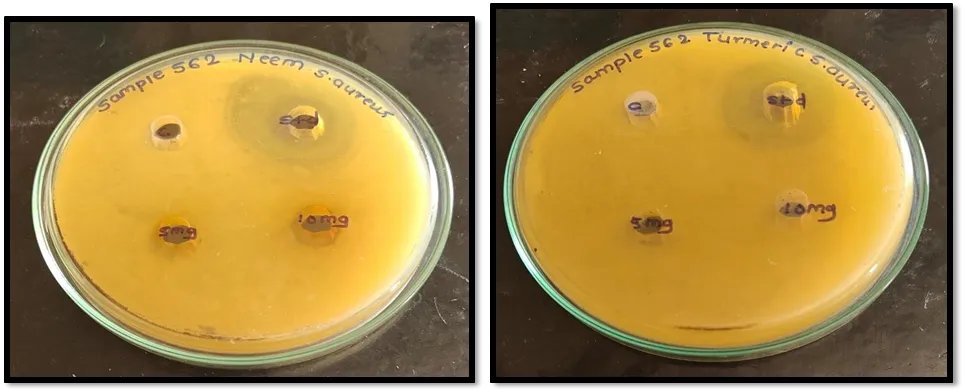
Fig. Neem Against Staphylococcus aureus] [Fig Turmeric againt S. areus]
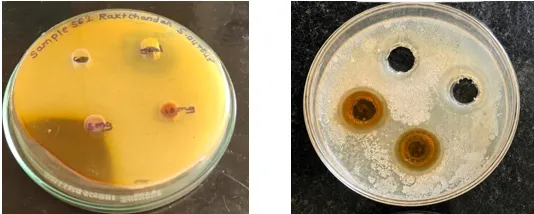
[Fig Raktchandan against Staphylococcus aureus] [Fig Turmeric against Escherichia.coli]
RESULTS
Table 1. Percentage Yield of Hydroalcoholic Extracts
|
Plant Material |
Initial Weight (g) |
Extract Obtained (g) |
Percentage Yield (%) |
|
Neem |
5 |
0.45 |
9 |
|
Turmeric |
5 |
0.60 |
12 |
|
Raktchandan |
5 |
0.35 |
7 |
The antibacterial potential of the hydroalcoholic extracts of Neem, Turmeric, and Raktchandan was studied against Staphylococcus aureus by using the agar well diffusion technique. The effectiveness of each extract was determined by observing and measuring the clear inhibitory zones formed around the wells on the agar plates. The diameter of these zones was recorded in millimeters, where a wider clear zone represented stronger antibacterial activity of the respective plant extract against the test bacteria.
Table 2. Antibacterial Activity of Neem Extract Against Staphylococcus aureus
|
Well No. |
Sample |
Concentration |
Zone of Inhibition (mm) |
|
1 |
Empty Well |
- |
No Zone |
|
2 |
Streptomycin |
1 mg/mL |
32 |
|
3 |
Turmeric Extract |
5 mg/mL |
3 |
|
4 |
Turmeric Extract |
10 mg/mL |
6 |
Table 3. Antibacterial Activity of Turmuric Extract Against Staphylococcus aureus
|
Well No. |
Sample |
Concentration |
Zone of Inhibition (mm) |
|
1 |
Empty Well |
- |
No Zone |
|
2 |
Streptomycin |
1 mg/mL |
32 |
|
3 |
Neem Extract |
5 mg/mL |
2 |
|
4 |
Neem Extract |
10 mg/mL |
4 |
Table 4. Antibacterial Activity of Raktchandan Extract Against Staphylococcus aureus
|
Well No. |
Sample |
Concentration |
Zone of Inhibition (mm) |
|
1 |
Empty Well |
- |
No Zone |
|
2 |
Streptomycin |
1 mg/mL |
32 |
|
3 |
Raktchandan Extract |
5 mg/mL |
2 |
|
4 |
Raktchandan Extract |
10 mg/mL |
3 |
The hydroalcoholic extract of Curcuma longa was tested for its antibacterial activity against Escherichia coli by the agar well diffusion method using Mueller Hinton Agar medium. The antibacterial effect of the extract was determined by checking the clear area formed around the wells after incubation. The size of this clear zone was measured to evaluate the ability of the extract to inhibit the growth of the test bacteria.
Table 5. Antibacterial Activity of Turmeric Extract Against Escherichia coli
|
Well No. |
Sample |
Concentration |
Zone of Inhibition (mm) |
|
1 |
Empty Well |
- |
No Zone |
|
2 |
Solvent Control |
1 mg/mL |
No Zone |
|
3 |
Turmeric Extract |
20 mg/mL |
10 |
|
4 |
Turmeric Extract |
25 mg/mL |
12 |
DISCUSSION
The findings of the present study revealed that the hydroalcoholic extracts of Neem, Turmeric, and Raktchandan exhibited antibacterial activity against Staphylococcus aureus. It was observed that the Antibacterial effect increased with an increase in the concentration of the extracts. Higher Concentrations produced comparatively larger zones of inhibition, indicating stronger antibacterial Action than the lower concentrations. Among the tested plant extracts, Turmeric showed comparatively higher antibacterial activity. This May be due to the presence of active phytoconstituents such as curcumin, which is well known for Its antimicrobial properties. Neem also exhibited moderate antibacterial activity, possibly because Of bioactive compounds like nimbidin and azadirachtin. In comparison, Raktchandan showed lower Antibacterial activity against the tested organism. The standard drug Streptomycin produced a significantly greater zone of inhibition than all the Herbal extracts, indicating its strong antibacterial effectiveness. However, the plant extracts still Demonstrated mild to moderate antimicrobial activity, suggesting their potential use as natural Antimicrobial agents. The study results suggest that the hydroalcoholic extracts of the selected medicinal plants showed Noticeable antibacterial activity. It was also observed that the antibacterial effect became stronger as The concentration of the extracts increased. Further studies using higher concentrations, isolation of Active constituents, and evaluation against different microorganisms may help to better understand The hydroalcoholic extract of Curcuma longa also showed noticeable antibacterial activity against Escherichia coli in the agar well diffusion study. The findings confirmed that the antibacterial effect Was due to the plant extract itself and not because of the solvent or experimental conditions. The antibacterial effect of turmeric could be due to the presence of various active constituents such As curcumin, flavonoids, tannins, and phenolic compounds, which are known for their antimicrobial Properties.. These phytochemicals are known to inhibit bacterial growth by damaging the bacterial Cell membrane, interfering with protein synthesis, and affecting microbial metabolic activities.
CONCLUSION
The findings of the present investigation confirmed that the hydroalcoholic extracts of Neem, Turmeric, and Raktchandan exhibited antibacterial activity against Staphylococcus aureus when tested by the agar well diffusion technique. It was observed that the effectiveness of the extracts improved as their concentration increased from 5 mg/mL to 10 mg/mL, resulting in greater inhibition of bacterial growth. Among all the plant extracts evaluated, Turmeric demonstrated the strongest antibacterial activity, while Neem showed moderate activity and Raktchandan showed comparatively lower activity. However, the standard antibiotic Streptomycin produced the greatest antibacterial effect when compared with all the tested herbal extracts.
The findings of the study suggest that these medicinal plant extracts have mild to moderate antimicrobial potential and may serve as natural antimicrobial agents. Further research involving higher concentrations, isolation of active phytoconstituents, and advanced studies may help in the development of effective herbal antimicrobial formulations. The study also demonstrated that the hydroalcoholic extract of Curcuma longa showed noticeable antibacterial activity against Escherichia coli. The extract effectively inhibited bacterial growth, indicating the presence of active antimicrobial compounds in turmeric. Overall, the findings of the study support the traditional use of Turmeric and other medicinal plants for the treatment of infections. These herbal extracts may serve as promising natural antimicrobial agents and could have potential applications in future pharmaceutical and therapeutic research.
REFERENCES




Rushikesh Markad*, Chaitanya Hegadkar, Mayur kekan, N. G. Shinde, R. R. Bendgude, Comparative In-Vitro Evaluation of Antimicrobial Activity of Hydroalcoholic Extracts of Azadirachta Indica Pterocarpus Santalinus, and Curcuma Longa, Int. J. Med. Pharm. Sci., 2026, 2 (7), 115-121. https://doi.org/10.5281/zenodo.21128617
 10.5281/zenodo.21128617