

We use cookies to ensure our website works properly and to personalise your experience. Cookies policy
Dr. M. C. Saxena College of Pharmacy
Cancer is a complex and multifactorial disease characterized by the uncontrolled growth and spread of abnormal cells to other parts of the body. The structural analysis of several approved anticancer agents demonstrates that both the isatin/indolin-2-one and sulphonamide scaffolds play crucial roles in cancer drug discovery. The target compounds was synthesized through a one-pot reaction. Synthesized Compounds were Spectraialy characterized. synthesized indoline-2,3-dione derivatives (JCP01–JCP05) was evaluated against the MCF-7 human breast cancer cell line, JCP04 displayed the most promising anticancer activity among the newly synthesized compounds, Among the synthesized molecules, JCP01 (1-(phenylsulfonyl)indoline-2,3-dione) exhibited the highest binding affinity with a docking score of −6.566 kcal/mol, indicating the strongest predicted interaction. The ADMET analysis indicates that the synthesized indoline-2,3-dione derivatives possess favorable physicochemical and pharmacokinetic profiles.
Cancer is a complex and multifactorial disease characterized by the uncontrolled growth and spread of abnormal cells to other parts of the body [1]. It can arise in various tissues, including the skin, organs, blood, and connective tissues, thereby affecting almost any part of the human body [2]. Under normal physiological conditions, cell division and growth are tightly regulated by genetic instructions encoded within DNA. However, in cancer, mutations or alterations in cellular DNA disrupt these regulatory pathways, resulting in uncontrolled cell proliferation and tumor formation [3].
Several risk factors contribute to cancer development, including smoking, exposure to carcinogens such as asbestos and industrial chemicals, excessive ultraviolet or ionizing radiation, certain viral infections (e.g., hepatitis B and C viruses, human papillomavirus), genetic predisposition, obesity, poor dietary habits, physical inactivity, and hormonal imbalances [4]. Tumors are broadly classified into two types: benign and malignant. Benign tumors are non-cancerous and do not usually invade neighboring tissues or metastasize; however, they can cause complications by exerting pressure on adjacent organs when they enlarge [5]. In contrast, malignant tumors have the ability to invade surrounding tissues and metastasize to distant organs via the bloodstream or lymphatic system [6]. Cancer development is influenced by a combination of genetic, environmental, and lifestyle factors. While some genetic mutations predisposing individuals to cancer may be inherited, most malignancies are associated with acquired genetic alterations that occur over a person’s lifetime [7].
Globally, cancer remains a major public health concern, affecting millions of individuals each year. It is the second leading cause of death worldwide, following cardiovascular diseases [8]. Colorectal cancer, in particular, is the third most commonly diagnosed cancer and the second leading cause of cancer-related mortality in both men and women [9]. Notably, colorectal cancer is often preventable and highly curable when detected early [10, 11]. Current treatment strategies include surgery, chemotherapy, and radiotherapy, with the therapeutic approach largely depending on the stage of the disease and the patient’s overall health status. Early detection and timely intervention significantly improve survival outcomes [12] .
Nearly 10% of all cancers diagnosed are colorectal cancers (CRCs), making them one of the most prevalent diseases in the world. Recent projections from the International Agency for Research on Cancer (IARC) and the World Health Organization (WHO) indicate that there were about 930,000 fatalities and 1.9 million new cases worldwide in 2020. If present trends continue, this number is expected to increase to around 3.2 million new cases and 1.6 million fatalities every year by 2040. The incidence of colorectal cancer (CRC) is considerably
greater in high-HDI and industrialized nations (over 45 cases per 100,000 population) than in poor nations (less than 5 cases per 100,000) [13, 14].
Multiple oncogenic signaling pathways interact intricately to induce the development and progression of colorectal cancer. APC mutations cause β-catenin accumulation and unchecked cell proliferation, which is the main way that the Wnt/β-catenin pathway contributes to early carcinogenesis. Additionally important regulators of CRC cell survival, proliferation, and metastasis are the MAPK/ERK (ERK1/2) and PI3K/AKT pathways, which are frequently triggered downstream of growth factor receptors like EGFR. Disease progression and treatment resistance are facilitated by the dysregulation of these cascades. In early stages, the TGF-β/SMAD pathway suppresses tumors, but in advanced colorectal cancer, it promotes invasion and metastasis. Additionally, other pathways like JAK/STAT, Notch, and Hedgehog (SHH/GLI) have been linked to preserving cancer stemness, cellular differentiation, Targeting the ERK1/2 pathway offers a promising approach to CRC treatment because of its crucial role in the MAPK signaling cascade. It has been demonstrated that ERK1/2 inhibitors have the ability to reduce tumor growth and get past the resistance mechanisms linked to traditional treatments. However, because signaling networks like Wnt, PI3K/AKT, and TGF-β have a lot of cross-talk, monotherapy might not be enough, and combinatorial targeting strategies are being investigated to improve therapeutic success. All things considered, knowledge of these signaling pathways promotes the further development of ERK1/2 inhibitors as possible agents for the treatment of colorectal cancer and offers vital insights for the logical design of innovative targeted therapeutics [15-17].
According to the Global Cancer Observatory (GLOBOCAN, 2023), cancer remains one of the leading causes of morbidity and mortality worldwide. In 2023, approximately 1,958,310 new cancer cases and 609,820 deaths were reported across all cancer types. Among specific cancers, lung cancer accounted for around 238,340 new cases and 127,070 deaths, making it the most lethal form of cancer. Colon cancer showed about 106,970 new cases with 3,245 deaths, whereas melanoma recorded 97,610 new cases and 7,990 deaths. Non-Hodgkin’s lymphoma and cell leukemia contributed 80,550 and 59,610 new cases, with 20,180 and 23,710 deaths, respectively. Thyroid cancer had 43,720 new cases and 2,120 deaths, while biliary tract cancer accounted for 41,210 new cases and 29,380 deaths. Similarly, ovarian cancer contributed 19,710 new cases and 13,270 deaths, stomach cancer had 26,500 new cases and 11,130 deaths, and esophageal cancer recorded 21,560 new cases with 16,120 deaths. These statistics highlight the global burden of cancer and the urgent need for improved diagnostic, preventive, and therapeutic strategies [18, 19].
Rationality design based on structural moiety: The structural analysis of several approved anticancer agents demonstrates that both the isatin/indolin-2-one and sulphonamide scaffolds play crucial roles in cancer drug discovery (Fig 1). Drugs such as sunitinib, semaxanib, nintedanib, and toceranib contain the isatin/indolin-2-one framework, which is a privileged pharmacophore known to inhibit receptor tyrosine kinases by binding to ATP-binding sites, thereby blocking downstream signaling pathways involved in tumor growth and angiogenesis. In contrast, compounds such as pazopanib and belinostat highlight the importance of the sulphonamide group, which contributes to enhanced aqueous solubility, favorable pharmacokinetic properties, hydrogen bonding interactions, and improved selectivity toward biological targets. By integrating these two pharmacologically relevant moieties, the design of phenylsulfonyl indoline-2,3-dione derivatives emerges as a rational approach for the development of novel anticancer drugs. Such hybrid molecules are expected to combine the kinase inhibitory activity of the isatin nucleus with the solubility and selectivity advantages of the sulphonamide group. This dual incorporation may result in compounds with enhanced binding affinity, improved pharmacological profiles, and the ability to overcome challenges such as poor bioavailability, limited selectivity, and drug resistance associated with existing anticancer therapies.
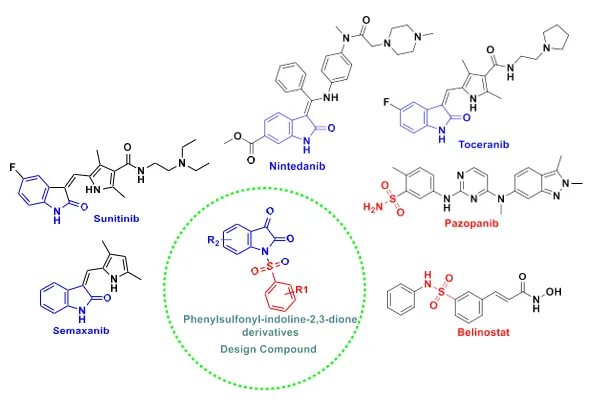
Fig. (1) Rationality design based on structural moiety of isatin and sulphonamide
General procedure for the synthesis of isatin-sulphonamide derivatives: The target compounds was synthesized through a one-pot reaction. Phenylsulfonyl chloride derivatives (1 mmol) and isatin derivatives (1 mmol) will dissolved in dichloromethane (DCM) in a round-bottom flask. To this solution, triethylamine ((Et)₃N, 3–5 mL) will added dropwise under constant stirring, while maintaining the reaction temperature at 0–3 °C using an ice bath. The reaction will allowed to proceed for 8–10 hours, and its completion will be monitored by thin-layer chromatography (TLC) using petroleum ether:ethyl acetate as the solvent system. After completion, the reaction mixture will quenched and subjected to liquid–liquid extraction with water and ethyl acetate. The organic layer will collected, and the solvent will evaporated under reduced pressure using a rotary evaporator, affording the isatin derivatives (phenylsulfonyl-indoline-2,3-diones) as solid products [54, 55].
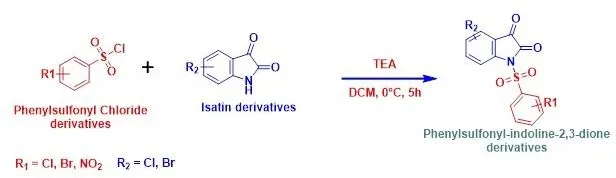
The reaction between phenylsulfonyl chloride derivatives and isatin derivatives in the presence of triethylamine (TEA) proceeds through a nucleophilic substitution mechanism leading to the formation of N-sulfonylated isatin derivatives. Initially, triethylamine acts as a base and abstracts the acidic proton from the nitrogen atom of the isatin ring, generating a nucleophilic nitrogen anion. This activated nitrogen species then attacks the electrophilic sulfur atom of the phenylsulfonyl chloride. The sulfur center is highly electrophilic due to the presence of two electron-withdrawing sulfonyl (S=O) groups, which facilitate nucleophilic attack. As the nitrogen lone pair attacks the sulfur atom, a tetrahedral intermediate is formed. Subsequently, this intermediate collapses with the elimination of the chloride ion as a good leaving group, resulting in the formation of the N-phenylsulfonyl indoline-2,3-dione derivative. During this process, the hydrochloric acid generated in situ is neutralized by triethylamine, forming triethylammonium chloride. The overall reaction thus results in the efficient N-sulfonylation of isatin under mild conditions using DCM as the solvent at 0 °C.
1.1. In silico studies of the proposed compound into the binding site of the target protein: By molecular docking studies: In-silico studies on synthesized compounds will done on in Schrodinger 2024 software using the Maestro module. Binding affinity will assessed with standard drug.
Preparing the protein is a crucial step in molecular docking. The protein structure will imported into Maestro for processing using its unique PDB ID: and the Protein Preparation Workflow will employed for protein preparation. The Protein Preparation Workflow shows several options such as preprocessing, optimising H-bond assignments, minimising, and deleting waters. The protein preparation job will executed with all these options set to their default selections. The OPLS 2005 force field will utilised to minimise and refine the protein structure.
The structures of the molecules, along with standard molecules stored in SDF files, will imported into Maestro using the "Import Structures" option. Ligand preparation will performed using Maestro's LigPrep module. In the LigPrep panel, the neutralisation option will selected, and only one stereoisomer per ligand will generated. The ligands will prepared with all other settings left at their default values. The OPLS 2005 force field algorithm will employed for this preparation.
The X-ray crystal structure of the protein will used to bind a ligand, which will then employed in glide molecular docking to identify the active site receptor grid. This allowed for the exploration of multiple conformations for the binding of constituents. In addition, sites, constraints, rotatable groups and excluded volumes will incorporated into the process.
After the preparation of the ligand, protein, and generation of grids on the active sites,
molecular docking will performed using extra precision. This approach enables rapid and precise evaluation of binding interactions, including the calculation of binding energy in kcal/mol. Various factors will assessed, such as hydrogen bonding, lipophilic interactions, pi-pi stacking interaction, internal energy, RMSD, and desolvation energy. Extra precision mode XP will used to increase the accuracy in the results.
The final score will evaluated based on the obtained docking score and interaction of the ligand and protein. The constituents that exhibited docking scores superior to the standard demonstrated a strong interaction with the target protein [56, 57].
ADMET Study: ADME (Absorption, Distribution, Metabolism, and Excretion) studies are crucial for evaluating the pharmacokinetic properties of quercetin derivatives, aiding in drug development and optimization. The SWISS ADME web tool provides a comprehensive in silico assessment of ADME properties, including physicochemical parameters, lipophilicity, water solubility, gastrointestinal absorption, blood-brain barrier (BBB) permeability, cytochrome P450 (CYP) enzyme interactions, and drug-likeness criteria.
The ADME analysis begins with the input of the molecular structure of quercetin derivatives in SMILES format into the SWISS ADME interface. The tool calculates key physicochemical properties such as molecular weight (MW), topological polar surface area (TPSA), and lipophilicity (log P), which influence oral bioavailability and membrane permeability. Compounds following Lipinski’s Rule of Five (MW < 500 Da, log P < 5, hydrogen bond donors ≤ 5, and hydrogen bond acceptors ≤ 10) are considered to have good oral bioavailability.
Gastrointestinal (GI) absorption is predicted based on the BOILED-Egg model, which classifies compounds as highly absorbed in the GI tract or poorly absorbed based on their TPSA and log P values. BBB permeability, an essential factor for central nervous system (CNS)-targeted drugs, is also assessed through this model, determining whether quercetin derivatives can effectively cross the BBB and act on neurological targets.
The metabolism of quercetin derivatives is analyzed by predicting their interactions with cytochrome P450 (CYP) enzymes. These enzymes, including CYP3A4, CYP2D6, and CYP1A2, play a crucial role in drug metabolism. Inhibition or induction of these enzymes may lead to drug-drug interactions, affecting pharmacokinetics and toxicity. Drug-likeness assessment is performed using multiple filters, including Lipinski’s, Veber’s, and Ghose’s rules, which help determine the oral drug potential of quercetin derivatives. Additionally, bioavailability scores are provided to estimate the likelihood of systemic availability after oral administration. The Pan-Assay Interference Compounds (PAINS) filter is used to identify potential false-positive compounds that may exhibit promiscuous binding. Toxicity prediction, though not explicitly provided by SWISS ADME, can be complemented with additional in silico tools such as ProTox 3.0 or pkCSM to assess potential hepatotoxicity, mutagenicity, and cardiotoxicity risks. The SWISS ADME study of quercetin derivatives provides critical insights into their drug-likeness, bioavailability, and potential metabolic interactions. These in silico evaluations facilitate the selection and optimization of lead compounds with favorable pharmacokinetic profiles for further preclinical and clinical studies.
1.2. In vitro anticancera assisment againt cancer cell lines: By MTT assay protocol: MTT Assay: The synthesized derivatives will assessed for their anticancer potential against the HCT-116 human colon carcinoma cell line, while the HFF human foreskin fibroblast cell line served as a normal control. Cells will seeded at a density of 1 × 10⁵ cells/well in 96-well plates and cultured in Dulbecco’s Modified Eagle’s Medium (DMEM) supplemented with 10% heat-inactivated fetal bovine serum (FBS), 1% L-glutamine, and 50 µg/mL gentamicin sulfate. Cultures will maintained at 37 °C in a humidified atmosphere of 5% CO₂ and 95% air.
The synthesized compounds will initially dissolved in DMSO to obtain stock solutions (1 mg/mL), which will subsequently diluted with DMEM containing 10% FBS to achieve working concentrations. All solutions will be sterilized through 0.2 µm syringe filters, and final concentrations ranging from 1–100 µM will be prepared.
Cells will be treated with varying concentrations of the compounds and incubated for 48 hours. Following treatment, 10 µL of MTT solution (5 mg/mL) will added to each well, and the plates will incubated for an additional 4 hours. After incubation, the medium will carefully removed, and the insoluble formazan crystals formed will dissolved in 100 µL of DMSO. The absorbance will be recorded at 540 nm using a microplate reader. Sorafenib will be employed as a reference standard drug.
All experiments will be performed in triplicate, with each concentration tested in three independent replicates. The IC₅₀ values will determined using appropriate nonlinear regression and statistical analysis [58, 59].
All the data regarding biological evaluation will be added in final thesis submission with picture.
Synthesized Derivatives:
|
|
|
|
|---|---|---|
| 1-(phenylsulfonyl) indoline-2,3-dione (JCP01) | 1-((4-chlorophenyl)sulfonyl)indoline-2,3-dione (JCP02) | 1-((4-nitrophenyl)sulfonyl)indoline-2,3-dione (JCP03) |
|
|
|
|
| 1-((4-bromophenyl)sulfonyl)indoline-2,3-dione (JCP04) | 1-((4-fluorophenyl)sulfonyl)indoline-2,3-dione (JCP05) |
Spectral characterization of Synthesized Compounds:
1-(phenylsulfonyl)indoline-2,3-dione (JCP01): Brick Red color, yield: 90%, m.p. 169-171 oC; IR (KBr, νmax cm⁻¹): 2921 (Ar–C–H), 2165 (weak, aliphatic C–H), 1725 (C=O, lactam), 1608 (C=O, ketone), 1580 and 1458 (Ar C=C). 1H NMR (600 MHz, DMSO-d6) δ (ppm): 8.17 (d, J = 7.1 Hz, 2H, Ar-H), 7.94 (d, J = 7.5 Hz, 2H, Ar-H), 7.55 (d, J = 7.4 Hz, 2H, Ar-H), 6.55 (d, J = 7.0 Hz, 2H, Ar-H). 13C NMR (151 MHz, DMSO-d6) δ (ppm): 185.81 (C=O), 154.82 (C=O), 134.86, 134.59, 133.07, 132.13, 131.79, 131.48, 131.07 (2C), 129.59 (2C), 129.21, 128.83. Mass (m/z): Calcd for C14H9NO4S: 287.00; Found: 287.0.
1-((4-chlorophenyl)sulfonyl)indoline-2,3-dione (JCP02): Brown color, yield: 85%, m.p. 172-174 oC; IR (KBr, νmax cm⁻¹): 2928 (Ar–C–H), 2164 (weak, aliphatic C–H), 1730 (C=O, lactam), 1661 (C=O, ketone), 1599 and 1507 (Ar C=C). 1H NMR (600 MHz, DMSO-d6) δ (ppm): 7.94 (d, J = 7.4 Hz, 2H, Ar-H), 7.82 (m, 1H, Ar-H), 7.80 (d, J = 7.5 Hz, 2H, Ar-H), 7.65 (m, 1H, Ar-H), 7.55 (d, J = 7.3 Hz, 2H, Ar-H). 13C NMR (151 MHz, DMSO-d6) δ (ppm): 165.53 (C=O), 164.06 (C=O), 151.46, 136.9, 135.42, 132.73 128.87 (2C), 128.48 (2C), 126.60, 124.71, 122.71 114.02. Mass (m/z): Calcd for C14H8ClNO4S: 320.00; Found: 320.0.
1-((4-nitrophenyl)sulfonyl)indoline-2,3-dione (JCP03): Red color, yield: 84%, m.p. 174-176 oC; IR (KBr, νmax cm⁻¹): 3160 (Ar–C–H), 2915 (weak, aliphatic C–H), 1738 (C=O, lactam), 1715 (C=O, ketone), 1590 and 1532 (Ar C=C). 1H NMR (600 MHz, DMSO-d6) δ (ppm): 8.17 (m, 1H, Ar-H), 7.90 (m, 2H, Ar-H), 7.1 (d, J = 7.1 Hz, 2H, Ar-H), 6.90 (m, 1H, Ar-H), 6.55 (m, 2H, Ar-H). 13C NMR (151 MHz, DMSO-d6) δ (ppm): 185.84 (C=O), 154.82 (C=O), 132.75, 131.92, 129.27, 127.00 (2C), 125.40, 119.67 (2C), 115.10 (2C), 113.61, 113.27. Mass (m/z): Calcd for C14H8N2O6S: 334.00; Found: 334.0.
1-((4-bromophenyl)sulfonyl)indoline-2,3-dione (JCP04): Reddish brown color, yield: 81%, m.p. 178-180 oC; IR (KBr, νmax cm⁻¹): 2922 (Ar–C–H), 2167 (weak, aliphatic C–H), 1729 (C=O, lactam), 1661 (C=O, ketone), 1599 and 1506 (Ar C=C). 1H NMR (600 MHz, DMSO-d6) δ (ppm): 8.10 (d, J = 7.6 Hz, 2H, Ar-H), 7.80 (d, J = 7.1 Hz, 2H, Ar-H), 7.30 (d, J = 7.2 Hz, 2H, Ar-H), 6.95 (d, J = 7.2 Hz, 2H, Ar-H). 13C NMR (151 MHz, DMSO-d6) δ (ppm): 185.85 (C=O), 154.83 (C=O), 135.52, 135.37, 132.45, 132.22, 131.92, 130.16, 129.81 (2C), 126.27, 128.35, 125.44, 113.29. Mass (m/z): Calcd for C14H8BrNO4S: 364.00; Found: 364.0.
1-((4-fluorophenyl)sulfonyl)indoline-2,3-dione (JCP05): Dark Dark yellowish color, yield: 85%, m.p. 186-187 oC; IR (KBr, νmax cm⁻¹): 2855 (Ar–C–H), 2165 (weak, aliphatic C–H), 1725 (C=O, lactam), 1608 (C=O, ketone), 1580 and 1458 (Ar C=C). 1H NMR (600 MHz, DMSO-d6) δ (ppm): 8.28 (m, 1H, Ar-H), 8.01 (m, 3H, Ar-H), 7.68 (m, 2H, Ar-H), 6.31 (m, 2H, Ar-H). 13C NMR (151 MHz, DMSO-d6) δ (ppm): 186.93 (C=O), 154.53 (C=O), 140.77, 139.18 (2C), 135.81 (2C), 132.75 (2C), 132.34 (2C), 131.96, 123.92, 113.62. Mass (m/z): Calcd for C14H8FNO4S: 305.00; Found: 305.0.
The in vitro anticancer activity: of the synthesized indoline-2,3-dione derivatives (JCP01–JCP05) was evaluated against the MCF-7 human breast cancer cell line, and the results were expressed as IC₅₀ values (µM). A lower IC₅₀ value indicates greater cytotoxic potency, as a smaller concentration of the compound is required to inhibit 50% of cancer cell growth.
Among the synthesized compounds, JCP04 exhibited the highest antiproliferative activity with an IC₅₀ value of 4.29 ± 0.19 µM, followed by JCP01 (5.12 ± 0.17 µM), JCP05 (5.34 ± 0.20 µM), JCP02 (6.90 ± 0.47 µM), and JCP03 (7.42 ± 0.20 µM). The reference drug Sorafenib demonstrated the greatest cytotoxic activity with an IC₅₀ value of 2.12 ± 0.12 µM, as expected.
Although none of the synthesized derivatives surpassed the potency of Sorafenib, JCP04 displayed the most promising anticancer activity among the newly synthesized compounds, with an IC₅₀ value approximately two-fold higher than Sorafenib. The enhanced activity of JCP04 may be attributed to the presence of the para-bromo substituent, which could improve molecular interactions with the target protein, consistent with its favorable molecular docking and molecular dynamics simulation results. Overall, the order of antiproliferative activity was:
Sorafenib > JCP04 > JCP01 > JCP05 > JCP02 > JCP03.
Table 5: In vitro MTT Assay Against MCF7 Cell Line
| Compounds Name | MCF7* (cell line) |
|---|---|
| IC50 inhibition (μM) | |
| (JCP01) | 5.12±0.17 |
| (JCP02) | 6.90±0.47 |
| (JCP03) | 7.42±0.20 |
| (JCP04) | 4.29±0.19 |
| (JCP05) | 5.34±0.20 |
| Sorafenib | 2.12±0.12 |
*Assay was performed in triplicate, and data were compiled for 48h incubation; Data were presented as mean ± standard error mean of three independent experiments
In silico studies of synthesized compounds:
Molecular Docking: To investigate the potential anti-breast cancer activity of the synthesized N-sulfonyl isatin derivatives, molecular docking studies were carried out against the ATP-binding site of Epidermal Growth Factor Receptor (EGFR) kinase (PDB ID: 4ZAU). EGFR is an important therapeutic target in breast cancer, particularly in triple-negative breast cancer, where its overexpression promotes uncontrolled cell proliferation, migration, angiogenesis, and resistance to apoptosis.
Detailed analysis of the ligand-protein interactions revealed the formation of key hydrogen bonds, and hydrophobic interactions with essential amino acid residues in the active site. These interactions play a pivotal role in stabilizing the ligand-protein complex and enhancing the inhibitory activity of the compounds. Additionally, the docking poses demonstrated that the quercetin core and its substituents are well-accommodated within the binding pockets, contributing to specificity and selectivity. Substituents at certain positions of the quercetin ring appeared to enhance binding affinity, highlighting possible structure-activity relationships (SAR) useful for future optimization. The molecular docking analysis supports the hypothesis that quercetin derivatives can serve as potent inhibitors Table 1& Fig. (3). The docking results demonstrated that all synthesized compounds exhibited favorable binding affinities toward the EGFR active site, with docking scores ranging from −5.566 to −6.566 kcal/mol, outperforming the reference inhibitor Sorafenib (−5.126 kcal/mol).
Among the synthesized molecules, JCP01 (1-(phenylsulfonyl)indoline-2,3-dione) exhibited the highest binding affinity with a docking score of −6.566 kcal/mol, indicating the strongest predicted interaction with EGFR. This compound formed two hydrogen bonds with the key catalytic residues Met793 and Thr854, along with extensive hydrophobic interactions involving Met766, Leu788, Ile789, Thr790, Gln791, Leu792, Lys745, Ile744, Ala743, Val726, and Leu718. These residues constitute the ATP-binding pocket of EGFR and play a crucial role in stabilizing kinase inhibitors.
JCP03 (4-nitrophenyl derivative) also demonstrated strong binding (−6.496 kcal/mol) by forming a hydrogen bond with Met793, a highly conserved hinge-region residue essential for kinase inhibition. The compound was further stabilized through hydrophobic interactions with Phe723, Leu718, Cys797, Leu792, Ala743, and Val726. The presence of the electron-withdrawing nitro group may enhance binding through favorable electronic interactions within the kinase pocket.
Similarly, JCP02 (4-chlorophenyl derivative) exhibited a docking score of −6.441 kcal/mol and maintained the crucial hydrogen bond with Met793. Additional hydrophobic interactions with Met766, Leu788, Thr790, Gln791, Pro794, Gly796, Glu762, Lys745, Leu844, Val726, and Leu718 contributed to the stability of the ligand within the active site.
The 4-bromophenyl analogue (JCP04) displayed a docking score of −6.366 kcal/mol, forming hydrogen bonds with Met793 and Val726, together with hydrophobic contacts involving Cys797, Leu792, Ala743, Leu718, and Phe723. Although its affinity was slightly lower than JCP01–JCP03, the bromine substituent appears to support favorable hydrophobic interactions.
The 4-fluorophenyl derivative (JCP05) showed the lowest binding affinity among the synthesized compounds (−5.566 kcal/mol), yet it still demonstrated stronger binding than Sorafenib. It formed hydrogen bonds with Met793 and Thr854 and interacted hydrophobically with residues including Met766, Leu788, Ile789, Thr790, Gln791, Leu792, Lys745, Ile744, Ala743, Val726, and Leu718.
A significant observation across all synthesized compounds is the conservation of hydrogen bonding with Met793, the hinge residue of EGFR. This interaction is widely recognized as one of the most important determinants of potent EGFR inhibition because it anchors inhibitors within the ATP-binding cleft. The frequent involvement of hydrophobic residues such as Leu718, Val726, Ala743, Lys745, Met766, Leu788, Leu792, and Cys797 further suggests stable occupation of the kinase active site.
Table 1: Docking Score of Synthesized Compounds (PDB IDs: 4ZAU) And Key Amino Acid Residues Involved in Binding Interaction Analysis of Docked Ligands
| Compound NAME | DOCKING SCORE (Kcal/Mol) | Key Binding Interactions | |
|---|---|---|---|
| Hydrophobic Interaction | H-bond Interaction | ||
| 1-(phenylsulfonyl)indoline-2,3-dione (JCP01) | -6.566 | MET766, LEU788, ILE789, THR790, GLN791, LEU792, LEU844, LYS745, ILE744, ALA743, VAL726, LEU718 | MET793, THR854 |
| 1-((4-chlorophenyl)sulfonyl)indoline-2,3-dione (JCP02) | -6.441 | MET766, LEU788, THR790, GLN791, PRO794, GLY796, GLU762, MET766, LYS745, LEU844, VAL726, LEU718 | MET793 |
| 1-((4-nitrophenyl)sulfonyl)indoline-2,3-dione (JCP03) | -6.496 | PHE723, LEU718, CYS797, LEU792, ALA743, LEU792, PHE723, ALA743, VAL726, LEU718 | MET793 |
| 1-((4-bromophenyl)sulfonyl)indoline-2,3-dione (JCP04) | -6.366 | CYS797, LEU792, ALA743, LEU718, PHE723 | MET793, VAL726 |
| 1-((4-fluorophenyl)sulfonyl)indoline-2,3-dione (JCP05) | -5.566 | MET766, LEU788, ILE789, THR790, GLN791, LEU792, LEU844, LYS745, ILE744, ALA743, VAL726, LEU718 | MET793, THR854 |
| Standard (Sorafenib) | -5.126 | MET766, LEU788, LEU792, LEU844, LYS745, ILE744, ALA743, LEU844, MET766, VAL726, LEU718 | MET793 |
Table 2: Docking Image of Synthesized Compounds (PDB IDs: 4ZAU) And Key Amino Acid Residues Involved in Binding Interaction Analysis of Docked Ligands
| Sr No. | Compound Name | Docking Image |
|---|---|---|
| 1 | 1-(phenylsulfonyl)indoline-2,3-dione (JCP01) | |
| 2 | 1-((4-chlorophenyl)sulfonyl)indoline-2,3-dione (JCP02) | |
| 3 | 1-((4-nitrophenyl)sulfonyl)indoline-2,3-dione (JCP03) | |
| 4 | 1-((4-bromophenyl)sulfonyl)indoline-2,3-dione (JCP04) | |
| 5 | 1-((4-fluorophenyl)sulfonyl)indoline-2,3-dione (JCP05) | |
| 6 | Standard (Sorafenib) |
6.3.2 In Silico ADME-T and Drug-Likeness Profiling: The physicochemical and pharmacokinetic properties of the synthesized compounds (JCP01–JCP05) were evaluated and compared with the reference drug, Sorafenib. All synthesized derivatives exhibited molecular weights ranging from 287.0 to 364.0 g/mol, which are considerably lower than that of Sorafenib (464.82 g/mol), suggesting favorable drug-like characteristics in accordance with Lipinski's rule of five.
The number of hydrogen bond acceptors (HBA) ranged from 4 to 6 among the synthesized compounds, while hydrogen bond donors (HBD) were absent in all derivatives except JCP02, which possessed four hydrogen bond donors. These values fall within the acceptable limits for oral drug candidates and are expected to support efficient molecular recognition and receptor binding.
The lipophilicity (Log P) values of JCP01–JCP05 ranged between 1.86 and 2.72, indicating balanced hydrophilic and lipophilic properties that are favorable for membrane permeability. In comparison, Sorafenib exhibited a higher Log P value (4.07), reflecting greater lipophilicity that may negatively influence aqueous solubility.
All synthesized compounds demonstrated high predicted gastrointestinal (GI) absorption, whereas Sorafenib showed low GI absorption, suggesting that the designed molecules may possess superior oral bioavailability. None of the synthesized compounds or Sorafenib were predicted to cross the blood–brain barrier (BBB), indicating a lower likelihood of central nervous system-related adverse effects.
Furthermore, all compounds were predicted to be non-substrates of P-glycoprotein (P-gp), suggesting a reduced risk of drug efflux and potentially improved intracellular drug retention. Additionally, none of the synthesized derivatives were predicted to inhibit the CYP1A2 or CYP2C19 isoenzymes, indicating a lower probability of cytochrome P450-mediated drug–drug interactions.
Overall, the ADMET analysis indicates that the synthesized indoline-2,3-dione derivatives possess favorable physicochemical and pharmacokinetic profiles, particularly high gastrointestinal absorption, moderate lipophilicity, absence of BBB penetration, lack of P-gp substrate characteristics, and minimal CYP-mediated interaction potential. Among the synthesized compounds, JCP04 and JCP05 demonstrated the most balanced drug-like properties, supporting their potential as promising oral anticancer candidates compared with the reference drug Sorafenib.
Table 2: ADME Profile of Synthesized Molecules
| Properties | (JCP01) | (JCP02) | (JCP03) | (JCP04) | (JCP05) | Standard (Sorafenib) |
|---|---|---|---|---|---|---|
| Formula | C14H9N4O4S | C14H8ClN4O4S | C14H8N2O6S | C14H8BrNO4S | C14H8FNO4S | C21H16ClF3N4O3 |
| Molecular weight | 287.0 g/mol | 320.00 g/mol | 334.00 g/mol | 364.00 g/mol | 305.00 g/mol | 464.82 g/mol |
| Num. H-bond acceptors | 4 | 4 | 6 | 4 | 5 | 7 |
| Num. H-bond donors | 0 | 4 | 0 | 0 | 0 | 3 |
| Log Po/w | 2.03 | 2.65 | 1.86 | 2.72 | 2.13 | 4.07 |
| GI absorption | High | High | High | High | High | Low |
| BBB penetration | No | No | No | No | No | No |
| Pgp substrate | No | No | No | No | No | No |
| CYP1A2 | No | No | No | No | No | No |
| CYP2C19 | No | No | No | No | No | No |
Table 2: ADME Profile Image of Synthesized Molecules
| Sr No. | Compound NAME | ADME prediction |
|---|---|---|
| 1 | 1-(phenylsulfonyl)indoline-2,3-dione (JCP01) |
|
| 2 | 1-((4-chlorophenyl)sulfonyl)indoline-2,3-dione (JCP02) |
|
| 3 | 1-((4-nitrophenyl)sulfonyl)indoline-2,3-dione (JCP03) |
|
| 4 | 1-((4-bromophenyl)sulfonyl)indoline-2,3-dione (JCP04) |
|
| 5 | 1-((4-fluorophenyl)sulfonyl)indoline-2,3-dione (JCP05) |
|
| 6 | Standard (Sorafenib) |
|
Toxicity profile: he toxicity profiles of the synthesized indoline-2,3-dione derivatives (JCP01–JCP05) were predicted using computational toxicity assessment and compared with the reference drug Sorafenib. The results indicate that most synthesized compounds exhibited a comparatively safer toxicity profile than Sorafenib.
For hepatotoxicity, JCP01 and JCP02 were predicted to be inactive (non-hepatotoxic), whereas JCP03–JCP05 showed mild predicted activity. In contrast, Sorafenib demonstrated a strong hepatotoxicity prediction (A, 0.82), indicating a higher risk of liver toxicity.
In terms of neurotoxicity, all synthesized compounds were predicted to be inactive, while Sorafenib was predicted to be active (A, 0.94), suggesting that the synthesized derivatives may have a lower potential for central nervous system toxicity. For nephrotoxicity, only JCP02 showed borderline predicted activity, whereas the remaining compounds were inactive. Sorafenib was predicted to be inactive for nephrotoxicity. Regarding cardiotoxicity, JCP01, JCP02, JCP03, and JCP05 were predicted to be inactive, while JCP04 showed mild predicted activity. Sorafenib was also predicted to be inactive for cardiotoxicity. The carcinogenicity prediction indicated that JCP01, JCP02, JCP04, and JCP05 were inactive, whereas JCP03 showed possible activity. Sorafenib showed borderline carcinogenicity prediction. Similarly, for mutagenicity, JCP01, JCP02, JCP04, and JCP05 were predicted to be inactive, while JCP03 was predicted to be active, indicating a comparatively higher mutagenic risk for this derivative. All synthesized compounds were predicted to be BBB toxicity active, with probability values ranging from 0.70 to 0.77, similar to Sorafenib (0.77). However, this prediction reflects a potential BBB-related toxicity alert and should be interpreted alongside the earlier ADMET prediction, which indicated no BBB penetration; thus, further experimental validation is required.
Additional alerts may indicate potential for carcinogenicity, immunotoxicity, mutagenicity, or hepatotoxicity based on structural analysis Table 3.
Table 3: Toxicity Profile of Synthesized Molecules
| Comp code | Hepato toxicity | Neurotoxicity | Nephro toxicity | Cardio toxicity | Carcinogenicity | Mutagenecity | BBB Toxicity |
|---|---|---|---|---|---|---|---|
| (JCP01) | I(0.50) | I(0.77) | I(0.51) | I(0.68) | I(0.68) | I(0.61) | A(0.76) |
| (JCP02) | I(0.51) | I(0.7) | A(0.50) | I(0.68) | I(0.68) | I(0.69) | A(0.75) |
| (JCP03) | A(0.57) | I(0.85) | I(0.58) | I(0.70) | A(0.51) | A(0.70) | A(0.70) |
| (JCP04) | A(0.53) | I(0.70) | I(0.50) | A(0.56) | I(0.68) | I(0.68) | A(0.75) |
| (JCP05) | A(0.51) | I(0.69) | I(0.51) | I(0.67) | I(0.69) | I(0.67) | A(0.77) |
| Sorafenib | A(0.82) | A(0.94) | I(0.82) | I(0.85) | I(0.50) | I(0.79) | A(0.77) |
CONCLUSION:
Cancer is a complex and multifactorial disease characterized by the uncontrolled growth and spread of abnormal cells to other parts of the body. The structural analysis of several approved anticancer agents demonstrates that both the isatin/indolin-2-one and sulphonamide scaffolds play crucial roles in cancer drug discovery.
The target compounds was synthesized through a one-pot reaction. Synthesized Compounds were Spectraialy characterized. synthesized indoline-2,3-dione derivatives (JCP01–JCP05) was evaluated against the MCF-7 human breast cancer cell line, JCP04 displayed the most promising anticancer activity among the newly synthesized compounds, Among the synthesized molecules, JCP01 (1-(phenylsulfonyl)indoline-2,3-dione) exhibited the highest binding affinity with a docking score of −6.566 kcal/mol, indicating the strongest predicted interaction. The ADMET analysis indicates that the synthesized indoline-2,3-dione derivatives possess favorable physicochemical and pharmacokinetic profiles.
CONCLUSION:
Cancer is a complex and multifactorial group of diseases characterized by uncontrolled cell proliferation, resistance to apoptosis, tissue invasion, and metastasis. The present study focuses on the design, synthesis, and evaluation of benzimidazole-based compounds with the aim of identifying novel anticancer agents with improved therapeutic potential.
Five different derivatives were synthesized. The docking results suggest that the synthesized benzimidazole derivatives possess favorable binding characteristics toward the target protein. Although ACP01 achieved the lowest docking energy, ACP04 exhibited a more comprehensive interaction profile, including dual hydrogen bonds and additional hydrophobic contacts, indicating enhanced binding stability. These findings are consistent with its superior biological activity and subsequent molecular dynamics simulation results, supporting ACP04 as the most promising lead compound in the synthesized series.
ACP04 displayed the most potent antiproliferative effect among the synthesized series. The ADMET analysis demonstrates that the synthesized benzimidazole derivatives possess favorable drug-like characteristics, including low molecular weight, moderate lipophilicity, high gastrointestinal absorption, absence of P-gp substrate liability, and minimal CYP1A2 interaction potential. Overall, the computational toxicity analysis suggests that ACP01, ACP02, ACP03, and ACP05 possess relatively favorable safety profiles, particularly with respect to nephrotoxicity, cardiotoxicity, carcinogenicity, and mutagenicity, while ACP04, despite its promising biological activity, demonstrated potential carcinogenic and mutagenic liabilities that warrant further investigation.
Acknowledgements:
The authors are thankful to Dr. M.C. Saxena College of Pharmacy, Lucknow for providing the necessary facilities to execute this manuscript.
Conflicts of interest/Competing interests: The authors declare no competing interest
Code availability: NA
Authors' contributions:
Conceptualization: Shobhit Praksh Srivsatava; Data collection: Ajeet Verma, Writing the manuscript: Ajeet Verma; Sketching of figures and data interpretation: Ajeet Verma; Writing, review and final editing of the manuscript: Shobhit Praksh Srivsatava.
Funding information: NA
REFERENCES

Ajeet Verma, Shobhit Praksh Srivsatava, Isatin-sulphonamide Derivatives as Anti-Cancer Compounds via Synthesis, Computational, and Biological Studies, Int. J. Med. Pharm. Sci., 2026, 2 (11), 234-251. https://doi.org/10.5281/zenodo.24489213
 10.5281/zenodo.24489213