

We use cookies to ensure our website works properly and to personalise your experience. Cookies policy
Department of Pharmacy, University College of Technology (A), Osmania University, Hyderabad, 500007, Telangana, India
Multicomponent reactions (MCRs) represent one of the most powerful and sustainable paradigms in modern organic synthesis and drug discovery. By combining three or more starting materials in a single reaction vessel to construct highly functionalized products with high atom economy and step efficiency, MCRs provide unprecedented access to vast chemical space. This review comprehensively covers the fundamental principles of MCRs, detailed electron-pushing reaction mechanisms (Ugi, Biginelli, Passerini, Mannich, Hantzsch, Groebke-Blackburn-Bienaymé, Kabachnik-Fields, Gewald, Petasis, Asinger, Bucherer-Bergs, and Povarov), and their application in assembling bioactive heterocyclic scaffolds. Special emphasis is placed on Central Nervous System (CNS) pathologies, including Alzheimer’s disease, Parkinson’s disease, epilepsy, schizophrenia, depression, and ischemic cerebrovascular accidents. We critically examine Structure-Activity Relationship (SAR) insights, Multi-Target Directed Ligand (MTDL) design, library synthesis, green chemistry metrics, and recent technological breakthroughs (2020-2026) including photoredox, continuous flow, and biocatalysis.
In contemporary pharmaceutical research, the rapid assembly of complex, drug-like molecular architectures remains a pivotal determinant of drug discovery velocity [18][67]. Traditional linear multistep organic synthesis-characterized by sequential bond-forming operations, intermediate isolation, and labor-intensive purification steps-is increasingly constrained by severe step inefficiencies, low overall yield accumulation, high energy consumption, and substantial waste generation [65][14]. The fine chemical and pharmaceutical manufacturing sectors historically exhibit an Environmental factor (E-factor, defined as the mass ratio of waste generated per unit mass of product) ranging from 25 to over 100, significantly exceeding that of bulk chemical production [65]. Consequently, the integration of Green Chemistry principles-specifically waste prevention, atom economy, less hazardous chemical synthesis, and step reduction-has transitioned from an academic ideal to an industrial necessity [2][14]. Within this evolving landscape, Multicomponent Reactions (MCRs) have emerged as indispensable synthetic tools for both target-oriented synthesis (TOS) and diversity-oriented synthesis [70][19][10]. An MCR is defined as an operationally efficient one-pot transformation wherein three or more precursor components react simultaneously or in a closely orchestrated domino cascade to form a single product that incorporates substantially all non-hydrogen atoms of the starting materials [71][60]. By forming multiple carbon-carbon (C-C) and carbon-heteroatom (C-X, where X = N, O, S, P) bonds in a single synthetic operation, MCRs maximize bond-forming efficiency (BFI) and step economy while minimizing solvent requirements for extractions and chromatographic separations [53][34]. The therapeutic landscape for Central Nervous System (CNS) pathologies presents some of the most daunting challenges in modern medicine [11]. Neurological disorders-encompassing neurodegenerative conditions such as Alzheimer’s disease (AD) and Parkinson’s disease (PD), neuropsychiatric illnesses such as schizophrenia and major depressive disorder, and paroxysmal conditions like epilepsy-constitute the primary cause of global disability and the second leading cause of worldwide mortality [54][11]. Drug discovery for CNS targets is exceptionally complex due to the multifactorial etiology of neurodegeneration, strict blood-brain barrier (BBB) penetration requirements (dictating specific ranges for molecular weight, lipophilicity logP, topological polar surface area TPSA, and hydrogen-bond donor/acceptor counts), and the frequent emergence of drug resistance or dose-limiting peripheral toxicities [17][45]. MCR chemistry offers unique advantages in tackling CNS drug discovery. First, the dense functionalization and three-dimensional structural complexity characteristic of MCR adducts impart superior globularity (measured by fraction of sp³ carbons, f-sp³) and shape diversity compared to flat, aromatic non-MCR screening libraries [68][21]. Second, the high modularity of MCRs allows medicinal chemists to rapidly synthesize systematically varied analog libraries for fine-tuning BBB permeability and receptor isoform selectivity [52]. Third, MCRs facilitate the rational construction of Multi-Target Directed Ligands (MTDLs)-single chemical entities capable of simultaneously modulating multiple disease-relevant enzymatic pathways or neurotransmitter receptors [64][47]. This review provides an exhaustive, source-grounded examination of MCR fundamentals, chemical mechanisms, heterocyclic library generation, SAR rules, and clinical breakthroughs targeting CNS pathologies and related therapeutic areas.
2. Fundamentals of Multicomponent Reactions
2.1 Definition and Concept
The fundamental concept of MCRs relies on converging three, four, or more distinct chemical inputs into a unified reaction matrix under a single set of experimental conditions [70]. Mechanistically, an MCR does not occur via an impossible simultaneous multi-body collision; rather, it proceeds through a highly organized sequence of reversible elementary steps (such as imine condensation, Knoevenagel adduct formation, or nucleophilic addition) that culminate in a driving, irreversible thermodynamic process (such as a Mumm rearrangement, ring cyclization, or elimination of water) [1][14]. This irreversible thermodynamic sink effectively pulls all prior reversible equilibria forward, driving the conversion to completion with high chemo- and regioselectivity.
2.2 Characteristics of MCRs
Key defining attributes of MCRs include:
1. High Atom Economy (AE %): The majority of constituent atoms from starting reactants are retained in the final structure. Condensation by-products, if any, are typically benign small molecules such as water, alcohols, or simple salts [2][14].
2. Superior Bond-Forming Index (BFI): Multiple covalent bonds (typically 2 to 6 new C-C or C-X bonds) are created in a single vessel without inter-step isolation [59].
3. High Structural Convergence: Rather than building complexity linearly over 5-10 steps, MCRs assemble complex core frameworks in a single operational turn [20].
4. Densely Functionalized Chemical Space: MCR products naturally contain multiple hydrogen-bond donors, acceptors, and stereogenic centers around a central heterocyclic core, offering ideal topological complementarity for biological macromolecular targets such as G-protein coupled receptors (GPCRs), ion channels, and protein-protein interactions (PPIs) [20][29].
Advantages over Conventional Multistep Synthesis
When compared to linear multi-step reaction sequences, MCRs offer dramatic operational and economic advantages. In linear synthesis, an 8-step sequence with an average yield of 80% per step yields an overall efficiency of only 16.8%, generating substantial waste during intermediate workups, silica gel column chromatography, and solvent evaporation [53]. In contrast, a 1-step 4-component MCR yielding 85% achieves immediate complexity with minimal process mass intensity (PMI) [14]. Furthermore, MCRs eliminate the need for temporary protecting group manipulations, significantly improving atom and time economy [34].
Importance in Medicinal Chemistry
In modern drug discovery pipelines-spanning hit identification, lead optimization, and process development-MCRs play a transformative role.The inherent modularity of MCR inputs enables automated parallel synthesis and combinatorial chemistry, allowing automated synthesis platforms to generate libraries of thousands of distinct analogs in parallel [77]. Furthermore, MCR adducts serve as versatile 'synthetic hubs' for secondary transformations-an approach known as the Ugi-Deprotection-Cyclization (UDC) or post-MCR strategy-unlocking hundreds of unique fused, bridged, and spirocyclic ring systems from a single primary adduct [20] [76].
Table 1. Quantitative Green Chemistry Metrics Comparison across Classic MCRs vs Linear Synthesis
|
MCR / Synthetic Method |
Atom Economy (AE %) |
E-Factor (Emw) |
Condensation By-product |
Reaction Type / Driving Force |
|
Passerini 3-CR (P-3CR) |
100% |
0.00 |
None (Addition) |
Mumm rearrangement |
|
Ugi 4-CR (U-4CR) |
91% |
0.10 |
1 H2O |
Mumm rearrangement |
|
Groebke-Blackburn (GBB-3CR) |
90% |
0.11 |
1 H2O |
[3+2] cycloaddition / aromatization |
|
Mannich 3-CR |
89% |
0.13 |
1 H2O |
Iminium addition |
|
Biginelli 3-CR (B-3CR) |
84% |
0.20 |
2 H2O |
Knoevenagel / Cyclodehydration |
|
Petasis 3-CR (PR) |
65% |
0.55 |
1 H2O, B(OH)3 |
Intramolecular organoboron transfer |
|
Conventional Linear Synthesis (3-step) |
38% |
1.85 |
Multiple organic/inorganic salts |
Sequential protection/deprotection |
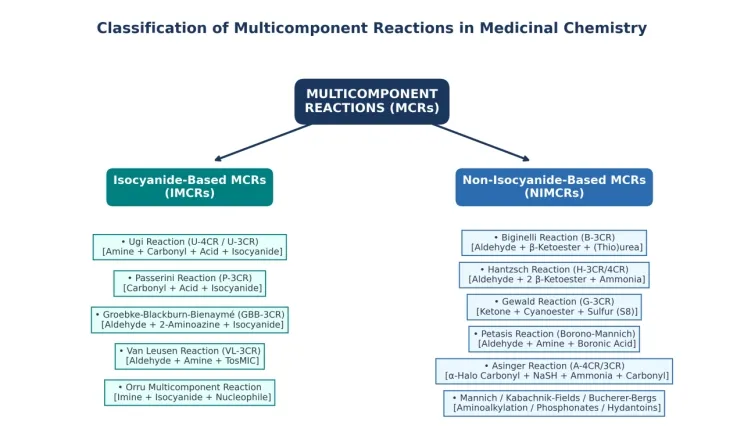
Figure 1. Structural classification and taxonomy of major Isocyanide-Based (IMCR) and Non-Isocyanide-Based (NIMCR) multicomponent reactions in medicinal chemistry.
3. Major Multicomponent Reactions
The repertoire of classic and contemporary MCRs encompasses diverse reaction mechanisms, nucleophile/electrophile pairings, and intermediate cascades. Below, the seven major name reactions requested, alongside additional crucial MCR transformations, are analyzed in mechanistic and synthetic detail.
3.1 Ugi Reaction
Discovered by Ivar Ugi in 1959, the classic Ugi four-component reaction (U-4CR) combines a primary or secondary amine, an aldehyde or ketone, a carboxylic acid, and an isocyanide in polar protic solvents (such as methanol, 2,2,2-trifluoroethanol, or ethanol) to yield an α-acylamino carboxamide (bis-amide) [70][18][25].
Mechanistic Cascade: The detailed step-by-step mechanism proceeds via:
1. Condensation: Nucleophilic attack of the primary amine on the carbonyl component forms a neutral hemiaminal, which undergoes rapid acid-catalyzed dehydration to generate a polar iminium intermediate [R¹-CH=N⁺H-R²].
2. Isocyanide Addition: The divalent, ambiphilic C atom of the isocyanide (:C=N-R³) acts as a nucleophile, attacking the electrophilic iminium carbon to form an unstable, highly reactive nitrilium ion intermediate [R¹-CH(NHR²)-C≡N⁺-R³].
3. Carboxylate Attack: The carboxylate anion (R⁴-COO⁻), generated during initial imine protonation, acts as a nucleophile and attacks the electrophilic nitrilium carbon to yield an α-adduct imidate intermediate [R¹-CH(NHR²)-C(O-COR⁴) =NR³].
4. Mumm Rearrangement: The intramolecular, irreversible acyl transfer from oxygen to the secondary amino nitrogen (the Mumm rearrangement) drives the overall process forward, providing the stable α-acylamino amide product with high thermodynamic driving force [1][25].
Post-Ugi Modifications & Nitrilium Trapping: The utility of the Ugi reaction is dramatically expanded when bifunctional starting materials are employed. In cases where an intramolecular nucleophilic moiety (such as an alcohol, thiol, amine, or carboxamide) is present on one of the inputs, it can intramolecularly trap the reactive nitrilium intermediate prior to carboxylate addition (a phenomenon known as 'nitrilium trapping') [64]. This pathway enables direct access to nitrogen, oxygen, and sulfur heterocycles such as quinoxalines, benzoxazines, imidazoles, and tetrazoles. Furthermore, post-Ugi secondary transformations-such as Ugi-Heck, Ugi-Diels-Alder, Ugi-click, Ugi-Pictet-Spengler, and Ugi-Buchwald-Hartwig couplings-provide rapid entry to complex polycyclic peptidomimetics and alkaloid-like frameworks. [44][76]
3.2 Biginelli Reaction
First reported by Pietro Biginelli in 1891, the classic Biginelli three-component reaction (B-3CR) involves the acid-catalyzed cyclocondensation of an aryl or aliphatic aldehyde, a β-ketoester (such as ethyl acetoacetate), and urea or thiourea to afford 3,4-dihydropyrimidin-2(1H) -(th) ones (DHPMs) [5] [43][73].
Mechanism: The widely accepted iminium mechanism involves an initial acid-catalyzed condensation between urea and the aldehyde to generate an N-acyliminium ion intermediate. Subsequent nucleophilic Michael-type addition of the β-ketoester enol tautomer to the iminium carbon creates an open-chain ureide intermediate. Intramolecular nucleophilic attack of the secondary urea nitrogen onto the β-keto carbonyl followed by dehydration yields the functionalized DHPM ring [1]. DHPMs represent privileged scaffolds in cardiovascular and oncology therapeutics, exemplified by the antihypertensive agent nifedipine analogs and the mitotic kinesin Eg5 inhibitor monastrol[43][50].
3.3 Passerini Reaction
Discovered by Mario Passerini in 1921, the Passerini three-component reaction (P-3CR) is the premier isocyanide-based MCR operating in the absence of an amine input. It combines an aldehyde or ketone, a carboxylic acid, and an isocyanide in aprotic, non-polar or moderately polar solvents (such as dichloromethane or diethyl ether) to yield an α-acyloxy carboxamide. [55][4]
Mechanism: The reaction proceeds via electrophilic activation of the carbonyl component by the carboxylic acid through hydrogen bonding or protonation. The isocyanide carbon attacks the carbonyl carbon, forming a transient nitrilium-carboxylate ion pair. Subsequent carboxylate addition to the nitrilium carbon yields an imidate intermediate, which undergoes an intramolecular Mumm acyl shift to deliver the α-acyloxy amide product [4]. In the Seebach variant of the Passerini reaction, Lewis acids such as TiCl₄ mediate the addition of isocyanides to carbonyls in the presence of water, cleanly affording α-hydroxy amides-a key transformation employed in the industrial manufacturing of the anti-androgenic drug bicalutamide (Casodex) [62].
3.4 Mannich Reaction
The classical Mannich reaction (1912) is an enamine- or iminium-initiated three-component condensation involving an enolizable carbonyl compound (or active methylene component), formaldehyde or an aromatic aldehyde, and a primary or secondary amine (or ammonia) to yield β-amino carbonyl compounds, commonly designated as 'Mannich bases'[49][24]. The reaction initiates with dehydration of the amine and aldehyde to form an electrophilic iminium ion, which is subsequently trapped by the enol form of the active methylene input. Mannich bases serve as fundamental synthetic precursors for CNS-active central analgesics, local anesthetics (e.g., tramadol, procaine derivatives), and natural alkaloid total synthesis [24].
3.5 Hantzsch Reaction
Reported by Arthur Hantzsch in 1881, the Hantzsch dihydropyridine synthesis is a pseudo four-component reaction combining an aldehyde, two equivalents of a β-ketoester, and ammonia (or an ammonium salt / primary amine) to yield symmetrical or asymmetrical 1,4-dihydropyridine (DHP) derivatives [32][35].
Mechanism: The process involves two simultaneous parallel pathways: (a) Knoevenagel condensation between the aldehyde and one equivalent of β-ketoester to yield an α, β-unsaturated alkylidene intermediate, and (b) condensation of the second β-ketoester equivalent with ammonia to form an β-aminocrotonate enamine. Intermolecular Michael addition of the enamine to the alkylidene intermediate followed by intramolecular cyclization and dehydration affords the 1,4-DHP ring [1][35]. 1,4-DHPs constitute the core pharmacophore of clinically essential L-type and T-type calcium channel blockers, including nifedipine, amlodipine, and nimodipine [39][47].
3.6 Groebke-Blackburn-Bienaymé Reaction
Independently disclosed in 1998 by Groebke, Blackburn, and Bienaymé, the GBB-3CR is an isocyanide-based multicomponent reaction combining an aldehyde, a 2-aminoazine (such as 2-aminopyridine, 2-aminopypyrazine, 2-aminothiazole, or 2-aminopyrimidine), and an isocyanide in the presence of protic or Lewis acid catalysts (e.g., HCl, Yb(OTf)₃, Sc(OTf)₃, or acetic acid) to furnish fused 3-aminoimidazo[1,2-a]azines[31][6][63].
Mechanism: Acid-catalyzed condensation of the 2-aminoazine with the aldehyde yields an electrophilic endocyclic iminium species. Non-concerted [3+2] cycloaddition with the isocyanide generates a non-aromatic imidazoline intermediate, which undergoes prototropic proton shift and rearomatization to form the fused imidazo-azine skeleton [20][63]. The GBB reaction represents a premier strategy for accessing GPCR modulators, kinase inhibitors, and central hypnotics such as the GABAA receptor positive allosteric modulator zolpidem (Ambien) [67][29].
3.7 Kabachnik-Fields Reaction
The Kabachnik-Fields three-component reaction involves the condensation of a carbonyl compound (aldehyde or ketone), a primary or secondary amine, and a dialkyl phosphite (or phosphonate) to produce α-aminophosphonates [40][22][13]. Mechanistically, the reaction proceeds via in situ imine/iminium formation followed by nucleophilic addition of the phosphite P-H bond (Pudovik-type addition). α-Aminophosphonates function as transition-state bioisosteres of α-amino acids, exhibiting significant enzyme inhibitory, antiviral, antibacterial, and neuroactive properties [39][77].
3.8 Asinger Reaction (A-4CR and A-3CR Variants)
Discovered by Friedrich Asinger in 1956, the classical Asinger multicomponent reaction is a non-isocyanide MCR that combines an α-halogenated aldehyde or ketone, sodium hydrosulfide (NaSH) or elemental sulfur, ammonia, and an oxo-component (ketone or aldehyde containing at least one α-hydrogen) to furnish 3-thiazoline heterocycles [3][30]. The modified 'resynthesis' variant operates as a 3-component coupling between an α-mercaptoketone/aldehyde, a carbonyl component, and ammonia.
Mechanism: The reaction initiates with nucleophilic substitution of the α-halogen by hydrosulfide (SH⁻) to generate an in situ α-mercapto carbonyl intermediate. Condensation with ammonia forms an α-mercaptoimine. Subsequent condensation with the oxo-component forms an enamine-thiol adduct, which undergoes intramolecular cyclization to yield the 3-thiazoline ring [30]. Asinger chemistry provides direct industrial access to the radioprotective and anti-rheumatoid API D-penicillamine, as well as structurally diverse spiro-thiazolidines, imidazolines, and 1,4-thiazines targeting central nervous system convulsive and inflammatory pathways [30].
3.9 Gewald Reaction (G-3CR)
Discovered by Karl Gewald in 1966, the Gewald three-component reaction (G-3CR) involves the base-catalyzed condensation of an aldehyde or ketone possessing an α-methylene group, an active methylene nitrile (such as ethyl cyanoacetate or malononitrile), and elemental sulfur (S₈) in ethanol or ionic liquids to yield 2-aminothiophenes[28][37].
Mechanistic Cascade: (1) Base-promoted Knoevenagel condensation between the carbonyl and active nitrile component yields an α,β-unsaturated cyanoalkene intermediate. (2) Deprotonation at the α'-position generates an enolate that attacks elemental octasulfur (S₈), inserting sulfur into the C-H bond. (3) Intramolecular Thorpe-Ziegler cyclization of the thiol enolate onto the nitrile group constructs the 2-aminothiophene ring, followed by prototropic tautomerization to achieve full ring aromatization [37]. 2-Aminothiophenes act as planar, aromatic bioisosteres of anthranilic acids and aniline motifs, forming the core structural architecture of Olanzapine (Zyprexa), Tinoridine, and T-62
3.10 Petasis Borono-Mannich Reaction (PR)
First reported by Nicos Petasis in 1993, the Petasis reaction (PR) is a versatile multicomponent coupling between an amine (primary, secondary, or hydrazine), an α-hydroxy aldehyde, glyoxylic acid, or salicylaldehyde, and an organoboronic acid (or boronic ester) in protic solvents (ethanol, methanol, HFIP, or water) to yield substituted alkylamines, α-amino acids, or 1,2-aminoalcohols[56][42].
Mechanism: Condensation of the amine and carbonyl component generates an electrophilic iminium species. Crucially, the neighboring hydroxyl or carboxylate moiety on the aldehyde coordinates to the trivalent boron atom of the boronic acid, forming a nucleophilic organoboronate 'ate' complex. Intramolecular, stereospecific transfer of the organic substituent (aryl, alkenyl, or alkynyl group) from boron to the iminium carbon delivers the product while releasing boric acid [B(OH)₃] as an environmentally benign by-product [42]. PR is extensively utilized in assembling pyrazine-based AChE/tau MTDLs, mGlu2/3 receptor agonists, and macrocyclic peptidomimetics.
3.11 Bucherer-Bergs Reaction
The Bucherer-Bergs reaction involves the four-component condensation of an aldehyde or ketone with potassium cyanide (KCN) and ammonium carbonate [(NH₄)₂CO₃] in heated aqueous alcohol to form hydantoins (imidazolidine-2,4-diones)[9][41]. Mechanistically, cyanohydrin formation is followed by reaction with ammonia to yield an α-aminonitrile. Reversible reaction with carbon dioxide (generated from ammonium carbonate) forms an N-carbamate intermediate, which undergoes intramolecular cyclization and iminohydantoin hydrolysis to deliver the hydantoin ring. Hydantoins are privileged anticonvulsant pharmacophores, exemplified by Phenytoin (Dilantin) and the mGlu2/3 agonist intermediate Pomaglumetad.
3.12 Povarov Reaction (Aza-Diels-Alder 3-CR)
The Povarov three-component reaction is a Lewis acid-catalyzed aza-Diels-Alder cycloaddition combining an aromatic amine (aniline), an aromatic or heterocyclic aldehyde, and an electron-rich olefin (such as cyclopentadiene, dihydrofuran, or indene) to construct substituted tetrahydroquinolines and pyrano-quinolines [57][52]. Condensation of the aniline and aldehyde generates an N-aryl imine, which acts as a 2-azadiene. Concerted or stepwise inverse-electron-demand [4+2] cycloaddition with the olefin establishes the quinoline framework with high diastereoselectivity. Povarov adducts serve as dual-site acetylcholinesterase inhibitors and neuroprotective bioprobes[52].
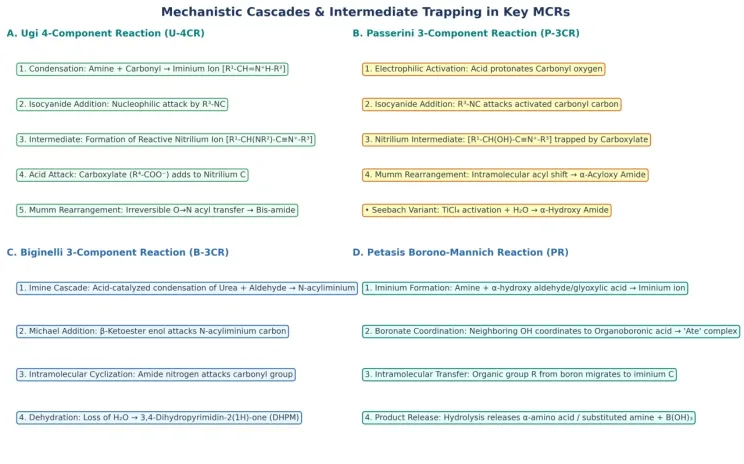
Figure 2. Step-by-step chemical mechanisms, reactive intermediates, and thermodynamic driving forces for Ugi, Passerini, Biginelli, and Petasis reaction cascades.
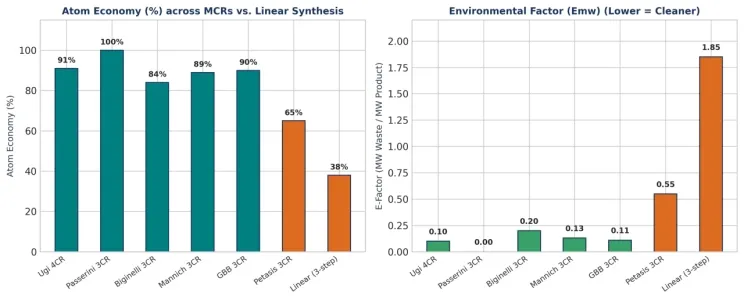
Figure 3. Quantitative Green Chemistry evaluation: Atom Economy (%) and Environmental Factor (Emw) comparison between MCRs and conventional linear synthesis.
4. MCRs in the Synthesis of Bioactive Heterocycles
Heterocyclic ring systems constitute the core structural backbone of over 85% of small-molecule active pharmaceutical ingredients (APIs) approved by the FDA [64][68]. Heterocycles provide essential hydrogen-bonding networks, directional electrostatic interactions, and rigid structural scaffolds that orient pharmacophoric moieties into active site pockets of enzymes and receptors [52]. MCRs excel in constructing complex, highly functionalized N-, O-, and S-containing heterocycles in a single vessel.
Key Heterocyclic Families Accessibly via MCRs:
• 2-Aminothiophenes & Thieno-pyrimidines: Constructed via the Gewald G-3CR. These systems act as bioisosteres of anthranilic acid and indole rings, offering high affinity for GPCRs (A₁/A₂A adenosine, cannabinoid GPR55) and protein kinases (IKKβ, PknG) [37].
• 1,4-Dihydropyridines (DHPs) & Pyridines: Prepared via Hantzsch 3CR/4CR or multi-component condensations of chalcones, 1,3-dicarbonyls, and ammonium acetate. Modulate L-type and Cav1.3 calcium channels for neuroprotection and antihypertensive therapy [39][47].
• Dihydropyrimidinones (DHPMs) & Pyrimidinones: Assembled via Biginelli B-3CR. Serve as potent antineoplastic agents, adrenergic antagonists, and calcium channel modulators [43][29]
• Imidazo[1,2-a] pyridines & Fused Imidazoles: Synthesized via GBB-3CR. Display exceptional CNS selectivity as GABAA receptor allosteric modulators, neuroprotective agents, and anti-tubercular hits [63][48].
• Oxindoles & Spirooxindoles: Generated via 1,3-dipolar cycloaddition of in situ generated azomethine ylides (isatin + amino acid) with dipolarophiles, or via Knoevenagel-Michael cascades. Spirooxindoles represent rigid, 3D sp³-rich scaffolds that potently inhibit p53-MDM2 interactions, AChE/BuChE, SIRT2, and bacterial cell wall synthesis [7][33].
• Chromenes, Coumarins & Benzopyrans: Built via Knoevenagel-initiated multicomponent condensations using 4-hydroxycoumarin or resorcinol derivatives. Display potent antioxidant, cholinesterase inhibitory, and neuroprotective properties [39].
• Racetam Pyrrolidones: Constructed via direct Ugi 4CR employing γ-aminobutyric acid (GABA), aldehydes, and isocyanides, yielding piracetam, etiracetam, and nefiracetam in a single step [15][11].
Table 2. Heterocyclic Scaffolds, MCR Synthetic Pathways, and Biological Properties
|
Heterocyclic Core |
Primary MCR Route |
Key Starting Materials |
Target Class / Pathway |
Representative Bioactive Drug / Lead |
|
2-Aminothiophene |
Gewald G-3CR |
Cyclohexanone + Ethyl cyanoacetate + S8 |
D2/5-HT2A GPCRs, A1 Adenosine |
Olanzapine, Tinoridine, T-62 |
|
1,4-Dihydropyridine |
Hantzsch H-4CR |
Aldehyde + 2 β-Ketoester + NH3 |
Cav1.2/Cav1.3 Calcium Channels |
Nifedipine, Nimodipine, Amlodipine |
|
Dihydropyrimidinone |
Biginelli B-3CR |
Ar-CHO + Ethyl acetoacetate + Urea |
Kinesin Eg5, NPY Y5 Receptor |
Monastrol, SNAP-7941 |
|
Imidazo[1,2-a]pyridine |
GBB-3CR |
Ar-CHO + 2-Aminopyridine + Isocyanide |
GABAA Receptor, TLR7/8 |
Zolpidem, Alpidem |
|
Spirooxindole-Pyrrolidine |
1,3-Dipolar Cycloaddition |
Isatin + Sarcosine + Chalcone/Dipolarophile |
p53-MDM2, AChE, SIRT2 |
Nutlin mimetics, Spiro-AD hits |
|
Pyrrolidino-2-one (Racetam) |
Ugi 4-CR |
GABA + Aldehyde + Isocyanide |
SV2A Synaptic Protein, mGluR |
Etiracetam, Nefiracetam, Piracetam |
|
Hydantoin |
Bucherer-Bergs |
Ketone + KCN + (NH4)2CO3 |
Voltage-gated Na+ Channels |
Phenytoin (Dilantin), Sorbinil |
5. Applications in Drug Discovery
MCR chemistry has significantly impacted drug discovery across multiple disease areas. Below, applications targeting CNS pathologies are examined in detail, followed by major findings in oncology, infectious diseases, and inflammation.
5.1 CNS-Active Compounds (Comprehensive Examination)
5.1.1 Alzheimer’s Disease (AD) Therapeutics & MTDL Strategies:
AD is a multifactorial neurodegenerative disorder pathologically characterized by cholinergic deficits, extracellular β-amyloid (Aβ₁₋₄₂) senile plaque deposition, intracellular hyperphosphorylated tau neurofibrillary tangles, glutamate excitotoxicity, and neuronal oxidative stress [61][11]. Traditional single-target therapies (such as classical cholinesterase inhibitors donepezil, rivastigmine, galantamine, or memantine) provide only transient symptomatic relief. Consequently, MCRs have become the primary synthetic engine for constructing Multi-Target Directed Ligands (MTDLs) designed to simultaneously address multiple pathogenic cascades [47][11].
• Donepezil-Oxindole-Lactam Hybrids: [8]
synthesized a novel series of oxindole-β-lactam and γ-lactam hybrids utilizing a 4-center 3-component Ugi reaction (U4C-3CR) combining substituted isatins, amino acids (β-alanine or γ-aminobutyric acid), and isocyanides. The resulting spirooxindole-lactams displayed potent, selective inhibition of butyrylcholinesterase (BuChE)-an enzyme elevated in late-stage AD brain tissue-with nanomolar potency (IC₅₀ = 68.2 nM for lead compound FATH 5a) alongside notable inhibition of self-induced Aβ₁₋₄₂ aggregation (65.6% inhibition) and minimal hepatotoxicity in HepG2 cells [8].
• Tacrine-Melatonin Hybrids (FATMHs & LATMHs):[47][64]
engineered ferulic acid-tacrine-melatonin hybrids (FATMHs) and lipoic acid-tacrine-melatonin hybrids (LATMHs) via Ugi 4-component coupling. By integrating the acetylcholinesterase-inhibiting tacrine motif with the radical-scavenging melatonin pharmacophore, the resulting MTDLs exhibited potent human AChE and BuChE inhibition, robust oxygen radical absorbance capacity (ORAC-FL values up to 4.5 TE), neuroprotection against Aβ-induced toxicity, and activation of the Nrf2/ARE antioxidant defense pathway [47][11].
• Pyrazine-Based Petasis MTDLs: [46]
developed pyrazine-containing MTDLs via the Petasis Borono-Mannich reaction coupling 2-pyrazinylpiperazine, substituted salicylaldehydes, and arylboronic acids. Lead compound 7a exhibited potent human AChE inhibition (IC₅₀ = 0.71 μM) and tau oligomerization inhibition (EC₅₀ tauFRET = 2.21 μM), superior SH-SY5Y cell viability protection compared to donepezil, and favorable BBB penetration parameters [46].
• Chromone-Donepezil Hybrids (CDHs):[47]
synthesized CDHs via the Passerini 3CR combining chromone carboxylic acids, aldehydes, and donepezil-like benzylpiperidine isocyanides, delivering single molecules capable of simultaneously inhibiting AChE/BuChE and neutralizing intracellular reactive oxygen species (ROS).
• Tacrine-Povarov Pyrano-quinolines:
Camps, Muñoz-Torrero, and Lavilla developed dual-site AChE inhibitors by coupling a tacrine catalytic-site binder to a pyrano-quinoline peripheral anionic site (PAS) binder via a Povarov multicomponent condensation [52]. Lead hybrid 2a displayed nanomolar AChE inhibition, blocked Aβ aggregation promoted by PAS-AChE binding, inhibited BACE1 (β-secretase), and crossed the BBB in PAMPA-BBB assays [52].
• Imidazoline I₂ Receptor (I₂-IR) Ligands: Lavilla, Escolano, and coworkers utilized PhosMic-based [3+2] cycloadditions and MCRs to access 2-(imidazoline-4-yl) phosphonates (e.g., compound 24a). In SAMP8 neurodegenerative mouse models, compound 24a significantly reduced neuroinflammation, oxidative stress, and calcineurin levels, reversing cognitive decline and anxiety-like behavior[72][52].
5.1.2 Parkinson’s Disease (PD) Therapeutics:
In PD drug discovery, neuroprotective targets beyond dopaminergic replacement therapy have gained urgency [12]. [33] developed spirooxindole, spiroacenaphthylene, and bisbenzo[b]pyran derivatives via a 3-component Knoevenagel-Michael addition/cyclization cascade. The resulting spirooxindoles potently inhibited sirtuin 2 (SIRT2)-an NAD⁺-dependent deacetylase heavily implicated in α-synuclein toxicity-with IC₅₀ values ranging from 118 to 126 μM[33][48]. In parallel, [23] synthesized ML192 2-aminothiophene derivatives via Gewald G-3CR as selective antagonists of GPR55-a non-classical cannabinoid receptor widely expressed in basal ganglia regions regulating motor function [11].
5.1.3 Epilepsy & Anticonvulsants:
Levetiracetam ((S)-2-(2-oxopyrrolidin-1-yl) butanamide) acts as a high-affinity ligand for synaptic vesicle protein 2A (SV2A), suppressing abnormal burst firing in epileptic foci.[15] disclosed a direct one-pot synthesis of racetam derivatives (etiracetam, nefiracetam, piracetam) via an Ugi 4CR employing γ-aminobutyric acid (GABA), aldehydes, and convertible isocyanides [15][48]. In classical antiepileptic therapy, hydantoins synthesized via the Bucherer-Bergs reaction (such as phenytoin / Dilantin) continue to serve as core voltage-gated sodium channel blockers.
5.1.4 Schizophrenia & Psychosis:
The atypical antipsychotic olanzapine (Zyprexa)-prescribed worldwide for schizophrenia and bipolar disorder-features a thieno [2,3-b] [1,5] benzodiazepine structure wherein the substituted 2-aminothiophene core is manufactured via a Gewald G-3CR key step [51]. Furthermore, Aripiprazole and Cariprazine dual D₂/5-HT₁A partial agonist analogues have been constructed by combining 2,3-dichlorophenylpiperazine building blocks in Ugi-Deprotection-Cyclization (UDC) sequences [48]. In glutamatergic schizophrenia therapy, the mGlu2/3 receptor agonist pomaglumetad methionil (POM) utilizes both Bucherer-Bergs and Petasis MCR steps in its scalable synthesis.
5.1.5 Cerebral Ischemia & Neuroprotective Calcium Channel Blockers:
Cerebrovascular accidents (ischemic stroke) trigger massive oxygen and glucose deprivation (OGD), inducing metabolic cascades, glutamate excitotoxicity, and intracellular Ca²⁺ overload leading to neuronal cell death [11]. [39] described a CAN-catalyzed three-component reaction producing C5-unsubstituted-C6-aryl-1,4-dihydropyridines. These DHP adducts displayed selective Cav1.3 calcium channel blockade over Cav1.2 cardiovascular subtypes, protecting neuroblastoma cells against calcium overload and oxidative stress in acute ischemia/reperfusion OGD models with a broad therapeutic window [39].
5.2 Anticancer Agents
Antineoplastic drug discovery represents the largest application area of MCRs [29]. Notable successes include: (a) Monastrol, a Biginelli 3CR product that selectively inhibits mitotic kinesin Eg5, inducing cell cycle arrest in mitosis without disturbing axonal tubulin[50] (b) Ivosidenib (Tibsovo), an IDH1 gene mutation inhibitor synthesized via an Ugi 4CR key step; (c) Tubulysin A analogs (potent microtubule-disrupting antimitotic peptides) assembled via strategic Passerini-Dömling 3CR and Ugi 4CR couplings; (d) Trabectedin (Yondelis) pentacyclic marine alkaloid core synthesized via Fukuyama's Ugi sequence[26] and (e) p53-MDM2 protein-protein interaction antagonists (such as imidazoline nutlin mimetics and benzodiazepinediones) constructed via Ugi-4CR (Dömling et al., 2012).
5.3 Antimicrobial & Antiviral Agents
Rising resistance against conventional antibiotics has catalyzed MCR-driven antibacterial development. Trimethoprim adducts synthesized via GBB-3CR exhibit potent activity against methicillin-resistant Staphylococcus aureus (MRSA) [39]. Isatin-derived spirooxindole-pyrrolidines (1,3-dipolar cycloaddition) display minimal inhibitory concentrations (MIC = 0.78-1.56 μM) against S. aureus, E. coli, and K. pneumoniae [7]. In virology, Telaprevir (Incivek), a hepatitis C virus (HCV) NS3/4A serine protease inhibitor, is manufactured using two strategic Passerini/Ugi MCR steps [78].
5.4 Anti-Inflammatory Agents
Anti-inflammatory MCR products include tinoridine (Gewald 3CR anti-arthritic drug), (p38 MAP kinase inhibitor via Ugi 3CR reaching Phase III trials for rheumatoid arthritis), and tetrahydropyridines inhibiting matrix metalloproteinases MMP-2 and MMP-9[39].
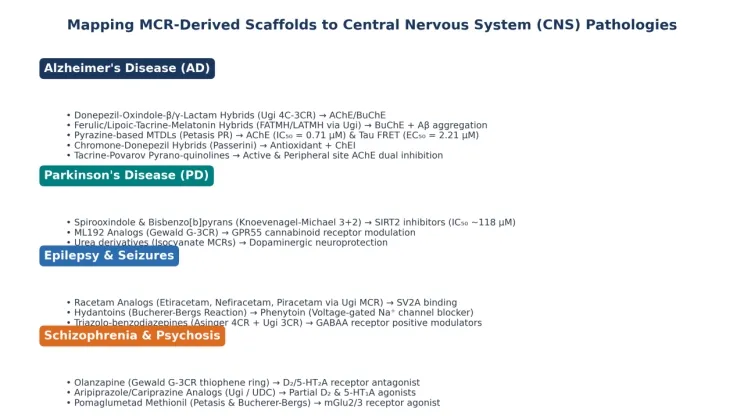
Figure 4. Strategic mapping of MCR-derived heterocyclic scaffolds to therapeutic targets across major Central Nervous System (CNS) pathologies.
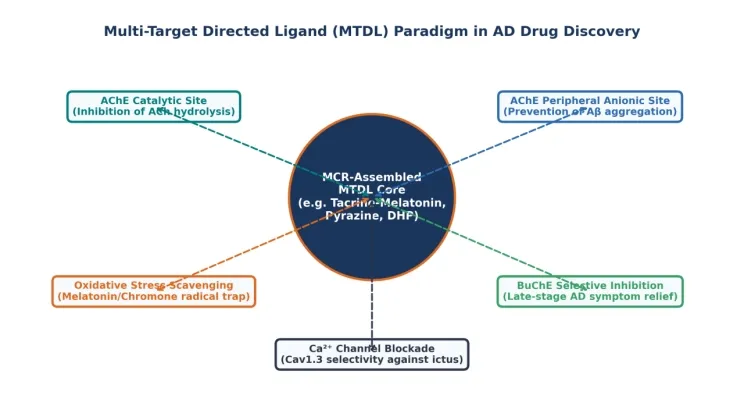
Figure 5. Multi-Target Directed Ligand (MTDL) design paradigm: MCR-assembled core simultaneously targeting AChE catalytic/peripheral sites, BuChE, Tau aggregation, Cav1.3 calcium channels, and oxidative stress.
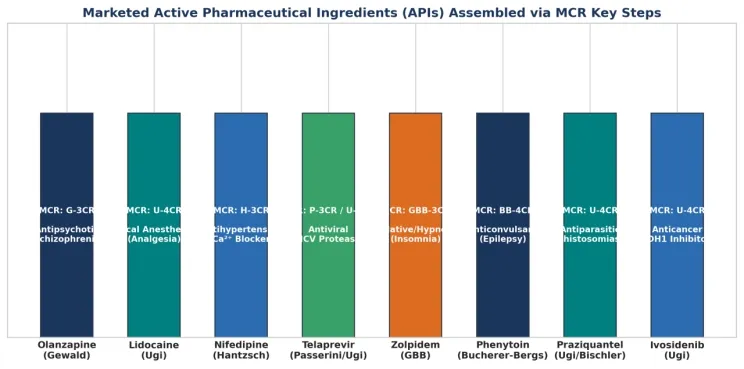
Figure 6. Marketed and clinical drugs manufactured using key Multicomponent Reaction steps across therapeutic indications.
6. Structure-Activity Relationship Studies of MCR-Derived Compounds
Systematic Structure-Activity Relationship (SAR) studies on MCR-derived compound libraries provide critical insights into pharmacophore optimization, electronic substitution effects, stereochemical requirements, and physicochemical ADME properties.
Key SAR Trends Dissected Across MCR Chemotypes:
1. Electronic & Halogen Substitution Effects: In isatin-derived spirooxindole and pyrano-quinoline libraries, substitution at position 5 or 7 of the oxindole ring exerts a profound impact on biological potency. Electron-withdrawing halogen substituents (5-Br, 5-Cl, 5-F) consistently enhance cholinesterase inhibition and antimicrobial activity compared to unsubstituted or 5-OCH₃ analogues. For example, in spirooxindole-β-lactam series, 5-Br substitution increases BuChE potency by 10-fold (IC₅₀ = 68.2 nM vs >600 nM for 5-H) due to halogen bonding with hydrophobic active site residues (Phe297, Trp231) [7].
2. Hydrogen-Bonding Bridges in Gewald 2-Aminothiophenes: X-ray crystallographic studies of Gewald G-3CR adducts bound to PDE4B (PDB ID: 3HMV) reveal that the 2-amino group forms essential bidentate hydrogen bonds with conserved Asn395 side chains and structured water molecules. Acylation of the 2-amino group with lipophilic thiophene or benzoyl carboxylates increases PDE4B selectivity over PDE4D by 10-fold (pIC₅₀ = 7.3 vs 6.3) by filling a hydrophobic sub-pocket [20].
3. Stereochemical & Diastereoselective Control: In chromeno β-lactam and 2-pyrroline MCR adducts, diastereoselectivity plays a dominant role in target binding. Exclusively cis-configured chromeno β-lactams display 20-fold higher anti-inflammatory ratios than trans-isomers [39]. In Ugi-derived peptidomimetics, chiral amino acid-derived isocyanides ensure complete retention of configuration at stereogenic alpha-carbons, preventing racemization [20].
4. Lipophilicity (logP) & TPSA Balance for BBB Penetration: For CNS active MCR adducts, optimal central nervous system exposure requires logP values between 2.0 and 3.5, MW < 450 Da, TPSA < 90 Ų, and hydrogen-bond donor count ≤ 2[45][17]. In tacrine-melatonin MTDL series, replacing rigid aromatic linkers with flexible 7-carbon polymethylene chains lowered TPSA below 75 Ų, dramatically boosting PAMPA-BBB permeability (P_e > 10 × 10⁻⁶ cm/s) [47].
Table 3. Quantitative Structure-Activity Relationship (SAR) & Biological Activity Profile Matrix
|
MCR Chemotype / Lead |
Core Scaffold |
Primary Target |
Potency (IC50 / MIC) |
Key SAR Feature |
BBB / ADME Status |
|
FATH 5a (Ugi 4C-3CR) |
Spirooxindole-γ-Lactam |
hBuChE / Aβ Aggregation |
IC50 = 68.2 nM |
5-Br substitution increases BuChE affinity 10x |
BBB+ High |
|
FATMH 6a (Ugi 4CR) |
Tacrine-Melatonin |
hBuChE / AChE / ORAC |
IC50 BuChE = 234 nM |
7-carbon chain optimizes PAS binding & logP |
BBB+ High |
|
Pyrazine 7a (Petasis) |
Pyrazine-Aminophenol |
hAChE / Tau FRET |
IC50 AChE = 0.71 μM |
2-OMe-3-OH phenyl ring essential for AChE |
BBB+ High |
|
Tacrine-Povarov 2a |
Pyrano-quinoline |
AChE / BACE1 / Aβ |
IC50 AChE = 1.2 nM |
Dual catalytic + peripheral site binding |
BBB+ High |
|
DHP 9c (Hantzsch) |
Nimodipine-Melatonin |
Cav1.3 Ca2+ / ORAC |
Equipotent Nimodipine |
DHP ring blocks Ca2+; melatonin scavenges ROS |
BBB+ High |
|
Gewald ML192 (G-3CR) |
2-Aminothiophene |
GPR55 Receptor |
IC50 = 0.48 μM |
2-carboxamide thiophene ring bridge required |
BBB+ Moderate |
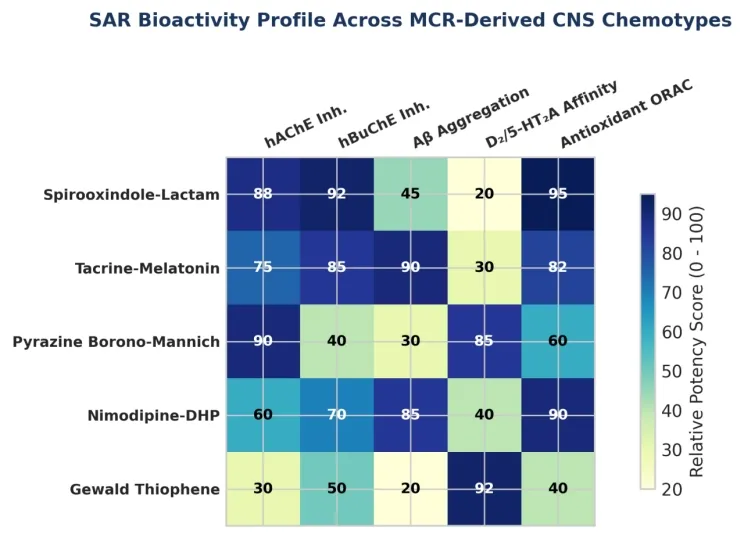
Figure 7. Structure-Activity Relationship (SAR) bioactivity landscape comparing relative target potencies across major MCR-derived CNS chemotypes.
7. MCRs in Lead Generation and Library Synthesis
The unique operational characteristics of MCRs make them ideal platforms for lead generation, high-throughput parallel screening, and diversity-oriented synthesis [10][75].
• Diversity-Oriented Synthesis (DOS) vs. Target-Oriented Synthesis (TOS): While TOS aims to construct a single specific complex molecule (such as a natural product API), DOS leverages MCRs to deliberately explore broad regions of uncharted chemical space by systematically varying building blocks, stereochemistry, and core heterocyclic skeletons [10][68]. Cheminformatic shape analysis (Murcko scaffold mapping, shape index, and principal component analysis PCA) demonstrates that MCR libraries cover a significantly broader, more globular 3D spatial distribution than traditional commercial screening collections [68].
• ANCHOR-Based Virtual Screening & Constrained Docking: Dömling and coworkers developed the ANCHOR drug discovery methodology, which integrates structure-based virtual screening with MCR feasibility filters [20]. By identifying key amino acid interaction 'hot spots' in protein crystal structures (such as p53-MDM2 or PPI interfaces), ANCHOR generates virtual MCR libraries constrained to incorporate specific anchor motifs. Docking filtering rapidly selects high-affinity candidates that are synthesized in one pot and screened directly in biology assays without intermediate isolation [20].
• Solid-Phase & Soluble Polymer Supports: MCRs seamlessly adapt to solid-phase organic synthesis (SPOS) using Rink amide, Wang, or Merrifield resins, as well as soluble polymer supports (e.g., polyethylene glycol PEG) and ionic liquid supports [37][29]. Solid-phase Ugi and Passerini parallel syntheses allow excess reagents to be washed away, delivering high-purity compound libraries for automated high-throughput screening.
8. Recent Advances (2020-2026)
The field of multicomponent reactions has experienced rapid methodological innovation between 2020 and 2026, driven by the synergistic integration of MCR chemistry with green catalysis, photoredox activation, and automated continuous flow technology [16][42].
Key Breakthroughs (2020-2026):
1. Sustainable & Heterogeneous Catalysis: Transitioning away from toxic homogenous metal catalysts, recent protocols employ renewable bio-catalysts such as chitosan, recyclable alumina, 3D-printed ceramic catalyst supports, and magnetic silica-supported metal nanoparticles for solvent-free MCRs [8][42].
2. Photoredox & Visible-Light MCRs: Merging visible-light photoredox catalysis with IMCRs has enabled radical cascade MCRs operating under ambient temperatures. Photo-induced Minisci MCRs and organo-photoredox Petasis couplings generate complex alkylated heterocycles without harsh peroxide reagents [27][16].
3. Automated Continuous Flow Synthesis: Flow microreactors combined with real-time in situ analytical monitoring (FTIR, NMR) allow highly exothermic or rapid MCR cascades to run continuously with precise temperature and stoichiometry control, overcoming scale-up heat transfer limitations [14][42].
4. High-Order Multi-MCR Unions: The coupling of distinct MCRs in sequential single-pot operations (e.g., Knoevenagel-Ugi-click 6-component reactions, Asinger-Ugi-Mumm 5-component unions, or Petasis-Ugi 6-component condensation) allows the assembly of multi-ring peptidomimetics and stapled macrocyclic peptides in unprecedented step economy [76][58].
5. Bioconjugation & Site-Selective Peptide Diversification: Isocyanide and organoboron MCRs are increasingly applied for site-selective post-translational modification of proteins, lipid-peptide ligation, fluorescent tagging, and constructing antibody-drug conjugates (ADCs) such as Trastuzumab-MMAE conjugates [42].
9. Advantages and Limitations
While MCRs offer transformative potential for sustainable drug discovery, a balanced scientific evaluation requires analyzing both their strategic advantages and inherent limitations.
Advantages:
• Exceptional Atom and Step Economy: Maximum structural complexity built in a single step with minimal waste generation [14].
• High Chemical & Scaffold Diversity: Unlocks diverse 3D heterocyclic architectures from simple, commercially available building blocks [18].
• Operational Simplicity & Scalability: High compatibility with green solvents (water, ionic liquids, bio-derived solvents), microwave irradiation, and continuous flow systems [66].
• Ideal for MTDL & PPI Drug Design: High functional density enables simultaneous interaction with complex macromolecular interfaces [29].
Limitations & Challenges:
• Stereocontrol & Enantioselective Control: Achieving catalytic asymmetric control in certain classical IMCRs (such as Ugi 4CR) remains challenging due to competitive non-catalyzed background reactions and flexible polar ionic intermediates [67].
• Side Reactions & Off-Path Condensations: In complex four- or five-component matrices, competing two-component additions (e.g., Passerini side-products during Ugi reactions) can reduce yields if stoichiometry and addition order are not strictly controlled [29].
• Substrate Scope Constraints: Sterically hindered or electronically deactivated inputs (e.g., bulky tertiary alkylamines or electron-deficient aromatic aldehydes) often exhibit poor reactivity, requiring forcing microwave or Lewis acid conditions [68].
• Industrial Scale-Up Balance: Processing multi-kilogram volumes of MCRs under solvent-free conditions requires specialized heat-transfer equipment and continuous flow engineering to prevent runaway exotherm [66].
FUTURE PERSPECTIVES
The future of multicomponent reactions in medicinal chemistry is poised at the intersection of computational artificial intelligence (AI), automated robotic synthesis, and advanced chemical biology.
Promising Future Horizons:
1. AI/ML-Driven Retro-MCR Prediction: Machine learning models trained on vast MCR reaction datasets will predict novel multi-component retrosynthetic disconnections, guiding automated platforms to synthesize target drug candidates via unexplored MCR pathways [68].
2. Closed-Loop Autonomous Flow Synthesis: Integrating real-time biological screening data with automated continuous flow microreactors will enable closed-loop 'design-make-test-analyze' cycles, executing lead optimization in hours rather than months [14][42].
3. Enzyme Promiscuity & Biocatalytic MCRs: Expanding the overlap between biocatalysis and MCRs-using promiscuous enzymes (lipases, oxidases, aldolases) to promote imine formation, selective nucleophilic additions, and asymmetric MCR cyclizations-will establish ultra-green, highly enantioselective MCR platforms [14].
4. Breakthrough MTDLs for Neurodegenerative Diseases: Applying MCRs to design brain-penetrant MTDLs that simultaneously inhibit neuroinflammation, scavenge reactive oxygen species, prevent tau/Aβ aggregation, and restore neurotransmitter homeostasis will drive next-generation clinical candidates for Alzheimer's and Parkinson's diseases [11].
CONCLUSION
Multicomponent reactions have evolved from classical organic named chemistry into a dominant technology driving modern medicinal chemistry and sustainable drug R&D. By enabling the rapid, atom-economic, step-efficient, and eco-friendly assembly of structurally complex, densely functionalized heterocycles from simple, commercially available precursors, MCRs bridge the gap between chemical space exploration and commercial drug production. In the arena of Central Nervous System (CNS) pathologies-where multifactorial disease etiologies demand sophisticated multi-target therapeutics and precise physicochemical tuning for blood-brain barrier permeability-MCRs offer unprecedented solutions. From MTDL candidates for Alzheimer's disease (such as donepezil-lactams, tacrine-melatonin hybrids, pyrazine adducts, and chromone derivatives) to clinical drugs like olanzapine, racetams, phenytoin, nifedipine, and telaprevir, MCR chemistry continues to prove its clinical value. As methodological advances in continuous flow, photoredox chemistry, biocatalysis, and machine learning further expand MCR capabilities, multicomponent chemistry will remain a cornerstone of sustainable, innovative pharmaceutical discovery for decades to come.
REFERENCES

Anitha Sadula*, Aruna Devi P., Usha Rani Peddaboina, Thahera Shaik, Sandhya Rani Moluguri, Pranathi Lakkakula, Pendyala Meghana, Multicomponent Reactions Targeting Central Nervous System Pathologies and Broader Medicinal Chemistry Applications: A Review, Int. J. Med. Pharm. Sci., 2026, 2 (10), 53-72. https://doi.org/10.5281/zenodo.23118559
 10.5281/zenodo.23118559