
We use cookies to ensure our website works properly and to personalise your experience. Cookies policy
1Mayor Radhakrishnan College of Pharmacy, Chennai, Tamil Nadu, India.
2Assistant Professor, Department of pharmaceutical chemistry, Mayor Radhakrishnan College of Pharmacy, Chennai, Tamil Nadu, India
3Principal & Professor Department of Pharmaceutics, Mayor Radhakrishnan College of Pharmacy, Chennai, Tamil Nadu, India
Process Analytical Technology (PAT) has emerged as a transformative framework in pharmaceutical manufacturing, enabling the transition from conventional end-product testing to science-based, real-time process monitoring and control. Introduced by the United States Food and Drug Administration (USFDA), PAT integrates advanced analytical techniques, multivariate data analysis, chemometric tools, and process control strategies to ensure consistent product quality throughout the manufacturing process. This review provides a comprehensive overview of the principles, objectives, and key components of PAT, emphasizing its role in monitoring Critical Quality Attributes (CQAs), Critical Process Parameters (CPPs), and Critical Material Attributes (CMAs). The review discusses the working principles, methodologies, industrial significance, and pharmaceutical applications of major PAT tools, including Near-Infrared (NIR) spectroscopy, Raman spectroscopy, UV-Visible spectroscopy, High-Performance Liquid Chromatography (HPLC), particle size analyzers, and moisture analysis techniques. Furthermore, the applications of PAT in solid and liquid dosage form manufacturing, regulatory perspectives based on USFDA and International Council for Harmonisation (ICH) guidelines, implementation challenges, and future developments involving artificial intelligence, continuous manufacturing, and smart pharmaceutical factories are critically examined. By facilitating Quality by Design (QbD), Real-Time Release Testing (RTRT), and data-driven decision-making, PAT enhances process understanding, minimizes variability, reduces manufacturing costs, and improves regulatory compliance. Overall, PAT represents a cornerstone of modern pharmaceutical manufacturing and is expected to play a pivotal role in advancing efficient, robust, and sustainable production systems.
Pharmaceutical manufacturing is the large-scale production of medicines using active pharmaceutical ingredients (APIs) and excipients under Good Manufacturing Practices (GMP) to ensure product safety, quality and consistency. Maintaining consistent quality is essential because even minor manufacturing errors can affect patient health. Process Analytical Technology (PAT) enhances quality control through real-time monitoring and control of manufacturing processes, enabling early detection of process deviations, reducing batch failures and ensuring that quality is built into the product rather than relying solely on final product testing.
Process Analytical Technology (PAT)
Process Analytical Technology (PAT) is a scientific framework introduced by the U.S. Food and Drug Administration (FDA) to improve pharmaceutical manufacturing through real-time monitoring and control of Critical Quality Attributes (CQAs) and Critical Process Parameters (CPPs). Unlike conventional quality testing, PAT focuses on process understanding and continuous monitoring rather than relying solely on end-product testing. By integrating advanced analytical tools, process control strategies, and data analysis techniques, PAT enables consistent product quality, reduces process variability, minimizes manufacturing failures, and supports Quality by Design (QbD), Real-Time Release Testing (RTRT), and continuous manufacturing.
Basic Concept Of PAT
Process Analytical Technology (PAT) is a scientific framework for designing, monitoring, and controlling pharmaceutical manufacturing through real-time measurement of critical quality and process attributes. Unlike traditional end-product testing, PAT focuses on continuous process monitoring to ensure consistent product quality.
Need for Pat in The Pharmaceutical Industry
PAT is essential for improving product quality, process efficiency, and manufacturing consistency. It enables real-time monitoring, reduces process variability and product failures, supports regulatory compliance, and promotes Quality by Design (QbD) and continuous manufacturing.
Important Terms in Process Analytical Technology (PAT)
Several key terms are essential for understanding the application of Process Analytical Technology (PAT) in pharmaceutical manufacturing:
Tools Used In PAT
Near-Infrared Spectroscopy (NIR)
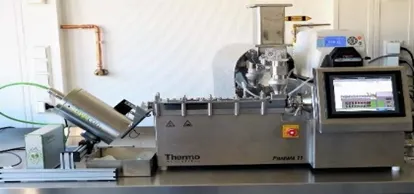
Principle:
NIR measures the absorption of near-infrared light by chemical bonds (C–H, O–H, N–H), enabling rapid analysis of pharmaceutical materials. (Fig. 2)
Methodology:
An NIR probe is installed in processing equipment to collect real-time spectral data. Chemometric models analyze the spectra to monitor parameters such as moisture content, blend uniformity, and API concentration, allowing timely process control.
Applications:
Industrial outlook
NIR is a widely used PAT tool because it is rapid, non-destructive, and supports real-time process monitoring, reducing the need for offline testing.
Raman Spectroscopy
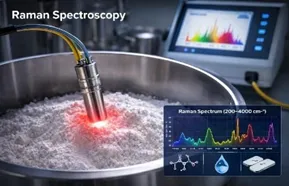
Principle:
Raman spectroscopy is based on the inelastic scattering of monochromatic light, producing a molecular fingerprint for compound identification. (Fig. 3)
Methodology:
A Raman probe collects real-time spectra from the manufacturing process. Chemometric models compare the spectra with reference data to identify raw materials, quantify API, and detect polymorphic changes.
Applications:
Industrial outlook
Raman spectroscopy is a highly specific PAT tool widely used for solid-state analysis, process monitoring, and counterfeit drug detection.
UV-Visible Spectroscopy
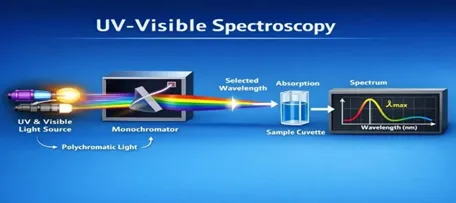
Principle:
UV-Visible spectroscopy measures the absorption of ultraviolet or visible light by molecules. The absorbance follows the Beer–Lambert law, which relates absorbance to concentration.
Methodology:
Fiber-optic probes monitor samples in real time by measuring absorbance at specific wavelengths. The data are converted into concentration profiles for process control and adjustment.
Applications:
Industrial outlook
UV-Visible spectroscopy is a simple, rapid, and cost-effective PAT tool widely used for liquid formulations and real-time process monitoring.
High-Performance Liquid Chromatography (HPLC)
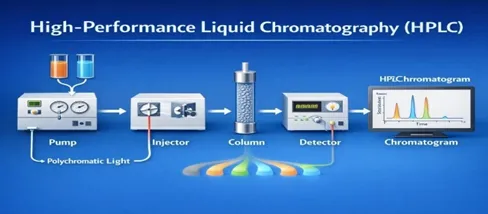
Principle:
HPLC separates and quantifies components based on their interaction with the mobile and stationary phases.
Methodology:
In PAT, automated sampling systems collect samples from the production line, and HPLC analysis provides rapid feedback on assay, impurities, and degradation products.
Applications:
Industrial outlook
HPLC remains a reliable PAT tool due to its high accuracy and specificity, particularly for impurity and stability analysis.
Particle Size Analyzer (Laser Diffraction)
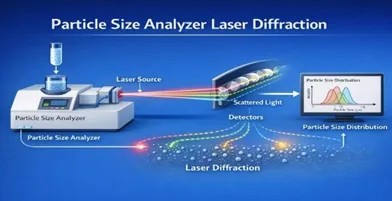
Principle:
Laser diffraction determines particle size distribution by measuring light scattering patterns from particles.
Methodology:
In PAT, in-line laser systems continuously monitor particle size parameters such as D10, D50, and D90 during milling and granulation, enabling immediate process adjustments.
Applications:
Industrial outlook:
Real-time particle size monitoring improves dissolution, bioavailability, and product consistency.
Moisture Analysis
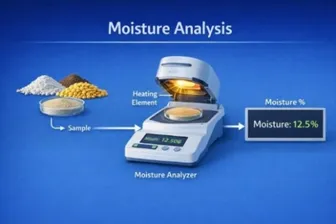
Principle:
Moisture analysis determines water and volatile content in pharmaceutical materials. (Fig. 7)
Methodology:
PAT uses in-line NIR or microwave sensors to monitor moisture levels during drying and enables real-time process control.
Applications:
Industrial outlook:
Moisture monitoring improves product stability, tablet compression, and overall quality.
Advantages Of PAT
Improves Product Quality
Reduces Batch Failure
Saves Time and Cost
Faster Product Release
Application of PAT In Manufacturing
Solid Dosage Forms
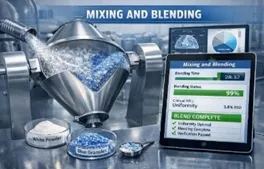
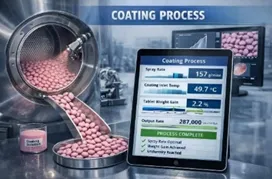
PAT enables real-time monitoring of Critical Quality Attributes (CQAs) and Critical Process Parameters (CPPs) throughout tablet and capsule manufacturing.
Granulation
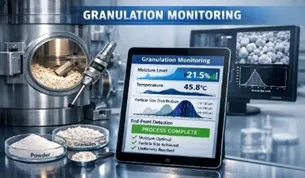
Mixing/Blending
Tablet Compression

Coating
Liquid Dosage Forms
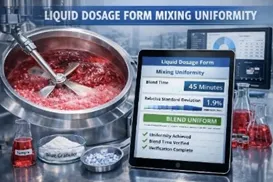
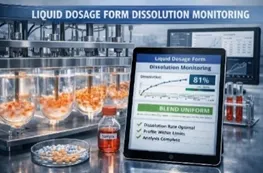
PAT improves process control in liquid formulations by ensuring uniform mixing and consistent drug dissolution.
Mixing Uniformity
Dissolution Monitoring
Regulatory Aspects
FDA Guidance on PAT
The U.S. FDA defines Process Analytical Technology (PAT) as a framework for designing, analyzing, and controlling pharmaceutical manufacturing through real-time monitoring of critical quality attributes. The 2004 FDA guidance supports Quality by Design (QbD), risk-based manufacturing, continuous improvement, and Real-Time Release Testing (RTRT) to ensure product quality and regulatory compliance.
ICH Guidelines
The International Council for Harmonisation (ICH) provides global guidelines for pharmaceutical quality, safety, and efficacy. The guidelines are classified into Quality (Q), Safety (S), Efficacy (E), and Multidisciplinary (M) categories, promoting harmonized regulatory submissions and consistent pharmaceutical development worldwide.
CHALLENGES IN IMPLEMENTING PAT
High Initial Cost
Skilled Personnel
Complex Data Management
Validation and Regulatory Compliance
System Integration
FUTURE SCOPE OF PAT
Artificial Intelligence (AI)
Continuous Manufacturing
Smart Factories
RESULTS AND DISCUSSIONS
CONCLUSION
Process Analytical Technology (PAT) has become a cornerstone of modern pharmaceutical manufacturing. By enabling real-time monitoring, control, and optimization of critical process parameters, PAT ensures consistent product quality, process efficiency, and regulatory compliance. It supports continuous manufacturing, Real-Time Release Testing (RTRT), and aligns with Quality by Design (QbD) principles, facilitating a science-based, risk-managed approach to production. In the contemporary pharmaceutical industry, PAT not only reduces waste and production costs but also enhances process understanding, accelerates product development, and promotes innovation. Its integration with advanced analytics, automation, and smart manufacturing systems positions PAT as a key enabler for reliable, efficient, and high-quality pharmaceutical production.
ACKNOWLEDGEMENT
The authors express their sincere gratitude to the Principal of our institution for providing the facilities, encouragement, and academic environment necessary to complete this review work successfully. We would also like to extend our heartfelt thanks to all the faculty members and staff of the Department of Pharmacy for their valuable guidance, continuous support, and constructive suggestions throughout the preparation of this manuscript Finally, we acknowledge all the researchers and authors whose published work has served as a valuable source of information and inspiration for this review.
JOURNAL REFERENCES
Books
C. Thesis / Dissertation
D. Conference / Proceedings
E. Patent References
None.
REFERENCES

Akshaya A., Sarumathi B., Roja K.*, Saminathan C., Review on Process Analytical Technology in Pharmaceutical Manufacturing, Int. J. Med. Pharm. Sci., 2026, 2 (8), 465-475. https://doi.org/10.5281/zenodo.21917909
 10.5281/zenodo.21917909