

We use cookies to ensure our website works properly and to personalise your experience. Cookies policy
Greenarray Genomic Research & Solutions Pvt Ltd
Recurrent pregnancy loss (RPL) is a complex, multifactorial condition, and chromosomal aberrations represent the most important causative factor in such cases. Chromosomal microarray analysis (CMA) has been recognized as an important diagnostic method in the assessment of products of conception (POC) to determine underlying genetic etiology. This case reports the use of CMA in the genetic testing of POC in a non-consanguineous couple with five successive pregnancy losses and whose products were examined by chromosomal microarray analysis. Two large pathogenic copy number gains were detected in the analyzed abortus samples.
Recurrent pregnancy loss (RPL) is defined as two or more unsuccessful clinical pregnancies that are verified by histopathology or ultrasonography. In 50% of RPL cases, the etiology remains unknown. Fetal chromosomal abnormalities during or before to pregnancy are thought to cause miscarriages in 50–70% of couples, with the majority of these occurring before 10 weeks of pregnancy. High rates of structural chromosomal rearrangements, mosaicism, and repeated polyploid conceptions indicate a genetic propensity to nondisjunction and genomic instability in recurrent pregnancy losses. (Yatsenko et al., 2021)
The possibility of improved diagnostic resolution was raised by the introduction of more recent molecular cytogenomic technologies, such as chromosomal microarray analysis (CMA). CMA easily outperforms traditional karyotyping, which is restricted to imbalances larger than 7–10 million bases, by detecting imbalances in the kilobase range. CMA will have an extra diagnostic yield of clinically significant sub-chromosomal abnormalities of between 12 to 15% in postnatal studies of children with congenital abnormalities, developmental delay, or intellectual disability. (Levy & Wapner, 2018)
The ability of CMA to accurately identify an area of imbalance is one of its main advantages. This makes it possible to precisely define the borders (breakpoints) of the affected region and to further evaluate its genomic sequence. This is crucial for both obvious cytogenetic abnormalities of unknown origin and sub-microscopic imbalances. The ensuing clinical phenotype and prognosis for chromosomal abnormalities of unknown origin rely on the number of clinically important coding and regulatory sequences present in the affected region as well as the chromosomal origin of the excess or missing material.
Genetic evaluation of products of conception (POC) has become one of the major tools used in the investigation of recurrent pregnancy loss (RPL) with the rising popularity of chromosome microarray analysis. It was noted in a study that genetic evaluation of products of conception can help detect chromosomal anomalies in more than 55% of miscarriages. (Zhu et al., 2018) This is very important because it explains the cause of the pregnancy loss, and at the same time, differentiates between sporadic aneuploid pregnancy losses and treatable reasons of RPL. Additionally, as it was mentioned above, when a couple experiences euploid losses, they need to undergo investigation for maternal, anatomical, endocrine, immunological, or genetic factors as the possible reason of the miscarriage. At the present moment, there are a number of advantages to CMA when compared to karyotyping, such as higher resolution, detection of submicroscopic copy number variations, lower culture failures, and reduced influence of the contamination by maternal cells. (Dahdouh & Kutteh, 2021) RPL has been linked to a number of endocrine-mediated conditions, such as luteal phase abnormalities, PCOS, poorly managed diabetes, and overt hypothyroidism. (Turesheva et al., 2023) A major contributing factor to early gestation pregnancy loss is partial chromosomal abnormalities, which involve gain or loss of chromosomal content.
Case presentation-
Clinical History-
Case of couple with advanced reproductive age (Advanced paternal and maternal age) and non- consanguinously married. The couple was diagnosed with primary infertility in March 2024 after a hysterosalpingogram revealed evidence of left tubal obstruction. Following a diagnostic laparohysteroscopy and bilateral tubal cannulation, the couple took fertility treatment. The wife is a known case of hypothyroidism and was diagnosed with Gestational Glucose Intolerance. TB-PCR testing to check for gestational infections was negative.
Family history-
The husband's mother was diagnosed with arthritis, the husband's father with late-stage lung cancer, and the wife's parents with diabetes mellitus. There is no consanguinity and no other relevant family history.
Obstetric History-
The couple had three natural conceptions, all of which ended in chemical pregnancies. The IVF (embryo transfer) conception that resulted in their fourth pregnancy ended in a non-viable gestation at 9+1 (D)/8+4 (S) weeks gestational age. Their fifth pregnancy ended in a non-viable twin gestation at around 10+5 (D)/9+3 (S) weeks gestation, which was an IUI conception. In February 2025, sac I showed no cardiac activity, and shortly after, sac II showed no cardiac activity, fetal pole, or yolk sac.
Genetic Investigations-
In July 2024, the couple was advised to have the POC sample to be tested by CMA analysis, which revealed a pathogenic mosaic gain in the X chromosome, indicating partial duplication Xp. CMA 315K testing for POC was performed using Affymetrix CytoScan Optima Microarray. Findings were reported as per ACMG guidelines. (Shao et al., 2021)
The couple was advised to undergo karyotyping owing to their history of recurrent pregnancy losses (RPL), but the results showed no chromosomal abnormalities. In February 2025, following the non-viable gestation of their fifth pregnancy, the couple was advised to undertake CMA investigation on the POC once more. This time, the analysis showed a pathogenic mosaic gain in chromosome 22. The couple had a post-natal CMA at a higher resolution (CMA 750K*) in March 2025 to check for heterozygosity (AOH) and copy number alterations. No chromosomal abnormalities, deletions, duplications, or variations in copy numbers were found. Possibility of ambiguous results due to maternal cell contamination was ruled out as MCC testing by QF-PCR was negative.
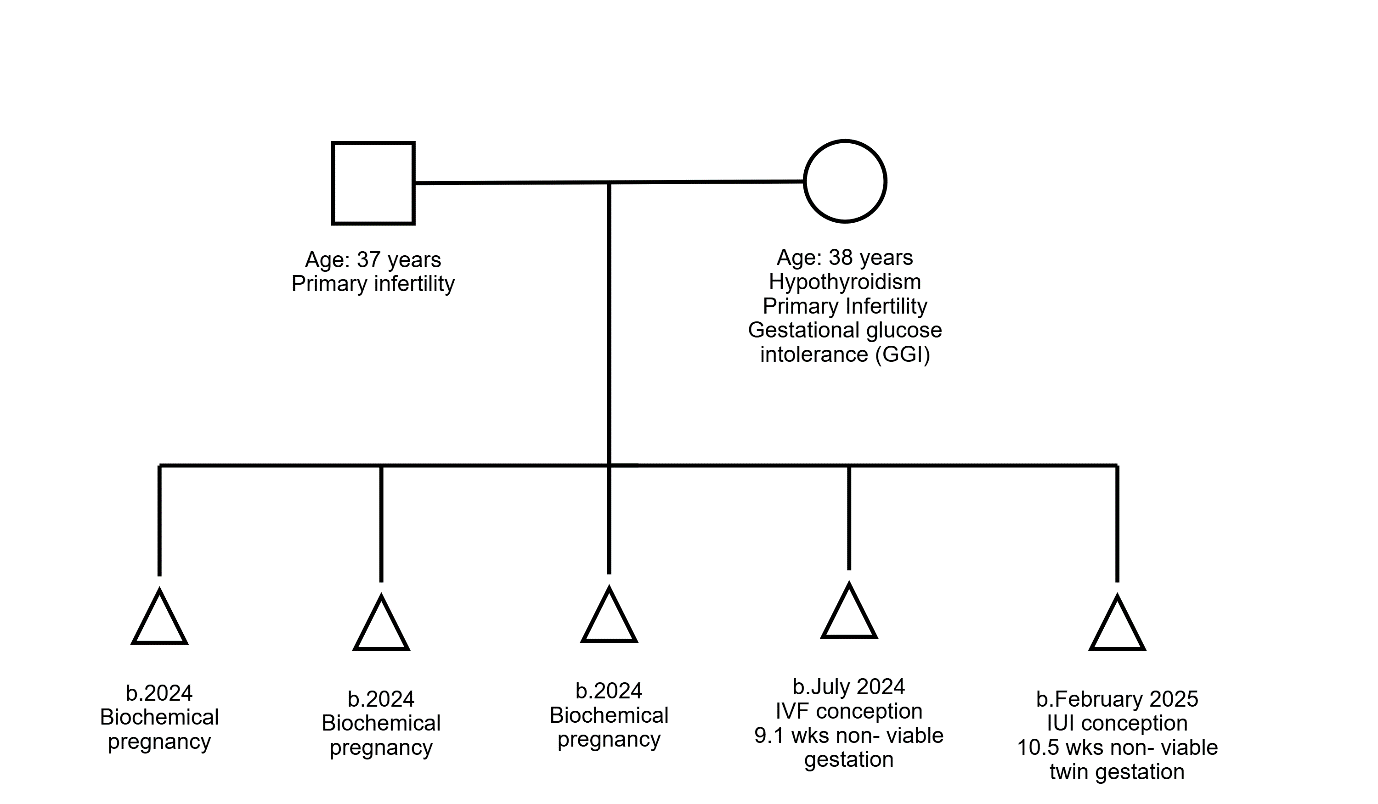
Figure 1: Case pedigree
Report Findings-
Figure 2: Report findings of tested POC samples
| Copy No. | Type | Size | Chromosome | Variant nomenclature | Classification | |
|---|---|---|---|---|---|---|
| G4 (July 2024) |
1.21 | Gain Mosaic | 55,701 | X | arr[GRCh38] Xp22.33p11.1 (2,799,497 _58,500,731) x1~2 | Pathogenic |
| G5 (February 2025) |
3 | Gain | 33,773 | 22 | arr[GRCh38] 22q11.1q13.33 (16,986,584 _50,759,411) x3 | Pathogenic |
DISCUSSION-
Recurrent pregnancy loss (RPL) is a multifactorial disorder where genetic disorders represent a considerable percentage of early miscarriages. Although numerical chromosomal disorders, particularly autosomal trisomies, remain the most common reason for spontaneous abortion, segmental chromosomal disorders and complex copy number variants have become more apparent through the use of chromosomal microarray analysis (CMA). (Sahoo et al., 2017)
In the current case, chromosomal microarray analysis performed on products of conception revealed two clinically significant copy number variations on chromosomes 22 and X, explaining the genetic basis of the miscarriage. The importance of using CMA in assessing products of conception has gained increasing attention due to its ability to detect sub-microscopic and complex genetic imbalances which would otherwise go undetected using standard cytogenetic techniques.
An important observation made in the current case is that parental studies did not demonstrate any chromosomal aberration, indicating the presence of a de novo origin for both copy number gains. It is implied that the chromosomal abnormalities in question must have occurred either during the formation of gametes or as a result of a post-zygotic mitotic process. The presence of both large duplications on two separate chromosomes increases the likelihood of a complex de novo mutation in the form of unbalanced derivative chromosome or chromosomal rescue with mosaicism. De novo mutations are of clinical significance in cases of fetal demise as they help identify the cause even if parental studies fail to demonstrate anything significant.
This particular case underscores the need for conducting chromosomal microarray analysis (CMA) of products of conception in couples suffering from recurrent pregnancy losses even when the usual parental karyotype studies are found to be normal. Detection of de novo CNVs not only helps in explaining the cause of the miscarriage in this case but also helps in recurrence risk counseling. The current findings further support the inclusion of CMA in routine genetic investigation of unexplained RPL.
The extensive gains detected in the current study involving the regions Xp22.33-p11.1 and 22q11.1-q13.33 are associated with several dosage-sensitive developmental genes and are likely to be causative for the patient’s pathological phenotype. Several reports have shown that large duplications involving the Xp22.33-p11.22 chromosomal band are often associated with severe fetal malformations, including congenital heart defects and neuro-developmental disturbances. Zhang et al. reported recurrent fetal duplication cases carrying the ~52.9 Mb Xp22.33-p11.22 duplication resulting in critical congenital heart defects, which corroborates the role of dosage imbalance of this region.(Zhang et al., 2015)
In addition, the duplication involving the region of Xp in the current study also includes the SHOX gene, a known dosage-sensitive developmental gene with an important role in bone development and embryo formation. In the same manner, duplications of the 22q11 chromosomal region have also been noted to demonstrate great variation in the prenatal phenotype, which includes an increased nuchal translucency, congenital heart disease, kidney defects, and other multisystem developmental disorders. In a study on prenatal 22q11 duplications conducted by Mary et al., the authors were able to identify and describe the great phenotypic variation and developmental consequences of such genomic aberrations. (Mary et al., 2022).
CONCLUSION-
Overall, it can be considered that the existence of large Xp and 22q duplications in the current case implies a serious dosage imbalance, making fetal development nonviable. The detection of large pathogenic duplications in chromosome Xp and 22q among the products of conception indicates significant dosage imbalances that cannot sustain normal fetal development. Furthermore, the lack of such abnormalities among the parents during their respective cytogenetic investigations indicates de novo formation of the chromosomal abnormalities. This particular case underscores the importance of performing chromosomal microarrays to unravel the etiology of recurrent pregnancy loss in couples experiencing unexplained recurrent miscarriages.
REFERENCES





Dr. Sarjan Shah, Manju Kurup, Dr. Preeti Arora, Antara Joshi, Dr. Sanjay Gupte, Dual Pathogenic Copy Number Gains Identified by Chromosomal Microarray Analysis in Products of Conception from Recurrent Pregnancy Loss, Int. J. Med. Pharm. Sci., 2026, 2 (11), 111-115. https://doi.org/10.5281/zenodo.24414859
 10.5281/zenodo.24414859