

We use cookies to ensure our website works properly and to personalise your experience. Cookies policy
1Department of Nutrition and Dietetics, S.D.M. College of Naturopathy and Yogic Sciences, Ujire (D.K.), Karnataka, India.
2Department of Yoga, SDM College of Naturopathy and Yogic Sciences, Ujire (D.K), Karnataka, India.
3Medical Officer, AYUSH wing, District Teaching Hospital, KOIMS, Madikeri, Karnataka, India
Background: Stress, anxiety, and sleep disorders are common among college students and may negatively affect their academic performance and general health. The yoga breathing technique Bhramari Pranayama is reported to have a calming effect on the nervous system and alleviate the symptoms of stress; however, the effectiveness of this technique in the novice population should be validated. Aim: To determine the impact of one month of practice of Bhramari Pranayama on perceived stress, state/trait anxiety, and sleep quality among healthy novice university students. Materials and Methods: A randomized controlled trial was conducted on 60 healthy participants aged 18-20 years from S.D.M. College of Naturopathy and Yogic Sciences, Ujire, divided into intervention (A) and control (B) groups (30 participants in each group). At baseline and after one month, all participants were assessed using the PSS, STAI, and PSQI; the data were statistically analyzed using paired t-tests and independent-samples t-tests. Results: Significant reduction in PSS (20.13±5.71 to 13.43±5.18), PSQI (7.30±8.85 to 3.50±1.80), state anxiety (2.27±0.48 to 1.77±0.39), and trait anxiety (2.31±0.52 to 1.90±0.41) was noted in the intervention group (p≤0.001); between-group comparison confirmed the superior improvement in the intervention group (p=0.001). Conclusion: A one-month practice of Bhramari Pranayama leads to significant improvements in stress, state/trait anxiety levels, and sleep quality among novice university students.
Stress, anxiety, and sleep disturbances have become pervasive across all populations (1). Stress occurs when genetically programmed or learned expectations fail to match an individual's perception of their environment (2). As primary drivers of morbidity, stress and anxiety contribute significantly to chronic illness, reduced quality of life, and shortened life expectancy. Academic stress, in particular, has surfaced as a major mental health challenge for adolescents and young adults. In particular, stress, anxiety, and depression are seen to be significant markers of mental health that may negatively affect people if left untreated. The American Psychological Association states that anxiety and depression are both emotional reactions that result in a fairly similar set of symptoms, such as irritation, fatigue, muscle tension, and difficulty sleeping. According to earlier research, the student population had a notable prevalence of stress (34.5%), anxiety (23.6%), and depression (18.4%)(3). Biologically, stress can lead to chronic dysregulation of allostatic systems, including the immune system, the metabolic system, the autonomic nervous system, and the HPA axis (4). According to the World Health Organization’s Global Burden of Disease survey, mental health conditions and stress-related disorders were projected to become the second leading cause of disability by 2020 (5). Anxiety often arises from prolonged or intense stress and represents the most common mental health issue found in general communities (6). It is important to distinguish anxiety from fear; while fear is a rational and appropriate response to a tangible or dangerous threat, anxiety is a state of apprehension or worry that is often generalized and unfocused. It typically manifests as an overreaction to a situation that is only subjectively perceived as threatening (7). This state is frequently accompanied by physical symptoms such as muscle tension, fatigue, restlessness, and impaired concentration. While many people experience occasional anxiety, it is not considered a standard response to stress. Sleep is an important physiological process that promotes good brain function and mental well-being. Although the exact health advantages of sleep are still poorly known across many groups, it is generally accepted that a lack of sleep can be detrimental to health(8). Restorative sleep is vital for maintaining physical, psychological, and cognitive health. However, human sleep patterns are often dictated by social factors rather than biological imperatives. Global research indicates that more than one-third of students report sleeping less than 7 hours per night, with 35-60% reporting poor sleep quality(9). Medical students are more likely to have poor-quality sleep as a result of their attitudes, lifestyle, academic load, internet use, and probable sleep apnea. In addition, poor sleep quality was linked to students' academic performance, life satisfaction, anger, and tiredness. Individuals who do not get enough sleep are more likely to experience anxiety, stress, and depression(10). The presence of these psychological difficulties affects their sleeping patterns, lowering their quality of life. These negative consequences of mental stress can be alleviated using yoga techniques such as pranayama (breathing exercises), which enhance vagal tone, which is necessary for maintaining a calm mind. Breathing exercises have been shown in different studies to improve quality of life and alleviate mental health disorders such as stress, anxiety, and depression. Bhramari Pranayama (low-pitched humming bee breathing) is one such breathing technique that has been demonstrated to alleviate stress by reducing cardiovascular reactivity in healthy volunteers(11). Bhramari Pranayama is a balancing technique that involves deep inhalation, followed by a humming sound (resembling a bee) during exhalation, while the ears are closed. According to traditional practitioners like Swami Satyananda Saraswati, this practice alleviates cerebral tension and stress, thereby reducing anger, insomnia, and anxiety while promoting the body's internal healing. The vibration of humming creates a calming effect on the nervous system and encourages an inwardly focused, meditative state (12). Given that stress is a precursor to numerous diseases, prioritising stress management and the reduction of negative emotional states is essential to lowering the global disease burden. As a form of Complementary and Alternative Medicine (CAM), yoga provides a holistic approach to dampening the physiological stress response. While clinical interest in yoga has grown and its immediate benefits are well-documented, the long-term effects and underlying mechanisms of specific practices like Pranayama require further investigation(13). Consequently, the current study aims to evaluate the impact of Bhramari Pranayama on the stress levels, anxiety, and sleep quality of newly enrolled university students.
MATERIALS AND METHODS
Study design: This study was conducted as a randomised controlled trial at S.D.M. College of Naturopathy and Yogic Sciences, Ujire, Dharmasthala, Beltangady Taluk, Dakshina Kannada District, Karnataka. The research protocol received prior approval from the college authorities before participant recruitment commenced
Participants
Recruitment and Sampling
A total of 60 healthy volunteers were recruited from the college student population using a computer-generated random number table to assign participants. Participants were randomly allocated into two groups: Group A (intervention group, n=30) and Group B (wait-list control group, n=30)
Inclusion Criteria
Participants were eligible for inclusion if they met all of the following criteria:
Exclusion Criteria
Participants were excluded from the study if any of the following conditions were present:
Interventions
Group A (Intervention Group)
Participants in Group A practised Bhramari Pranayama for 20 minutes daily over a period of one month. The practice was supervised to ensure correct technique and adherence to the protocol
Group B (Control Group)
Participants in Group B served as a wait-list control and received no intervention during the study period. They were assessed at the same time points as the intervention group but did not engage in any structured yoga or pranayama practice.
Outcomes Measure and Data Collection
Assessment Instruments
Data were collected using standardised questionnaires with established reliability and validity for assessing the study variables:
Perceived Stress Scale (PSS): The PSS was used to assess perceived stress levels. This scale has demonstrated adequate-to-high internal consistency reliability (Cronbach's α ≥ 0.75) and good test-retest reliability across multiple validation studies(14).
State-Trait Anxiety Inventory (STAI): Anxiety was assessed using the STAI questionnaire, which measures both state and trait anxiety. The instrument has shown high internal consistency reliability, with Cronbach's alpha coefficients indicating strong psychometric properties(15).
Pittsburgh Sleep Quality Index (PSQI): Sleep quality was evaluated using the PSQI, a validated instrument for assessing sleep disturbances and quality over a specified time period(16).
Data Collection Timeline
Data were collected at two time points:
Randomisation
Randomisation was performed using a computer-generated random number table to ensure unbiased allocation of participants to either the intervention or control group. Eligible subjects were assigned sequential numbers, and the random number table determined group allocation, maintaining equal distribution (30 participants per group) across both arms of the study. This method ensured that each participant had an equal probability of being assigned to either group, thereby minimising selection bias and balancing known and unknown confounding variables between groups.
Statistical methods
Statistical analysis was performed using the Statistical Package for the Social Sciences (SPSS) software, version 21.0. Data were first checked for normal distribution to determine the appropriateness of parametric tests. A paired t-test was employed to compare pre- and post-intervention data within each group. A p-value of less than 0.001 (p < 0.001) was considered statistically significant, indicating significant differences between pre- and post-intervention measurements.
Intervention:
Brahmari pranayama:
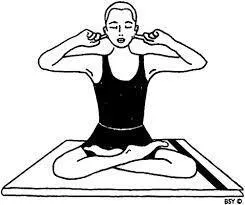
Figure1: Bhramari Pranayama
Procedure: To practice Bhramari Pranayama, sit in a comfortable meditation posture, preferably padmasana, with your hands resting on your knees in chin mudra. Close your eyes, completely relax your entire body, and keep your lips gently closed with your teeth slightly separated to allow the sound vibrations to be heard and felt more distinctly. Next, raise your arms sideways, bend your elbows, and bring your hands to your ears, using either your index or middle fingers to plug them, or simply pressing the ear flaps closed without inserting your fingers. Bring your awareness to the center of your head where the ajna chakra is located, keep your body absolutely still, and inhale deeply through your nose. Exhale slowly in a controlled manner while making a deep, steady humming sound like that of a black bee. This humming should remain smooth, even, and continuous for the entire duration of the exhalation, keeping the sound soft and mellow so that the front of your skull reverberates. At the end of the exhalation, you may keep your hands steady or return them to your knees before raising them again for the next round, ensuring that every inhalation and exhalation remains smooth and controlled throughout the practice.
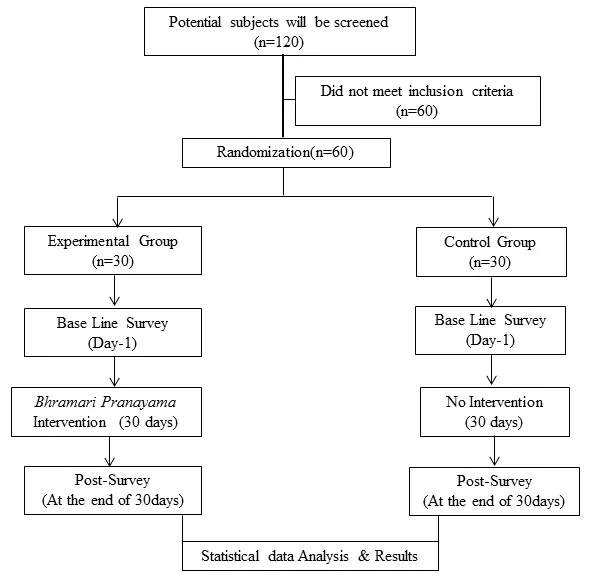
Figure 2: Flowchart of study
RESULTS
The present study was conducted to evaluate if the practice of Brahmari pranayama had any influence on any of the outcome variables, viz., Quality of sleep, anxiety, and perceived stress in Novices. Results were compared within two groups, interventional and control, wherein data were extracted at both baseline and post intervention and also compared between the groups. The data obtained following Brahmari pranayama were analyzed for normal distribution. Data of both the groups were found to be normally distributed with equal variance. The pre –post data of both the groups were analyzed separately using a paired sample t-test, and the data of pre-post comparisons between the groups were analyzed using an independent-t test.
PSS:
The interventional group demonstrated a significant reduction in perceived stress scores from pre-intervention (20.13 ± 5.71) to post-intervention (13.43 ± 5.18; p< 0.001). A significant reduction was also observed in the control group, from 22.67 ± 3.70 to 19.30 ± 5.48 (p = 0.01). The between-group analysis showed a statistically significant difference in change between the groups (p = 0.001), with a mean difference of −5.87 as shown in Table 1 and Graph 1.
PSQI:
Sleep quality scores in the interventional group improved significantly, with PSQI scores decreasing from 7.30 ± 8.85 at baseline to 3.50 ± 1.80 after the intervention (p = 0.05). The control group also showed a significant reduction from 6.53 ± 3.16 to 5.93 ± 3.02 (p = 0.023). The between-group analysis demonstrated a statistically significant difference (p = 0.001), with a mean difference of −2.43 as shown in Table 1 and Graph 2.
State-Anxiety:
State anxiety scores significantly decreased in the interventional group from 2.27 ± 0.48 to 1.77 ± 0.39 (p = 0.001). In contrast, the control group showed an increase in scores from 2.19 ± 0.39 to 2.35 ± 0.46, although this change was reported as statistically non-significant (p = 0.05). The between-group analysis demonstrated a statistically significant difference (p = 0.001), with a mean difference of −0.58 as shown in Table 1 and Graph 3.
Trait-Anxiety:
Trait anxiety scores in the interventional group decreased significantly from 2.31 ± 0.52 at baseline to 1.90 ± 0.41 following the intervention (p = 0.001). The control group showed an increase from 2.28 ± 0.34 to 2.41 ± 0.38, which was not statistically significant (p = 0.08). A statistically significant between-group difference was observed (p = 0.001), with a mean difference of −0.51, as shown in Table 1 and Graph 4.
Table 1. Within-Group and Between-Group Comparison of PSS, PSQI, and State and Trait Anxiety Scores in the Interventional and Control Groups
|
Parameter |
Interventional Group |
Control Group |
Between-group analysis p-value
|
Mean difference (df) |
||||
|
Pre-Mean ±SD |
Post Mean ±SD |
Within-group analysis p-value |
Pre-Mean ±SD |
Post Mean ±SD |
Within-group analysis p-value |
|||
|
PSS |
20.13 ± 5.71 |
13.43 ± 5.18 |
<.001** |
22.67 ± 3.70 |
19.30 ± 5.48 |
0.01 |
0.001 |
-5.87 |
|
PSQI |
7.30 ± 8.85 |
3.50 ± 1.80 |
0.05 |
6.53 ± 3.16 |
5.93 ± 3.02 |
0.023 |
0.001 |
-2.43 |
|
State Anxiety |
2.27 ± 0.48 |
1.77 ± 0.39 |
0.001 |
2.19 ± 0.39 |
2.35 ± 0.46 |
0.05 |
0.001 |
-0.58 |
|
Trait Anxiety |
2.31 ± 0.52 |
1.90 ± 0.41 |
0.001 |
2.28 ± 0.34 |
2.41 ± 0.38 |
0.08 |
0.001 |
-0.51 |
Note: Values are presented as mean ± standard deviation. Within-group p-values represent pre- to post-intervention comparisons. Between-group p-values represent comparisons between the interventional and control groups at post-intervention. Mean difference was calculated as the post-intervention mean of the interventional group minus the post-intervention mean of the control group. p ≤ 0.05 was considered statistically significant.
Abbreviations: PSS – Perceived Stress Scale; PSQI – Pittsburgh Sleep Quality Index; SD – Standard Deviation; df – degrees of freedom
Figure 3: Showing the Changes in PSS- Perceived Stress Scale, PSQI- Pittsburgh Sleep Quality Index, & Anxiety (state and trait) scores of the experimental group.
Figure 4: Showing the Changes in PSS- Perceived Stress Scale, PSQI- Pittsburgh Sleep Quality Index, & Anxiety (state and trait) scores of the Control group.
Graph 1: Shows pre- and post-changes in the intervention group and control group for stress level.
Graph 2: Shows pre- and post-changes in the intervention group and control group for sleep level.
Graph 3: Shows pre- and post-changes in the intervention group and control group for STAI STATE Y1.
Graph 4: Shows pre- and post-changes in the intervention group and control group for STAI TRAIT Y2.
DISCUSSION
The present study evaluated the impact of a one-month Bhramari Pranayama interventionon stress, anxiety, and sleep quality in university students who were novices to yoga practice. Our findings demonstrate a significant reduction in perceived stress (PSS), state and trait anxiety (STAI), and sleep disturbances (PSQI) in the intervention group compared to the wait-list control group. These results underscore the efficacy of Bhramari Pranayama as a potent, non-pharmacological tool for enhancing the psychological well-being of young adults facing academic pressures. Practicing Bhramari Pranayama regularly has been shown to influence stress, sleep, and anxiety status. In this study, following the yogic intervention, the stress (p<0.05), sleep (p<0.02), and anxiety (p<0.05) levels were reduced significantly when compared to the control group. Similar changes were seen in a previous study considerable effect of several pranayama techniques in lowering middle-aged women's levels of stress, anxiety, and depression, indicating that pranayama is a useful technique for improving mental health in this population. When compared to the control group, the pranayama group showed significant improvements in stress, anxiety, and depression, suggesting that regulated breathing techniques may be important for maintaining psychological well-being(17).Practice of breathing exercises such as bhramari pranayama showed improvement in reduced negative emotions and improved sleep quality in COVID-19-affected patients, which can help to regulate the autonomic nervous system by lowering the sympathetic tone and raising the parasympathetic output, which can aid in lessening negative emotions like stress, depression, and anxiety(18,19). Similarly, in this study, there was a significant reduction in perceived stress (PSS), state and trait anxiety (STAI), and sleep disturbances (PSQI) Results of our study indicate that practicing Brahmari pranayama regularly had better overall sleep quality. These results were in accordance to previous studies where effect of 6 months Yoga intervention on elderly people was studied and found that Yoga group participants had better sleep quality and less sleeping disturbances (20). Yogic breathing exercises like Brahmari pranayama can improve the strength of the respiratory muscles, which results in better tissue perfusion and improved oxygen saturation. Considering the fact that sleep disorders are associated with decreased oxygen saturation, improved oxygen saturation due to Yoga exercise might be another possible explanation for better quality sleep shown by the subjects of the Yoga group in our study(21). A standard mental health scale with good psychometric properties was used in a study by Suprabha Srivastav et al. (March 2007) to assess the impact of Bhramari Pranayama on college students' mental health. The results showed an increase in mental health scores following Bhramari Pranayama practice compared to pre-mental health scores. According to the study, pranayama, such as Bhramari pranayama, increases noradrenaline levels and stimulates the autonomic nervous system. Through a biofeedback mechanism, this hormone rises with a deeper breath, resonates after exhalation, and lowers the amount of neurohormones that cause different types of stress, anxiety, and altered mental states(22). The present study also shows that by practicing Bhramari pranayama, stress, anxiety, and sleep were reduced significantly. Given its cost-effectiveness, cultural adaptability, and ease of learning, Bhramari Pranayama is an ideal lifestyle intervention for university students. It requires no specialized equipment or biofeedback devices, making it a portable and practical tool for managing academic stress and improving sleep hygiene. Integrating this non-invasive practice into daily routines can support long-term mental resilience and mind-body coordination in this vulnerable population.
STRENGTHS AND LIMITATIONS
The study utilized a randomized controlled trial (RCT) design, ensuring robust comparison between intervention and control groups. The intervention was highly standardized, involving supervised daily 20-minute sessions to ensure consistent practice and adherence. The focus on novices (university students) minimized the confounding effects of prior yoga experience, providing a clearer baseline for assessing the impact of Bhramari Pranayama Limitations include a small sample size and the absence of objective parameters. For assessment self-reported questioner were used, which may be susceptible to subjective bias
FUTURE DIRECTION OF STUDY
Future studies should utilize larger cohorts over extended durations while integrating physiological metrics like EEG and HRV. Also, standard stress parameters such as serum cortisol levels.
CONCLUSION:
Summarizing the findings of the study, we conclude that one month of practice of Brahmari pranayama decreases stress and anxiety, and improves the quality of sleep in novices who are healthy individuals as compared to the control group. With the findings of the present study, we conclude that Brahmari pranayama is effective in enhancing psychological well-being, such as quality of sleep, stress, and anxiety in Novices.
REFERENCES

Shobith S. Shetty*, Prashanth Shetty, Shivaprasad Shetty, Arun P. G., Abhishek Poojari, Effect of Bhramari Pranayama on Stress, Anxiety and Sleep Disturbance in Novices: A Randomized Controlled Trial, Int. J. Med. Pharm. Sci., 2026, 2 (9), 177-186. https://doi.org/10.5281/zenodo.22643342
 10.5281/zenodo.22643342