

We use cookies to ensure our website works properly and to personalise your experience. Cookies policy
1Assistant Professor, Faculty of Physiotherapy, Bharath Institute of Higher Education and Research (BIHER), Selaiyur, Tambaram, Chennai, Tamil Nadu, India
2Assistant Professor, Department of Physiotherapy, St. Joseph University, Tindivanam
3Tutor, Faculty Of AHS, Bharath Institute of Higher Education and Research (BIHER), Selaiyur, Tambaram, Chennai, Tamil Nadu, India
4Assistant Professor, Vels School of Physiotherapy, VISTAS, Periyapalaiyam
5Principal, Allied and Healthcare Profession, Bharath Institute of Higher Education and Research (BIHER), Selaiyur, Tambaram, Chennai, Tamil Nadu, India
Background: Shoulder impingement syndrome (SIS) is a common cause of shoulder pain and is frequently accompanied by altered scapular position. Kinesio taping (KT) and rigid taping (RT), combined with scapular mobilization, are used in its management, but comparative evidence is limited. Aim: To compare the effectiveness of KT and RT, each combined with scapular mobilization technique (SMT), on scapular position in individuals with SIS. Methods: This experimental comparative study was conducted at Well Care Physiotherapy Clinic on 40 participants aged 30–50 years with SIS, selected by convenience sampling and allocated equally to Group A (KT + SMT, n = 20) or Group B (RT + SMT, n = 20). Treatment was given twice a week for 2 weeks. Scapular position (Lateral Scapular Slide Test, LSST, positions 1–3), pain (Numerical Pain Rating Scale, NPRS) and shoulder function (Constant score) were measured before and after the intervention. Results: Both groups showed significant pre- to post-intervention changes in all outcome measures (p < 0.01). After treatment, pain was lower in Group B than in Group A (NPRS 3.60 ± 0.74 vs 5.47 ± 0.83; p < 0.001), whereas LSST position 1 was higher in Group A (2.41 ± 0.20 vs 1.81 ± 0.26; p < 0.001). Constant score and LSST positions 2 and 3 did not differ significantly between groups. Conclusion: KT and RT, each combined with SMT, were associated with significant short-term changes in scapular position, pain and function in SIS. RT with SMT was associated with greater pain reduction and KT with SMT with a greater change in LSST position 1. Because the study had a small sample, a short duration and no group receiving SMT alone, longer controlled trials are needed.
Shoulder impingement syndrome (SIS), also described as subacromial impingement syndrome, painful arc syndrome, swimmer’s shoulder or thrower’s shoulder, arises when the rotator cuff tendons, particularly supraspinatus, and the subacromial bursa are compressed in the narrowed subacromial space beneath the coracoacromial arch [1,2]. It is characterised by pain and functional restriction, most noticeably during overhead activity and at night, and it is regarded as one of the commonest causes of shoulder pain and work-related disability [1,3]. The shoulder is the most mobile joint of the body and functions as a complex of the glenohumeral, acromioclavicular, sternoclavicular and scapulothoracic articulations working together. Glenohumeral motion alone cannot account for full arm elevation; the remaining range depends on scapular movement on the thorax. Altered scapular position or control can therefore reduce the subacromial space and perpetuate symptoms, and restoring scapular control is a recognised aim in the management of SIS. Conservative management, which has been compared with surgical treatment [4], includes scapular stabilization exercise [5,6,7,8], manual therapy and mobilization [9,10,11,12,13] and taping. Kinesio tape is elastic and is thought to act through proprioceptive feedback and correction of alignment during movement, although its mechanisms are not fully established. Rigid tape is non-elastic and is used mainly to limit unwanted joint movement and to support joint structures. Kinesio tape has been compared with sham tape [14], local injection [15] and exercise alone [16], and has been tested in healthy individuals [17]; a systematic review has also examined scapular taping [18]. Evidence for taping in SIS is mixed. A meta-analysis found that KT improved shoulder pain and disability mainly when combined with exercise [19], and KT has produced faster early pain relief than conventional physical therapy modalities, with similar outcomes by the second week [20]. Studies comparing KT and rigid taping in the same population, particularly when combined with scapular mobilization and judged by scapular position, are scarce. Therefore, this study compared KT and RT, each combined with scapular mobilization, on scapular position, pain and shoulder function in individuals with SIS.
AIM
To compare the effectiveness of Kinesio taping and rigid taping along with scapular mobilization technique on scapular position in individuals with shoulder impingement syndrome.
OBJECTIVES
Hypotheses
Null hypothesis (H0): There is no significant difference between Kinesio taping and rigid taping, each combined with scapular mobilization, in scapular position, pain and shoulder function in individuals with SIS.
Alternate hypothesis (H1): There is a significant difference between Kinesio taping and rigid taping, each combined with scapular mobilization, in scapular position, pain and shoulder function in individuals with SIS.
MATERIALS AND METHODS
Study design and setting
An experimental, comparative study was carried out at Well Care Physiotherapy Clinic. The intervention period was 2 weeks. Participants were selected by convenience sampling.
Participants
Forty participants were enrolled and allocated into two groups of 20: Group A (Kinesio taping with scapular mobilization) and Group B (rigid taping with scapular mobilization).
Inclusion criteria
Exclusion criteria
MATERIALS
Inch tape, Kinesio tape and rigid tape.
Interventions
Participants in both groups received treatment twice a week for 2 weeks.
Kinesio taping (Group A)
The participant sat or stood with a neutral spine and the shoulder slightly retracted. Three applications were made. For supraspinatus, the base of the strip was placed 3 cm below the greater tuberosity of the humerus with no tension while the participant adducted the shoulder with lateral neck flexion to the opposite side; the rest of the strip was laid along the spine of the scapula with 15–25% of full stretch. For the deltoid, the base of a Y-shaped strip was placed 3 cm below the deltoid tuberosity without tension, and the anterior and posterior tails were laid along the outer borders of the anterior and posterior deltoid, respectively, with 15–25% tension. For teres minor, an I-strip was anchored on the lower facet of the greater tuberosity without tension while the participant abducted the shoulder in horizontal flexion with internal rotation, and the remainder was laid along the axillary border of the scapula with 15–25% tension.
Rigid taping (Group B)
Rigid tape was applied with the shoulder positioned in 80° of abduction and 30° of forward flexion, so that in the relaxed position the arm hung in slight abduction owing to the tension of the tape.
Scapular mobilization technique (both groups)
Scapular mobilization was given to improve scapular position and movement and comprised the following techniques.
Outcome measures
All outcomes were recorded before and after the 2-week intervention.
Statistical analysis
Data are presented as mean ± standard deviation (SD). Pre- and post-intervention values within each group were compared using t-tests. Post-intervention values were compared between groups using the independent samples t-test (Welch). A p value < 0.05 was considered significant.
RESULTS
Forty participants (20 per group) completed the study. At baseline, the two groups were comparable in Constant score, NPRS and LSST positions 1 and 2 (all p > 0.05); LSST position 3 differed slightly between groups (p = 0.021) (Table 2).
Within each group, there were significant changes from pre- to post-intervention in all measures (Table 1, Figure 1). In Group A, the Constant score rose from 67.10 ± 5.88 to 75.55 ± 4.08 and NPRS fell from 7.13 ± 0.99 to 5.47 ± 0.83. In Group B, the Constant score rose from 66.20 ± 7.47 to 74.75 ± 5.08 and NPRS fell from 6.73 ± 0.88 to 3.60 ± 0.74. LSST scores increased in both groups at all three positions.
Between groups after treatment (Table 2), NPRS was lower in Group B (p < 0.001) and LSST position 1 was higher in Group A (p < 0.001). Post-treatment Constant score (p = 0.586), LSST position 2 (p = 0.226) and LSST position 3 (p = 0.520) did not differ significantly.
Table 1. Pre- and post-intervention values within each group (mean ± SD, n = 20 per group)
|
Outcome |
Group |
Pre |
Post |
Change |
t |
p |
|
Constant score |
A (KT + SMT) |
67.10 ± 5.88 |
75.55 ± 4.08 |
+8.45 |
3.406 |
0.002 |
|
|
B (RT + SMT) |
66.20 ± 7.47 |
74.75 ± 5.08 |
+8.55 |
4.165 |
<0.001 |
|
NPRS |
A (KT + SMT) |
7.13 ± 0.99 |
5.47 ± 0.83 |
−1.66 |
4.986 |
<0.001 |
|
|
B (RT + SMT) |
6.73 ± 0.88 |
3.60 ± 0.74 |
−3.13 |
10.547 |
<0.001 |
|
LSST position 1 |
A (KT + SMT) |
1.425 ± 0.207 |
2.410 ± 0.200 |
+0.985 |
15.297 |
<0.001 |
|
|
B (RT + SMT) |
1.455 ± 0.235 |
1.810 ± 0.259 |
+0.355 |
4.536 |
<0.001 |
|
LSST position 2 |
A (KT + SMT) |
2.435 ± 0.254 |
3.360 ± 0.173 |
+0.925 |
13.464 |
<0.001 |
|
|
B (RT + SMT) |
2.330 ± 0.218 |
3.289 ± 0.191 |
+0.959 |
14.586 |
<0.001 |
|
LSST position 3 |
A (KT + SMT) |
1.655 ± 0.384 |
2.545 ± 0.214 |
+0.890 |
8.948 |
<0.001 |
|
|
B (RT + SMT) |
1.425 ± 0.171 |
2.505 ± 0.173 |
+1.080 |
19.831 |
<0.001 |
KT, Kinesio taping; RT, rigid taping; SMT, scapular mobilization technique; NPRS, Numerical Pain Rating Scale; LSST, Lateral Scapular Slide Test. Lower NPRS indicates less pain.
Table 2. Between-group comparison at baseline and after intervention (mean ± SD)
|
Outcome / time |
Group A (KT + SMT) |
Group B (RT + SMT) |
t |
p |
|
Constant score – pre |
67.10 ± 5.88 |
66.20 ± 7.47 |
0.42 |
0.675 |
|
Constant score – post |
75.55 ± 4.08 |
74.75 ± 5.08 |
0.55 |
0.586 |
|
NPRS – pre |
7.13 ± 0.99 |
6.73 ± 0.88 |
1.35 |
0.185 |
|
NPRS – post |
5.47 ± 0.83 |
3.60 ± 0.74 |
7.52 |
<0.001 |
|
LSST 1 – pre |
1.425 ± 0.207 |
1.455 ± 0.235 |
−0.43 |
0.671 |
|
LSST 1 – post |
2.410 ± 0.200 |
1.810 ± 0.259 |
8.20 |
<0.001 |
|
LSST 2 – pre |
2.435 ± 0.254 |
2.330 ± 0.218 |
1.40 |
0.169 |
|
LSST 2 – post |
3.360 ± 0.173 |
3.289 ± 0.191 |
1.23 |
0.226 |
|
LSST 3 – pre |
1.655 ± 0.384 |
1.425 ± 0.171 |
2.45 |
0.021 |
|
LSST 3 – post |
2.545 ± 0.214 |
2.505 ± 0.173 |
0.65 |
0.520 |
Independent samples t-test (Welch), calculated from the group means and SDs.
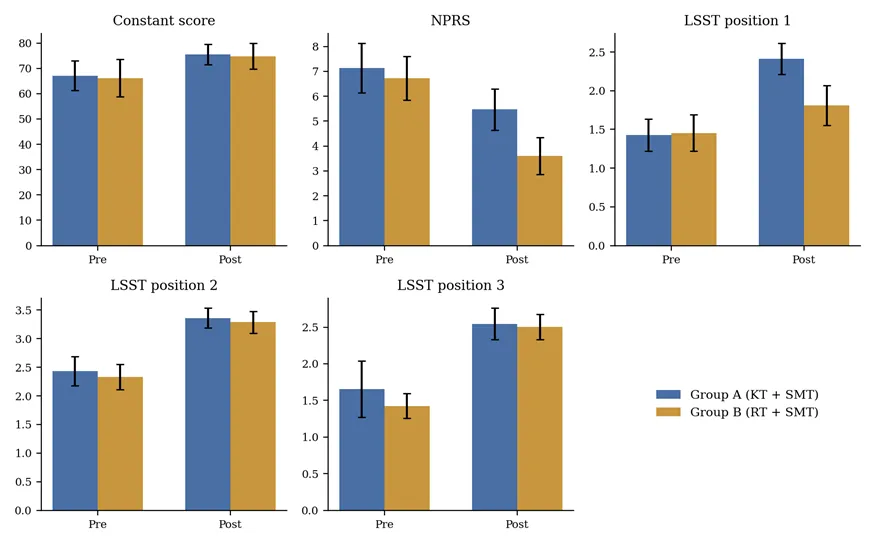
Figure 1. Pre- and post-intervention mean values (± SD) of Constant score, NPRS and LSST positions 1–3 in Group A and Group B
DISCUSSION
This study compared KT and RT, each combined with scapular mobilization, in individuals with SIS over 2 weeks. Both combinations were followed by significant changes in scapular position, pain and shoulder function. Between groups, pain was lower after RT with SMT, LSST position 1 changed more after KT with SMT, and the Constant score and LSST positions 2 and 3 were similar. The greater pain reduction in the RT group may reflect the mechanical support of non-elastic tape, which limits unwanted movement and offloads painful structures, whereas KT is proposed to act mainly through sensory input and alignment cues, and its mechanisms remain uncertain. The larger change in LSST position 1 with KT suggests that elastic tape may assist resting scapular alignment, but this was not seen at positions 2 and 3, and these observations need confirmation. Scapular mobilization given to both groups is intended to improve scapulothoracic mobility and reduce pain, and the studies cited here have examined the benefit of adding manual therapy to exercise in SIS [9,10,11,12,13]. Our findings are broadly in line with the literature on KT. A meta-analysis reported that KT improved pain and disability in shoulder conditions chiefly when it was combined with another treatment, namely exercise [19], and an earlier trial found faster pain relief with KT than with conventional modalities in the first week, with comparable results by the second [20]. Mobilization with movement combined with KT has also been reported to increase range of motion in painful shoulders [21]. In contrast, a trial in asymptomatic overhead athletes found that KT, but not rigid tape, improved glenohumeral rotation range [22]; that population and those outcomes differ from ours, which may explain the different pattern of results. Clinically, both combinations can be used in the short term for SIS, and the choice between them may be guided by the main treatment goal, such as pain relief or scapular alignment. The absence of a group receiving SMT alone means that the contribution of each tape cannot be separated from that of mobilization.
LIMITATIONS
RECOMMENDATIONS
CONCLUSION
Kinesio taping and rigid taping, each combined with scapular mobilization, were associated with significant short-term improvements in scapular position, pain and shoulder function in individuals with shoulder impingement syndrome. Rigid taping with mobilization produced greater pain reduction, and Kinesio taping with mobilization produced a greater change in LSST position 1, while function was comparable. These findings should be confirmed in larger controlled trials with longer follow-up.
REFERENCES


K. P. Abhishek*, C. Divyamalini, V. Mageswari, S. Aysha farsana, Senthil purushothaman, Effectiveness of Kinesio Taping and Rigid Taping Along with Scapular Mobilization Technique on Scapular Position Among Individuals with Shoulder Impingement Syndrome, Int. J. Med. Pharm. Sci., 2026, 2 (11), 75-81. https://doi.org/10.5281/zenodo.24412648
 10.5281/zenodo.24412648