

We use cookies to ensure our website works properly and to personalise your experience. Cookies policy
1Department of Pharmaceutical Chemistry, Shantha College of Pharmacy, Peresandra, Chikkaballapur, Karnataka 562104, India (affiliated to Rajiv Gandhi University of Health Sciences, Bengaluru)
Ultraviolet (UV) radiation causes erythema, photoaging and skin cancer, and there is growing interest in plant-based photoprotective products. This study aimed to formulate and evaluate a herbal nanoemulgel sunscreen containing hydroalcoholic extracts of Centella asiatica leaves and Calendula officinalis flowers. The extracts were prepared by cold maceration with 70% ethanol and screened for phytoconstituents. A nanoemulsion of MCT oil, Span 80, Tween 80 and the combined extracts was prepared by homogenization and sonication and incorporated into a Carbopol 940 gel to give four batches (F1–F4) that differed in extract (0.5–1.5% w/w) and Carbopol (1.0–1.25% w/w) content. The batches were evaluated for appearance, pH, spreadability, viscosity, extrudability, washability, microbial growth and in-vitro sun protection factor (SPF) by the Mansur spectrophotometric method. Extract yields were 13.7% (C. asiatica) and 11.4% (C. officinalis), and alkaloids, flavonoids, phenolics, tannins, saponins, glycosides and terpenoids were detected in both. All batches were smooth, homogeneous, pale green, easily washable and free of visible microbial growth, with pH 5.5–6.0 and extrudability of 88.2–94.1%. In-vitro SPF values were 13.87 (F1), 12.54 (F2), 16.79 (F3) and 9.62 (F4); F3, with the highest extract content (1.5% w/w), gave the highest value. The herbal nanoemulgel is a promising base for plant-based photoprotection, but droplet-size characterization, quantitative antioxidant assay, stability and in-vivo studies are still required.
Solar ultraviolet (UV) radiation reaching the earth’s surface consists of UVB (about 290–320 nm) and UVA (320–400 nm); UVC is almost completely absorbed by the ozone layer. UVB causes sunburn (erythema) and direct DNA damage, whereas UVA penetrates to the dermis and promotes photoaging through reactive oxygen species (ROS). Repeated exposure leads to photoaging, pigmentary change, immunosuppression and skin cancer.1
Sunscreens protect the skin by absorbing, reflecting or scattering UV radiation. Concerns about photoallergy with some organic filters and about the environmental effects of filters such as oxybenzone, which has been shown to be toxic to coral,2 have increased interest in plant-based alternatives. Flavonoids, phenolic acids, tannins and terpenoids from plants absorb in the UV region and scavenge free radicals, and may therefore add antioxidant protection to a sunscreen.
Centella asiatica (L.) Urban (family Apiaceae) contains triterpenoid saponins such as asiaticoside and madecassoside, together with flavonoids, and has reported antioxidant, anti-inflammatory and wound-healing activity.3 Calendula officinalis L. (family Asteraceae) contains flavonoids, carotenoids, triterpenoids and phenolic acids, and is used for its anti-inflammatory, antioxidant and skin-soothing properties.4
Plant extracts are often difficult to deliver in conventional creams. Oil-in-water nanoemulsions, with droplets of about 20–200 nm, improve the solubilization, stability and skin penetration of actives, but their low viscosity limits retention on the skin. Incorporating a nanoemulsion into a gel network gives a nanoemulgel, which combines nanoscale delivery with better spreadability, skin contact and patient acceptability.5 A nanoemulsion sunscreen containing C. asiatica extract showed SPF values that increased with extract amount,6 and C. officinalis extract has been used in nanoparticle systems with antioxidant and wound-healing activity in vitro.7
Most studies have examined these two plants separately, and to the best of our knowledge a nanoemulgel sunscreen containing both extracts has not been reported. The present work therefore aimed to prepare hydroalcoholic extracts of C. asiatica and C. officinalis, formulate them into a Carbopol 940-based nanoemulgel in four batches, and evaluate the batches for physicochemical properties and in-vitro SPF.
MATERIALS AND METHODS
Plant Material and Chemicals
Fresh leaves of Centella asiatica and flowers of Calendula officinalis were collected from the Chikkaballapur region of Karnataka, India. The plant materials were washed thoroughly with water to remove dirt and other impurities, shade-dried, and powdered using a mechanical grinder. The resulting powders were passed through a sieve to obtain a uniform coarse powder for further use. Ethanol and Carbopol 940 were obtained from Loba Chemie Pvt. Ltd.; Tween 80 and Span 80 from Karnataka Fine Chem; medium-chain triglyceride (MCT) oil from Spectrum Reagents and Chemicals Pvt. Ltd.; and propylene glycol from Huraim Naturals. Triethanolamine and distilled water were of laboratory grade. The instruments used in the study included a magnetic stirrer with a hot plate, high-speed homogenizer, ultrasonicator, UV–visible spectrophotometer, Brookfield viscometer, and digital pH meter
Preparation of Extracts
Powdered leaves of C. asiatica and flowers of C. officinalis (500 g each) were extracted separately by cold maceration with 70% v/v ethanol (about 1:10 w/v) for 72 h at room temperature with intermittent shaking and protection from light. The macerates were filtered through Whatman No. 1 filter paper and the filtrates were concentrated on a water bathto semisolid extracts. Percentage yield was calculated as the weight of extract divided by the weight of powder taken, multiplied by 100. The extracts were stored in airtight, light-protected containers at 2–8 °C.
Preliminary Phytochemical Screening
Both extracts were tested for alkaloids (Dragendorff’s test), flavonoids (lead acetate test), phenolic compounds and tannins (ferric chloride test), saponins (foam test), glycosides (Keller–Kiliani test) and terpenoids (Salkowski test) using standard procedures.8
Preparation of the Nanoemulsion
The oil phase, consisting of 5 mL of medium-chain triglyceride (MCT) oil and 1 mL of Span 80, was heated to approximately 60 °C. The aqueous phase, containing 2 mL of Tween 80, 10 mL of distilled water, and the combined herbal extracts of Centella asiatica and Calendula officinalis in a 1:1 ratio, was heated to the same temperature. The aqueous phase was then added slowly to the oil phase with continuous stirring to form a coarse emulsion. The resulting emulsion was homogenized at 10,000 rpm for 10 minutes using a high-speed homogenizer and subsequently sonicated for 5–10 minutes to reduce droplet size and improve emulsion uniformity.
Preparation of the Nanoemulgel
Carbopol 940 (1.0–1.25% w/w) was dispersed in distilled water with continuous stirring and allowed to hydrate overnight. The dispersion was neutralized with triethanolamine to form a clear gel base, and propylene glycol was added as a humectant. The nanoemulsion was incorporated into the gel base slowly with continuous stirring until a smooth, homogeneous nanoemulgel was obtained. Four batches (F1–F4) were prepared by varying the combined extract and Carbopol 940 concentrations (Table 3).
Evaluation of the Nanoemulgel
Appearance and homogeneity were evaluated by visually examining the colour, odour, consistency, uniformity, and presence of phase separation in the nanoemulgel formulations. The pH was measured at room temperature using a calibrated digital pH meter by directly immersing the electrode into the formulation. Viscosity was determined using a Brookfield viscometer with spindle No. 64 at 20 rpm and a temperature of 25 ± 2 °C. Spreadability was assessed using the glass slide method, in which a weighed quantity of nanoemulgel was placed between two glass slides, a 250 g weight was applied, and the time (T) required for the upper slide to travel a fixed distance (L) of 5 cm was recorded. Spreadability was calculated using the formula S = M × L/T, where M represents the applied weight, L is the distance travelled, and T is the time taken. Extrudability was evaluated by filling the nanoemulgel into a collapsible tube and determining the percentage of formulation extruded under a standardized applied pressure. Microbial quality was assessed by inoculating the formulation onto suitable microbiological culture media and incubating at 37 ± 2 °C for 24–48 hours, followed by examination for visible microbial growth. Washability was evaluated by assessing the ease of removal of the formulation from the skin using water. All tests were performed in triplicate (n = 3), and quantitative results were expressed as mean ± standard deviation (SD).
In-Vitro SPF Determination
In-vitro SPF was determined by the Mansur spectrophotometric method.9 A weighed quantity of each formulation was dispersed in ethanol at concentration of 1 mg/mL, filtered, and the absorbance was read against an ethanol blank at 5 nm intervals from 290 to 320 nm. SPF was calculated as SPF = CF × Σ EE (λ) × I (λ) × Abs (λ), summed over 290–320 nm, where CF is the correction factor (10), EE (λ) the erythemal effect spectrum, I (λ) the solar intensity spectrum and Abs (λ) the absorbance of the sample. The normalized EE × I values of Sayre et al.10 were used (Table 5).
Ethical Considerations
No human participants or animals were used in this study, so ethics committee approval was not required.
RESULTS
Extraction Yield and Phytochemical Screening
Cold maceration of 500 g of powder gave 68.5 g of C. asiatica extract (13.7% w/w) and 57.0 g of C. officinalis extract (11.4% w/w) (Table 1). Both yields lie within the range of about 10–15% generally obtained for 70% ethanol maceration of leaf and flower material. All seven classes of phytoconstituents tested were detected in both extracts (Table 2).
Table 1: Extract Yield and Organoleptic Characteristics
| Plant extract | Powder taken (g) | Extract obtained (g) | Yield (% w/w) | Colour and consistency |
|---|---|---|---|---|
| Centella asiatica | 500 | 68.5 | 13.7 | Dark green to brownish-black; thick, sticky semisolid |
| Calendula officinalis | 500 | 57.0 | 11.4 | Bright orange-yellow; slightly aromatic |
Table 2: Preliminary Phytochemical Screening of the Extracts
| Phytoconstituent | Test | C. asiatica | C. officinalis |
|---|---|---|---|
| Alkaloids | Dragendorff’s test | + (orange-red precipitate) | + (orange) |
| Flavonoids | Lead acetate test | + (yellow) | + (yellow) |
| Phenolic compounds | Ferric chloride test | + (blue-green) | + (blue) |
| Tannins | Ferric chloride test | + (dark blue-black) | + (dark blue) |
| Saponins | Foam test | + (persistent foam) | + (persistent foam) |
| Glycosides | Keller–Kiliani test | + (reddish-brown) | + (reddish-brown) |
| Terpenoids | Salkowski test | + (reddish-brown) | + (reddish-brown) |
+ = present.
Physicochemical Evaluation of the Nanoemulgel
The four batches differed in extract and Carbopol 940 content (Table 3). All were smooth, pale green, semisolid, homogeneous and free of phase separation, with the characteristic odour of the extracts. All batches were easily washable and showed no visible microbial growth after incubation.
Table 3: Composition of the Nanoemulgel Batches
| Batch | Combined extract (% w/w) | Carbopol 940 (% w/w) | Distilled water |
|---|---|---|---|
| F1 | 0.5 | 1.0 | q.s. |
| F2 | 1.0 | 1.0 | q.s. |
| F3 | 1.5 | 1.0 | q.s. |
| F4 | 1.0 | 1.25 | q.s. |
The pH ranged from 5.5 to 6.0 (Table 4). Viscosity increased from F1 (8450) to F4 (10850), the highest value being obtained with 1.25% Carbopol 940. In the glass slide test the slides travelled 3.2–3.5 cm in 2 s, giving spreadability of 400.0–437.5 g·cm/s, the highest being for F1. Extrudability ranged from 88.2 ± 0.8% (F1) to 94.1 ± 0.5% (F4) and increased across the series from F1 to F4.
Table 4: Physicochemical Properties of the Nanoemulgel Batches
| Batch | pH | Distance travelled (cm) | Spreadability (g·cm/s) | Viscosity [unit] | Extrudability (%) |
|---|---|---|---|---|---|
| F1 | 5.9 | 3.5 | 437.5 | 8450 | 88.2 ± 0.8 |
| F2 | 5.8 | 3.2 | 400.0 | 9120 | 90.5 ± 0.6 |
| F3 | 6.0 | 3.4 | 425.0 | 9680 | 92.4 ± 0.7 |
| F4 | 5.5 | 3.3 | 412.5 | 10850 | 94.1 ± 0.5 |
Time taken for the slides to travel the distance was 2 s for all batches; weight on the upper slide, 250 g.
In-Vitro SPF
Absorbance of the batches between 290 and 320 nm decreased with increasing wavelength (Table 5). The calculated in-vitro SPF values were 13.87 (F1), 12.54 (F2), 16.79 (F3) and 9.62 (F4) (Figure 1). F3, which contained the highest extract concentration (1.5% w/w), gave the highest SPF and F4 the lowest.
Table 5: Absorbance (290–320 nm) And In-Vitro SPF of the Nanoemulgel Batches
| Wavelength (nm) | EE × I | F1 | F2 | F3 | F4 |
|---|---|---|---|---|---|
| 290 | 0.0150 | 2.382 | 2.198 | 2.801 | 1.582 |
| 295 | 0.0817 | 2.144 | 1.788 | 2.558 | 1.344 |
| 300 | 0.2874 | 1.642 | 1.565 | 1.923 | 1.132 |
| 305 | 0.3278 | 1.442 | 1.152 | 1.780 | 0.942 |
| 310 | 0.1864 | 0.954 | 0.924 | 1.164 | 0.811 |
| 315 | 0.0837 | 0.567 | 0.798 | 0.789 | 0.474 |
| 320 | 0.0180 | 0.319 | 0.481 | 0.503 | 0.212 |
| In-vitro SPF | 13.87 | 12.54 | 16.79 | 9.62 |
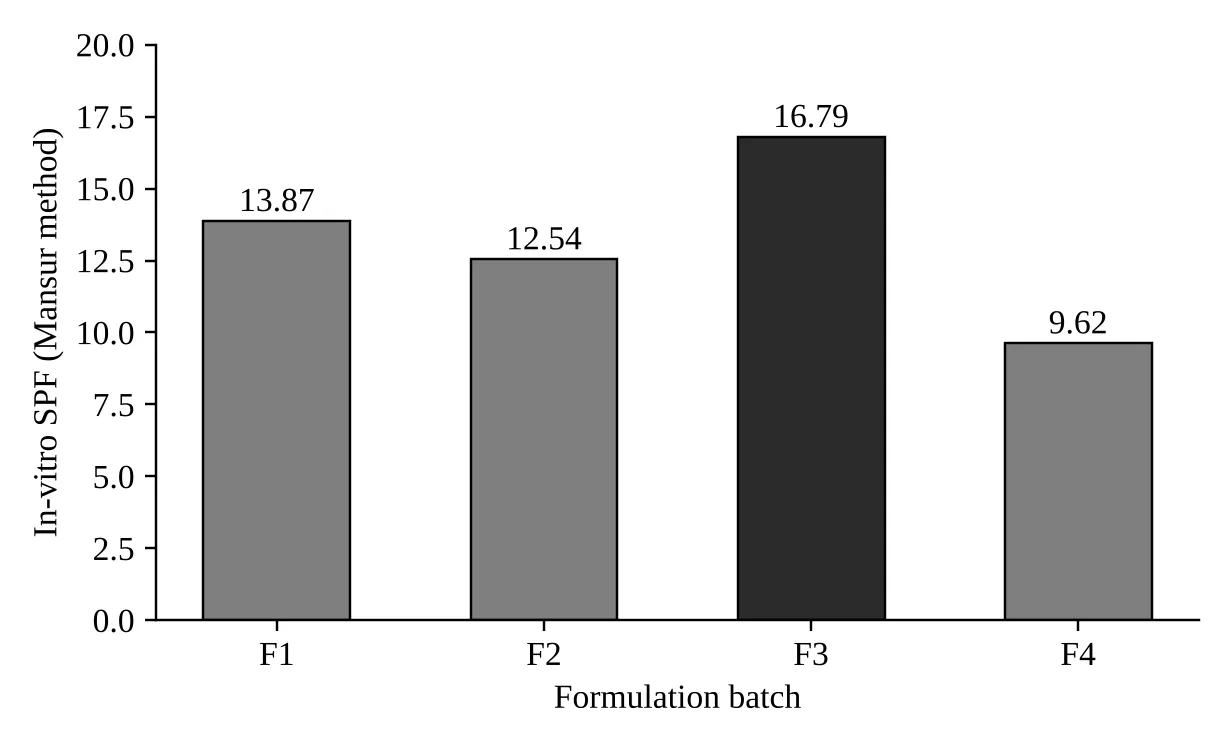
Figure 1: In-Vitro SPF of Nanoemulgel Batches F1–F4
DISCUSSION
The extract yields of 13.7% and 11.4% are typical of hydroalcoholic maceration, and the presence of flavonoids, phenolic compounds, tannins and terpenoids in both extracts is consistent with the antioxidant and UV-absorbing activity reported for these plants.3,4 The tests used are qualitative, so they show which classes are present but not how much, and the contribution of each class to photoprotection was not measured.
The pH of 5.5–6.0 is close to the upper end of the range reported for normal skin surface pH,11 and is generally acceptable for leave-on products; a small adjustment toward 5.0–5.5 could be considered in later batches. Viscosity rose with Carbopol 940 content (F2 to F4) and with extract content (F1 to F3), as expected for a gel network, and extrudability rose with viscosity across the series. Spreadability varied little among the batches (400.0–437.5 g·cm/s) and did not follow viscosity strictly. Because the slides travelled 3.2–3.5 cm in a fixed time of 2 s, differences of this size lie within the resolution of the method and should not be over-interpreted.
In-vitro SPF was highest for F3 (16.79), the batch with the most extract, which agrees with the report that SPF of a C. asiatica nanoemulsion increased with extract amount.6 SPF did not, however, rise steadily with extract content: F1 (0.5% extract) gave 13.87, higher than F2 (1.0% extract, 12.54). F2 and F4 contain the same extract content but differ in Carbopol 940 (1.0% and 1.25%), and SPF fell from 12.54 to 9.62, which suggests that the gel matrix itself influences the measured absorbance, for example through the sample dispersion or its scattering properties. With one set of absorbance readings per batch and no replicate statistics, the ranking of F1 and F2 cannot be regarded as established. The Mansur method is a rapid screening estimate based on absorbance of a diluted ethanolic sample; it does not replace the standardized in-vivo or in-vitro SPF methods, and the values should be read as relative indicators of UV-absorbing capacity.
This study has limitations. Droplet size, polydispersity index and zeta potential were not determined, so the nanoscale character of the emulsion is assumed from the preparation method rather than demonstrated. Extract content in the finished gel, quantitative antioxidant activity (for example by DPPH assay), stability under storage, skin irritation and photostability were also not assessed. These measurements are required before the formulation can be recommended for further development.
CONCLUSION
Herbal nanoemulgel batches containing Centella asiatica and Calendula officinalis extracts in a Carbopol 940 gel were smooth, homogeneous, easily washable and free of visible microbial growth, with skin-compatible pH, acceptable spreadability and extrudability, and in-vitro SPF values of 9.62–16.79. The batch with the highest extract content (F3, 1.5% w/w) gave the highest SPF. These findings support further work on this plant-based photoprotective system, including droplet-size characterization, quantitative antioxidant evaluation, stability studies, skin-safety testing and in-vivo photoprotection studies.
CONFLICT OF INTEREST
The authors declare that they have no conflict of interest.
ACKNOWLEDGEMENT
The authors thank the Principal, Vice Principal, Chairman and staff of Shantha College of Pharmacy, Peresandra, for providing the facilities needed to carry out this work.
REFERENCES




Swathi S. N., Thanushree B., Vennela V., Mouna S. M., Gopinath Elumalai, Sunil Kumar Busi, Formulation and Evaluation of Herbal Nanoemulgel Sunscreen Containing Centella Asiatica and Calendula Officinalis Extracts, Int. J. Med. Pharm. Sci., 2026, 2 (11), 295-300. https://doi.org/10.5281/zenodo.24580277
 10.5281/zenodo.24580277