

We use cookies to ensure our website works properly and to personalise your experience. Cookies policy
School of Pharmacy, D. Y. Patil University Ambi, Pune
Schizophrenia remains one of psychiatry's hardest diagnostic and therapeutic puzzles: a disorder defined largely by subjective symptom clusters, treated with drugs whose mechanisms were discovered by accident seven decades ago, and managed through a trial-and-error prescribing process that fails roughly a third of patients. Artificial intelligence is now being layered onto every stage of this pathway. This review integrates the core pharmacology of schizophrenia, dopaminergic, glutamatergic, and serotonergic mechanisms, with a synthesis of peer-reviewed and preprint evidence on how machine learning and deep learning models are being used to classify the disorder from EEG and MRI data, mine genomic and multi-omic signatures of drug response, accelerate CNS drug discovery, forecast which antipsychotic will work for a given patient, and flag relapse days before it happens using nothing more than smartphone sensor data. Reported model performance across the reviewed studies is high (accuracies and AUCs frequently above 0.85), but the underlying datasets are small, site-specific, and rarely externally validated, which tempers any claim of imminent clinical deployment. The review closes with a frank look at the interpretability, bias, and regulatory hurdles that separate an impressive classifier from a usable clinical tool.
A Disorder That Resists Simple Answers
Schizophrenia affects roughly 1 in 300 people worldwide and typically announces itself between the ages of 15 and 34, precisely the years in which education, careers, and relationships are being built. It is defined clinically by a triad of positive symptoms (hallucinations, delusions, disorganized thought), negative symptoms (blunted affect, avolition, social withdrawal), and cognitive impairment, yet no blood test, scan, or biomarker panel can confirm the diagnosis. A psychiatrist still arrives at it the way clinicians did in the 1950s: by listening, observing, and applying a diagnostic manual. Pharmacological treatment has advanced, but not as much as the sixty-year gap since chlorpromazine's discovery might suggest. Every antipsychotic on the market today still leans, to some degree, on dopamine D2 receptor blockade, and choosing the right one for the right patient is still largely a matter of clinical trial and error. This is precisely the kind of high-dimensional, pattern-heavy problem that machine learning is good at, and over the past decade a fast-growing body of research has applied it to nearly every stage of the schizophrenia care pathway. This review connects that AI literature to the underlying pharmacology, so the two are read together rather than as separate stories.
2. The Pharmacological Backbone: What AI Is Actually Trying to Predict
Any AI model built for schizophrenia is, in the end, trying to predict something rooted in neurochemistry. Three overlapping hypotheses explain most of what current drugs do and don't do.
2.1 The dopamine hypothesis
Antipsychotic efficacy correlates closely with D2 receptor affinity, and this observation, formalized decades ago, remains the pharmacological foundation of the field. Dopamine acts through four principal pathways, and a drug's effects (both therapeutic and adverse) map directly onto them:
Mesolimbic pathway: dopaminergic hyperactivity here is linked to positive symptoms; D2 blockade in this pathway is the therapeutic target.
Mesocortical pathway: relative dopaminergic hypoactivity here is implicated in negative and cognitive symptoms, which typical antipsychotics do little to relieve and can even worsen.
Nigrostriatal pathway: D2 blockade here produces extrapyramidal symptoms, parkinsonism, dystonia, akathisia, and with chronic blockade, tardive dyskinesia.
Tuberoinfundibular pathway: D2 blockade removes tonic inhibition of prolactin, producing hyperprolactinemia, galactorrhea, and menstrual disturbance.
2.2 Beyond dopamine: glutamate and serotonin
Pure dopamine blockade cannot explain treatment-resistant cases or the prominence of negative and cognitive symptoms, which is why the glutamatergic NMDA-receptor hypofunction hypothesis has gained ground: NMDA antagonists such as ketamine and phencyclidine reproduce both positive and negative symptoms in healthy volunteers, pointing to glutamatergic dysregulation as an upstream driver of the dopaminergic disturbance. Serotonin (5-HT2A) also modulates dopamine release in the cortex, and 5-HT2A antagonism is the pharmacological signature that separates second-generation ('atypical') antipsychotics from the first-generation ('typical') agents, generally lowering extrapyramidal risk while introducing a different problem: metabolic syndrome.
2.3 Antipsychotic classes at a glance
Table 1 summarizes the major antipsychotic classes, their receptor targets, and their principal liabilities, the very outcomes that treatment-response AI models (Section 5) are trained to predict before a clinician ever writes the prescription.
Table 1. Major antipsychotic drug classes, receptor pharmacology, and clinical liabilities.
|
Class |
Representative agents |
Primary receptor pharmacology |
Key clinical / ADR profile |
|
First-generation, high-potency |
Haloperidol, Fluphenazine |
Strong D2 antagonism |
Low sedation/anticholinergic burden; high risk of EPS and tardive dyskinesia |
|
First-generation, low-potency |
Chlorpromazine |
D2, H1, muscarinic, alpha-1 antagonism |
Sedation, anticholinergic effects, orthostasis; lower EPS than high-potency agents |
|
Second-generation (serotonin-dopamine antagonists) |
Risperidone, Olanzapine, Quetiapine |
D2 + 5-HT2A antagonism |
Reduced EPS; weight gain, dyslipidemia, insulin resistance (esp. olanzapine) |
|
Second-generation (partial D2 agonists) |
Aripiprazole, Brexpiprazole |
D2/D3 partial agonism, 5-HT1A partial agonism |
"Dopamine stabilizer" profile; lower metabolic and EPS burden; akathisia possible |
|
Atypical, multi-receptor |
Clozapine |
Broad D1-D4, 5-HT2A/2C, H1, M1, alpha-1 antagonism |
Reserved for treatment-resistant schizophrenia; agranulocytosis risk mandates blood-count monitoring |
|
Emerging non-D2 mechanism |
Ulotaront (investigational) |
TAAR1 agonism, 5-HT1A agonism |
No direct D2 blockade; under AI-assisted development pipelines |
3. Teaching Machines to Recognize Schizophrenia
The largest single strand of the AI-schizophrenia literature concerns diagnosis and classification from neurophysiological or imaging data, an area a 2024 PRISMA-guided systematic review covering studies from 2015 to 2024 mapped in detail across EEG, structural MRI, and functional MRI modalities [1].
3.1 Electroencephalography (EEG)
EEG is cheap, non-invasive, and captures the millisecond-scale electrical signature of a brain that behaves differently in schizophrenia, which is why it dominates the AI-diagnosis literature. Within the studies reviewed, a deep residual network paired with a support-vector-machine classifier reached 99.23% accuracy distinguishing patients from healthy controls, outperforming the ResNet's own softmax layer [1]. A random-forest model built on the openly available RepOD dataset, using independent component analysis and spectral features, achieved 100% accuracy at excluding schizophrenia, a result its authors suggested could support faster differential diagnosis in acute settings [1]. A broader 2024 Frontiers review of EEG-based classification pipelines found that classical ML methods such as support vector machines and decision trees remain competitive and more interpretable on smaller datasets, while deep-learning approaches demand more data and compute but adapt better to complex spectral patterns [2].
3.2 Structural and functional MRI
Structural MRI studies exploit the well-documented gray-matter and ventricular changes associated with schizophrenia. An extreme-learning-machine model trained on the COBRE dataset reached 99.29% accuracy using combined morphological and connectivity features [1]. A separate deep-learning model trained on the SchizConnect dataset achieved an AUC of 0.96, and a 3D convolutional network using purely structural T1-weighted scans across three open datasets pushed that to an AUC of 0.987 [1]. On the functional side, a 2024 study reconstructing cortical activity from EEG and building a graph neural network over functional brain networks reached 84.17% accuracy, notably outperforming a conventional SVM trained on the same graph-theoretic features (69.17%), and localized the auditory cortex as disproportionately affected, particularly in patients with a longer illness course [1].
3.3 Why the numbers deserve a skeptical read
Reported accuracies above 95% look extraordinary, and that is precisely the point at which a reviewer should slow down. Nearly all of these studies train and test on small, single-site cohorts, often fewer than 100 patients, with narrow demographic ranges and no external validation cohort. A 2026 review of AI in schizophrenia diagnosis explicitly flagged this problem, noting that widely used datasets such as DAIC-WOZ, CLPsych, and AVEC struggle to represent diverse populations, remain unstable across time, and were not built to satisfy DSM-5 diagnostic standards [5]. High internal accuracy on a homogeneous 30-to-70-patient dataset is not the same claim as a clinically deployable diagnostic tool, and the review literature itself is candid about that gap.
4. From Bench to Algorithm: AI in Genomics and Drug Discovery
A parallel strand of research points AI not at the clinic but at the laboratory bench. A 2024 JMIR scoping review of schizophrenia, machine learning, and genomics identified machine-learning analyses of a combined Chinese Antipsychotics Pharmacogenomics/Pharmacogenetics cohort of more than 3,600 patients that used support-vector-machine and random-forest models to flag six candidate risk genes (LINC01795, DDHD2, SBNO1, KCNG2, SEMA7A, and RUFY1) linked to cortical morphology and gene-epigenetic interactions relevant to treatment response [6]. On the multi-omics side, a 2025 study following 208 schizophrenia patients through six weeks of paliperidone treatment combined genotyping, proteomics, and metabolomics, and used machine learning to identify twenty proteins and twenty metabolites, most notably phosphatidylcholine and sphingomyelin species, predictive of treatment response at baseline. The proteomic and metabolomic models individually reached cross-site AUCs of 0.923 and 0.816, and a combined multi-omics ensemble model reached 0.941, alongside 32 genome-wide loci and dozens of proteins and metabolites significantly associated with efficacy [10]. CNS drug discovery itself is one of pharmacology's slowest and costliest domains, with an average 15-to-19-year path from target identification to regulatory approval. A review of AI/ML-aided CNS drug discovery describes how these timelines are now being compressed through machine-learning-assisted target identification, QSAR (quantitative structure-activity relationship) modelling, and dose-response prediction specifically applied to schizophrenia drug candidates, even as it acknowledges that, despite over a century of research, no antipsychotic mechanism outside the dopamine-serotonin-glutamate framework has yet reached the market [7].
5. Picking the Right Drug the First Time: AI-Guided Treatment Selection
Roughly a third to a half of patients fail to respond adequately to their first antipsychotic, and the standard next step, cross-titrating to a different agent, can take weeks to fail again. This is arguably the domain where AI's clinical upside is most direct. A comprehensive PRISMA-guided review of 28 studies published through March 2022 examined machine-learning models predicting antipsychotic treatment outcomes from neuroimaging, neurophysiological, genetic, and clinical features, and found that functional MRI-derived connectivity features were consistently the strongest single-modality predictors of response, with clinical-feature-only models also showing adequate predictive value [8]. A Danish multi-site study built a machine-learning framework combining structural and functional imaging, EEG, and clinical variables in antipsychotic-naive, first-episode patients, and reported it could reliably forecast both short- and long-term response before a single dose of medication had been given [11]. A more applied step in this direction appeared in 2025: a hospital-deployable machine-learning medication recommender system, trained on the MIMIC-IV critical-care database and externally validated across Northwestern ICU and MIMIC-III cohorts, used similarity-based collaborative-filtering and distance-based algorithms to recommend antipsychotic choices for in-patients with schizophrenia-spectrum disorders. It maintained recommendation quality across different institutions and time periods, though its authors were explicit that prospective clinical trials are still required before any claim of real-world effectiveness [9]. Explainable-AI methods have also been retrospectively applied to existing antipsychotic clinical trial data to identify which patient subgroups actually benefited, a use case that improved the apparent treatment effect simply by refining who the model judged eligible for the analysis [15].
6. Watching for Relapse Before It Happens: Digital Phenotyping
Up to 40% of patients discharged after a schizophrenia hospitalization relapse within a year, even with appropriate treatment, and relapse is frequently preceded by subtle behavioral shifts that patients themselves may not notice, changes in sleep, movement, and social contact. Digital phenotyping uses a smartphone's own sensors (GPS, accelerometer, screen-on time) to capture this passively and continuously. The foundational pilot study, conducted with the open-source Beiwe platform, established the feasibility of forecasting relapse from passively collected phone data alone [13]. A larger 2023 study extended this across three sites in Boston, Bangalore, and Bhopal using the mindLAMP app, and found that statistically anomalous patterns in geolocation, accelerometer, and screen-state data occurred 2.12 times more frequently in the month before a relapse, and 2.78 times more frequently across the month before and after, compared with non-relapse periods; an anomaly-detection model built on this passive data outperformed a simpler model relying on active self-report surveys alone [12]. A 2026 systematic review pooling passive-sensing relapse-prediction studies across schizophrenia-spectrum, bipolar, and major depressive disorders found sleep and physical-activity disruption were the most consistent predictive features (present in 83% of studies), with models achieving AUCs between 0.70 and 0.88 for forecasting relapse one to four weeks in advance, while cautioning that most of these estimates came from internal validation and likely overstate real-world performance [14]. The same approach is now being extended to low-resource settings, including an ongoing NIHR-funded cohort study of 430 participants in the Korail slum of Dhaka, Bangladesh, designed explicitly to test whether digital phenotyping can close the psychiatric monitoring gap where in-person follow-up is hardest to sustain [22].
Table 2. AI applications mapped across the schizophrenia care continuum, with representative studies.
|
Domain |
Data modality |
Representative study |
Key reported result |
|
Diagnosis |
EEG |
Deep ResNet + SVM classifier [1] |
99.23% classification accuracy vs. healthy controls |
|
Diagnosis |
Structural MRI |
Extreme learning machine, COBRE dataset [1] |
99.29% classification accuracy |
|
Diagnosis |
Functional connectivity |
Graph neural network [1] |
84.17% accuracy; identified auditory-cortex involvement |
|
Genomics |
Genotype + proteome + metabolome |
Multi-omics ensemble, paliperidone cohort [10] |
AUC 0.941 predicting antipsychotic efficacy |
|
Drug discovery |
Chemical/target data |
QSAR / target-ID pipelines [7] |
Accelerated candidate screening within a still-lengthy CNS development timeline |
|
Treatment response |
Multimodal neuroimaging + clinical |
ML framework, antipsychotic-naive cohort [11] |
Robust short- and long-term response prediction pre-treatment |
|
Treatment selection |
EHR / prescribing records |
ML medication recommender system [9] |
Consistent recommendation quality across institutions and time periods |
|
Relapse prediction |
Smartphone passive sensors |
mindLAMP anomaly detection [12] |
Anomalies 2.1–2.8x more frequent around relapse |
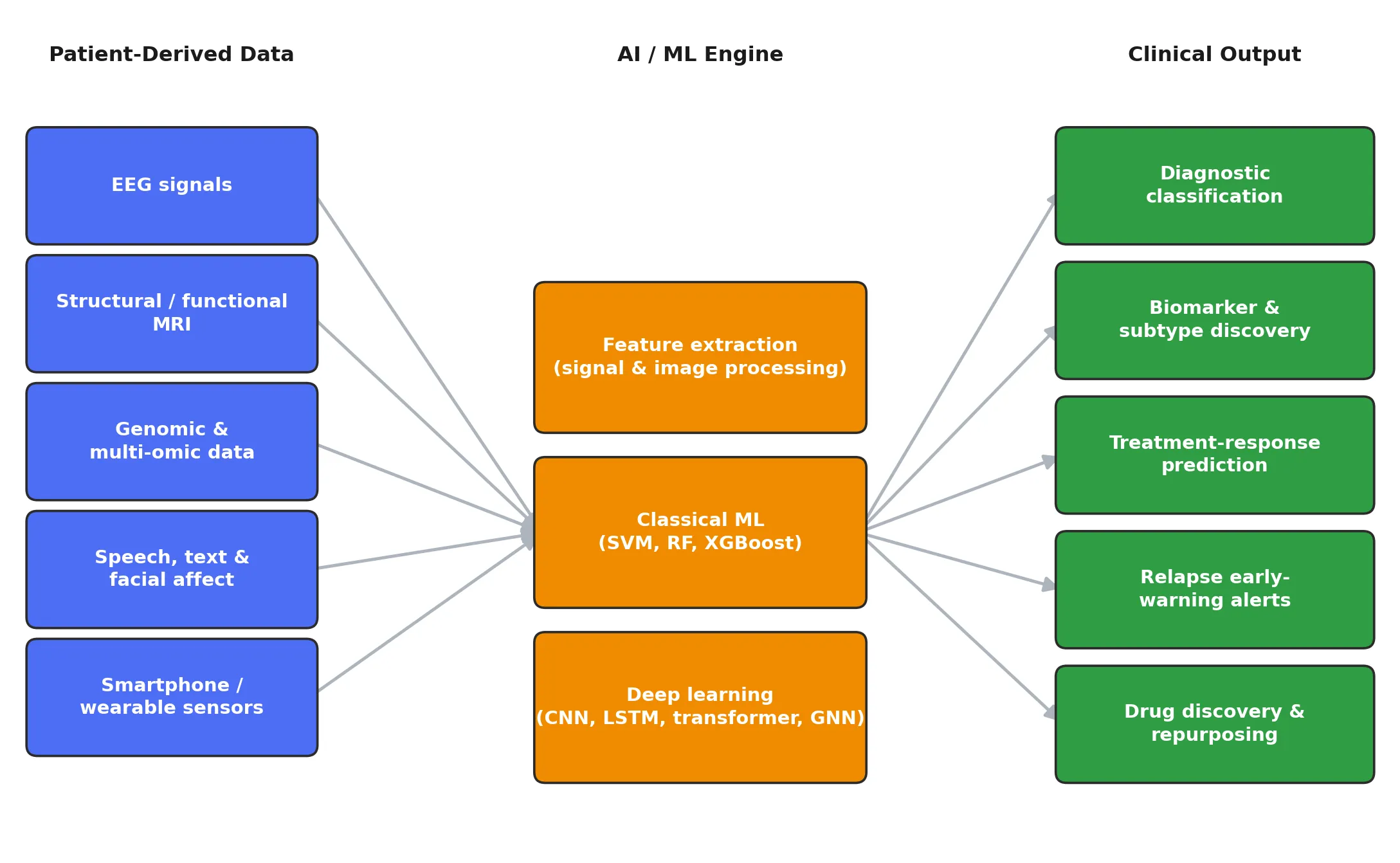
Figure 1. Conceptual pipeline linking patient-derived data sources, AI/ML model classes, and downstream clinical outputs in schizophrenia research.
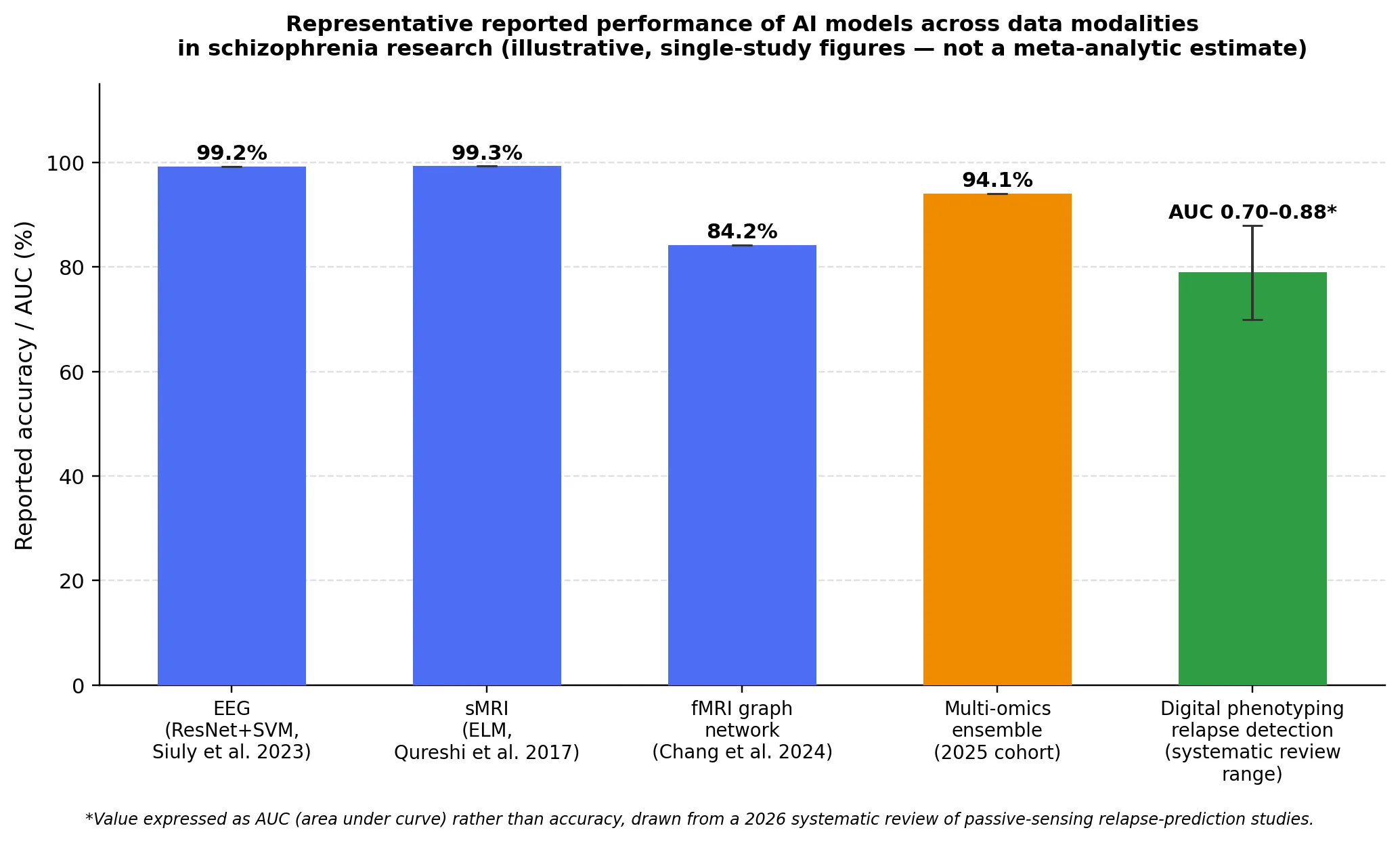
Figure 2. Representative single-study performance figures across modalities. These are illustrative values drawn from individual cited studies, not a pooled meta-analytic estimate, and should be read alongside the small-sample caveats discussed in Section 7.
7. The Gap Between a Good Classifier and a Usable Clinical Tool
Three problems recur across almost every study cited above, and a review that only celebrated the accuracy numbers would be an incomplete one.
Small, homogeneous datasets. The most widely reused public datasets (COBRE, RepOD, NUSDAST, MCIC, MLSP2014) each contain fewer than 200 patients, drawn overwhelmingly from single countries or institutions, which inflates internal accuracy while leaving external generalizability largely untested [1].
Interpretability. A clinician cannot act on a black-box probability score with no explanation, which is why explainable AI (XAI) methods, feature attribution, attention visualization, LIME-style local explanations, are increasingly built into these pipelines rather than added as an afterthought [16].
Regulation and governance. The European Union's Artificial Intelligence Act (2024) now directly constrains how AI systems handling psychiatric data can be deployed clinically, and comparable frameworks are still being worked out elsewhere, leaving a real gap between what a model can do in a paper and what a regulator will let it do in a hospital [5].
8. Where This Is Heading
The trajectory across the literature reviewed here points toward three convergent directions. First, multimodal fusion, combining EEG, imaging, genomics, and passive smartphone data within a single model, consistently outperforms any single modality and is likely to become the default architecture rather than the exception [8]. Second, precision psychiatry is edging closer to reality: multi-omic and pharmacogenomic models are beginning to answer not just "does this patient have schizophrenia" but "which specific drug, at what dose, will this specific patient respond to," which is the pharmacologically meaningful question clinicians actually need answered [10]. Third, AI-assisted rehabilitation and community management, symptom monitoring, medication adherence tracking, and psychosocial support delivered through digital platforms, is expanding well beyond the diagnostic use case that dominated the field a decade ago [3]. None of this replaces the psychiatrist. It replaces some of the guesswork.
CONCLUSION
Artificial intelligence has not solved schizophrenia, and nothing in the literature reviewed here suggests it is close to doing so. What it has done is give a notoriously subjective disorder a growing set of quantitative handles: EEG and MRI classifiers that flag patterns a clinician's eye alone would miss, genomic and multi-omic signatures that hint at who will respond to which antipsychotic, and smartphone sensors that catch relapse in its earliest, quietest days rather than its loudest, most dangerous ones. The pharmacology underneath all of this, dopamine, glutamate, serotonin, has barely changed in decades. What has changed is the amount of pattern hidden inside that pharmacology that a machine can now surface. The next decade of this field will be decided less by whether these models can hit 95% accuracy on a 70-patient dataset, and more by whether they can survive contact with a messy, diverse, 7,000-patient one.
REFERENCES


Namita Kamble, Zubeen Hussain*, Machines That Listen to Mental Illness: Artificial Intelligence, Pharmacology, and the Reinvention of Schizophrenia Care, Int. J. Med. Pharm. Sci., 2026, 2 (8), 657-664. https://doi.org/10.5281/zenodo.22006993
 10.5281/zenodo.22006993