

We use cookies to ensure our website works properly and to personalise your experience. Cookies policy
1Post Graduate Trainee, Department of Homoeopathic Materia Medica, Mahesh Bhattacharyya Homoeopathic Medical College & Hospital. Sailen Manna Sarani, Doomurjala Howrah - 711104, Howrah, West Bengal, India
2Post Graduate Trainee, Department of Practice of Medicine, Mahesh Bhattacharyya Homoeopathic Medical College & Hospital. Sailen Manna Sarani, Doomurjala, Howrah - 711104, Howrah, West Bengal, India
3H.O.D., Department. Of Homoeopathic Materia Medica Mahesh Bhattacharyya Homoeopathic Medical College & Hospital Sailen Manna Sarani, Doomurjala, Howrah – 711104, Howrah, West Bengal, India
Background: Cutaneous warts are common benign proliferative skin lesions caused by human papillomavirus (HPV). Although various treatment modalities are available, treatment response may vary according to the type, site and duration of the lesion. Case Presentation: This case series describes seven patients with clinically diagnosed cutaneous warts of varying duration, number, morphology and anatomical distribution. Most lesions involved the hands and fingers, while one case involved the eyelid. Individualized homoeopathic case-taking was performed, considering characteristic mental, physical, general and particular symptoms. Repertorial analysis was followed by consultation with Homoeopathic Materia Medica for selection of the prescribed medicine. Outcomes: Individualized homoeopathic medicines prescribed included Medorrhinum, Sulphur, Causticum, Ruta, Sarsaparilla and Silicea in 200C or 0/1 potency, according to individual case characteristics. Placebo was prescribed during subsequent follow-up periods. Progressive reduction and eventual disappearance of the wart lesions were documented clinically and photographically in the cases, with follow-up observations ranging from approximately two to four months or longer. Conclusion: This case series documents the clinical course and individualized prescribing approach in seven patients with cutaneous warts. The observed changes provide descriptive clinical information and may generate hypotheses for further research; however, a case series cannot establish treatment efficacy or causality. Controlled and systematically designed studies are required to further evaluate individualized homoeopathic treatment of cutaneous warts.
Warts (ICD-11: 1E80) are common benign proliferative lesions of the skin caused by infection with human papillomavirus (HPV). [1] They commonly occur on the hands, fingers, feet and periungual areas and may present as solitary or multiple, well-defined, hyperkeratotic and verrucous lesions. [2] Although generally benign, warts may persist for prolonged periods and can cause pain, functional inconvenience and cosmetic concern. [2][3] Cutaneous warts are particularly common in children and young adults, with studies demonstrating a substantial prevalence in school-aged children. [4] The natural course is variable, and spontaneous resolution may occur; therefore, persistence, recurrence and the possibility of spontaneous regression are important considerations when assessing treatment outcomes. [5] Various treatment modalities, including keratolytic agents, cryotherapy and other destructive or immunotherapeutic approaches, are available, but treatment response may vary according to the type, site and duration of the wart. [3][6] Individualized homoeopathy considers the totality of characteristic symptoms of the patient in selecting the medicine rather than prescribing solely on the basis of the pathological diagnosis. Reporting such cases requires adequate documentation of the clinical presentation, individualized symptomatology, rationale for medicine selection, medicine details, follow-up and objective evidence of change. Evidence concerning individualized homoeopathic treatment of cutaneous warts remains limited. A randomized, double-blind, placebo-controlled pilot trial of 60 patients reported significant within-group changes but no statistically significant between-group differences in the primary or secondary outcomes, and concluded that the evidence was inconclusive. [7] An earlier randomized, double-blind trial in children with hand warts similarly found no statistically significant difference between individualized homoeopathic treatment and placebo. [8] These findings indicate the need for further systematic clinical research while emphasizing that case series are primarily descriptive and hypothesis-generating. The present case series describes seven patients with clinically diagnosed cutaneous warts who received individualized homoeopathic medicines. The cases document the clinical presentation, individualized symptomatology, repertorial analysis, prescribed medicines, follow-up findings and photographic changes observed during treatment.
CASE REPORTS
Case No. 1:
A 7-year-4-month-old male patient reported to the OPD of Mahesh Bhattacharya Homoeopathic Medical College & Hospital with the chief complaint of multiple wart-like growths on the hand for approximately 2–3 years. There was no associated abnormal sensation or any kind of discharge with warty growth.
On Local clinical Examination:
Site – left index finger, dorsum of hand, right palm near ring and middle finger
No. of lesion – 5
Size- 2-4 mm
Morphology- multiple discrete, well-defined, raised papular lesions with a rough and keratotic surface
Colour- variable brownish to skin-coloured appearance
Surrounding Skin- the surrounding skin appeared normal
Discharge- absent
Itching/ pain/ burning – not present
Diagnosis
The clinical presentation was suggestive of multiple viral warts involving upper extremities. The prolonged duration, multiplicity of lesions and distribution over the hands taken into consideration while evaluating the case.
Characteristic mental physical and particular symptoms:
Repertorial Result:
On repertorial analysis using Hompath firefly software, Medorrhinum scored 26 and covers maximum rubrics of 7, followed by Lycopodium, Sulphur, Argentum Nitricum and others. The details of repertorial sheet given in figure 1.
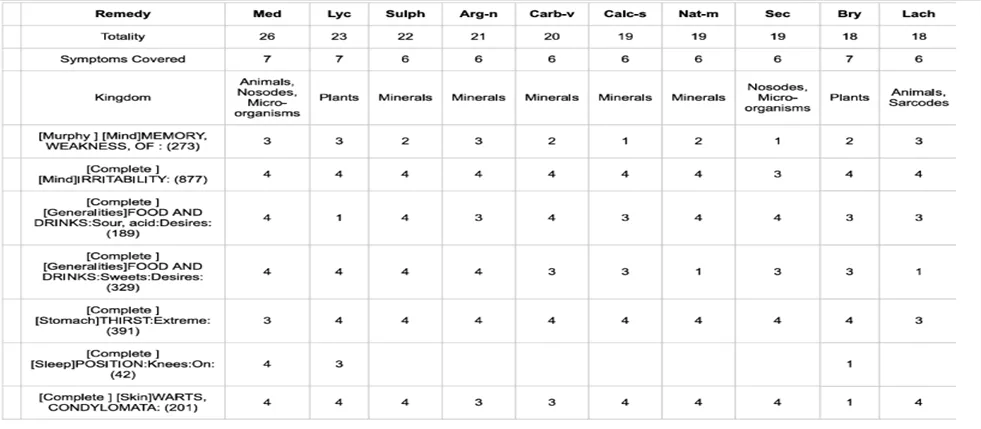
Figure 1: Repertorial sheet of Case 1
Prescription:
After considering the repertorial analysis and consulting Homoeopathic Materia Medica, Medorrhinum 0/1 ,1 medicated globule (no. 10) in 100 ml of distilled water, made16 doses was prescribed for 16 days followed by placebo for 30 days and patient was advised to come for follow up after 30 days. After one month of treatment the warts were removed and no new complaints shown on Figure 2. Follow ups are given in table no. 1
Follow up and Outcomes:
Table 1: Follow up and Outcome of case 1
|
Date |
Clinical findings |
Prescription |
|
30.05.2025 |
Warts on left index finger, right dorsum of hand, palm near ring and middle finger |
Medorrhinum 0/1, 16 doses followed by placebo |
|
28.06.2025 |
Warts on left index finger, right dorsum of hand, palm near ring and middle finger disappeared |
Placebo |
|
23.08.2025 |
No new complaint and no reapperence of old symptoms |
Placebo |
|
04.10.2025 |
No new complaint and no reapperence of old symptoms |
Placebo |
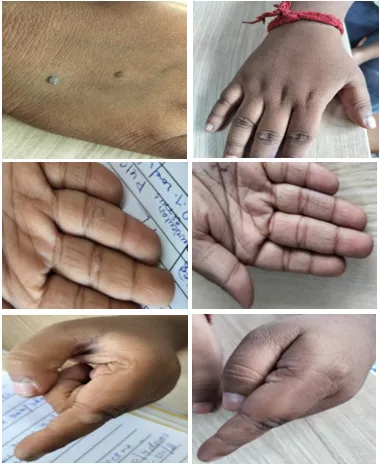
Figure 2: Clinical figures showing before and after pictures of warts of Case 1
Case no: 2
A 47 yrs male patient came to medicine opd of Mahesh Bhattacharyya Homoeopathic Medical College and Hospital, complaining of warty like growth on dorsum of hand near middle finger joint and tip of ring finger and thumb of right hand, it was painless and without any discomfort for 3-4 years, patient didn’t took any treatment previously.
On local/ clinical examination:
Site- dorsum of hand near middle finger joint and tip of ring finger and thumb of right hand
No. of lesion- 3
Size- 4-8 mm
Morphology- well-defined, regular margins, a rough, dry, verrucous surface with visible fissuring
Colour- greyish-white to pale yellowish-brown coloration against the surrounding skin
Distribution- upper extremity
Surrounding skin- evident hyperkeratotic scaling and distal dystrophy along the adjacent nail margins
Discharge- absent
Itching/pain/burning- absent
Diagnosis:
The clinical presentation was suggestive of multiple viral warts involving upper extremity.
Characteristic mental physical and paticular general symptoms are:
Repertorial Result:
After repertorisation Sulphur covers all the symptoms with maximum score 19 covering maximum syptoms of 5. The repertorial details shown in figure 3.
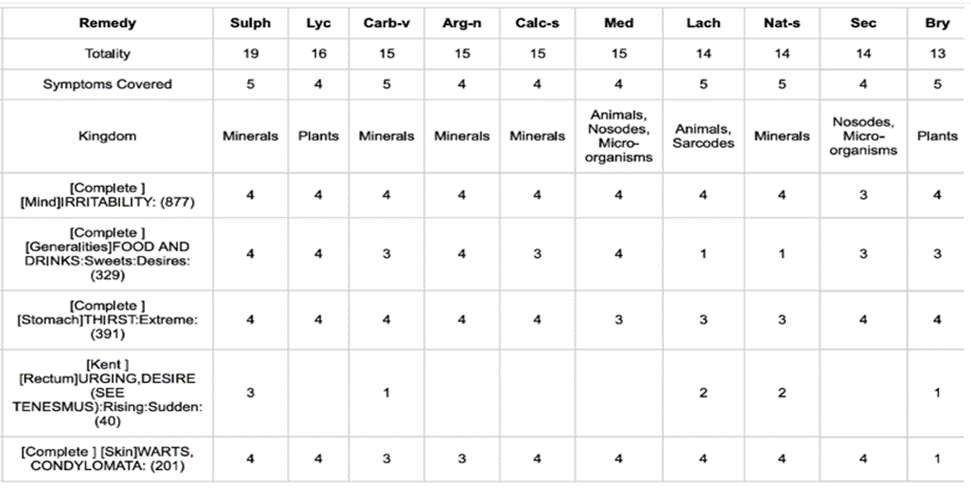
Figure 3: Repertorial sheet of Case 2
Prescription
Sulphur 200, 2 doses for 2 days followed by placebo for 4 weeks were prescribed after analysing repertorial result and consulting materia medica. After one months of treatment the warts were removed and no new complaints as shown in figure 4. Follow ups are given in table no. 2
Follow up
Table 2: Follow up and Outcome of case 2
|
Date |
Clinical findings |
prescription |
|
25.08.2025 |
warty like growth on dorsum of hand near middle finger joint and tip of ring finger and thumb of right hand |
Sulphur 200, 2 doses |
|
24.09.2025 |
All Warty growth disappeared |
placebo |
|
27.10.2025 |
No new symptoms |
placebo |
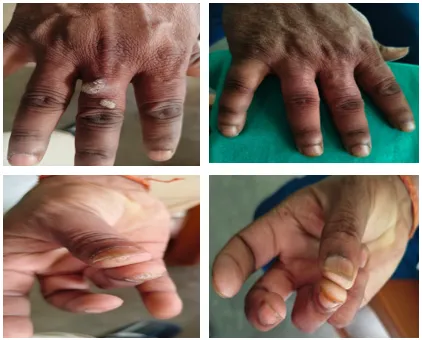
Figure 4: Clinical figures showing before and after pictures of warts of Case 2
Case no: 3
A female patient came to OPD of Mahesh Bhattacharyya Homoeopathic Medical College and Hospital with complaint of solitary warty growth on right eyelid with no associated discomfort or abnormal sensation as such for 2-3 years
On Local Examination:
Site- right eyelid
No. of lesion- 1
Size- 2-3 mm
Morphology-round and rough surface
Colour- brownish and slight darker than surrounding skin colour
Distribution-right eyelid
Surrounding skin- normal
Discharge- absent
Itching/pain/burning- absent
Diagnosis:
The clinical presentation was suggestive of cutaneous warts.
Characteristic Mental, Physical and Particular symptoms:
Repertorial Result
After repertorisation Causticum covers all 6 symptoms and scored maximum of 14, Followed by Thuja, Sulphur, Nitric acid and others. Details of repertorization given in figure 5.
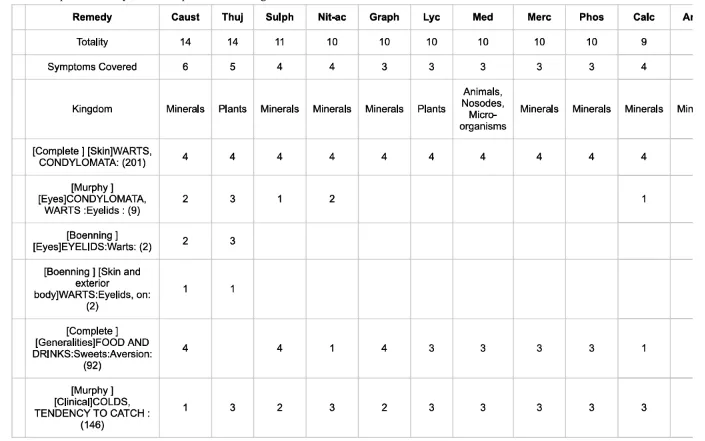
Figure 5: Repertorial sheet of Case 3
Prescription
After repertorisation and consulting with Homoeopathic Materia Medica Causticum 200C 2 doses were prescribed for 2 days followed by placebo for 28 days. Patient was advised to come for follow up after 30 days. After 3months of treatment the complaints reduced shown in figure 6. Follow ups are given in table no. 3
Follow up
Table 3: Follow up and Outcome of case 3
|
Date |
Clinical findings |
Prescription |
|
13.02.2026 |
Warty growth on right upper eyelid |
Causticum 200, 2 doses |
|
28.03.2026 |
Complaints same as before |
Placebo was given |
|
08.05.2026 |
Growth slightly reduced |
Placebo was given |
|
29.05.2026 |
No warts present |
Placebo was given |
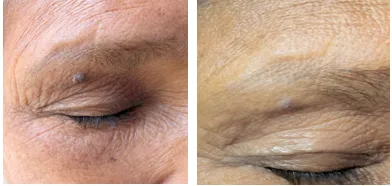
Figure 6: Clinical figures showing before and after pictures of warts of Case 3
Case No: 4
A male patient of 21 years old came to Mahesh Bhattacharyya Homoeopathic Medical College and Hospital complaining of warty growth on lateral side of index finger of right hand with itching and soreness of the lesion.
On Local/ Clinical examination
Site- Dorsal aspect of the hand, close to the first web space/base of thumb
No. of lesion- Single lesion
Size- Approximately 0.8–1 cm in diameter
Morphology- Well-defined, raised, dome-shaped, hyperkeratotic, rough surface
Colour-Greyish hyperkeratotic surface over a mildly erythematous to skin-coloured base
Distribution- solitary
Surrounding skin- Mild erythema immediately surrounding the lesion; no obvious ulceration or significant edema
Discharge- absent
Itching/pain/burning- soreness present
Provisional Diagnosis
Verruca vulgaris (common wart)
Characteristic mental, physical and particular symtoms:
Repertorisation
After repertorisation Ruta Graveolens covers maximum symptoms which is 6 and scored maximum i:e 17. The repertorisation sheet is given in figure 7.
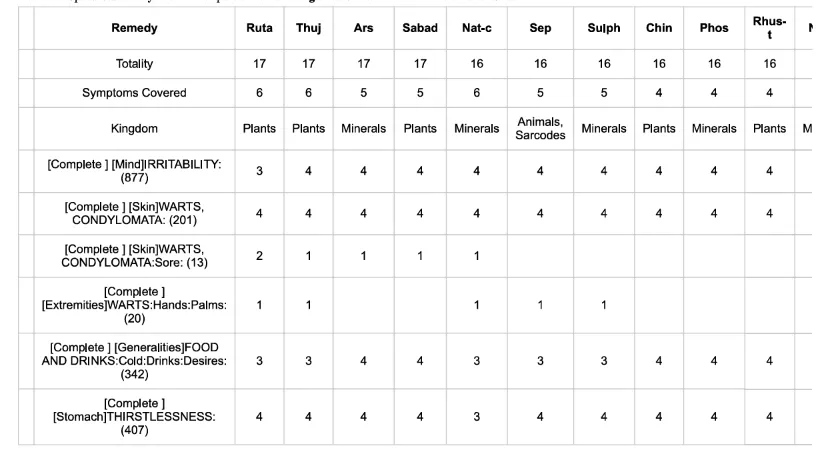
Figure 7: Repertorial sheet of Case 4
Prescription
Ruta Graveolens 200, 2 doses for 2 days consecutevely followed by placebo for 2 weeks were prescribed after analysing repertorial result and consulting Homoeopathic Materia Medica. After 1 months of treatment the complaints reduced shown in figure 8. Follow ups are given in table no. 4
Follow up
Table 4: Follow up and Outcome of case 4
|
Date/visit |
Clinical findings |
Prescription |
|
21/05/26 |
warty growth on lateral side of index finger of right hand with itching and soreness of the lesion |
Ruta G 200/ 2 doses |
|
04/06/26 |
Warty growth reduced in size, itching reduced, mild soreness was present |
Placebo |
|
18/06/26 |
Warty growth vanished, tenderness and soreness disappeared |
Placebo |
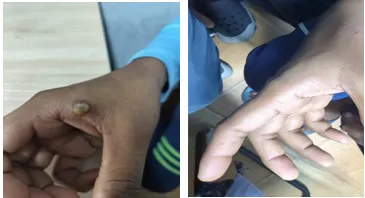
Figure 8: Clinical figures showing before and after pictures of warts of Case 4
Case No. 5
A female patient of 50 year of age presented with a wart over the right thumb in OPD of Mahesh Bhattacharyya Homoeopathic Medical college and hospital for 4 years, he had history of taking covid vaccine 4 years ago, warts developed since then gradually with cracks and fissures on hand.
On local examination
Site: Right thumb, dorsal aspect
Number of lesions: 1
Size: Approximately 2 mm - 3mm diameter
Morphology: Well-defined, raised, hyperkeratotic verrucous papule with an irregular rough surface.
Colour: slightly darker than skin
Distribution: Solitary, localized lesion over the right thumb.
Surrounding skin: Appears normal, with no significant erythema or oedema.
Discharge: No discharge noted.
Tenderness/Pain: absent
Consistency: Firm and hyperkeratotic.
Provisional Diagnosis
Verruca vulgaris (common wart) of the right thumb, based on the solitary, well-defined, raised and hyperkeratotic verrucous lesion.
Characteristic mental, physical and particular symptoms
Repertorial results
After repertorisation Arsenicam Album scored higher with score of 13. given in figure 9
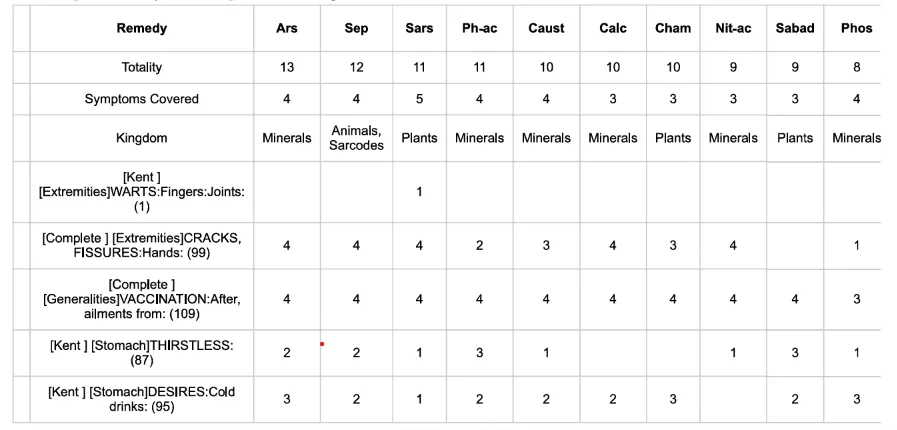
Figure 9: Repertorial sheet of Case 5
Prescription
After repertorial analysis since Arsenicum Album scored higher but Sarsaparilla covered all the symptoms and after consulting Homoeopathic Materia Medica Sarsaparilla 200, 2 doses were prescribed for two days followed by placebo for 28 days and patient was advised to report after 30 days. After 3 months of treatment the complaints reduced shown in figure 10. Follow ups are given in table no. 5.
Follow up
Table 5: Follow up and Outcome of case 5
|
Date |
Clinical findings |
Prescription |
|
03.04.2026 |
Warty growth on thumb of right hand with cracks and fissures on hand. |
Sarsaparilla 200, 2 Doses |
|
15.05.2026 |
Warty growth remained same size, crack and fissures on hand slight reduced |
Placebo was given |
|
12.06.2026 |
Wart reduced in size along with no fissure on hand |
Placebo was given |
|
03.07.2026 |
Wart completely reduced no more new complaint. |
Placebo was given |
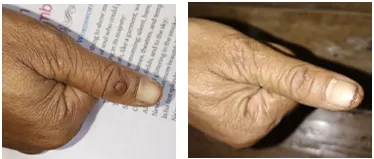
Figure 10: Clinical figures showing before and after pictures of warts of Case 5
Case no 6
Multiple warts on both hands (specifically involving the fingers, thumb, and periungual areas) with associated cosmetic concern and discomfort for last 5 months. Slight sore pain was present on pressure.
On local examination
Site: Both hands, affecting multiple digits (middle, ring finger), periungual and digital creases.
No. of Lesion: Multiple around 10-12 in numbers.
Size: Variable, ranging from small papules to larger coalesced verrucous plaques.
Morphology: Hyperkeratotic, rough, papular, and verrucous lesions.
Colour: Skin-colored to hyperpigmented brownish.
Distribution: Distribution across multiple fingers.
Surrounding Skin: Normal to mildly dry.
Discharge: None.
Itching / Pain: Mild tenderness or pain, particularly with pressure.
Diagnosis: Viral warts
Characteristic Mental Physical and Particular Symptoms
Repertorial Result
After repertorisation Dulcamara scored highest of 9 covering 3 rubrics, But Ruta covers all the 6 rubrics and scored 8. The details given in fig. 11.
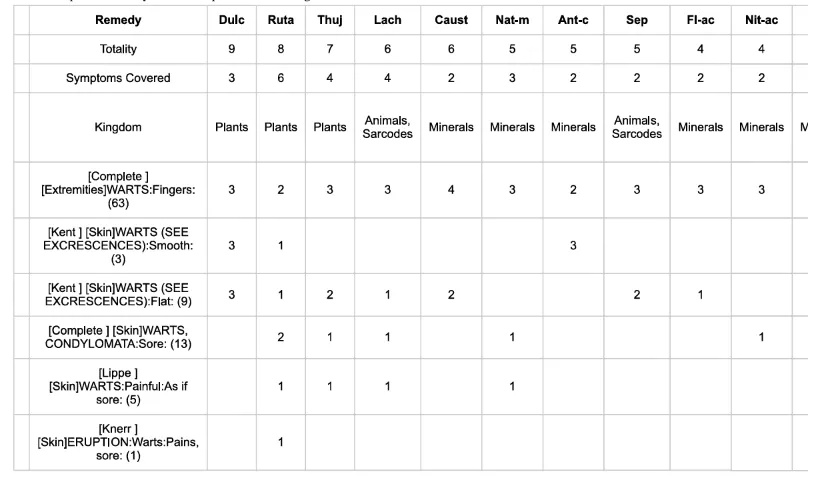
Figure 11: Repertorial sheet of Case 6
Prescription
After repertorisation and consulting Homoeopathic Materia medica Ruta Graveolens 200, 2 doses were prescribed for 2 days followed by placebo for 28 days and advised to visit after 1 month. After 2 months of treatment the complaints reduced shown in figure 12. Follow ups are given in table no. 6
Follow up
Table 6: Follow up and Outcome of case 6
|
Date |
Clinical findings |
Prescription |
|
13.06.2026 |
Warty growth on both hands (specifically involving the fingers, thumb, and periungual areas) |
Ruta Graveolens 200, 2 Doses |
|
24.07.2026 |
Warty reduced in size |
Placebo was given |
|
21.08.2026 |
Wart completely disappeared no more new complaint. |
Placebo was given |
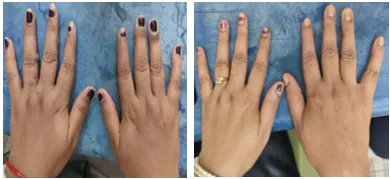
Figure 12: Clinical figures showing before and after pictures of warts of Case 6
Case no. 7
A male patient of 15 year of age presented with a wart on index finger of left hand for last 6 months in OPD of Mahesh Bhattacharyya Homoeopathic Medical college and hospital. There were no other complaints associated with it.
On local examination
Site: Index finger of left hand.
Number of lesions: 1
Size: Approximately 2 mm - 3mm diameter
Morphology: Well-defined, raised, hyperkeratotic papule with smooth surface
Colour: slightly darker than skin
Distribution: Solitary, localized lesion
Surrounding skin: Appears normal, with no significant erythema or oedema.
Discharge: No discharge noted.
Tenderness/Pain: absent
Consistency: Firm
Provisional Diagnosis
Common wart
Characteristic mental, physical and particular symptoms
Repertorial results
After repertorisation Silicea scored highest of 10 covering 4 rubrics followed by Nitric acid and Dulcamara. The details given in fig. 13.
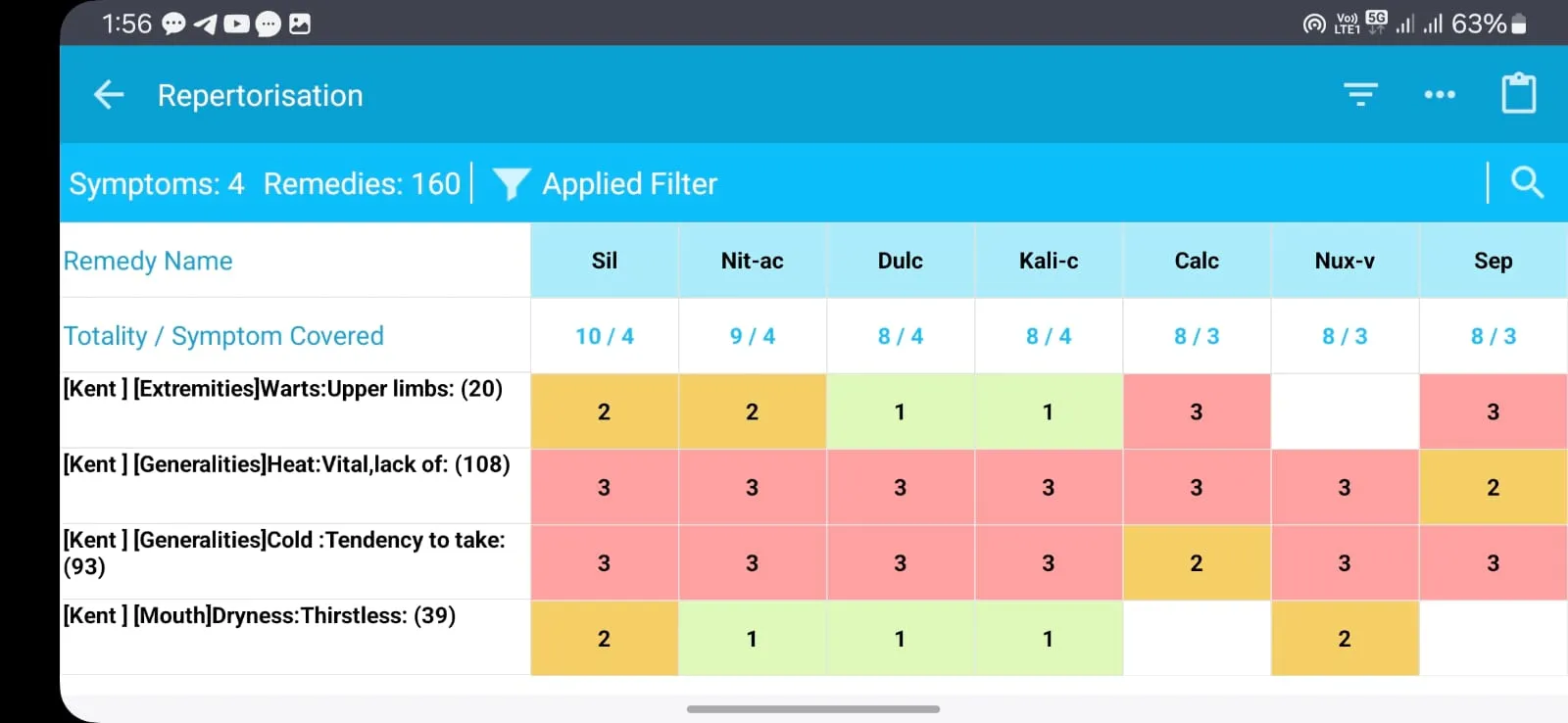
Figure 13: Repertorial sheet of Case 7
Prescription
After repertorisation and consulting Homoeopathic Materia Medica Silicea 200, 2 doses were prescribed for 2 days followed by placebo for 28 days and advised to visit after 1 month. After 2 months of treatment the complaints reduced shown in figure 14. Follow ups are given in table no. 7.
Table 7: Follow up and Outcome of case 7
|
Date / visit |
Clinical findings |
Prescription |
|
10.06.2025 |
Warty growth on index finger of left hand |
Silicea 200, 2 Doses |
|
22.07.2025 |
Warty reduced in size |
Placebo was given |
|
12.08.2025 |
Wart completely reduced. No new complaint |
Placebo was given |
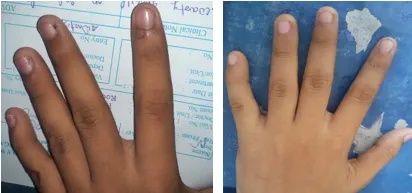
Figure 14: Clinical figures showing before and after pictures of warts of Case 7
DISCUSSION
Cutaneous warts are common benign lesions associated with human papillomavirus infection and may occur as solitary or multiple lesions at different anatomical sites. Their clinical course is variable, and spontaneous regression is well recognised. Consequently, when evaluating outcomes in individual cases, the possibility of spontaneous resolution and variation in the natural history of warts should be considered. The present case series describes seven patients with clinically diagnosed cutaneous warts who received individualized homoeopathic treatment based on their individual symptomatology rather than solely on the pathological diagnosis. The cases demonstrated variation in age, duration, number, morphology and anatomical distribution of lesions. Most lesions involved the hands and fingers, while one involved the eyelid. The duration of the lesions ranged from approximately 6 months to 4 years. Individualized prescribing was based on characteristic mental, physical, general and particular symptoms, followed by repertorial analysis and consultation with Homoeopathic Materia Medica. The medicines prescribed were Medorrhinum, Sulphur, Causticum, Ruta graveolens, Sarsaparilla and Silicea. In Case 1, Medorrhinum was selected following repertorial analysis and Materia Medica consultation, with disappearance of the documented warts by the subsequent follow-up. In Case 2, Sulphur was selected and disappearance of the lesions was documented at follow-up. Similarly, Causticum was selected in Case 3 for a solitary eyelid lesion, while Ruta graveolens was prescribed in Cases 4 and 6 despite differences in clinical presentation. Sarsaparilla was selected in Case 5 after repertorial analysis and Materia Medica consideration, and Silicea was selected in Case 7. Progressive reduction followed by disappearance of the lesions was documented in the respective follow-ups. This variation in prescriptions illustrates the individualized nature of the therapeutic approach: the same diagnosis of a wart did not lead to selection of a single medicine across all cases. The repertorial results were also not used in isolation; the final prescription was based on repertorial findings together with consideration of the individual symptom picture and Materia Medica. The findings should be considered in the context of the existing evidence concerning homoeopathic treatment of cutaneous warts. A randomized, double-blind, placebo-controlled pilot trial of individualized homoeopathic medicines for cutaneous warts reported significant within-group changes but did not demonstrate statistically significant between-group differences in the principal outcomes, leading the authors to consider the evidence inconclusive. [7] Another randomized, double-blind clinical trial in children with hand warts similarly did not demonstrate a statistically significant difference between individualized homoeopathic treatment and placebo. [8] Therefore, the clinical improvements observed in the present cases should not be interpreted as confirmation of efficacy. Rather, these cases add detailed clinical observations concerning individualized prescribing, follow-up and photographic documentation. The descriptive nature of a case series makes it useful for documenting clinical experiences and generating hypotheses, but it does not provide the controlled comparison necessary to determine whether the observed changes were attributable to the intervention. A strength of this case series is the detailed documentation of individual clinical presentations, characteristic symptoms, repertorial analysis, medicine selection, dosage and follow-up. The inclusion of clinical photographs provides additional visual documentation of changes in lesion appearance. The cases also demonstrate individualized prescribing across patients with the same broad clinical condition rather than the routine use of a single medicine for all cases. Several limitations should nevertheless be acknowledged. The sample consisted of only seven cases and there was no control or comparison group. The lesions were clinically diagnosed without reported histopathological or laboratory confirmation. The possibility of spontaneous regression, particularly in lesions of relatively shorter duration, cannot therefore be excluded. The present observations may be useful for future research, which should employ prospective designs with predefined outcome measures, standardized photographic documentation, longer follow-up and appropriate comparison groups. Randomized controlled studies would be particularly important for distinguishing treatment-associated changes from the natural course of cutaneous warts.
CONCLUSION
This case series describes seven patients with cutaneous warts managed through individualized homoeopathic prescribing based on their characteristic symptomatology, repertorial analysis and Materia Medica consultation. Progressive reduction and eventual disappearance of the wart lesions were documented clinically and photographically during follow-up. The findings provide useful descriptive clinical observations on individualized prescribing in cutaneous warts. However, the small sample size, absence of a control group and possibility of spontaneous regression limit causal interpretation. Therefore, these observations should be considered hypothesis-generating rather than evidence of treatment efficacy. Further well-designed controlled studies with objective outcome measures and longer follow-up are required.
ACKNOWLEDGEMENT:
The authors are thankful to the patients for their co-operation and giving consent for publication of the cases
Source of Funding: None
Conflict of Interest: The authors declare no conflict of interest.
REFERENCES




Apurba Pratihar, Parveen Middya*, Sonali Priya, Kausthab Dey, Mihir Kanti Biswas, One Condition, Seven Individuals: A Case Series on Individualized Homoeopathic Management of Cutaneous Warts, Int. J. Med. Pharm. Sci., 2026, 2 (10), 141-154. https://doi.org/10.5281/zenodo.23164545
 10.5281/zenodo.23164545