
We use cookies to ensure our website works properly and to personalise your experience. Cookies policy
1Assistant Professor, Department of Pharmacy, Brilliant Grammar School Educational Society's Group of Institutions - Integrated Campus
2Department of Pharmacy, Brilliant Grammar School Educational Society's Group of Institutions - Integrated Campus
3Teegala Ramreddy College of Pharmacy Affiliated to Jawaharlal Nehru Technological University
Three-dimensional (3D) printing has become an important technology in pharmaceutical sciences because it allows the development of medicines that can be customized according to individual patient needs. Unlike conventional manufacturing methods, 3D printing builds dosage forms layer by layer, making it possible to produce tablets and drug delivery systems with different shapes, sizes, doses, and drug-release patterns. This review highlights the recent advances, major printing technologies, pharmaceutical applications, and future prospects of 3D printing in drug delivery. The review discusses widely used 3D printing techniques, including Binder Jet Printing (BJ-3DP), Fused Deposition Modeling (FDM), Semi-Solid Extrusion (SSE), Melt Extrusion Deposition (MED), Stereolithography (SLA), Selective Laser Sintering (SLS), and Inkjet Printing. Each technique has unique advantages and limitations in terms of drug loading, material compatibility, printing accuracy, and release characteristics. These technologies have been successfully applied to prepare personalized tablets, modified-release formulations, polypills, orally disintegrating tablets, chewable dosage forms, microneedles, implants, transdermal systems, and tissue engineering scaffolds. 3D printing offers several benefits, including precise dose adjustment, improved patient compliance, rapid prototyping, reduced material waste, and on-demand manufacturing in hospitals and pharmacies. It is especially useful for pediatric, geriatric, and patients with rare diseases who require individualized therapy. However, challenges such as limited printable pharmaceutical materials, high equipment costs, regulatory uncertainties, quality control, and large-scale manufacturing still need to be addressed before widespread clinical adoption. Overall, 3D printing has the potential to transform pharmaceutical manufacturing by supporting personalized medicine and advanced drug delivery systems. Continued progress in printable materials, automation, artificial intelligence, and regulatory guidelines is expected to expand its clinical and industrial applications. This technology is likely to play a key role in the future of precision medicine by improving treatment effectiveness, patient convenience, and healthcare outcomes.
Three-dimensional (3D) printing has rapidly evolved from a prototyping tool into a transformative technology with wide-ranging implications for biotechnology, engineering, and pharmaceutical sciences. Early work demonstrated its utility in chemical sciences and analytical applications, highlighting the flexibility, precision, and rapid fabrication potential of additive manufacturing systems [1]. Parallel advancements in mechanical engineering underscored the ability of 3D printing to fabricate optimized, complex geometries and lightweight structures, reinforcing its relevance across multiple technological domains [2]. These foundational developments paved the way for biomedical innovations, where 3D bioprinting enabled the construction of tissue scaffolds, organ models, and regenerative engineering platforms, significantly advancing personalized healthcare research [3]. As additive manufacturing matured, its application within the pharmaceutical sector gained momentum. Extensive evaluations of 3D printing technologies including fused deposition modeling, stereolithography, selective laser sintering, binder jetting, and inkjet printing have provided a comprehensive understanding of their operational mechanisms, benefits, and limitations for drug delivery applications [4,7]. This technological versatility allows precise control over dosage form geometry, drug loading, release kinetics, and mechanical strength, features that are often difficult to achieve through conventional manufacturing. The integration of 3D printing into pharmaceutical science has also been driven by the growing demand for personalized and patient-specific therapies. Tailored dosage forms, adjustable strengths, modified-release systems, and multi-drug polypill configurations represent some of the most promising outcomes, directly supporting the global shift toward individualized medicine [5,6]. The potential for decentralized and on-demand manufacturing in hospitals, pharmacies, and clinical settings further highlights the relevance of 3D printing in improving patient access and therapeutic outcomes. Recent research has demonstrated innovative applications such as orally disintegrating tablets, high-porosity dosage forms produced through inkjet printing, and structurally complex tablets with customizable release profiles, all achievable via advanced additive manufacturing techniques [10,11]. Moreover, comprehensive analyses within the healthcare field emphasize the ability of 3D printing to address unmet clinical needs particularly in paediatric, geriatric, and rare-disease populations where conventional mass production is insufficient or impractical [8,9]. Despite these significant advancements, challenges remain, including regulatory uncertainties, limited availability of pharmaceutically acceptable printable materials, and the need for standardized quality assurance protocols. Nonetheless, ongoing progress in materials science, bioprinting, computational modeling, and smart drug delivery systems continues to expand the boundaries of this technology. In this context, the present review aims to provide a detailed analysis of current advances in 3D printing for pharmaceutical applications, evaluate emerging technologies across additive manufacturing platforms, and explore future directions that will shape the next generation of drug delivery systems. By integrating insights from engineering, bioprinting, pharmaceutical formulation, and clinical innovation, this review seeks to highlight the transformative potential of 3D printing within modern healthcare.
Advantages of 3D Printing Technology in Pharmaceuticals
Three-dimensional (3D) printing offers several distinct advantages that are reshaping pharmaceutical manufacturing, drug delivery, and patient-centred therapeutic design. These advantages stem from the unique capabilities of additive manufacturing to create complex, customizable, and functionally optimized dosage forms, which traditional manufacturing approaches cannot easily achieve.
Personalised and Age-Specific Drug Therapy
One of the most significant advantages of 3D printing is its ability to provide personalised medication, particularly essential for vulnerable populations such as children and the elderly, who often require tailored doses, age-appropriate formulations, and flexible strengths [12-14]. The high prevalence of off-label drug use and associated adverse events in paediatric units further underscores the need for individualized dosage forms that 3D printing can reliably address [15].
For instance, 3D printing has enabled the development of personalised paediatric dosage forms such as “Starmix” chewable tablets [17], taste-masked fruit chews [18], and custom-dosage ibuprofen tablets produced via micro-extrusion [19], all of which demonstrate improved acceptability and dosing flexibility. Moreover, comprehensive reviews confirm that 3D-printed paediatric medications can overcome long-standing challenges such as poor taste, unsuitable liquid formulations, and difficulty swallowing conventional tablets [20-22].
High Flexibility in Dosage Form Design
3D printing empowers formulators to engineer drugs with highly customizable shapes, internal structures, porosities, and geometries that directly influence drug release and therapeutic outcomes. This capability allows researchers to design modified-release and complex multi-compartmental dosage forms with unparalleled precision. For example, compartmentalized capsules inspired by bio architectures have been fabricated to provide sophisticated and predictable controlled-release behaviour [25]. Similarly, 3D printing technologies such as melt extrusion deposition (MED™) allow the fabrication of complex, modified-release products that would be challenging to manufacture by conventional tablet pressing [26]. Semi-solid extrusion (SSE) provides additional flexibility for developing personalized structures with adjustable mechanical and release properties [27].
Improved Patient Compliance and Acceptability
Taste masking, swallowability, and ease of administration are key determinants of patient compliance especially in paediatric and geriatric populations. 3D printing allows the incorporation of taste-masking polymers, chewable matrices, and child-friendly shapes, which significantly enhance acceptability [18,20]. Studies demonstrate that young patients strongly prefer such personalized chewable dosage forms over traditional tablets or bitter liquid medications [21]. This technology further supports the production of orally disintegrating tablets with high porosity, improving administration for patients with swallowing difficulties [10].
Production of Complex and Innovative Drug Delivery Systems
Another major advantage of 3D printing lies in its ability to fabricate architecturally complex drug delivery systems, like multi-drug polypills, multi-layered structures, osmotic pumps, floating or gastro-retentive systems, controlled-release capsules with hierarchical compartments. Such advanced systems can be produced in a single manufacturing step, enabling rapid prototyping and precise structural tailoring [4,7,25,26]. Research has shown that 3D printing enables internal microstructures that can fine-tune dissolution rates, mechanical strength, and drug diffusion pathways features not achievable through traditional methods [28].
On-Demand, Decentralized, and Automated Manufacturing
3D printing provides a unique opportunity to shift from large-scale centralized production to on-demand, localized manufacturing in hospitals, pharmacies, and personalized care centres. This approach is especially useful for rare diseases, where small batches of patient-specific formulations are needed. A notable example is the fully automated preparation of isoleucine formulations for patients with Maple Syrup Urine Disease (MSUD), representing one of the first successful clinical demonstrations of automated therapy preparation using 3D printing [23]. The ability to automate dosage preparation reduces medication errors, improves dosing precision, and streamlines individualized therapeutic regimens.
Material Versatility and Design Optimization
Pharmaceutical 3D printing supports a wide range of materials, including polymers, gels, pastes, and bio-inspired formulations. Techniques such as fused deposition modeling (FDM) and hot-melt extrusion allow precise drug-polymer combinations, while ensuring batch reproducibility of filaments a critical requirement for regulatory acceptance [24]. Design optimization tools, informed by advances in engineering and bioprinting, further enhance the precision of dosage form architecture [1,3].
Acceleration of Research, Prototyping, and Innovation
3D printing significantly accelerates research and development cycles by enabling rapid prototyping, iterative testing, and on-demand production of experimental dosage forms. Additive manufacturing techniques allow scientists to quickly assess new designs, test release kinetics, and refine structural features without the time and cost constraints of large-scale manufacturing [1,4,16]. Recent reviews emphasize that 3D printing is not only a production method but also a powerful research tool that can fast-track innovation in drug delivery [8,9].
Binder Jet 3D Printing (BJ-3DP) Technology
Principle
Binder jet 3D printing (BJ-3DP) is one of the most widely explored additive manufacturing techniques in pharmaceutical applications due to its ability to fabricate highly porous and rapidly disintegrating dosage forms. The fundamental principle of BJ-3DP involves the selective deposition of a liquid binding agent onto a powder bed, resulting in the layer-by-layer formation of solid structures without the need for high temperatures or mechanical compression [29,30].
Working Mechanism
In BJ-3DP, a thin layer of powder typically composed of excipients and active pharmaceutical ingredients (APIs) is first spread uniformly across a build platform. A computer-controlled inkjet printhead then selectively deposits droplets of a liquid binder onto predefined regions of the powder bed, causing localized adhesion of particles [29,31]. Once a layer is completed, the build platform lowers, and a new powder layer is spread, repeating the process until the final three-dimensional structure is formed [30,33]. This layer-by-layer fabrication enables the production of complex geometries and highly porous matrices, which are particularly advantageous for achieving rapid disintegration and tailored drug release profiles [32].
Inkjet Printing Fundamentals in BJ-3DP
The performance of BJ-3DP is closely related to the principles of drop-on-demand inkjet printing, where precise control over droplet formation, trajectory, and deposition is critical [35,42]. The fluid dynamics of droplet generation are governed by factors such as viscosity, surface tension, and nozzle design, which determine the size, velocity, and stability of the droplets [36]. Polymer additives are often incorporated into the binder solution to improve droplet formation and control spreading behaviour upon impact with the powder bed [34]. The interaction between droplets and the powder surface including spreading, penetration, and solidification plays a crucial role in determining the mechanical strength and resolution of the printed structure [37].
Droplet Impact and Powder-Binder Interaction
The deposition of binder droplets onto the powder bed involves complex fluid dynamics phenomena such as impact, spreading, infiltration, and solidification. Upon impact, droplets may spread, penetrate the porous powder layer, or, under certain conditions, splash or rebound depending on surface characteristics and fluid properties [38,39]. Surface roughness and wettability significantly influence droplet behaviour, affecting the uniformity of binder distribution and interparticle bonding [37]. Studies on droplet impact dynamics highlight that parameters such as impact velocity, droplet size, and substrate properties govern the extent of spreading and penetration, which ultimately determine the structural integrity of the printed dosage form [40,41].
Solidification and Structure Formation
Following deposition, the liquid binder partially dissolves or wets the powder particles, forming solid bridges upon drying, which bind the particles together into a cohesive structure [29,32]. The resulting printed object is typically highly porous, requiring minimal post-processing compared to other 3D printing techniques. The degree of binding and mechanical strength can be optimized by adjusting formulation parameters such as binder concentration, powder particle size, and layer thickness [45]. This structured approach allows for the precise design of drug-loaded solid dosage forms with controlled porosity and drug distribution.
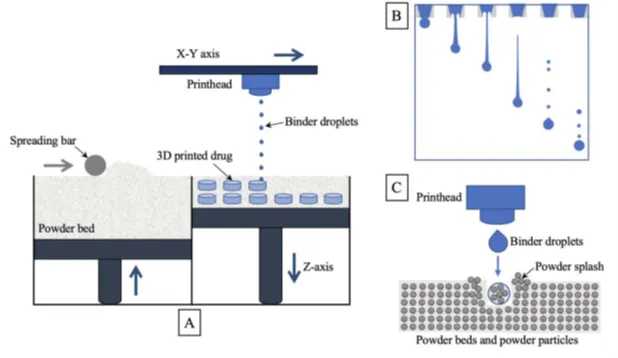
Figure 1. Schematic diagram of the principle and mechanism of tablet preparation by BJ-3DP technology: (A) schematic diagram of the printing principle of BJ-3DP technology; (B) schematic diagram of the flight state of a droplet after ejection through the nozzle; and (C) schematic diagram of droplet impact on the powder bed.
Pharmaceutical Relevance of BJ-3DP
BJ-3DP is particularly advantageous for pharmaceutical applications because it operates at ambient or low temperatures, making it suitable for thermolabile drugs [30,33]. Additionally, it enables the fabrication of low-dose formulations and drugs with poor solubility, which are often challenging to process using conventional techniques [32]. Inkjet-based binder deposition has also been successfully applied for the formulation of oral dosage forms, including the precise dispensing of drug solutions and the development of personalized medicines with accurate dosing [43,44].
Binder Jet 3D Printing (BJ-3DP) Technology in Pharmaceutical Applications
Binder jet three-dimensional printing (BJ-3DP) has emerged as a versatile additive manufacturing platform with significant relevance to pharmaceutical development, enabling the fabrication of oral dosage forms, controlled-release systems, personalized paediatric medicines, and advanced biomedical scaffolds. As one of the earliest techniques explored for drug-product fabrication, BJ-3DP was demonstrated by Wu et al. for producing solid free-form drug-delivery devices, marking the foundation for its pharmaceutical applicability [46]. The technology operates by selectively depositing a liquid binder onto powder beds, allowing precise spatial control of material consolidation without thermal stress, making it highly compatible with heat-sensitive APIs. In the field of oral drug delivery, binder jetting has been particularly influential. Wang et al. reported the successful additive manufacturing of solid oral products via BJ-3DP, demonstrating its capability to produce mechanically robust tablets with reliable performance attributes [47]. The method has been further advanced for paediatric personalization, where Wang and colleagues employed colour-jet BJ-3DP to fabricate levetiracetam formulations with customized doses and appealing visual characteristics for children [48]. Comprehensive reviews also highlight BJ-3DP as a leading platform for powder-based pharmaceutical design, due to its flexibility in material selection and potential for large-scale manufacturing [49]. Beyond conventional tablets, BJ-3DP enables the production of complex, functional structures. Early studies demonstrated that drug-release kinetics can be modulated through geometry, infill patterning, and gradient material distribution [55, 56, 57]. These innovations allow the creation of near zero-order release systems [55], gradient-based controlled-release tablets [56], and delivery systems engineered for multi-phase release profiles [57]. More recent advances include multicompartment dispersible tablets, such as those produced by Hong et al., which allow for combination formulations in a single printed unit [58]. Similarly, taste-masked instant-dissolving levetiracetam tablets produced using BJ-3DP and guided by electronic-tongue analysis highlight the technology's role in enhancing patient compliance [52]. BJ-3DP has also been applied in the development of photocurable bioinks for combination therapies, showcasing its capacity for innovative drug-delivery architectures [59]. At the industrial scale, Chang et al. developed a pilot-scale Husky Jet printer specifically for pharmaceutical tablet production, demonstrating progress toward commercial adoption and process scale-up [53]. Additionally, Kreft et al. provided insights into how print parameters and binder composition influence tablet quality, emphasizing the importance of formulation-process interplay in BJ-3DP [54]. In biomedical engineering, binder jetting plays a critical role in producing structurally and chemically tailored scaffolds for bone regeneration. Brunello et al. demonstrated its utility in fabricating complex ceramic scaffolds for tissue engineering [50], while Lin et al. used low-temperature BJ-3DP to produce biomimetic hydroxyapatite/collagen scaffolds suitable for bone repair [51]. Further studies show that scaffold functionality can be enhanced through chemical doping such as the addition of iron oxide or silica to tricalcium phosphate structures, resulting in improved bone and vascular regeneration [60]. Research in animal models similarly confirms that material chemistry significantly affects biological performance in printed bone scaffolds [61]. Control over pore distribution, binder interactions, and
Table 1. Advantages and Limitations of Binder Jet 3D Printing (BJ-3DP) Technology
|
Advantages |
|
|
Category |
Details |
|
Low processing temperature |
Ideal for heat-sensitive APIs and biologics due to absence of thermal stress. |
|
High design flexibility |
Enables complex geometries, porous structures, gradient materials, and multicompartment tablets. |
|
Precise dose personalization |
Allows individualized drug loading, paediatric doses, and visually customized medications. |
|
Rapid prototyping & scalability |
Fast production of model tablets; recent pilot-scale systems show potential for manufacturing scale-up. |
|
Excellent for powder-based systems |
Compatible with a wide range of excipients, ceramics, and biomaterials. |
|
Controlled drug-release modulation |
Achieves zero-order, multi-phase, or gradient release through structural design. |
|
Multimaterial printing capability |
Enables combination therapies and complex dispersible or taste-masked dosage forms. |
|
Useful for biomedical scaffolds |
Produces bone scaffolds with tunable pore structure, chemistry, and mechanical properties. |
|
Minimal material waste |
Powder-based nature supports efficient use and recycling of unused materials. |
|
Limitations |
|
|
Mechanical fragility of printed tablets |
Tablets often require post-processing to improve hardness and reduce friability. |
|
Binder-powder compatibility constraints |
Limited printable formulations due to sensitivity of APIs and excipients to binder solvents. |
|
Risk of binder migration and non-uniformity |
Can cause inconsistent drug distribution or altered tablet mechanical properties. |
|
Lower resolution compared to other AM methods |
Surface roughness and layer resolution may be inferior to photopolymer-based technologies. |
|
Limited API loading without structural compromise |
High drug loads can weaken mechanical strength or hinder printability. |
|
Post-processing requirements |
Drying, sintering (for ceramics), or infiltration steps may be needed depending on application. |
|
Moisture sensitivity |
Hygroscopic powders may clump, reducing print accuracy and flow. |
|
Regulatory challenges |
Standardized protocols, quality control, and large-scale validation remain under development. |
|
Potential for residual solvents |
Binder residues must be controlled to meet pharmaceutical safety standards. |
Fused Deposition Modelling (FDM) Technology
Principle
Fused Deposition Modeling (FDM) is one of the most widely utilized additive manufacturing techniques in pharmaceutical sciences, primarily due to its simplicity, accessibility, and compatibility with a broad range of thermoplastic polymers. The principle of FDM is based on the layer-by-layer deposition of molten material extruded through a heated nozzle, which solidifies upon cooling to form a three-dimensional structure [65,66].
Working Mechanism of FDM
The FDM process begins with the preparation of a drug-loaded filament, typically produced using hot-melt extrusion (HME), where the active pharmaceutical ingredient (API) is uniformly dispersed within a polymeric carrier [70,78]. This filament serves as the feedstock material for the printer. During printing, the filament is fed into a heated extrusion head (hot end), where it is softened or melted and then extruded through a fine nozzle. The semi-molten material is deposited onto a build platform in a predetermined pattern guided by computer-aided design (CAD) models. After deposition, the material rapidly cools and solidifies, forming a solid layer. This process is repeated layer-by-layer to construct the final dosage form [65,67,79].
Material Behaviour and Solidification
The success of FDM printing depends on the thermal and rheological properties of the polymeric materials used. The filament must possess sufficient mechanical strength for feeding, appropriate viscosity for extrusion, and rapid solidification behaviour to maintain structural integrity [78,80]. Polymers such as polyvinyl alcohol (PVA), polylactic acid (PLA), and various pharmaceutical-grade polymer blends are commonly used to optimize printability and drug release characteristics [75,76]. The incorporation of polymer blends has been shown to improve extrusion behaviour, reduce brittleness, and regulate drug release profiles [76,80]. Additionally, phase behaviour and miscibility of drug-polymer systems play a crucial role in ensuring uniform drug distribution and stability [77].
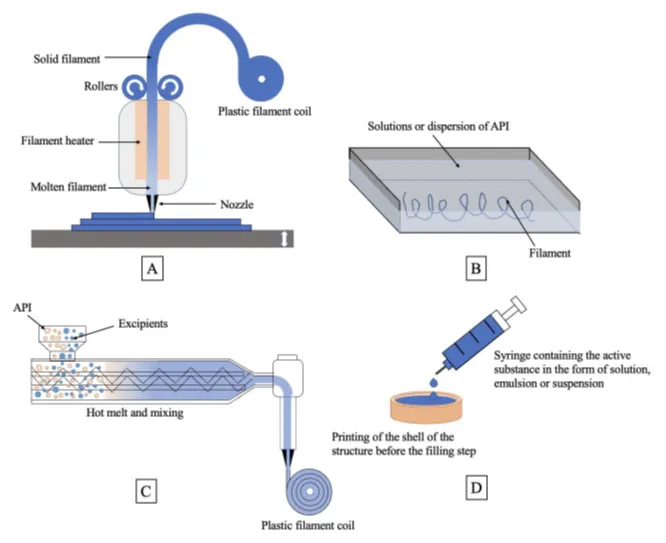
Figure 2. Schematic diagram of the principle of FDM technology and three methods of tablet preparation: (A) schematic diagram of the printing principle of FDM technology; (B) schematic diagram of the preparation of drug-containing filaments by the dipping-melting method; (C) schematic diagram of the preparation of drug-containing filaments by the HME-FDM method; and (D) schematic diagram of the preparation of tablets by the filling and forming method.
Process Parameters Influencing FDM
Several critical process parameters influence the performance of FDM printing, Such as Extrusion temperature, Printing speed, Layer height, Infill density and pattern. These parameters directly affect the mechanical strength, surface quality, and internal microstructure of the printed dosage forms [73]. Optimization of these parameters is essential to ensure consistent product quality, especially for pharmaceutical applications where precision is critical [68]. Furthermore, interlayer adhesion is a key factor in determining the structural integrity of printed objects. Adequate bonding between successive layers depends on temperature control and material flow properties, influencing both mechanical performance and drug release behaviour [81,82].
Pharmaceutical Relevance of FDM
FDM has gained considerable attention in pharmaceutical manufacturing due to its ability to produce personalized dosage forms with tailored drug release profiles [65,69]. The technology enables fabrication of tablets, capsules, and implantable systems with controlled geometries and internal architectures. For example, FDM has been explored for producing enteric capsules and modified-release dosage forms, demonstrating its versatility in drug delivery applications [71]. Moreover, FDM supports the development of patient-specific medicines, particularly in compounding pharmacies, where individualized dosing and on-demand production are required [67,68]. Its compatibility with biodegradable and functional polymers also allows the design of advanced drug delivery systems with programmable release characteristics.
Integration with Advanced Manufacturing Concepts
FDM is also a key component of emerging 3D and 4D printing technologies, where smart materials can respond to environmental stimuli such as temperature or pH, enabling dynamic drug delivery systems [83]. Continuous advancements in printer design, filament engineering, and process optimization are further enhancing the applicability of FDM in pharmaceutical sciences [72].
FDM Technology in Pharmaceutical Applications
Fused Deposition Modeling (FDM) has emerged as one of the most transformative additive manufacturing techniques in pharmaceutics, enabling the fabrication of personalized medicines, complex drug delivery systems, and innovative oral dosage forms. Owing to its versatility in processing thermoplastic polymers and its compatibility with a broad range of active pharmaceutical ingredients (APIs), FDM plays a central role in advancing patient-centric drug manufacturing [65,67,69].
1. Personalized and Patient-Specific Medicines
One of the most significant applications of FDM in pharmaceuticals is the production of personalized dosage forms tailored to individual patient needs. FDM enables precise adjustment of drug dose, shape, size, geometry, and drug release kinetics, offering superior flexibility compared to conventional manufacturing methods [65,67]. Clinical acceptability studies have demonstrated that 3D-printed medicines fabricated using FDM are well received by patients, particularly due to their customizable shapes, ease of swallowing, and visual appeal [84]. This highlights the potential of FDM-printed dosage forms to improve medication adherence in paediatric, geriatric, and dysphagic populations.
2. Complex Oral Drug Delivery Systems
FDM excels in producing oral dosage forms with complex geometries and programmable release behaviours. Through computer-aided design, FDM can fabricate structures such as Hollow tablets, Multiparticulate systems, geometrically modified matrices, Multisectional or multilayer tablets. These structural innovations enable controlled, delayed, pulsatile, or zero-order drug release profiles [85]. Goyanes et al. demonstrated the creation of novel oral devices with unique internal architectures, showing that manipulating infill patterns and shell thickness can dramatically alter drug release kinetics [85]. Such precision provides new opportunities for designing advanced oral drug delivery systems not achievable through traditional tablet compression.
3. Paediatric and Geriatric Dosage Forms
FDM technology allows the development of age-appropriate formulations, particularly beneficial for populations requiring flexible dosing. Mini-tablets for children, Low-dose formulations, Chewable or fast-disintegrating prints, Modified geometries to improve swallowability. Acceptability studies confirm that children respond positively to visually appealing and easy-to-handle 3D-printed designs [84]. Thus, FDM supports the movement toward personalized paediatric formulations.
4. Production of Tailored Release Profiles
FDM enables precise control over drug release through Polymer selection, Print density and infill pattern, Shell thickness, Drug-polymer dispersion uniformity, Complexity of the internal geometry. Thermoplastic polymers such as PLA, PVA, and pharmaceutical polymer blends allow formulation scientists to tune release characteristics ranging from immediate to sustained release [75,76,80]. Furthermore, hot-melt extrusion used in producing drug-loaded filaments ensures molecular-level dispersion of APIs, improving dissolution and bioavailability for poorly soluble drugs [70,77,78].
5. Fabrication of Enteric, Gastro-Retentive, and Targeted Systems
FDM technology supports the development of site-specific drug delivery systems, including Enteric-coated capsules, resistant to gastric pH [71], Floating systems for prolonged gastric retention, Colon-targeted dosage forms, Multi-compartment designs allowing separate delivery of incompatible drugs. Validated FDM for producing enteric capsules in compounding settings, demonstrating excellent acid resistance and reliable disintegration in intestinal conditions [71].
6. On-Demand and Decentralized Manufacturing in Pharmacies
FDM’s compact equipment requirements and digital workflow support on-demand manufacturing, which can be implemented in Hospital pharmacies, Community pharmacies, Point-of-care settings. Because dosage forms can be generated directly from digital files, pharmacists can rapidly produce customized medicines without the need for expensive Molds or large-scale production [67,68]. This capability is especially beneficial for rare diseases, narrow therapeutic index drugs, and individualized treatment plans.
7. Development of Advanced Biomedical and Implantable Systems
While most pharmaceutical work focuses on oral dosage forms, FDM is also used for Biodegradable implants, Localized drug delivery depots, Tissue engineering scaffolds, Customized prosthetics and medical devices. The capacity to blend APIs with biodegradable polymers enables the creation of implants with controlled and sustained release characteristics [75,80]. Moreover, advances in polymer engineering continue to improve the mechanical strength and biocompatibility of FDM-printed biomedical devices [73,82].
8. Enhanced Patient Acceptability and Treatment Personalization
FDM-printed medicines are not only structurally optimized, but they also enhance patient acceptance, a crucial factor in chronic therapies. Goyanes et al. reported that patients preferred colourful, uniquely shaped, and easy-to-handle 3D-printed medicines, suggesting that the customizability of FDM can significantly improve adherence [84]. Through design-driven personalization, FDM supports both functional and psychosocial aspects of pharmaceutical care.
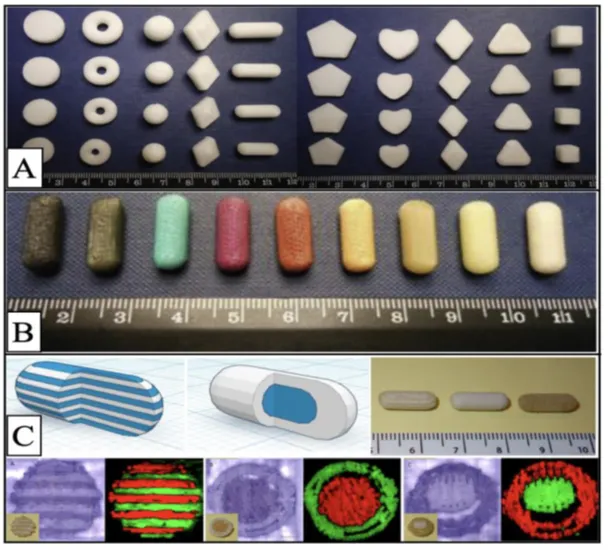
Figure 3. Images of various types of tablets prepared by FDM technology: (A) Images of 3D-printed tablets with different shapes and sizes [84]; (B) images of 3D-printed tablets in capsule form with different colors [84]; (C) sectioned multilayer device and sectioned DuoCaplet (caplet in caplet) model images, 3D-printed preparations, and white light and 2-dimensional Raman mapping images [85]. Figures were reproduced and modified with permission from [84,85].
Semi-Solid Extrusion (SSE) Technology
Principle
Semi-solid extrusion (SSE) also referred to as pressure-assisted syringe extrusion or paste extrusion is an additive manufacturing technique in which a viscoelastic semi-solid feed material is extruded through a nozzle under controlled pressure to create 3D structures layer by layer. Unlike fused deposition modeling (FDM), which relies on thermoplastic melting, SSE operates at low or room temperature, making it suitable for printing heat-sensitive drugs, biomolecules, and living cells [88, 89].
Material Basis and Viscoelastic Requirements
The foundational principle of SSE relies on the rheological behaviour of the feed material. A printable semi-solid must maintain shear-thinning behaviour, allowing it to flow during extrusion but rapidly regain viscosity to maintain its shape post-deposition [91, 92]. Shear-thinning ensures smooth extrusion under applied pressure. Rapid structural recovery prevents layer collapse and preserves geometry. Hydrogels (e.g., gelatine or cellulose nanocrystal blends), polymeric pastes, and drug-loaded gels are commonly used because they exhibit the necessary yield stress, viscoelasticity, and solid-like recovery [92].
Extrusion Mechanics and Printability
Printability in SSE depends on the interplay between nozzle diameter, extrusion pressure, printing speed, and material consistency. The feed material must not be too viscous to prevent clogging, nor too fluid to avoid spreading [91]. Extrudability analysis, as demonstrated for drug-loaded pastes, helps determine optimal pressure and formulation consistency to ensure continuous, defect-free deposition [93].
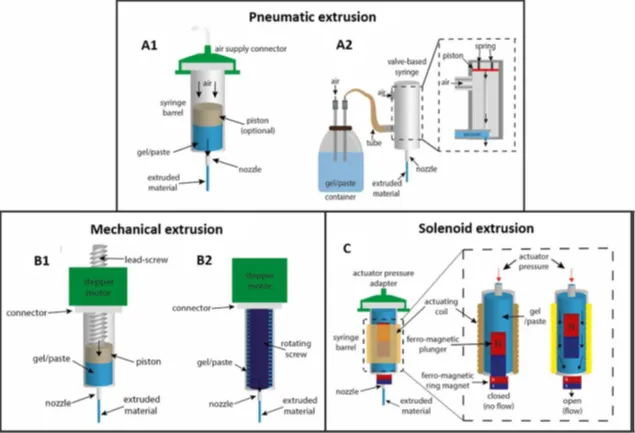
Figure 4. SSE 3DP extrusion mechanisms: (A) pneumatic extrusion, including (A1] valve-free and (A2] valve-based, (B) mechanical extrusion, including (B1] piston- or (B2] screw-driven, and (C) solenoid extrusion [27]. Figures were reproduced and modified with permission from [27]
Drug Incorporation and Release Modulation
Since SSE avoids high temperatures, it enables direct incorporation of a wide range of APIs without thermal degradation including thermolabile drugs, biopharmaceuticals, and combination therapies [88]. Formulation scientists can tune drug release by adjusting polymer matrix viscosity, adding release modifiers, or designing specific internal geometries, as demonstrated in SSE tablets modified with release modulators to produce customized dissolution profiles [90].
Multimaterial Printing and Complex Dosage Forms
A major advantage of SSE is its suitability for multimaterial and multi-drug printing. Technologies demonstrated include printing polypill systems, where separate drug layers are sequentially extruded from multiple syringes to generate distinct immediate and sustained-release compartments within one dosage form [94]. Such capabilities support highly customizable, patient-tailored dosage forms aligning with precision medicine approaches.
Applications in Bioprinting and Regenerative Medicine
Beyond conventional pharmaceuticals, SSE is central to bio fabrication, where it enables deposition of cell-laden hydrogels, scaffolds, and tissue constructs [89]. The technique’s temperature flexibility and gentle extrusion forces make it compatible with living cells, growth factors, and biologically active materials.
Advantages for Pharmaceutical Manufacturing
SSE’s low-temperature operation, material versatility, and ease of producing patient-specific geometries make it one of the most clinically relevant 3D printing approaches in pharmaceutical settings [88]. Compared to FDM, it is particularly advantageous for Personalized dosing, Oro dispersible and paediatric formulations, Thermosensitive API processing, and Rapid prototyping of semi-solid formulations.
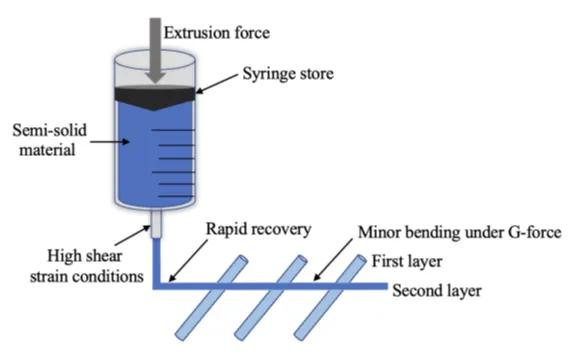
Figure 5. Diagram of semisolid material passing through a nozzle under extrusion and the rheological challenges that should be overcome.
Applications of Semi-Solid Extrusion (SSE) Technology in Pharmaceuticals
solid extrusion (SSE) has emerged as one of the most versatile 3D printing platforms in pharmaceutical manufacturing due to its low-temperature operation, compatibility with thermolabile drugs, and ability to process gels, pastes, and hydrogels. Its capability to print complex geometries and multi-drug systems has resulted in diverse applications ranging from paediatric formulations to wound-healing patches.
1. Personalized Oral Tablets and Polypills
SSE has shown significant promise in fabricating personalized oral dosage forms with adjustable geometries, doses, and release kinetics. Multi-drug polypills have been successfully printed using SSE, incorporating individual APIs in separate compartments to achieve tailored immediate and sustained-release profiles [94, 95]. These polypills enable polypharmacy reduction and improved patient adherence, particularly for chronic disease management. SSE also supports layer-by-layer dose adjustments, which is especially beneficial in paediatric and geriatric therapy. Pressure-assisted micro syringe systems have been used to accurately produce immediate-release levetiracetam tablets, demonstrating consistent mass, uniformity, and rapid disintegration [100, 101]. Hydrogel-based SSE printing has been used to develop extended-release theophylline tablets using HPMC matrices, wherein dissolution rates were effectively controlled by hydrogel concentration and infill patterns [102].
2. Paediatric Chewable and Gummy Dosage Forms
SSE is particularly attractive for paediatric drug delivery due to its ability to fabricate chewable, soft, or gummy formulations with appealing sensory attributes. Personalized gummy dosage forms containing therapeutic APIs have been printed using gelatin and hydrogel blends, offering an appealing alternative to conventional tablets for children with swallowing difficulties [96, 97]. SSE has also been used to create personalized chewable tablets containing amlodipine besylate, showing excellent mechanical properties and precise dose control [98]. Propranolol-loaded gummy chewable tablets have similarly demonstrated the feasibility of patient-specific dosing for paediatric populations [99]. These innovations highlight SSE’s potential to revolutionize paediatric therapeutics by enhancing acceptability, safety, and dosing flexibility.
3. Orodispersible Films and Rapid-Dissolving Systems
SSE has been employed to create personalized orodispersible films (ODFs) with accurate API distribution. Studies using warfarin-loaded ODFs illustrated the ability to modulate film thickness, drug loading, and disintegration time, providing rapid drug release suitable for patients requiring flexible dose titration [103].
4. Wound-Healing Patches and Transdermal Systems
The adaptability of SSE for soft, hydrogel-based formulations makes it ideal for topical and transdermal drug delivery systems. Bioactive wound-healing patches composed of pectin have been fabricated using SSE, enabling controlled incorporation of therapeutic agents for ulcer and wound management [105]. SSE’s precision allows creation of complex 2D and 3D structures, improving adhesion and drug distribution on the skin. In a related application using SSE-assisted methods, researchers fabricated microneedle patches for minimally invasive glucose control, highlighting SSE's role in shaping next-generation transdermal technologies [104].
5. Bio fabrication and Regenerative Medicine
SSE is widely utilized in bioprinting due to its compatibility with hydrogels, living cells, and biomaterials. Its gentle extrusion mechanism preserves cell viability while enabling the formation of biologically relevant architectures.
6. Rectal Drug Delivery Systems
SSE has also been applied to create personalized rectal dosage forms, such as tacrolimus-loaded suppositories for treating ulcerative colitis. By adjusting the formulation and printing parameters, researchers achieved high dose accuracy and reproducible release characteristics compatible with targeted colonic delivery [106].
7. Hospital and On-Demand Manufacturing
One of the most transformative applications of SSE is its integration into hospital pharmacy settings for rapid, on-demand preparation of individualized medicines. SSE enables dose modifications, personalized geometries, and medication adjustments within minutes, aligning with clinical needs such as paediatric titration or acute-care dosing [88, 23]. The feasibility studies demonstrate that SSE-based hospital compounding can streamline personalized therapeutic regimens and reduce reliance on mass-produced pharmaceuticals.
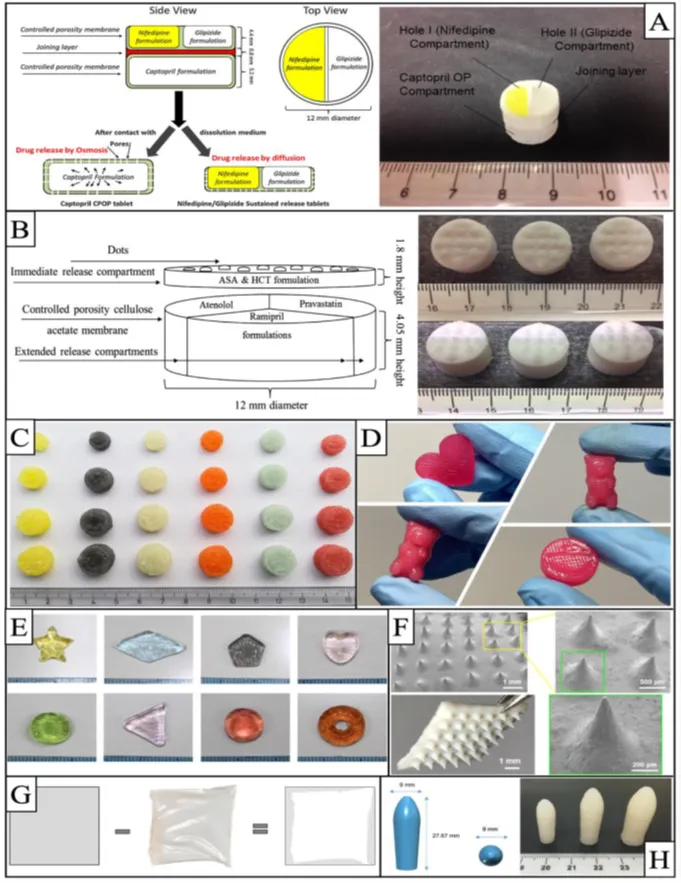
Figure 6. Images of various types of preparations prepared by SSE technology: (A) Multi-active tablet containing three APIs with sustained release zones in the upper layer and osmotic pumps in the lower layer, with the model picture on the left and the printed tablet picture on the right [95]; (B) compounded tablet containing five APIs, with the model picture on the left, with the immediaterelease layer at the top and the extended-release layer at the bottom, and the printed tablets on the right [94]; (C) chewable isoleucine tablets with different flavors, colors, and sizes [23]; (D) 3D-printed gummies with different shapes [96]; (E) 3D-printed gummies with different shapes and colors [97]; (F) image of a 3D-printed microneedle, and SEM image of partial enlargement [104]; (G) 3D-printed films of the patch, image of dried dimensions versus theoretical dimensions [105]; (H) 3D-printed tacrolimus suppositories, with the model image on the left and the different sizes of suppositories on the right [106]. Figures were reproduced and modified with permission from [23,94–97,104–106].
Med (Melt Extrusion Deposition) Technology
Principle
Melt Extrusion Deposition (MED) is an advanced, pharmaceutical-adapted evolution of fused deposition modeling (FDM), designed to overcome limitations associated with conventional thermoplastic extrusion in drug manufacturing. MED modifies the core principles of filament-based extrusion to provide greater control over temperature, deposition accuracy, and material handling, making it more suitable for pharmaceutical-grade processing [26].
Core Working Mechanism
In MED, a drug-polymer mixture is heated to a semi-molten or fully molten state and extruded through a precision nozzle to build objects layer-by-layer. The approach differs from typical FDM because it does not require pre-manufactured filaments. Instead, the formulation is fed as pellets, granules, or powders directly into the extruder, where it undergoes controlled melting and deposition [26].
Key steps in the MED process:
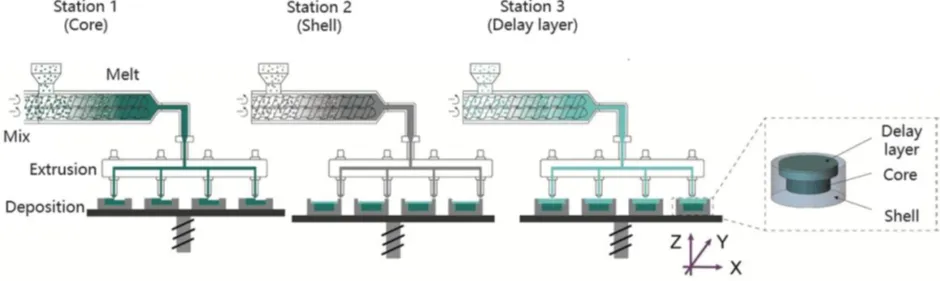
Figure 7. The principle of collaborative preparation of tablets with delayed release shells using multiple print stations through MED technology. Figures were reproduced and modified with permission from [26]
Advantages of MED Over Conventional FDM
MED technology was developed specifically to improve the pharmaceutical suitability of extrusion-based 3D printing. Key advantages include:
i. No Filament Requirement
Traditional FDM relies on uniform filaments, which are difficult to produce with high API loading. MED bypasses this challenge by allowing direct extrusion of raw materials.
ii. Improved Thermal Control
MED systems offer multi-zone temperature regulation, preserving thermolabile drugs and ensuring consistent rheological behaviour [26].
iii. Enhanced Drug Uniformity and Dose Precision
Direct extrusion ensures homogeneous distribution of APIs, reducing variability in content uniformity.
iv. Broader Material Compatibility
The technology can process a wide range of pharmaceutical polymers, softening agents, and drug load levels without compromising printability.
v. Greater Geometric Flexibility
Complex dosage forms multi-compartment tablets, controlled-release structures, and customized shapes can be produced with higher precision.
Pharmaceutical Relevance of MED
MED’s design enables the production of dosage forms that meet strict pharmaceutical standards. Such as High drug-loading formulations, Immediate, sustained, and delayed-release profiles, Personalized and patient-specific dosage forms, multi-drug devices (polypills), On-demand manufacturing in clinical settings. Its ability to maintain consistent thermal exposure and eliminate filament fabrication makes MED particularly attractive for hospital pharmacies and personalized medicine, where rapid manufacturing and dose flexibility are essential [26].
Integration Into Pharmaceutical Production
Due to its controlled and reproducible thermal extrusion, MED aligns well with pharmaceutical quality frameworks such as Good Manufacturing Practice (GMP), Quality by Design (QbD), Process Analytical Technology (PAT). MED systems can be fully integrated with quality monitoring tools, enabling real-time control of extrusion parameters and enhancing product reproducibility.
MED Technology in Pharmaceutical Applications
Melt Extrusion Deposition (MED) has emerged as a transformative 3D-printing platform tailored specifically for pharmaceutical manufacturing. MED addresses critical limitations of conventional fused deposition modeling (FDM) by enabling direct extrusion of pharmaceutical formulations without using pre-fabricated filaments, thereby expanding the range of drug products that can be manufactured through additive techniques [26].
1. Personalized and Patient-Specific Dosage Forms
One of the most significant applications of MED in pharmaceuticals is the fabrication of customized dosage forms designed according to individual patient requirements. MED allows modification of Dose Strength, Tablet Shape, Size, Release Behaviour, and Drug Combinations, making it highly suitable for patient groups requiring precise dose adjustments such as paediatrics, geriatrics, and patients with rare diseases [26]. The filament-free approach allows rapid adjustments to formulation and dose, enabling point-of-care manufacturing in clinical and hospital settings.
2. High Drug-Loading Formulations
A major pharmaceutical advantage of MED is its capability to process high API-loaded formulations. Traditional FDM struggles with high drug content because filament strength deteriorates; however, MED processes material directly in molten form, avoiding filament fragility. This makes MED highly applicable to potent drugs requiring small-volume tablets, poorly soluble drugs formulated as amorphous solid dispersions, combined high-dose therapies (polypills). MED’s thermal control and uniform mixing result in consistent drug distribution and dose uniformity, which are essential for regulatory compliance [26].
3. Complex and Functionalized Drug Delivery Systems
MED enables the production of structurally complex dosage forms that cannot be produced by conventional tableting. Such as multi-compartment tablets for sequential or dual release, Honeycomb or Porous Structures for enhanced disintegration, Geometrically Tailored Matrices for modified release, Devices with Controlled Infill Density affecting dissolution rate. By modulating layer patterns, deposition paths, and internal architecture, MED allows precise manipulation of drug release kinetics. These advanced geometries can significantly enhance therapeutic performance [26].
4. Polypills and Multi-Drug Devices
MED is especially useful for producing polypills, where multiple active pharmaceutical ingredients (APIs) are incorporated into distinct compartments of a single dosage form. Because MED prints directly from material reservoirs rather than from separate filaments, it can switch between formulations during printing with high accuracy. This enables multi-drug combinations for chronic disease management, Reduced pill burden for elderly patients, Targeted delivery using isolated compartments. The clinical relevance of such personalized combination therapy, which can improve adherence and therapeutic outcomes [26].
5. On-Demand and Decentralized Manufacturing
A major future application of MED is on-demand drug manufacturing in decentralized environments such as Hospitals, Compounding pharmacies, Remote or resource-limited areas, Clinical trial centres. MED’s compact, GMP-adaptable system can be integrated with digital health tools, enabling automated production of medicines based on electronic prescriptions. This capability can revolutionize supply chains and support personalized therapy at the point of care [26].
6. Stability-Optimized Processing for Thermolabile Drugs
MED offers multi-zone, highly controlled temperature profiles, allowing printing at lower and more consistent temperatures compared to standard FDM. This makes it suitable for drugs that are sensitive to thermal degradation. MED as capable of maintaining drug stability while still enabling robust extrusion and layer deposition [26]. This widens the range of candidate APIs and excipients for 3D-printed dosage forms.
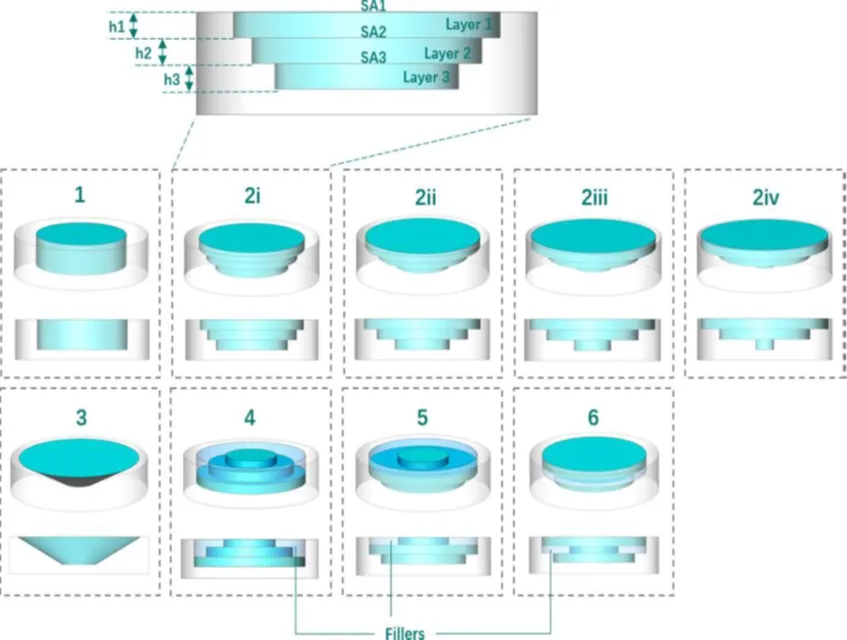
Figure 8. Multilayered drug compartments in core–shell structure tablets with constant or varied SA. Drug compartments (teal), shells (pale white), and fillers (bluish). [1] Drug compartment with constant SA. [2i–2iv) Drug compartment with stepwise decreasing SA. [3] Drug compartment with continuously decreasing SA. [4] Drug compartment with stepwise increasing SA. [5] Drug compartment with increasing–decreasing SA. [6] Drug compartment with decreasing-increasing SA. Figure reproduced and modified with permission from [26].
Stereolithography (SLA) Technology
Principle
Stereolithography (SLA) is one of the earliest and most precise additive manufacturing technologies, based on the principle of photopolymerization, where liquid photopolymer resins are selectively cured into solid structures using a light source, typically ultraviolet (UV) light or a laser [108,110]. Due to its high resolution and ability to fabricate intricate geometries, SLA has gained increasing attention in pharmaceutical and biomedical applications.
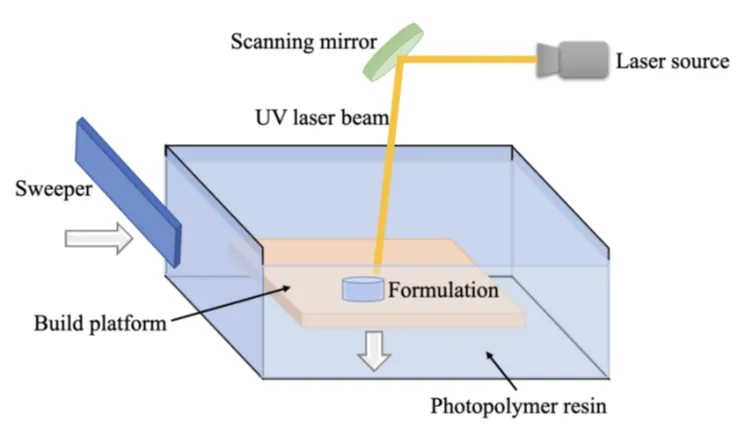
Figure 9. Schematic diagram of the printing principle of SLA technology.
1. Fundamental Working Mechanism
The SLA process involves a vat of liquid photopolymer resin that is selectively solidified layer-by-layer through exposure to a focused light source. The process begins with a computer-aided design (CAD) model, which is sliced into thin layers. A laser beam or projected light then scans across the resin surface, initiating polymerization only in predefined regions [108,110].
Key steps in SLA printing:
2. Photopolymerization Kinetics and Material Behaviour
The effectiveness of SLA depends heavily on the curing kinetics of photopolymers, which are influenced by factors such as light intensity, exposure time, and resin composition [112]. Acrylate-based photopolymers are commonly used due to their rapid polymerization and suitable mechanical properties [112,116]. Photopolymerization involves complex synergistic kinetics, where the rate of polymer formation and cross-linking determines the final mechanical strength and resolution of the printed structure [114]. Materials such as vinyl esters have also been explored to improve biocompatibility and reduce cytotoxicity, especially for biomedical applications [111].
3. Laser Scanning and Resolution Control
In SLA, the laser scanning path and exposure parameters play a critical role in defining the accuracy and structural integrity of printed objects. Controlled scanning strategies ensure uniform curing and minimize defects such as over-curing or incomplete polymerization [113]. The resolution of SLA is significantly higher than extrusion-based techniques, as it depends on laser spot size, layer thickness, curing depth, and exposure time. This allows fabrication of microscale features and highly detailed geometries, making SLA particularly suitable for biomedical devices such as microneedles and scaffolds [107].
4. Post-Curing and Mechanical Properties
After printing, SLA-fabricated structures typically undergo post-curing using additional UV exposure to enhance polymer cross-linking and improve mechanical strength. The duration of curing significantly affects material properties such as tensile strength, elasticity, and durability [115]. Mechanical characterization studies indicate that SLA-printed polymers exhibit strong structural integrity, though properties can vary depending on curing conditions and material composition [109].
5. Material and Process Considerations
The performance of SLA is influenced by several factors, including Resin viscosity and composition, Photoinitiator efficiency, Light penetration depth, Curing behaviour. Despite its advantages, the use of photopolymers introduces challenges such as potential toxicity, limited pharmaceutical-grade materials, and residual monomers, which must be carefully controlled for biomedical applications [116].
6. Integration with Advanced Additive Manufacturing
SLA is a key component of advanced additive manufacturing systems and is often compared with other techniques such as FDM and SLS in terms of precision and material capabilities [83]. Its ability to produce highly detailed and complex structures positions it as a valuable tool in microfabrication and high-resolution drug delivery systems.
SLA Technology in Pharmaceutical Applications
Stereolithography (SLA) is an additive manufacturing technology that uses photopolymerization of liquid resins to create highly accurate, complex 3D structures. In pharmaceuticals, SLA has emerged as a powerful platform for fabricating oral dosage forms, microneedles, and advanced drug-delivery systems with unprecedented design flexibility.
1. SLA for Oral Modified-Release Dosage Forms
Tailored Drug Release
SLA can be used to fabricate oral modified-release tablets with precise control over geometry and internal architecture [117]. Ability to create complex geometries (e.g., multilayer, compartmentalized, porous structures). Modulation of drug release achieved by altering Shell thickness, Internal channels, Overall shape. High manufacturing precision allowing predictable, reproducible release kinetics. This study established SLA as a suitable platform for personalized oral dosage forms, especially where modified or extended release is required.
2. Geometry-Driven Release Modulation
Impact of Shape and Structure
Tablet geometry itself plays a major role in release behaviour. Using SLA, they fabricated tablets with variable [118]. Surface area-to-volume ratio, Internal lattice pattern, Shell-core configurations. Major outcomes are SLA enables release tailoring without changing formulation composition. More intricate geometries produced unique release profiles not achievable using conventional tablets. This confirmed SLA’s suitability for precision medicine where individualized drug dosing is required.
3. SLA-Printed Microneedles for Transdermal Delivery
The exceptionally high resolution and precision of stereolithography (SLA) technology have made it particularly suitable for the fabrication of microneedle-based drug delivery systems. Unlike conventional manufacturing methods, SLA enables the production of microneedle arrays with intricate geometries, precise dimensions, and excellent mechanical strength, which are essential for effective skin penetration and controlled transdermal drug administration. Consequently, SLA has emerged as a promising platform for developing next-generation microneedle devices for a wide range of pharmaceutical applications. The fabrication of hollow microneedle arrays[119] using SLA for the transdermal delivery of rifampicin. The printed microneedles exhibited sharp tips and sufficient mechanical strength to penetrate the skin effectively. Furthermore, the hollow architecture enabled direct infusion of the drug through the needle lumen, thereby enhancing drug delivery efficiency. This approach offers significant potential for tuberculosis treatment and other therapeutic applications requiring minimally invasive administration routes. In another study, [120] employed SLA technology to develop microneedles for localized anticancer therapy of skin tumors. The SLA-fabricated microneedles facilitated direct delivery of anticancer agents into the targeted tissue, resulting in controlled micro-dosing and improved localization of the therapeutic effect. This targeted delivery strategy has the advantage of reducing systemic drug exposure and minimizing associated side effects while enhancing treatment efficacy. The study further highlighted the ability of SLA to produce microneedles with customizable mechanical properties tailored to specific therapeutic requirements.
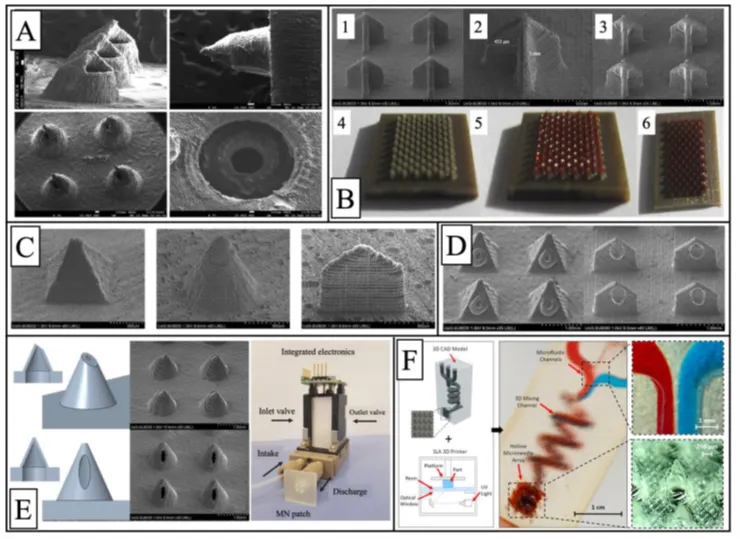
Figure 10. Images of various types of microneedles prepared by SLA technology: (A) SEM images of the 3D-printed microneedles at different angles [119]; (B) uncoated microneedles physical view [4] and SEM images [1,2], coated microneedles physical view [5,6] and SEM images [3] [120]; (C) 3D-printed microneedles in different shapes [121]; (D) pyramidal and spear-shaped microneedles with insulin coatings [122]; (E) from left to right are the model images of the hollow microneedles, the SEM images, and the 3DMNMEMS configuration [123]; (F) 3D-printing of microfluidic-enabled hollow microneedle devices [124]. Figures reproduced and modified with permission from [119–124]. The design flexibility of SLA was investigated the optimization of microneedle geometry and manufacturing parameters [122]. Their work focused on improving needle tip sharpness, mechanical robustness, and base support structures. Through careful design modifications, stronger and sharper microneedles were produced, resulting in enhanced skin penetration and improved drug delivery performance. These findings emphasize the importance of geometric optimization in maximizing the functionality of SLA-printed microneedle systems. SLA technology has also been explored for the delivery of biologics. The developed microneedle patches for intradermal insulin administration using SLA. The printed microneedles exhibited excellent dimensional accuracy and uniformity, enabling controlled insulin delivery with minimal pain and discomfort. The precise fabrication capability of SLA contributed to improved dosing accuracy and patient compliance, highlighting its potential for the management of chronic diseases such as diabetes mellitus.
Beyond conventional microneedle systems [123] an innovative hollow microneedle microelectromechanical system (MEMS) using SLA technology. The high spatial resolution offered by SLA enabled the integration of microchannels and drug reservoirs within the device, facilitating programmable and personalized drug administration. This advanced system represents an important step toward the development of smart drug-delivery platforms capable of delivering medications in a controlled and patient-specific manner. Combined microfluidic technology [124] with SLA-fabricated hollow microneedles to create a sophisticated transdermal drug delivery platform. The integrated microfluidic architecture allowed precise control over drug flow and administration rates, while the hollow microneedles ensured efficient transport of therapeutic agents across the skin barrier. The system demonstrated compatibility with a broad range of pharmaceutical compounds and highlighted the potential of SLA technology for developing next-generation transdermal delivery devices that combine precision, versatility, and patient convenience.
Table 2. Summary of SLA Applications in Pharmaceuticals
|
Application Area |
Contribution of SLA |
References |
|
Oral modified-release tablets |
Geometry-based modulation, personalized dosing |
117, 118 |
|
Hollow microneedles |
Efficient rifampicin delivery, microfluidic systems |
119, 124 |
|
Solid microneedles |
Strengthened structures, design optimization |
121 |
|
Microneedles for cancer therapy |
Localized anticancer drug delivery |
120 |
|
Insulin delivery patches |
Needle precision, controlled intradermal delivery |
122 |
|
MEMS delivery platforms |
Programmable, personalized drug administration |
123 |
Selective Laser Sintering (SLS)
Principle
The principle of SLS is based on selective thermal fusion of powdered materials using a high-energy laser source. During the printing process, a thin layer of pharmaceutical powder containing the drug and suitable excipients is evenly spread over the build platform [125]. A computer-controlled laser selectively scans predetermined regions of the powder bed, causing localized melting or sintering of particles [126]. After completion of one layer, the platform is lowered, a fresh powder layer is deposited, and the process is repeated until the final dosage form is produced.
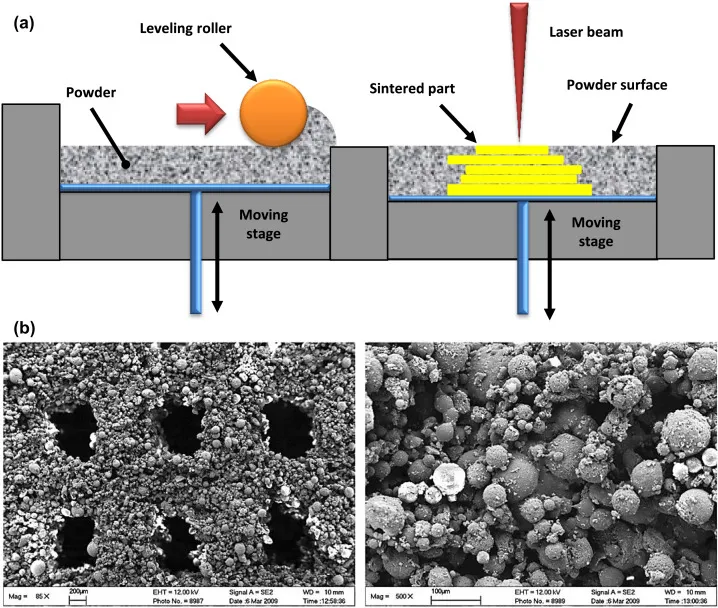
Figure 11. (a) Schematic representation of selective laser sintering (SLS) manufacturing technique and (b) scanning electron microscope (SEM) images of the surface of a scaffold fabricated using calcium phosphate (Ca-P)/poly(hydroxybutyrate-co-hydroxyvalerate) (PHBV) nanocomposite [136].
Working Mechanism of Selective Laser Sintering (SLS) Technology
The working mechanism of SLS involves a series of sequential steps beginning with digital design generation and ending with the recovery of the final printed pharmaceutical product. Initially, the desired dosage form is designed using three-dimensional CAD software, where parameters such as shape, dimensions, internal structure, and porosity are defined according to the intended therapeutic requirements. The CAD model is then converted into an STL file, which represents the external geometry of the dosage form [127, 128]. The STL file is imported into slicing software, where the three-dimensional structure is divided into multiple thin layers and printing parameters are assigned. Following digital preparation, the pharmaceutical powder mixture is loaded into the powder reservoir of the SLS printer. The powder formulation generally consists of the API incorporated into a thermoplastic polymer matrix or other suitable pharmaceutical excipients. A recoating system distributes a uniform layer of powder across the build platform. Uniform powder deposition is essential because variations in layer thickness can affect mechanical strength, drug content uniformity, and final product quality. After powder spreading, a laser beam selectively scans specific regions of the powder layer according to the digital instructions generated from the sliced CAD model. The absorbed laser energy increases the temperature of the powder particles, causing partial melting or softening of polymeric materials and fusion between adjacent particles. Only the selected regions undergo sintering, while the remaining powder remains unaffected and provides support for the developing structure. This selective fusion process creates the first layer of the pharmaceutical dosage form. Once a single layer is completed, the build platform moves downward by a predefined layer thickness. A fresh layer of pharmaceutical powder is then spread over the previously sintered layer, and the laser scanning process is repeated. Through continuous repetition of powder deposition and selective laser exposure, multiple layers are progressively fused until the complete three-dimensional pharmaceutical product is obtained. After completion of printing, the fabricated dosage form is carefully removed from the powder bed. The unsintered powder surrounding the printed product is separated and can potentially be collected and reused after appropriate evaluation. Depending on the formulation and intended application, additional post-processing steps such as powder cleaning, surface finishing, or quality evaluation may be performed. The final printed dosage form is then subjected to pharmaceutical characterization, including weight variation, mechanical strength, drug content uniformity, dissolution behavior, and stability studies. The unique layer-by-layer fabrication mechanism of SLS provides precise control over the architecture of pharmaceutical dosage forms. By modifying laser energy density, scanning parameters, and powder composition, researchers can manipulate the internal structure, porosity, mechanical properties, and drug-release characteristics of printed medicines. This flexibility makes SLS an attractive technology for developing personalized and multifunctional drug delivery systems in modern pharmaceutical manufacturing.
SLS Technology in Pharmaceutical Applications
1. SLS-Printed Oral Dosage Forms
SLS technology has been widely investigated for the production of oral solid dosage forms because of its ability to generate complex tablet architectures with controlled porosity. The porous structures produced during sintering facilitate rapid penetration of dissolution media, resulting in improved disintegration and dissolution performance. This property makes SLS particularly attractive for developing fast-dissolving tablets and patient-friendly dosage forms [129]. Compared with conventional tablet compression, SLS allows modification of tablet geometry and internal structure without changing the formulation composition. By adjusting laser energy density, researchers can control the degree of powder fusion, thereby regulating tablet hardness, porosity, and drug-release profiles [130].
2. SLS for Personalized Medicine
One of the most significant advantages of SLS is its suitability for personalized drug delivery. The digital nature of the technology allows modification of dose strength, tablet size, shape, and release characteristics according to individual patient requirements. This feature supports the development of personalized medicines for pediatric, geriatric, and patients requiring dose adjustments [131]. SLS-based personalized manufacturing may enable preparation of medicines directly at hospitals or pharmacies using patient-specific electronic prescriptions. Such decentralized manufacturing represents a major step toward precision medicine and individualized pharmacotherapy [132].
3. SLS-Based Modified Release Drug Delivery Systems
The ability of SLS to control internal tablet architecture provides opportunities for developing modified-release formulations. Variations in laser scanning parameters can generate differences in tablet density and porosity, which influence drug diffusion pathways and dissolution behaviour. Higher laser energy produces stronger particle fusion and reduced porosity, resulting in slower drug release, whereas lower energy settings produce more porous structures with faster dissolution. Therefore, SLS provides a formulation-independent strategy for designing immediate, sustained, and programmed-release drug delivery systems [128,133].
4. SLS in Pediatric Pharmaceutical Applications
Pediatric drug therapy frequently requires flexible dosing, small dosage forms, and improved patient acceptability. SLS technology can overcome these challenges by enabling fabrication of customized tablets with appropriate dose levels and patient-friendly designs. The ability to rapidly manufacture different dosage strengths using the same printer platform makes SLS highly suitable for pediatric medicine preparation. Additionally, porous SLS-printed structures may improve disintegration characteristics, making them more acceptable for children with swallowing difficulties [131,134].
5. SLS-Based Combination Drug Delivery Systems
SLS technology enables fabrication of complex multi-compartment dosage forms capable of incorporating multiple drugs with different release profiles. By controlling the spatial distribution of drug-loaded regions, individual active ingredients can be released independently from a single dosage form. This approach has potential applications in combination therapies where patients require multiple medications, reducing pill burden and improving adherence [132,135].
Table 3. Advantages and Limitations of Selective Laser Sintering (SLS) Technology in Pharmaceuticals
|
Advantages |
Limitations |
|
Solvent-free manufacturing process |
Risk of thermal degradation of APIs |
|
Fabrication of complex geometries |
Limited pharmaceutical-grade printable materials |
|
Personalized dose customization |
Requirement for extensive process optimization |
|
Controlled drug-release profiles |
Powder flowability challenges |
|
No requirement for additional support structures |
Limited industrial scalability |
|
Reduced material wastage |
Regulatory uncertainty |
|
Rapid digital manufacturing |
High equipment cost |
|
Suitable for advanced drug delivery systems |
Technical expertise requirement |
INKJET PRINTING
Principle
The principle of inkjet printing is based on the controlled generation and deposition of drug-loaded droplets using a computer-controlled printing system. In this technology, pharmaceutical ink containing active pharmaceutical ingredients (APIs), polymers, excipients, and suitable solvents or carriers is delivered through a print head containing multiple microscopic nozzles. The digital design controls the movement of the print head and determines the position, quantity, and distribution of deposited droplets. During printing, electrical or thermal energy generates pressure within the print head, resulting in the formation and ejection of uniform droplets through the nozzle. These droplets are deposited layer-by-layer onto a substrate to construct the desired pharmaceutical dosage form. The final product characteristics depend on ink properties, droplet size, printing parameters, substrate characteristics, and post-printing processing conditions [137,141]. The ability to precisely control droplet placement allows inkjet printing to achieve accurate drug dosing and spatial distribution of multiple pharmaceutical ingredients. This feature makes it particularly suitable for personalized medicine, where dosage strength and drug combinations can be adjusted according to individual patient requirements [138].
Types of Inkjet Printing Technologies
Inkjet printing technologies used in pharmaceuticals are mainly classified into two categories:
1. Continuous Inkjet Printing (CIJ)
Continuous inkjet printing involves the continuous generation of a stream of droplets from the print head. The droplets are electrically charged and selectively directed toward the printing surface using electrostatic fields. Unused droplets are collected and recycled within the system. Although CIJ provides high-speed printing capabilities, its application in pharmaceuticals is limited due to complex equipment requirements and challenges associated with formulation compatibility. However, it has potential applications in large-scale pharmaceutical manufacturing where continuous production is required [137].
2. Drop-on-Demand (DoD) Inkjet Printing
Drop-on-demand inkjet printing is the most widely investigated approach for pharmaceutical applications because it provides precise control over droplet deposition. In DoD systems, droplets are generated only when required, reducing material wastage and improving dose accuracy.
DoD printing is further divided into:
(a) Thermal Inkjet Printing
Thermal inkjet printing uses a heating element to rapidly vaporize a small amount of liquid, creating a bubble that generates pressure and ejects a droplet through the nozzle. This technique offers high printing resolution and low-cost operation. Thermal inkjet printing has been successfully explored for pharmaceutical applications, including preparation of oral dosage forms and deposition of drug solutions with controlled accuracy [142].
(b) Piezoelectric Inkjet Printing
Piezoelectric inkjet printing uses electrical stimulation of piezoelectric crystals to generate mechanical deformation, producing pressure waves that eject droplets from the nozzle. This approach avoids thermal stress and is suitable for heat-sensitive drugs and biological molecules. Piezoelectric systems provide improved control over droplet formation, making them attractive for complex pharmaceutical formulations and advanced drug delivery systems [137,143].
3. Pharmaceutical Ink Formulation (Pharma-Ink Development)
The development of suitable pharmaceutical ink is one of the most critical factors determining the success of inkjet printing. Unlike conventional printing inks, pharmaceutical inks must satisfy specific requirements related to drug stability, printability, viscosity, surface tension, solvent compatibility, and therapeutic effectiveness. An ideal pharmaceutical ink should possess appropriate viscosity and surface tension to enable stable droplet formation and prevent problems such as nozzle blockage, satellite droplet formation, and inconsistent deposition. The concentration of API, polymer selection, solvent system, and presence of additives strongly influence printing performance and final dosage form characteristics [137,139].
Common components of pharmaceutical inks include:
Optimization of ink properties is essential to achieve accurate dosing, reproducible printing, and desired drug-release behaviour [141].
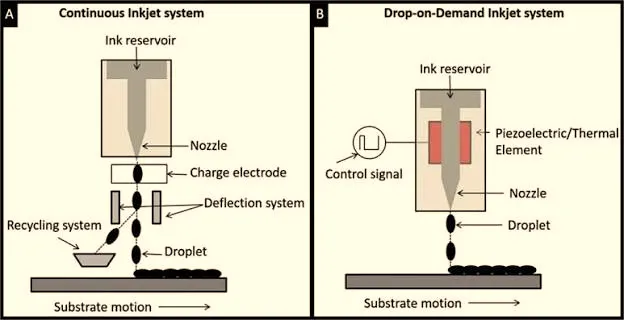
Figure 12. Graphical illustrations of the A) CIJP and B) DoD IJP systems.
Working Mechanism of Inkjet Printing
The general workflow of pharmaceutical inkjet printing involves several sequential steps:
Step 1: Digital Design Preparation
A three-dimensional or two-dimensional digital model of the dosage form is created using computer-aided design (CAD) software. The design determines the shape, dimensions, drug distribution, and printing pattern.
Step 2: Preparation of Pharmaceutical Ink
Drug-loaded ink is prepared by dissolving or dispersing the API and excipients in an appropriate solvent system. The formulation is optimized for viscosity, surface tension, stability, and printability.
Step 3: Droplet Generation
The ink is transferred into the printer cartridge. Controlled electrical or thermal signals generate droplets through the print nozzle.
Step 4: Layer-by-Layer Deposition
The droplets are accurately deposited onto the substrate according to the digital design. Multiple printing cycles can be performed to increase drug loading or create multilayer dosage forms.
Step 5: Drying and Post-Processing
After deposition, solvent evaporation or curing converts the printed layers into a stable pharmaceutical dosage form.
This digital manufacturing approach enables rapid modification of dosage strength and formulation characteristics without changing manufacturing equipment [137,138].
Inkjet Printing in Pharmaceutical Applications
1. Inkjet Printing of Oral Dosage Forms
Inkjet printing has demonstrated significant potential for manufacturing oral dosage forms including tablets, films, and orally disintegrating systems. The technology allows precise deposition of drug solutions onto pharmaceutical substrates, resulting in accurate dose control and improved formulation flexibility. Cader et al. demonstrated water-based inkjet printing for oral pharmaceutical dosage forms, showing that the technology could successfully manufacture drug-loaded formulations with controlled drug distribution and acceptable pharmaceutical characteristics [145]. Inkjet printing also enables preparation of dosage forms containing very small drug quantities, making it suitable for potent drugs and personalized dosing applications.
2. Personalized Medicine and Customized Drug Dosing
One of the most important applications of inkjet printing is personalized medicine. Conventional manufacturing produces fixed-dose medicines, which may not satisfy individual patient requirements. Inkjet printing overcomes this limitation by allowing adjustment of drug dose simply by modifying printing parameters. The number of printed layers, droplet frequency, and drug concentration can be adjusted to produce patient-specific doses. This approach is particularly beneficial for pediatric, geriatric, and patients requiring individualized treatment regimens [137,138].
3. Multi-Drug Combination Therapy
Inkjet printing enables spatial control over different drug components, allowing multiple APIs to be incorporated into a single dosage form. Different drugs can be printed in separate regions or layers, enabling independent control of release profiles. This capability supports the development of personalized combination therapies and polypills, which can improve patient compliance by reducing the number of medications taken daily [138,140].
4. Orodispersible Films and Fast-Dissolving Systems
Inkjet printing is highly suitable for preparing thin-film dosage forms because of its ability to deposit precise amounts of drug onto flexible substrates. Printed films generally exhibit rapid dissolution due to their high surface area, making them useful for patients with swallowing difficulties. Such systems have potential applications in pediatric and geriatric medicine, where rapid administration and improved patient acceptance are important considerations [137].
5. Drug-Loaded Microneedles and Transdermal Systems
Inkjet printing has been explored for fabrication of advanced transdermal drug delivery systems, including drug-loaded microneedles and patches. The ability to precisely deposit small drug quantities allows controlled drug distribution within microstructures. These systems may provide minimally invasive delivery with improved patient compliance compared with conventional injections [137,143].
6. Biomedical and Bioprinting Applications
Inkjet printing has also contributed to pharmaceutical biotechnology through fabrication of biological structures, cell-containing constructs, and tissue engineering scaffolds. The precise handling of small droplets enables controlled deposition of cells, proteins, and biomolecules. Although challenges remain regarding cell viability and bioink optimization, inkjet-based bioprinting represents an emerging area for regenerative medicine and advanced therapeutics [137].
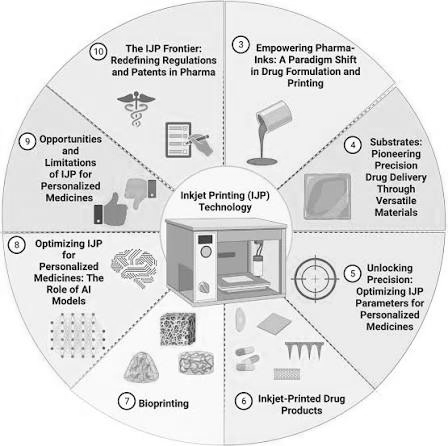
Figure 13. Summary of the scope of this review in the different sections.
Present Scope and Future Directions Of 3D Printing Technology in Pharmaceuticals
1. Present Scope of 3D Printing in the Pharmaceutical Industry
3D printing technology has evolved from experimental research to early commercialization over the past two decades. The field is still emerging, but significant advancements have been made in both large-scale drug manufacturing and personalized medicine.
1.1. Early Development and Breakthrough
The establishment of Therics in 1996 marked the first attempt to commercialize 3D-printed drugs. Although the company did not achieve industrialization due to technological challenges, its work laid the foundation for future progress. A major breakthrough arrived in 2015, when Aprecia’s ZipDose® technology enabled the FDA approval of Spritam®, the world’s first 3D-printed drug. This achievement triggered global interest and investment in pharmaceutical 3D printing.
1.2. Current Industry Landscape
Since 2015, the sector has experienced rapid growth, with companies emerging across Europe, the United States, and China. Their focus areas fall into two categories:
A. Large-Scale Manufacturing
Companies aim to integrate 3D printing into traditional drug production pipelines:
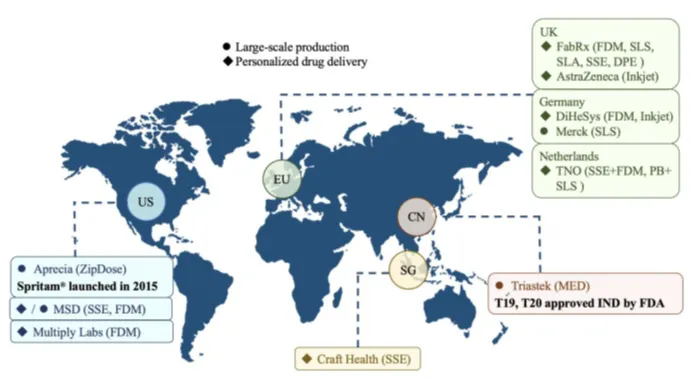
Figure 11. Global industry developments in 3D printed drugs.
B. Personalized Drug Delivery
3D printing uniquely supports individualized patient needs, making it ideal for hospital pharmacies and specialized cases.
Major contributors include:
This personalized approach aligns with the global shift toward precision medicine and patient-tailored therapies.
2. Regulatory Progress and Support
Regulatory agencies have shown increasing interest and support, FDA established the Emerging Technology Team (ETT) in 2014 to accelerate approval of innovative technologies. The FDA approved Spritam® in 2015 and later recognized 3D printing and continuous manufacturing as strategic directions in 2017 guidance. Triastek's MED technology entered the FDA’s Emerging Technology Program in 2020. In 2021, the National Academies of Sciences, Engineering, and Medicine predicted that 3D printing could replace traditional manufacturing in certain contexts. However, no regulatory body has yet released dedicated guidelines for 3D-printed drug products, highlighting the need for standardized frameworks.
3. Future Directions of 3D Printing in Pharmaceuticals
Based on the technological and regulatory evolution, several key future trajectories are evident.
3.1. Advancement Toward Full Personalization
The ability to produce patient-specific like Doses, Release profiles, Dosage forms, Combinations of multiple drugs. Will make 3D printing central to personalized medicine. Hospital-based 3D printing units may become routine, especially for paediatrics, geriatrics, oncology, and rare diseases.
3.2. Integration with Digital Health and AI
Future 3D printing platforms will integrate with AI-driven dose calculation, Machine-learning quality prediction, Digital twin models for real-time monitoring, Automated prescription-to-product workflows. This will create a fully closed-loop system from diagnosis to production.
3.3. Expansion of Industrial-Scale Production
Triastek and Aprecia show that large-scale manufacturing using 3D printing is achievable. Future industrial growth will focus on: Continuous manufacturing systems, Hybrid production lines combining traditional and additive methods, Increased automation and real-time process analytics. These improvements will reduce costs and shorten development timelines.
3.4. Regulatory Standardization and Global Harmonization
As more companies pursue FDA/EMA approvals, regulatory agencies will need to establish by Standards for material quality, Printer validation, In-process controls, post-market monitoring. Clear regulatory frameworks will accelerate commercialization and build confidence in 3D-printed medicines.
3.5. Development of New Printable Materials
Future research will focus on Novel photopolymers and excipients suitable for oral and transdermal applications, Biodegradable polymers for implantable devices, Bioinks for tissues and living therapeutics. Material innovation will expand the scope of drug types that can be printed.
3.6. Convergence With Other Emerging Technologies
3D printing will increasingly intersect with Microfluidics (e.g., Hollow Microneedles), MEMS for programmable delivery, Robotics for automated production, Nanotechnology for enhanced drug penetration. These hybrid systems will enable sophisticated drug-delivery platforms.
3.7. Transformation of Pharmaceutical Supply Chains
3D printing may shift the industry from centralized manufacturing to a distributed, on-demand model, including Point-of-care printing, On-site production during emergencies or pandemics, Localized production for remote regions. This model will reduce logistics challenges and drug wastage.
4. Overall Outlook
The present trajectory shows that 3D printing is moving from research laboratories to industrial and clinical implementation. Despite challenges regulatory uncertainty, multidisciplinary skill requirements, and manufacturing complexity the technology is set to become a foundational pillar of modernized pharmaceutical production.
Future Vision
3D printing is likely to enable with Fully automated, digital drug manufacturing, Personalized dose fabrication within minutes, Smart oral and transdermal systems, On-demand medicines in hospitals and pharmacies, Integration with precision diagnostics, as standards mature and technology advances, 3D printing has the potential to redefine the entire pharmaceutical value chain from development and manufacturing to distribution and patient care.
CONCLUSION
Three-dimensional (3D) printing has emerged as a promising technology that is transforming pharmaceutical research and drug manufacturing. Its ability to produce personalized medicines with customized doses, shapes, and drug-release profiles offers significant advantages over conventional manufacturing methods. Various 3D printing techniques, including Binder Jet Printing (BJ-3DP), Fused Deposition Modeling (FDM), Semi-Solid Extrusion (SSE), Melt Extrusion Deposition (MED), Stereolithography (SLA), Selective Laser Sintering (SLS), and Inkjet Printing, have demonstrated great potential in developing innovative drug delivery systems, polypills, modified-release formulations, implants, microneedles, and other patient-specific dosage forms. Although remarkable progress has been made, several challenges still need to be addressed before the widespread clinical and industrial adoption of 3D-printed medicines. These include the limited availability of pharmaceutical-grade printable materials, regulatory uncertainties, quality assurance requirements, process standardization, and the need for cost-effective large-scale manufacturing. Overcoming these challenges will require close collaboration among researchers, pharmaceutical industries, equipment manufacturers, and regulatory authorities. Future developments in advanced printable materials, artificial intelligence, automation, digital health technologies, and regulatory frameworks are expected to further enhance the capabilities of pharmaceutical 3D printing. As these technologies continue to evolve, 3D printing is likely to become an integral part of precision medicine, enabling safer, more effective, and patient-centered healthcare. Overall, 3D printing represents a significant step toward the next generation of pharmaceutical manufacturing and has the potential to improve therapeutic outcomes while making personalized treatment more accessible worldwide.
REFERENCES




Pocham Ravikiran*, Donthula Srilatha, Khushi Pol, Bondada Rose Sharon, Three-dimensional (3D) Printing in Pharmaceuticals: Current Advances, Technologies and Future Directions, Int. J. Med. Pharm. Sci., 2026, 2 (9), 686-722. https://doi.org/10.5281/zenodo.23057014
 10.5281/zenodo.23057014