

We use cookies to ensure our website works properly and to personalise your experience. Cookies policy
Laddhad College of Pharmacy, Yelgaon, Buldana
The present study was aimed at the formulation and evaluation of an aspirin colon-targeted drug delivery system. Aspirin is a widely used non-steroidal anti-inflammatory drug, but its conventional oral administration may cause gastric irritation and other gastrointestinal side effects. Therefore, a colon-targeted delivery approach was developed to minimize drug release in the upper gastrointestinal tract and promote release in the colon. Different formulations, F1 to F9, were prepared and evaluated for pre-compression and post-compression parameters. The pre-compression studies showed good flow properties of the powder blends, as indicated by acceptable bulk density, tapped density, angle of repose, Carr’s Index, and Hausner’s ratio. The prepared tablets were evaluated for weight variation, thickness, hardness, friability, disintegration time, and drug content. All formulations showed satisfactory tablet characteristics. Among them, formulation F9 was selected as the optimized batch due to its better overall performance, including acceptable weight, low friability of 0.50%, suitable disintegration time of 2.1 hours, and highest drug content of 97.30%. The results suggest that the optimized aspirin colon-targeted formulation may be suitable for site-specific drug delivery to the colon. This system may help reduce gastric irritation and improve local drug availability in the colon. Hence, the study concluded that aspirin colon-targeted tablets were successfully formulated and evaluated, with F9 showing the best formulation characteristics.
Colon-targeted drug delivery systems are designed to deliver drugs specifically to the colon while minimizing premature release in the stomach and small intestine. This approach is useful for the treatment of local colonic disorders such as ulcerative colitis, Crohn’s disease, colorectal inflammation, and colorectal cancer-related conditions. Compared with conventional oral dosage forms, colon-targeted systems may improve therapeutic efficiency by increasing drug concentration at the desired site, reducing dose requirement, limiting systemic side effects, and protecting the drug from degradation in the upper gastrointestinal tract. Aspirin, also known as acetylsalicylic acid, is a widely used non-steroidal anti-inflammatory drug with analgesic, antipyretic, anti-inflammatory, and antiplatelet activities. It acts mainly by inhibiting cyclooxygenase enzymes and reducing prostaglandin synthesis. Although aspirin has therapeutic importance, its long-term oral administration is commonly associated with gastrointestinal irritation, ulceration, and bleeding. These adverse effects limit its use, especially when prolonged therapy is required. Therefore, developing a colon-targeted delivery system for aspirin may be a useful strategy to reduce drug exposure in the upper gastrointestinal tract and enhance local availability in the colon. The colon provides several physiological features that can be exploited for targeted delivery, including relatively higher pH, longer residence time, lower enzymatic activity compared with the upper intestine, and the presence of abundant colonic microflora. Various formulation approaches have been investigated for colon targeting, such as pH-dependent coating, time-dependent release systems, polysaccharide-based carriers, prodrug systems, microbially triggered delivery, matrix tablets, microspheres, nanoparticles, and multiparticulate systems. Among these, polymer-based and polysaccharide-based systems are especially promising because they can protect the drug during transit through the stomach and small intestine and release it after reaching the colonic environment. A colon-targeted aspirin formulation may offer advantages by delaying aspirin release until the dosage form reaches the colon, thereby reducing gastric irritation and improving site-specific drug action. Such a system may be developed using suitable polymers that remain stable in acidic gastric pH but dissolve, degrade, or swell under colonic conditions. Evaluation of the prepared system generally includes preformulation studies, drug–excipient compatibility, physicochemical characterization, in-vitro drug release studies in simulated gastrointestinal fluids, and assessment of release kinetics. The present research focuses on the preparation and evaluation of an aspirin colon-targeted drug delivery system. The main objective is to formulate a dosage form capable of protecting aspirin in the upper gastrointestinal tract and releasing it specifically in the colon. This work may contribute to the development of safer and more effective oral aspirin therapy for conditions where localized colonic delivery is desirable.
MATERIALS AND METHODS
MATERIALS
Aspirin was used as the active pharmaceutical ingredient. Crospovidone, croscarmellose sodium, and Kyron T-114 were employed as . Mannitol was used as the diluent, aspartame as the sweetening agent, talc as the glidant, and magnesium stearate as the lubricant. All chemicals and reagents used in the study were of analytical grade and used without further purification.
2.2 Preformulation Studies
Preformulation studies were carried out to determine the physicochemical characteristics of Aspirin prior to formulation development.
2.2.1 Organoleptic Evaluation
The drug powder was visually examined under white light for colour and appearance. Odour was assessed by gentle smelling, while texture and flow characteristics were evaluated manually by rubbing the powder between the fingers. These observations were used to assess the suitability of the drug for direct compression.
2.2.2 Solubility Study
The solubility of Aspirin was determined in distilled water, 0.1 N hydrochloric acid, phosphate buffer (pH 6.8), and simulated saliva. An excess quantity of the drug was added separately to 10 mL of each solvent in stoppered conical flasks. The suspensions were shaken intermittently and allowed to equilibrate at room temperature for 24 h. The solutions were filtered through a 0.45 µm membrane filter, suitably diluted, and analysed using a UV–Visible spectrophotometer. Solubility was expressed in mg/mL.
2.2.3 Melting Point Determination
The melting point was determined using the capillary method. Approximately 25–50 mg of Aspirin was filled into a sealed capillary tube and placed in a digital melting point apparatus. The temperature was increased gradually at a rate of 1–2°C/min near the expected melting range, and the temperatures corresponding to the onset and completion of melting were recorded.
2.2.4 UV Spectrophotometric Analysis
A standard stock solution of Aspirin (100 µg/mL) was prepared by dissolving 10 mg of drug in methanol and making the volume up to 100 mL. The solution was further diluted to obtain a working solution of 10 µg/mL, which was scanned over the wavelength range of 200–400 nm to determine the maximum absorption wavelength (λmax). Standard solutions of 2–10 µg/mL were prepared from the stock solution, and absorbance was measured at 282 nm. A calibration curve was constructed by plotting absorbance against concentration to verify Beer–Lambert's law.
2.2.5 Drug–Excipient Compatibility Study
Compatibility between Aspirin and selected excipients was evaluated using FTIR spectroscopy and Differential Scanning Calorimetry (DSC). For FTIR analysis, the drug and physical mixtures (1:1) with individual excipients were blended with dry potassium bromide and compressed into transparent pellets. The spectra were recorded over the range of 4000–400 cm⁻¹ and compared for changes in characteristic absorption peaks. For DSC analysis, approximately 5–10 mg of the drug and physical mixtures were sealed in aluminium pans and analysed over the temperature range of 30–300°C under a nitrogen atmosphere at a heating rate of 10°C/min. The thermograms were compared to detect any thermal incompatibility.
2.3 Experimental Design
A three-level full factorial design was employed using Design-Expert® software (Version 13.0.5.0) to optimize the formulation variables. Crospovidone (Factor A) and croscarmellose sodium (Factor B) were selected as independent variables, while tablet disintegration time and hardness were selected as dependent responses. A total of nine formulations were generated to evaluate the individual and interaction effects of both formulation variables.
2.4 Preparation of Aspirin Oral Tablets
Aspirin oral tablets were prepared by the direct compression method. All ingredients were accurately weighed according to the formulation design and passed through a 40-mesh sieve to obtain uniform particle size. Aspirin, crospovidone, croscarmellose sodium, Kyron T-114, mannitol, and aspartame were blended for approximately 10–15 min to obtain a homogeneous mixture. Talc was then added and mixed for 3–5 min, followed by magnesium stearate, which was blended gently for an additional 2–3 min to avoid over-lubrication. The final powder blend was compressed using a rotary tablet compression machine to obtain tablets of approximately 200 mg with adequate hardness and mechanical strength.
|
Ingredient (mg/tablet) |
F1 |
F2 |
F3 |
F4 |
F5 |
F6 |
F7 |
F8 |
F9 |
F9 Optimized |
|
Aspirin |
80 |
80 |
80 |
80 |
80 |
80 |
80 |
80 |
80 |
80 |
|
Crospovidone |
4 |
4 |
4 |
9 |
9 |
9 |
14 |
14 |
14 |
14 |
|
Croscarmellose Sodium |
4 |
11 |
18 |
4 |
11 |
18 |
4 |
11 |
18 |
18 |
|
Kyron T-114 |
10 |
10 |
10 |
10 |
12 |
12 |
12 |
12 |
12 |
12 |
|
Mannitol (diluent) |
90 |
85 |
86 |
84 |
82 |
90 |
78 |
74 |
76 |
74 |
|
Aspartame |
4 |
4 |
4 |
4 |
4 |
4 |
4 |
4 |
4 |
4 |
|
Talc |
4 |
4 |
4 |
4 |
4 |
4 |
4 |
4 |
4 |
4 |
|
Magnesium Stearate |
4 |
4 |
4 |
4 |
4 |
4 |
4 |
4 |
4 |
4 |
2.5 Evaluation of Powder Blend
The prepared powder blends were evaluated for bulk density, tapped density, angle of repose, Carr's compressibility index, and Hausner's ratio according to standard pharmacopeial methods. Bulk and tapped densities were determined using a graduated cylinder method, while the angle of repose was measured by the fixed funnel method. Carr's index and Hausner's ratio were calculated from the measured density values to assess flowability and compressibility of the blends.
2.6 Evaluation of Tablets
The compressed tablets were evaluated for weight variation, thickness, hardness, friability, disintegration time, drug content, and in vitro drug release. Weight variation was determined by individually weighing twenty tablets and comparing the results with pharmacopeial limits. Tablet thickness was measured using a digital Vernier caliper, while hardness was determined using a Monsanto hardness tester. Friability was evaluated using a Roche friabilator operated at 25 rpm for 4 min, and percentage weight loss was calculated. Disintegration time was determined using a USP disintegration test apparatus containing purified water maintained at 37 ± 0.5°C. Drug content was estimated by UV spectrophotometry at 282 nm after suitable dilution of powdered tablets.
2.7 In Vitro Dissolution Study
Dissolution studies were carried out using USP Apparatus II (paddle method). Tablets were placed in 900 mL phosphate buffer (pH 6.8) maintained at 37 ± 0.5°C and stirred at 50 rpm. Samples (5 mL) were withdrawn at predetermined intervals, filtered through a 0.45 µm membrane filter, and analysed at lambda max using a UV–Visible spectrophotometer. An equal volume of fresh dissolution medium was replaced after each withdrawal to maintain a constant volume. The cumulative percentage drug release was calculated and dissolution profiles were plotted.
2.8 Stability Study
The optimized formulation was packed in airtight containers and subjected to accelerated stability studies according to ICH Q1A(R2) guidelines at 40 ± 2°C and 75 ± 5% relative humidity for three months. Samples were withdrawn initially and after 1, 2, and 3 months for evaluation of physical appearance, hardness, friability, disintegration time, drug content, and dissolution behavior. The stability of the formulation was assessed by comparing the results obtained at each storage interval.
3.1 Preformulation Studies
3.1.1 Organoleptic Properties
The organoleptic characteristics of Aspirin were evaluated prior to formulation to assess its suitability for direct compression. The drug was observed as a white to off-white crystalline powder possessing a fine, smooth texture without any characteristic odor. No greasiness or stickiness was observed during handling, indicating good physical characteristics for tablet manufacturing. These findings suggest that the drug possesses acceptable organoleptic properties and can be processed efficiently during formulation development.
Table 1. Organoleptic properties of Aspirin
|
Parameter |
Observation |
|
Color |
White to off-white crystalline powder |
|
Odor |
Odorless |
|
Texture |
Fine, smooth, non-gritty |
|
Stickiness/Greasiness |
Non-sticky, free-flowing |
The observed organoleptic properties were consistent with the reported physicochemical characteristics of Aspirin and indicated that no additional processing was required before formulation. The free-flowing nature of the drug also facilitates uniform blending with excipients during direct compression.
3.1.2 Solubility Study
Solubility is one of the critical physicochemical properties influencing drug dissolution and bioavailability. Aspirin exhibited excellent aqueous solubility, being freely soluble in distilled water and readily soluble in phosphate buffer (pH 6.8) as well as simulated saliva. However, only slight solubility was observed in 0.1 N HCl. The high solubility of the drug in aqueous media is advantageous for orally disintegrating tablets because rapid dissolution in saliva contributes to faster drug release and an earlier onset of therapeutic action.
Table 2. Solubility profile of Aspirin
|
Solvent |
Nature of Solubility |
|
Distilled water |
Freely soluble |
|
pH 6.8 phosphate buffer |
Soluble |
|
Simulated saliva |
Soluble |
|
0.1 N HCl |
Slightly soluble |
The observed solubility profile supports the selection of Aspirin as a suitable candidate for oral tablets intended for rapid migraine relief.
3.1.3 Melting Point Determination
The melting point of Aspirin was determined using the capillary method to assess drug purity and thermal stability. The drug showed an onset of melting between 165°C and 167°C, with complete melting occurring between 167°C and 169°C. The average melting point was calculated as 168 ± 2°C, which is in close agreement with reported literature values. The narrow melting range confirms the crystalline nature of the drug and indicates the absence of significant impurities.
Table 3. Melting point determination of Aspirin
|
Trial |
Onset (°C) |
Complete (°C) |
|
1 |
166 |
168 |
|
2 |
165 |
169 |
|
3 |
167 |
167 |
|
Mean |
168 |
The obtained melting point demonstrates that the drug maintained its physicochemical integrity and was suitable for subsequent formulation studies.
UV Spectrophotometric Analysis
The UV spectrophotometric method was developed for quantitative estimation of Aspirin. The maximum absorbance (λmax) was observed at 276 nm, indicating the wavelength at which the drug exhibits maximum absorption. Standard solutions in the concentration range of 2–10 μg/mL obeyed Beer–Lambert's law, demonstrating excellent linearity between absorbance and concentration.
Table. Calibration curve data
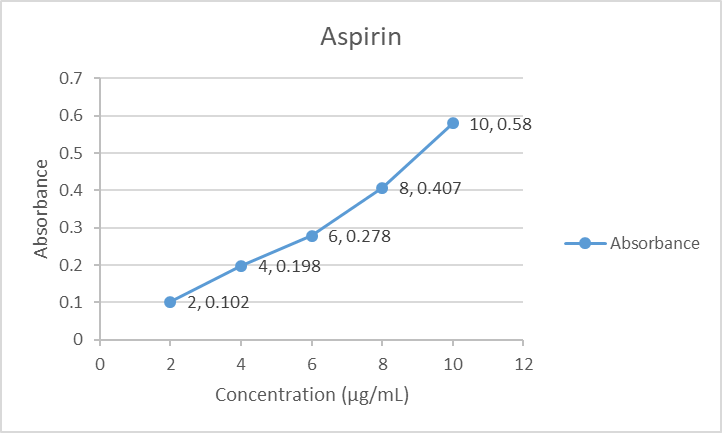
Figure. Calibration curve of Aspirin
3.5 Pre-compression Evaluation of Powder Blends
The pre-compression properties of the powder blends were evaluated to determine their suitability for direct compression. Parameters including bulk density, tapped density, angle of repose, Carr's compressibility index, and Hausner's ratio were assessed, and the results are presented in Table. These parameters provide valuable information regarding the flowability and compressibility of the powder blends, which are critical for achieving uniform die filling and consistent tablet quality during compression.
Table. Pre-compression flow properties of Aspirin oral tablet formulations
|
Formulation |
Bulk Density (g/mL) |
Tapped Density (g/mL) |
Angle of Repose (°) |
Carr's Index (%) |
Hausner's Ratio |
|
F1 |
0.48 |
0.56 |
30.2 |
14.3 |
1.17 |
|
F2 |
0.49 |
0.57 |
29.4 |
14.0 |
1.16 |
|
F3 |
0.50 |
0.58 |
28.8 |
13.8 |
1.16 |
|
F4 |
0.51 |
0.59 |
27.6 |
13.6 |
1.15 |
|
F5 |
0.52 |
0.60 |
26.8 |
13.3 |
1.15 |
|
F6 |
0.53 |
0.61 |
26.2 |
13.1 |
1.14 |
|
F7 |
0.54 |
0.62 |
25.4 |
12.9 |
1.14 |
|
F8 |
0.55 |
0.63 |
24.9 |
12.7 |
1.13 |
|
F9 Optimized |
0.54 |
0.62 |
23.2 |
11.3 |
1.14 |
Bulk density increased from 0.48 g/mL in F1 to 0.55 g/mL in F8, while F9 showed 0.54 g/mL. This indicates that the powder blend became slightly denser and more uniform across the formulations. Tapped density also increased from 0.56 g/mL to 0.63 g/mL, showing that the powder particles packed more efficiently after tapping. A small difference between bulk density and tapped density usually means better flow and less powder compressibility. Angle of repose decreased from 30.2° in F1 to 23.2° in optimized F9. Since a lower angle of repose indicates better flow, F9 showed the best flow property among all formulations. Values below 30° generally indicate good flow. Carr’s Index decreased from 14.3% to 11.3%, suggesting improvement in powder flow and compressibility. Lower Carr’s Index means the powder has less tendency to consolidate and better flow behavior. Hausner’s Ratio ranged from 1.17 to 1.13/1.14, which indicates good flowability. A Hausner’s ratio close to 1 means the powder flows well and has low interparticle friction.
Post-compression Evaluation
Table. Post-compression evaluation of Aspirin oral tablet formulations
|
Formulation |
Weight (mg) |
Thickness (mm) |
Hardness (kg/cm²) |
Friability (%) |
Disintegration Time (hr) |
Drug Content (%) |
|
F1 |
200 |
1.20 |
2.2 |
0.81 |
2.8 |
90.12 |
|
F2 |
201 |
1.32 |
2.3 |
0.75 |
2.4 |
91.84 |
|
F3 |
199 |
1.24 |
2.4 |
0.70 |
2.5 |
93.25 |
|
F4 |
200 |
1.40 |
2.5 |
0.74 |
2.3 |
94.76 |
|
F5 |
201 |
1.44 |
2.6 |
0.60 |
2.7 |
95.18 |
|
F6 |
200 |
1.52 |
2.7 |
0.61 |
2.6 |
96.95 |
|
F7 |
199 |
1.52 |
2.8 |
0.62 |
2.4 |
95.42 |
|
F8 |
200 |
1.55 |
2.9 |
0.60 |
2.5 |
95.15 |
|
F9 (Optimized) |
205 |
1.24 |
2.3 |
0.50 |
2.1 |
97.30 |
The post-compression evaluation of formulations F1 to F9 showed satisfactory tablet characteristics. The tablet weight ranged from 199 to 205 mg, indicating good weight uniformity among the batches. Thickness varied from 1.20 to 1.55 mm, showing slight differences due to formulation composition and compression behavior. Hardness values ranged from 2.2 to 2.9 kg/cm², suggesting that the tablets had sufficient mechanical strength to withstand handling. Friability values were between 0.50% and 0.81%, which are below 1%, indicating good resistance to abrasion and mechanical stress. The disintegration time ranged from 2.1 to 2.8 hours, showing delayed disintegration suitable for colon-targeted delivery. Drug content was found between 90.12% and 97.30%, indicating uniform distribution of aspirin in the formulations. Among all batches, F9 was selected as the optimized formulation because it showed the highest drug content of 97.30%, lowest friability of 0.50%, and shortest disintegration time of 2.1 hours, along with acceptable hardness and tablet weight.
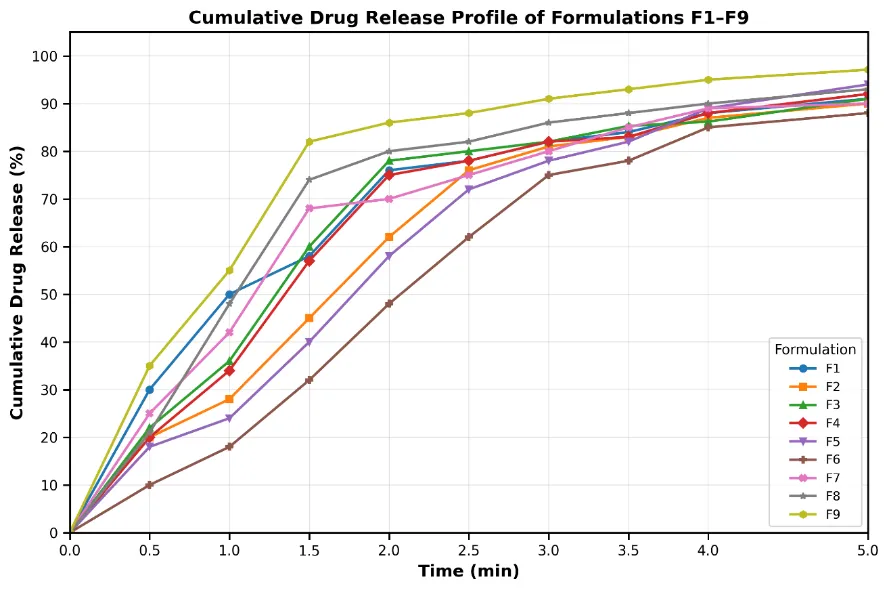
Fig: Percentage Drug Release of Aspirin Formulations
Drug content analysis demonstrated satisfactory content uniformity among all formulations, with values ranging from 90.12% to 97.30%. The optimized formulation (F9) exhibited the highest drug content (97.30%), indicating efficient blending, uniform distribution of the active pharmaceutical ingredient, and minimal drug loss during processing. These findings confirm the suitability of the direct compression method for producing Aspirin oral tablets with acceptable pharmaceutical quality. Overall, formulation F9 exhibited the most desirable balance of mechanical strength, rapid disintegration, low friability, and high drug content, and was therefore selected as the optimized formulation for subsequent dissolution and stability studies.
CONCLUSION
The present study was carried out to formulate and evaluate an aspirin colon-targeted drug delivery system. All prepared formulations showed acceptable pre-compression and post-compression properties. The powder blends exhibited good flow characteristics, as indicated by suitable bulk density, tapped density, angle of repose, Carr’s Index, and Hausner’s ratio values. The prepared tablets also showed satisfactory physical properties, including uniform weight, acceptable thickness, adequate hardness, low friability, suitable disintegration time, and good drug content. Among all formulations, F9 was selected as the optimized formulation because it showed the most desirable evaluation results. F9 exhibited good flow property, lowest friability, acceptable hardness, shorter disintegration time, and highest drug content compared with other batches. These results indicate that the optimized formulation may be suitable for colon-targeted delivery of aspirin. The developed system may help to protect aspirin from early release in the upper gastrointestinal tract and promote drug release in the colon, thereby reducing gastric irritation and improving site-specific drug delivery. Therefore, it can be concluded that the aspirin colon-targeted formulation was successfully prepared and evaluated, and formulation F9 showed the best overall performance among all batches.
REFERENCES

Disha Ghorpade*, Development and Evaluation of Colon-Targeted Aspirin Tablets, Int. J. Med. Pharm. Sci., 2026, 2 (7), 230-237. https://doi.org/10.5281/zenodo.21201010
 10.5281/zenodo.21201010