
We use cookies to ensure our website works properly and to personalise your experience. Cookies policy
1Department of Pharmacology, Faculty of Pharmacy, Uttar Pradesh University of Medical Sciences, Saifai, Etawah 206130, UP. India,
2Assistant Professor, Department of Pharmacology, Faculty of Pharmacy, Uttar Pradesh University of Medical Sciences, Saifai Etawah 206130, Up, India.
3Associate Professor, Department of Pharmacology, Faculty of Pharmacy, Uttar Pradesh University of Medical Sciences, Saifai Etawah 206130, Up, India.
Nutraceutical foods have garnered significant attention because of their potential to enhance health and mitigate lifestyle-related disorders, particularly metabolic disorders. Millets have remarkable nutritional qualities such as high dietary fibre, minerals, vitamins (B) and bioactive compounds with antioxidant properties, which is why the World Health Organization has earmarked them as functional foods. This makes them useful in metabolic disorders and health. The current study aimed to prepare and evaluate the multi-millet granules using a blend of finger millet (Eleusine coracana), pearl millet (Pennisetum glaucum), sorghum (Sorghum bicolor) and barnyard millet (Echinochloa frumentacea). The wet granulation procedure, along with binders (Pregelatinized corn starch), was used to prepare the granules and evaluate for appropriate standard physicochemical parameters such as bulk density, tapped density, angle of repose, Carr’s index, Hausner ratio, moisture content and organoleptic property. The results indicate that the formulated multi-millet granules exhibited good flow properties and acceptable physicochemical characteristics. In conclusion, these multi-millet granules offer a cost-effective and nutritionally enriched formulation with potential applications in the management of metabolic disorders and overall health.
The concept of "food as medicine," initially proposed by Hippocrates around 400 BC, remains highly relevant in contemporary healthcare. Nutrition is integral to health maintenance, influencing disease pathophysiology and contributing to its prevention. With the increasing prevalence of lifestyle-related illnesses such as obesity, hypertension, and diabetes, the significance of dietary patterns has increased markedly in recent years (1). Millets, including barnyard millet (Echinochloa frumentacea), finger millet (Eleusine coracana), pearl millet (Pennisetum glaucum), and sorghum (Sorghum bicolor), have emerged as important functional foods because of their exceptional nutritional and medicinal properties. These grains are rich in vitamins, dietary fibre, essential minerals, and bioactive compounds, including antioxidants and polyphenols, which support metabolic health and reduce the risk of chronic diseases. Their low glycemic index and capacity to induce satiety render them particularly beneficial for weight management and blood sugar regulation. Conversely, poor dietary habits lacking such nutrient-dense foods can impair the immune system and increase susceptibility to infections and metabolic disorders (2).
To address nutritional deficiencies like anemia (iron deficiency), goitre (iodine deficiency), and vitamin A insufficiency, within this context, millets have emerged as highly valuable grains due to their rich nutrient composition and potential to mitigate micronutrient deficiencies while promoting overall health. Varieties such as finger millet (Eleusine coracana), pearl millet (Pennisetum glaucum), sorghum (Sorghum bicolor), and barnyard millet (Echinochloa frumentacea) are excellent sources of iron, calcium, dietary fiber, and various bioactive compounds, rendering them ideal for the development of nutraceuticals and functional foods. Increasing health awareness and advancements in food processing technologies have further facilitated the incorporation of millets into value-added products. Although conventional healthcare has traditionally prioritized pharmaceutical treatments, there has been a notable shift toward preventive strategies emphasizing nutrition. Consequently, millet-based nutraceuticals are increasingly recognized as effective options for managing lifestyle-related disorders and supporting overall well-being by providing essential nutrients necessary for a healthy, disease-free life (3). Millets are increasingly recognized as key components of nutraceutical formulations due to their dense nutritional profile and therapeutic potential. They offer protection against various lifestyle-related disorders such as obesity, diabetes, and cardiovascular diseases. With the rising cost and limitations of conventional medical treatments, there is a growing inclination toward millet-based products as complementary or alternative dietary options. Furthermore, millet-based formulations offer a synergistic combination of essential nutrients and health-promoting bioactive compounds that extend beyond the benefits of conventional foods (4). Hence, the incorporation of millets into nutraceutical products represents a promising and sustainable approach for improving metabolic health, boosting immunity, and ensuring overall well-being.
Extensive research is being carried out on millets and millet-based products to better understand their role in promoting health and preventing disease. The use of millets, especially as functional and nutraceutical foods, has significantly increased as consumers become more aware of the close connection between nutrition and general health. This trend is especially evident in countries facing a growing burden of lifestyle-related disorders and rising healthcare costs. Due to their excellent nutritional profile and health-promoting qualities, millets, including finger millet (Eleusine coracana), pearl millet (Pennisetum glaucum), sorghum (Sorghum bicolor), and barnyard millet (Echinochloa frumentacea), are increasingly well-known worldwide. Furthermore, increasing emphasis on sustainable agriculture and climate-resilient crops has further boosted the demand for millets in recent years (5). According to recent market analyses, the global millet market is witnessing steady growth and is expected to expand significantly in the coming years, driven by the rising demand for healthy, gluten-free, and nutrient-rich food products.
The discovery of diverse bioactive phytochemicals has renewed scientific interest in millets as valuable functional food sources. The abundant presence of these bioactive constituents in millets offers significant potential for enhancing overall health, preventing chronic diseases, and addressing essential nutritional deficiencies. Among various nutrient-rich cereals, finger millet (Eleusine coracana), pearl millet (Pennisetum glaucum), sorghum (Sorghum bicolor), and barnyard millet (Echinochloa frumentacea) have gained considerable attention as promising candidates for the development of nutraceutical formulations due to their exceptional nutritional and therapeutic properties. These millets are rich in important micronutrients like iron, calcium, magnesium, and vitamins, in addition to macronutrients like proteins and dietary fiber. They also include a variety of phytochemicals, including polyphenols and antioxidants that have important bioactive effects (6). They are perfect ingredients for functional and nutraceutical product development because frequent consumption has been linked to improved metabolic health, increased antioxidant defence, and a lower risk of lifestyle-related illnesses.
Millets are one of the earliest domesticated cereal crops, often termed “nutri-cereals,” and have long been a staple in traditional diets owing to their high nutritional content and therapeutic benefits. They have been widely utilized in traditional food systems and are now gaining renewed attention in modern nutrition science. These include barnyard millet (Echinochloa frumentacea), sorghum (Sorghum bicolor), finger millet (Eleusine coracana), and pearl millet (Pennisetum glaucum), which are particularly valued for their diverse health-promoting properties. Essential elements, including dietary fiber, proteins, vitamins A, B complex, and E, and minerals like calcium, iron, magnesium, and potassium, are abundant in these millets (7).
Beyond their nutritional value, millets are rich in a variety of bioactive phytochemicals, including antioxidants, flavonoids, and polyphenols, which play a crucial role in preventing several illnesses. Frequent consumption of millets has been linked to the treatment and prevention of diseases such as diabetes, obesity, heart disease, and digestive disorders. Additionally, millets have hypolipidemic, antidiabetic, anti-inflammatory, and antioxidant qualities that make them ideal for use in nutraceutical and functional food formulations. Due to their wide-ranging health benefits, millets are being increasingly incorporated into dietary interventions and food fortification strategies aimed at enhancing nutritional status and overall health (8).
In this study, a detailed investigation was undertaken focusing on the formulation development, processing techniques, and rigorous quality evaluation of nutraceutical dosage forms prepared from selected millets, including finger millet (Eleusine coracana), pearl millet (Pennisetum glaucum), sorghum (Sorghum bicolor), and barnyard millet (Echinochloa frumentacea). Considering the rich presence of bioactive compounds, essential nutrients, and functional phytochemicals in these millets, the study emphasizes the scientific principles involved in the preparation and standardization of millet-based nutraceutical granules. These formulations offer significant potential health benefits, particularly in the management of lifestyle-related disorders such as obesity and metabolic dysfunctions. In order to meet a variety of health requirements and enhance overall health outcomes, this effort also seeks to produce important insights that can enable the development of novel dietary interventions and innovative, efficient, and financially viable nutraceutical products.
MATERIAL AND METHOD
Collection of millets
The millets utilized in this study, specifically finger millet (Eleusine coracana), pearl millet (Pennisetum glaucum), sorghum (Sorghum bicolor), and barnyard millet (Echinochloa frumentacea), were sourced from a local agricultural market in Agra, Uttar Pradesh, India. The collected samples were authenticated by Dr. Rajvir Singh, a qualified botanist at K.K Collage, Etawah, and voucher specimens were preserved for future reference. The millets underwent a cleaning process to eliminate extraneous matter such as dust, stones, and other impurities, followed by drying under appropriate conditions and storage in airtight containers until further use.
2.2. Preparation of granules
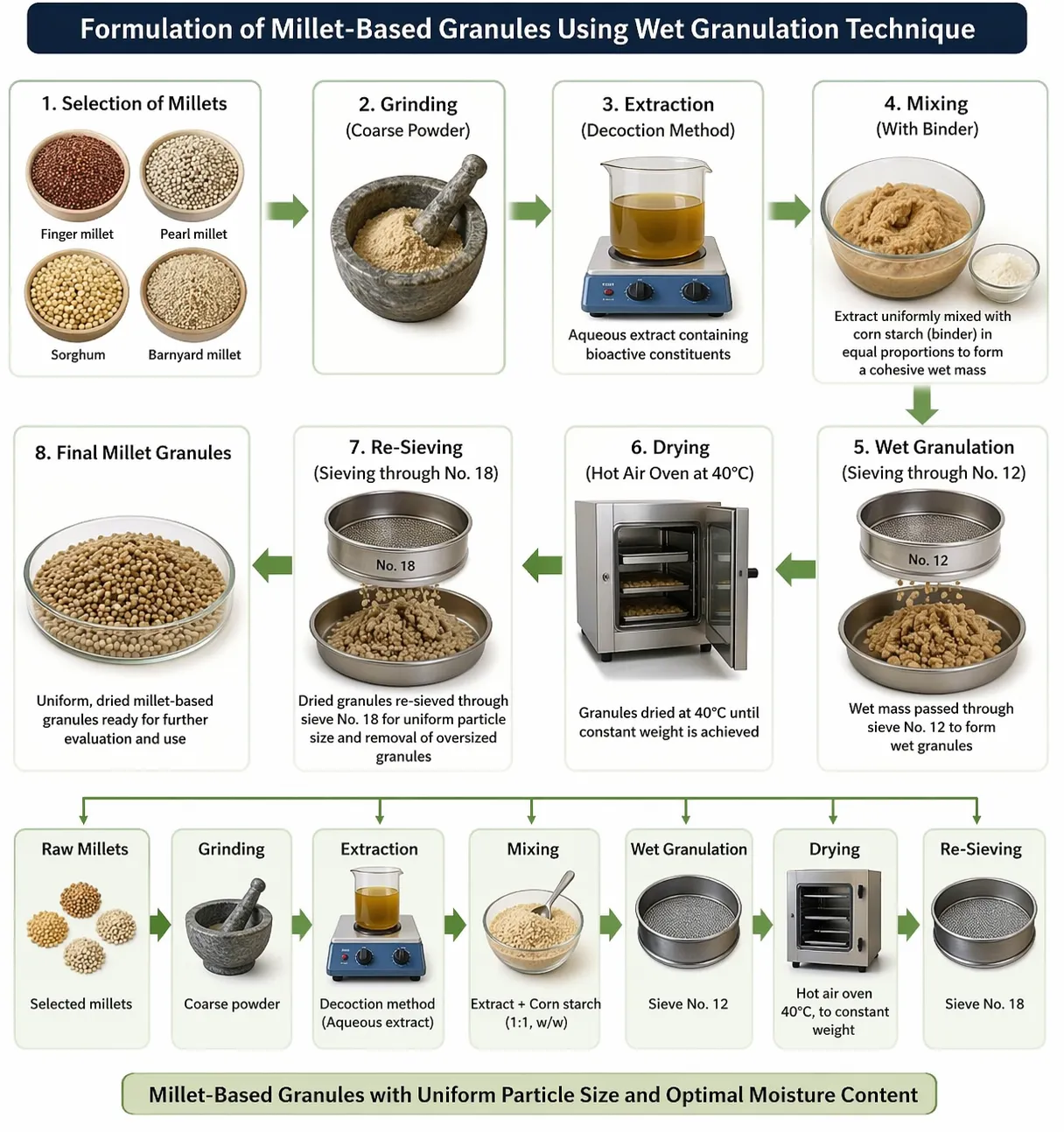
The formulation of millet-based granules was accomplished utilizing the wet granulation technique. Initially, the selected millets were ground into a coarse powder and subjected to extraction via the decoction method to obtain an aqueous extract containing bioactive constituents. This extract was then uniformly mixed with corn starch, serving as a binder, in equal proportions to form a cohesive wet mass. Wet granules were created by passing the prepared wet mass through filter No. 12. To ensure that all moisture was removed, these granules were dried in a hot air oven set at 40°C until they reached a consistent weight. The dried granules were then re-sieved through sieve No. 18 to achieve a uniform particle size distribution and to eliminate oversized granules (9).
2.3. Organoleptic characterisation of Millets Granules.
The organoleptic characterisation of millet granules was carried out by analysing their colour, odour, and taste at room temperature (35-37 ℃) (10,11).
2.4. Preliminary Phytochemical Screening of Millet Granules
To determine the active ingredients in the millet granules, phytochemical analysis was performed. Based on the colour shift observed, the results were recorded as either present (+) or absent (-).
Preparation of Extract for Phytochemical Screening
One gram of multi-millet granules was dispersed in 10 mL of warm distilled water and agitated for 15–20 minutes. The resulting mixture was then filtered using Whatman filter paper No. 1 to obtain a clear filtrate, which was subsequently used for qualitative phytochemical screening.
2.4.1. Procedure for Testing Alkaloids (Dragendorff’s Test)
Dragendorff's reagent was applied in little drops after 2 mL of hydrochloric acid and 2 mL of produced extract were combined.
2.4.2. Procedure for Testing Flavonoids (Flavonoids Test)
2 mL of the prepared extract were treated with 2 mL of hydrochloric acid, followed by the addition of five drops of 5% sodium hydroxide.
2.4.3. Procedure for Testing Phenolics (Ferric Chloride Test)
A few drops of a 10% w/v aqueous ferric chloride solution were added to a 2 mL quantity of the extract.
2.4.4. Procedure for Testing Saponins (Foam Test)
After adding 5 mL of distilled water to 2 mL of the produced extract, the mixture was violently agitated in a test tube for five to seven minutes.
2.4.5. Procedure for Testing Tannins (Ferric Chloride Test)
A 5% w/v solution of ferric chloride was added to the 2 mL of extracted material.
2.4.6. Procedure for Testing Glycosides (Killer-Killiani test)
First, 2–3 mL of glacial acetic acid and a few drops of ferric chloride solution were combined with around 2 mL of the extract. The test tube's side was then gently filled with 1 mL of pure sulfuric acid.
2.4.7. Procedure for Testing Carbohydrates (Molisch’s Test)
About 2 mL of the extract was treated with 2–3 drops of Molisch’s reagent. Subsequently, approximately 2 mL of concentrated sulfuric acid was carefully added along the inner wall of the test tube.
2.4.8. Test for Steroid (Salkowski test)
Approximately 2 mL of extract was combined with 2 mL of chloroform. Subsequently, 2mL of concentrated H2SO4 was carefully added along the inner wall of the test tube.
2.4.9 Test for Protein (Copper sulphate test)
To the 2mL of prepared extract, 1 mL of 10% sodium hydroxide solution was added, followed by the addition of 2-3 drops of 1% copper sulphate solution. The mixture was gently shaken and allowed to stand for a few minutes (12,13).
2 Characterization of Millets-Granules
4.1. Angle of response
Above a level surface coated with graph paper, a funnel was attached at a specific height. A conical heap was created by allowing the millet granules to pass freely through the funnel. After measuring the heap's height (h) and radius (r), the angle of repose (θ) was computed using the following formula:
4.2. Bulk Density
A graduated measuring cylinder was filled with a known amount of millet granules (e.g., 10 g) without compacting, and the starting volume (V₀) was noted. The following formula was used to determine bulk density:
Bulk Density=(Mass of granules)/(Bulk volume (V₀))
4.3. Tapped Density
Until a constant volume (Vt) was achieved, the granule-containing cylinder was mechanically tapped. The tapped density was computed as follows:
4.4. Carr’s Compressibility Index
The following formula was used to generate Carr's index, which shows the granules' compressibility and flow characteristics:
Carr’s Index (%)=(Tapped Density - Bulk Density)/(Tapped Density)×100
4.5. Hausner Ratio
Another metric for assessing flow characteristics is the Hausner ratio, which was computed as follows:
Hausner Ratio=(Tapped Density)/(Bulk Density)
RESULT AND DISCUSSION
1 Organoleptic Characteristics
At room temperature, the organoleptic qualities of the produced millet granules were assessed. Visual and sensory analysis was conducted on parameters such as colour, taste, and smell. Table 2 displays the findings of the organoleptic assessment of the prepared millet granules.
Table 2: Organoleptic Characteristics of Millets-Granules
| S.No. | Parameters | Result |
|---|---|---|
| 1. | Colour | Light brown |
| 2. | Odour | Characteristics |
| 3. | Taste | Bland taste |
2 Preliminary Phytochemical Screening of Millet Granules
Alkaloids, flavonoids, phenolics, tannins, saponins, glycosides, steroids, and protein were among the phytoconstituents found in the prepared millet granules, according to preliminary phytochemical screening. Additionally, the formulation contained carbohydrates. The results indicate that the millet granules contain a high concentration of bioactive substances, which may support their potential nutraceutical and medicinal properties. Table 3 displays the phytochemical analysis's complete findings.
Table 3: Phytochemical Screening Results
| S.No. | Phytoconstituent | Result |
|---|---|---|
| 1. | Alkaloids | + |
| 2. | Flavonoids | + |
| 3. | Phenolics | + |
| 4. | Saponins | - |
| 5. | Tannins | + |
| 6. | Glycosides | + |
| 7. | Carbohydrate | + |
| 8. | Steroid | - |
| 9. | Protein | + |
3 Characterization of Millet Granules
Angle of repose, Carr's index, and Hausner ratio were among the metrics used to assess the flow characteristics of the prepared millet granules. The granules showed fair to acceptable flow properties, according to the results, with an angle of repose over 35°, a Hausner ratio above 1.20, and a Carr's index between 18 and 28%. These results point to flow behavior that is appropriate for additional processing. Table 4 presents the millet granules' bulk characteristics and detailed flow properties.
Table 4: Physical Properties of Millets-Granules
| S.No. | Parameters | Means Value ± SD | Result |
|---|---|---|---|
| 1. | Bulk Density (g/cm3) | 0.42 ± 0.007 | Good |
| 2. | Tapped Density (g/cm3) | 0.50 ± 0.007 | Good |
| 3. | Carr’s Index (%) | 15.88% ± 1.83 | Good flow |
| 4. | Hausner Ratio | 1.19 ± 0.03 | Fair to good |
DISCUSSION
Preformulation and post-formulation characteristics were assessed for the formed millet granules made from finger millet (Eleusine coracana), pearl millet (Pennisetum glaucum), sorghum (Sorghum bicolor), and barnyard millet (Echinochloa frumentacea). The millets were first evaluated for bulk characteristics, phytochemical constituents, physicochemical properties, and organoleptic features. The results were found to be within acceptable bounds. The wet granulation technique was then used to turn the powdered millets into granules, a nutraceutical dose form.
The produced granules were further assessed for bulk characteristics, flow characteristics, and organoleptic qualities. When compared to the powdered form, the granules' angle of repose significantly improved and was determined to be between 23 to 32°, indicating good flow qualities. Additionally, the granules' Hausner ratio and Carr's index improved, falling between 1.07 and 1.24 and 7 to 21%, respectively. Nonetheless, there was little fluctuation in the bulk density and tapped density readings, which ranged from 0.42–0.61 g/cm³ and 0.50–0.72 g/cm³, respectively.
In order to promote appropriate granule formation and enhance flow properties, maize starch was used as a binder in the granule formulation. The produced millet granules demonstrated improved flow behavior and acceptable physicochemical characteristics overall, suggesting its applicability as a nutraceutical product. According to these results, millet-based granules may be a viable and efficient substitute for supplying vital nutrients and treating conditions linked to a certain lifestyle.
CONCLUSION
Finger millet (Eleusine coracana), pearl millet (Pennisetum glaucum), sorghum (Sorghum bicolor), and barnyard millet (Echinochloa frumentacea) were used in this study to assess the viability of creating nutraceutical granules. Organoleptic qualities, physicochemical traits, micromeritic qualities, and initial phytochemical screening were all methodically assessed for the produced granules. The outcomes showed that the millet granules had satisfactory flow characteristics and acceptable quality qualities, making them suitable for further use.
The plant-based nature of the formulation offers significant advantages, including reduced risk of adverse effects compared to synthetic formulations. The potential health advantages of millets are further enhanced by their abundance of vital elements such as dietary fiber, minerals, and bioactive phytochemicals. The use of wet granulation with corn starch as a binder enhanced the physical properties and stability of the formulation.
Overall, the study highlights the potential of millet-based granules as an effective nutraceutical dosage form. These granules can serve as a cost-effective, easily accessible, and nutritionally enriched supplement, particularly beneficial in managing nutritional deficiencies and lifestyle-related disorders. Furthermore, this work provides a foundation for future research focused on optimizing formulation parameters and exploring therapeutic applications of millet-based nutraceuticals.
4. Conflict of Interest
Regarding the publishing of this paper, the authors affirm that they have no conflicts of interest.
6 Acknowledgements
The authors would like to sincerely thank Mr. Vikash Chandra of the Institute of Uttar Pradesh University of Medical Sciences in Saifai, Etawah, Uttar Pradesh, India, for providing the resources needed to complete this study.
REFERENCES



Pooja Kushwah, Vikash Chandra, Yogesh Chand Yadav, Formulation and Physicochemical Evaluation of Multi-millet Granules by Wet Granulation Method, Int. J. Med. Pharm. Sci., 2026, 2 (11), 52-59. https://doi.org/10.5281/zenodo.24332209
 10.5281/zenodo.24332209