

We use cookies to ensure our website works properly and to personalise your experience. Cookies policy
Nagpur College of Pharmacy, Hingna, Nagpur-441110, Maharashtra, India
Background: Due to their anti-inflammatory and antioxidant characteristics, the use of polyherbal combinations including curcumin, piperine, and boswellic acid is very common. Standardization of these compounds relies on reliable analytical methods. Objective: The aim of this research is to develop and validate an efficient, accurate and precise RP-HPLC method for the determination of piperine, boswellic acid, and curcumin in a polyherbal combination. Method: The method of separation through the use of a mobile phase that is a mixture of acetonitrile and phosphate buffer was achieved using isocratic elution on a C18 column. The method was then validated based on linearity, accuracy, precision, robustness, LOQ, and LOD. Results: In addition to having very well-defined peaks, the method enabled a successful separation of curcumin, piperine, and boswellic acid. Linearity of the method was confirmed through calibration curves with correlation coefficients greater than 0.999. Although the precision of the method had % RSD values of less than 2%, its accuracy was proven through recovery experiments. Conclusion: To test the efficiency of quality control of polyherbal formulation containing curcumin, piperine, and boswellic acid, the validated RP-HPLC method is simple, accurate, and precise.
Highly sophisticated methods of separation are utilized to quantify and qualitatively analyze the components present in medicinal herbs or herbal preparations Curcumin, which is the major curcuminoid of Curcuma longa, shows antinflammatory, antioxidant, antimicrobial, and anticancer activities (Hewlings et al, Aggarwal BB et al). Piperine, which is an alkaloid in Piper nigrum, enhances the bioavailability of curcumin and acts as an antioxidant and anti-inflammatory agent (Srinivasan K et al, Shoba et al). The pentacyclic triterpenoids of Boswellia serrata resin are known as boswellic acids and are potent anti-inflammatory and anti-arthritic agents (Ammon HP et al, Siddiqui MZ et al). Out of all the constituents, 3-O-acetyl-11-keto-β-boswellic acid (AKBA) is the major one with pharmacological activity [6,7] (Ammon HP et al, Poeckel et al). It is very important to develop and validate methods for curcumin, piperine, and boswellic acid to control the quality of polyherbal preparations. The RP-HPLC method was developed in this study for the determination of curcumin, gallic acid, and piperine in the Turminice tablet. The Turminice tablet is employed for the treatment of osteoarthritis, rheumatoid arthritis, joint pain, and other inflammatory diseases. Curcumin, the bioactive component of Haldi, has anti-inflammatory, antibacterial, anti-allergic, and anti-cancer properties (Chainani Wu N. et al). The mode of action of curcumin as an anti-inflammatory agent can be explained by the binding of curcumin to its receptor; the activation of signaling pathway due to ligand-receptor binding results in increased expression of PPAR-γ and thus inhibition of cytokine production (Jacob A et al). Piperine, which is one of the active ingredients of Piper, has the following activities such as nervous system depressant activity, anti-inflammatory, antipyretic, analgesic, antioxidant, and bioenhancer (Jain V et al, Kaouriya KG et al, Shah U et al). Piperine facilitates the intestinal absorption of different compounds and decreases gut metabolism of the drugs. Due to these actions, Piper finds use in many Ayurvedic preparations. Moreover, piperine improves the bioavailability of curcumin and gallic acid by inhibition of cytochrome P450 enzymes (Amar S et al). Boswellic acids are one of the primary biological pentacyclic triterpenes that occur in the gum of Boswellia serrata. There are several types of boswellic acids, among which β-boswellic acid (BBA), acetyl-β-boswellic acid (ABBA), 11-keto-β-boswellic acid (KBA), and 3-O-acetyl-11-keto-β-boswellic acid (AKBA) are predominant. AKBA is the most active ingredient Curcumin, piperine, and boswellic acid have strong anti-inflammatory, antioxidant, and anti-arthritic effects that help to increase the efficiency of Turminice Tablet based on a literature review. Piperine can increase the bioavailability of curcumin and show pharmacological activity. Boswellic acid is known for immunomodulatory and anti-inflammatory activity. Curcumin serves as a strong antioxidant and anti-inflammatory compound. As a result, the development of RP-HPLC method for the quality control of Turminice Tablet was achieved because curcumin, piperine, and boswellic acid were chosen as marker compounds. As per our knowledge, few studies have been conducted for simultaneous development and validation of curcumin, piperine, and boswellic acid in Turminice Tablet by RP-HPLC. Hence, an attempt has been made in the present study to develop a simple, accurate, precise, and robust RP-HPLC method for the simultaneous determination of these markers. The method has been validated as per ICH guideline Q2(R1) regarding linearity, accuracy, precision, robustness, limit of detection (LOD), and limit of quantification (LOQ).
MATERIALS AND METHODS:
Instrumentation
Separation by chromatography was done by using Agilent HPLC Gradient System with auto sampler running ChemStation software. The separation was done using Agilent C18 column (250 mm × 4.6 mm, 5 µm). Spectrophotometric determination was done by using UV-Visible spectrophotometer (Analytical Technologies). The pH of mobile phase was determined using VSI pH meter (VSI 1-B). Weighing of standards and samples was done by using WENSAR™ High Resolution Balance. Sonication was done by using Ultrasonics electronic sonicator.
Standard Reagents
Piperine and curcumin reference standards were procured from Yarrow Chem Products, India. The reference standard of Boswellic acid was purchased from Konark Herbal and Healthcare Pvt Ltd, India. Acetonitrile, methanol, water, and other analytical grade solvents used in this study were purchased from reputed chemical suppliers.
Marketed Formulation
In order to design and validate the approach, Nexgen Healthcare Pvt. Ltd.'s Turminice pill was purchased from the local market. After then, the drug sample was stored properly until it was needed again.
Preparation of Standard Stock Solution
A 100 mL volumetric flask was prepared containing the accurately weighted amount of 300 mg of curcumin, 125 mg of boswellic acid, and 5 mg of piperine. For making the stock solution (Stock-I), the standards were solubilized in methanol with the help of sonication, and the volume was made up to the mark by adding methanol. The final concentrations of the stock solution were 25 µg/mL of piperine, 1250 µg/mL of boswellic acid, and 3000 µg/mL of curcumin.
Preparation of Working Standard Solutions
The stock solution was used to make appropriate dilutions with the mobile phase in order to get working solutions of desired concentrations for constructing a calibration curve and validation of the method. The validation parameters such as linearity, accuracy, precision, etc. were determined by these solutions.
Preparation of Working Standard Solutions
Preparation of Sample Solution
The stock solution was used to make appropriate dilutions with the mobile phase in order to get working solutions of desired concentrations for constructing a calibration curve and validation of the method. The validation parameters such as linearity, accuracy, precision, etc. were determined by these solutions.
RP-HPLC method development
Selection of wavelength
The stock solution was used to make appropriate dilutions with the mobile phase in order to get working solutions of desired concentrations for constructing a calibration curve and validation of the method. The validation parameters such as linearity, accuracy, precision, etc. were determined by these solutions.
Chromatographic Conditions
The components curcumin, piperine, and boswellic acid were purified by chromatography through reverse-phase HPLC using a C18 column. Acetonitrile formed the optimum mobile phase: methanol:water mixture in the most suitable proportion (adjusted to pH 3.0 using orthophosphoric acid). Prior to running the sample, the mobile phase was degassed and filtered using a 0.45 μm membrane filter. The analysis was performed at an injection volume of 20 μL with a flow rate of 1.0 mL/min in isocratic mode. For detection, a UV detector was employed at the optimal wavelength while the temperature of the column was maintained at 25°C. Retention times for curcumin, piperine, and boswellic acid were identified to be 2.237 min, 3.890 min, and 5.982 min, respectively, under optimal chromatographic conditions. Optimal peak separation with satisfactory peak symmetry and system suitability criteria was achieved. All the three markers were simultaneously quantified from the polyherbal tablet formulation in the developed RP-HPLC method.
Method validation
Validation of the method was carried out according to the ICH Q2 (R1) Guidelines [15] for metrics such as specificity, linearity, precision, system precision, accuracy, detection limit, quantification limit, and robustness.
Specificity
Specificity refers to the ability to assess the analyte in the presence of components that would otherwise have been expected to be there. This is done to ensure that the marker component is detected, purified, and quantified from the Ayurvedic preparation that is being analyzed. Specificity is determined by comparing the component of interest separated from the commercial preparation with the retention time and the UV spectrum of standards.
Linearity
The linearity of the new RP-HPLC method was determined through a correlation between peak area and concentration for curcumin, piperine, and boswellic acid. Curcumin concentrations were varied from 30–150 μg/mL; piperine concentrations were from 0.25–1.25 μg/mL; and boswellic acid concentrations were from 12.5–62.5 μg/mL. All concentration levels were prepared and analyzed thrice. A plot of the average peak area as a function of the concentration of each compound facilitated the preparation of calibration curves. Good linearity was demonstrated by the regression analysis performed at the selected concentrations. The compounds curcumin, piperine, and boswellic acid demonstrated very good linear correlations between the concentration and the peak areas, with r² values of 0.9990, 0.9990, and 0.9993, respectively. This confirms the linearity and suitability of the developed RP-HPLC method for the quantitative determination of curcumin, piperine, and boswellic acid in the polyherbal product.
Precision
The accuracy of the developed methodology was ensured through testing the repeatability (intra-day accuracy) and inter-day accuracy, which showed a percent relative standard deviation (% RSD) below 2%. The results were presented in the table below table 5.
Accuracy
The recovery of the spiked standard in the medicine product was evaluated to determine the precision of the procedure. The results indicated that the procedure was precise, having an RSD% below 2 and a recovery range of 98-100.6%. A table outlined the results below in table 4.
Robustness
The difference in flow rate that showed no change occurred in the validation column and that showed the validation parameters such as theoretical plates, tailing factor, retention time, resolution, and percentage relative standard deviation of the peak were used to measure the robustness of the method. More than 2000 theoretical plates were obtained using the developed method, and the validity of the method was shown from the percentage relative standard deviation for the peak area and retention times that were less than 2 and tailing factor that was less than 2.
LOD and LOQ
LOD and LOQ were calculated using the slope of the calibration curve of curcumin and piperine and the standard deviation of the responses. This method is highly sensitive and can detect and quantify these compounds at lower concentrations based on the LOD and LOQ of 1.413 μg/ml and 0.007 μg/ml for curcumin and 1.973 μg/ml and 0.022 μg/ml for piperine and boswellic acid.
RESULTS:
Table 1: Linearity and range of curcumin
|
S. No. |
Concentration(μg/ml) |
Peak area |
|
1 |
30 |
6981.60 |
|
2 |
60 |
15392.20 |
|
3 |
90 |
23601.15 |
|
4 |
120 |
31526.65 |
|
5 |
150 |
39644.60 |
|
Slope |
271.3 |
|
|
Y-intercept |
1008 |
|
|
Correlation coefficient |
0.999 |
|
Table 2: Linearity and range of piperine
|
S. No. |
Concentration(μg/ml) |
Peak area |
|
1 |
0.25 |
164.31 |
|
2 |
0.5 |
374.25 |
|
3 |
0.75 |
566.35 |
|
4 |
1 |
777.55 |
|
5 |
1.25 |
993.76 |
|
Slope |
824.44 |
|
|
Y-intercept |
43.41 |
|
|
Correlation coefficient |
0.999 |
|
Table 3: Linearity and range of boswellic acid
|
S. No. |
Concentration(μg/ml) |
Peak area |
|
1 |
12.5 |
1228.73 |
|
2 |
25 |
2550.70 |
|
3 |
37.5 |
3737.32 |
|
4 |
50 |
5006.97 |
|
5 |
62.5 |
6368.34 |
|
Slope |
101.88 |
|
|
Y-intercept |
42.23 |
|
|
Correlation coefficient |
0.999 |
|
Table 4: Result for accuracy studies of Boswellic acid, curcumin and piperine
|
Selected Markers
|
Level of Accuracy
|
Theoretical content of marker (μg/ml) |
Amount of marker added (μg/ml) |
Total Amount of marker (μg/ml) |
Amount of marker recovered (μg/ml) |
% recovery
|
Mean recovery
|
%RSD
|
|
Piperine
|
80 100 120 |
0.25 0.25 0.25 |
0.2 0.25 3 |
0.45 0.50 0.55 |
0.20 0.25 0.30 |
99.69 0.49 0.55 |
99.07
|
0.89
|
|
Boswellic Acid
|
80 100 120 |
12.5 12.5 12.5 |
10 12.5 15 |
22.54 24.97 27.43 |
10.04 12.47 14.93 |
100.5 100.4 100.0 |
100.45
|
0.06
|
|
Curcumin
|
80 100 120 |
30 30 30 |
24 30 36 |
53.91 60.26 66.36 |
23.91 30.26 36.36 |
100.1 100.2 100.9 |
99.90
|
0.39
|
Table 5: Result for system precision- Interday
|
Level of conc. |
Piperine
|
|
|
Boswellic acid |
|
|
Curcumin |
|
|
|
|
LQC
|
MQC |
HQC |
LQC |
MQC |
HQC |
LQC |
MQC |
HQC |
|
Avgarea of 3 d (ppm) n=3 |
373.52
|
569.16 |
821.1
|
2490.28
|
3741.82 |
5004.69 |
15397.95
|
23525.00 |
31497.55 |
|
SD |
1.66 |
0.81 |
0.65 |
11.98 |
28.90 |
3.54 |
1.91 |
31.11 |
431.41 |
|
%RSD
|
0.44 % |
0.14 % |
0.08 % |
0.48 % |
0.77 % |
0.07 % |
0.01 % |
0.13 % |
1.37 % |
Table 6: Result for system precision- Intraday
|
Level of con |
Piperine |
|
|
Boswellic acid |
|
|
Curcumin |
|
|
|
|
LQC |
MQC |
HQC |
LQC |
MQC |
HQC |
LQC |
MQC |
HQC |
|
Avg. area of 3 d (ppm) n=3 |
368.83
|
566.68 |
777.72 |
2487.67
|
3770.90 |
5024.48 |
373.52 |
569.16 |
773.66 |
|
SD |
5.01 |
3.68 |
2.17 |
10.83 |
5.59 |
63.20 |
17.82 |
145.73 |
575.37 |
|
%RSD |
1.36 % |
0.65 % |
0.28 % |
0.44 % |
0.15 % |
1.26 % |
0.12 % |
0.62 % |
1.83 % |
*conc = concentration, SD = standard deviation, mean for three independent analyses, %RSD = relative standard deviation, n= No. of injections.
Table 7: Result for LOD and LOQ values calculated from the calibration curve
|
Parameters |
Piperine |
Boswellic acid |
Curcumin |
|
LOD |
0.007 |
1.973 |
1.413 |
|
LOQ |
0.022 |
5.784 |
4.283 |
Table 8: System suitability of the developed method
|
Sample |
Retention time |
Area |
USP Tailing Factor |
USP Theoretical plates |
|
Curcumin |
5.982 |
6141.08 |
0.87 |
5877 |
|
Piperine |
3.890 |
1058.60 |
0.77 |
4483 |
|
Boswellic acid |
2.237 |
112.55 |
0.83 |
4764 |
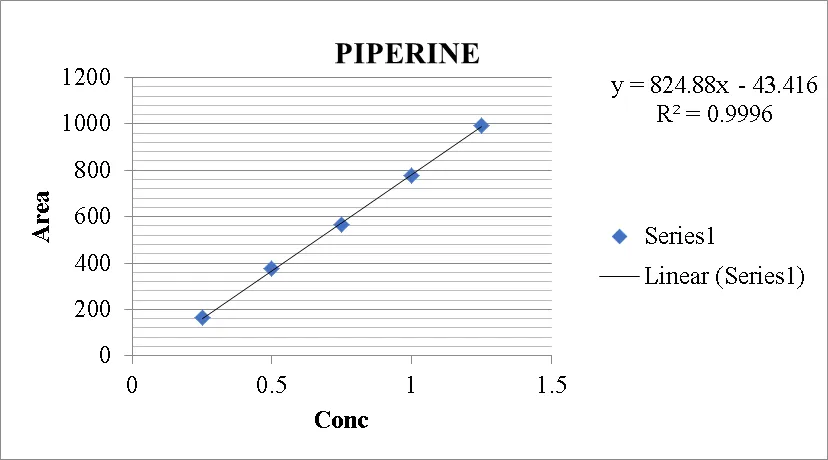
Fig.1. Calibration curve of piperine
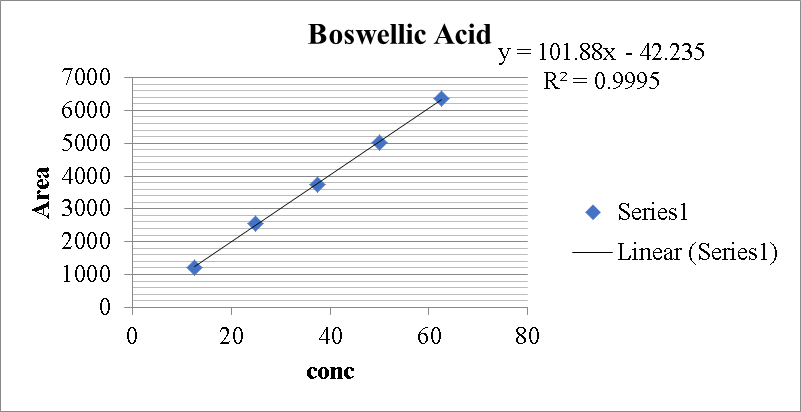
Fig.2. Calibration curve of Boswellic acid
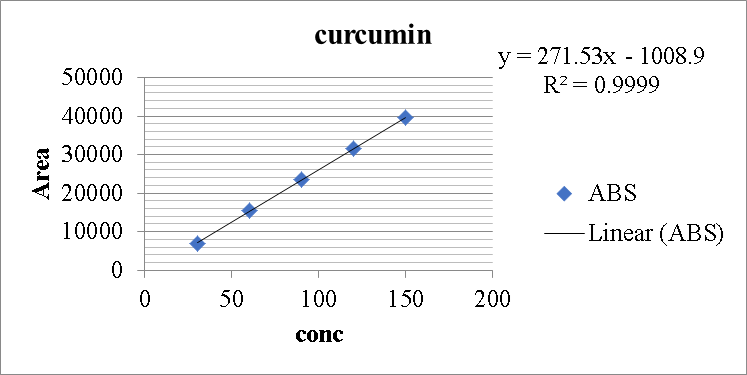
Fig.3. Calibration curve of Curcumin
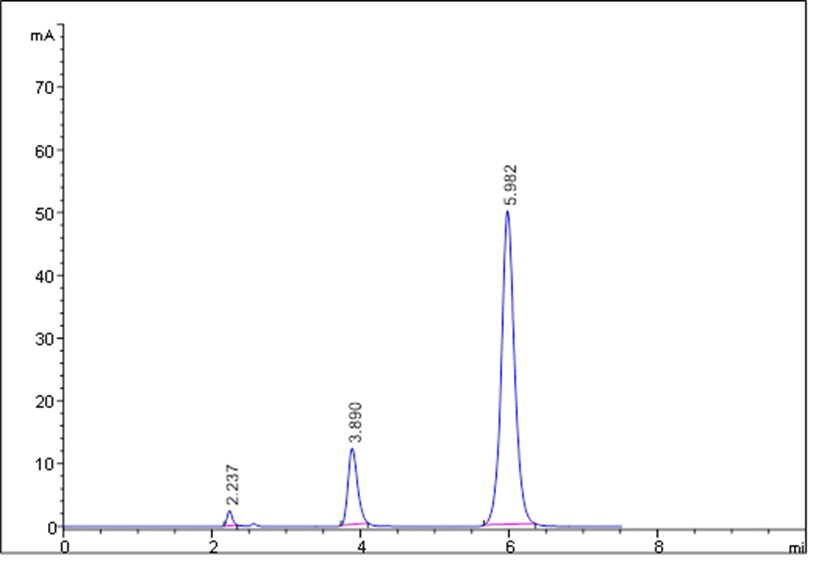
Fig. 4. Chromatogram of Standard of Curcumin Piperine and Bosswelic acid.
DISCUSSION:
A new, highly accurate, reliable, and precise RP-HPLC method has been developed and validated for simultaneous estimation of curcumin, piperine, and boswellic acid in a polyherbal tablet dosage form. In order to obtain optimum separation and resolution of peaks, various chromatographic parameters have been studied during method development. Acetonitrile was used as the mobile phase with a C18 column under optimum chromatographic conditions. Methanol: Water (isocratic elution with correction of pH by orthophosphoric acid). The analysis was performed using a column temperature of 25°C, injection volume of 20 μL, and flow rate of 1.0 mL/min. Detection was done using PDA detector at 244 nm. In view of the fact that the method did not encounter any interference from the formulating excipients in terms of the analyte retention times, the method exhibited specificity. As per the retention times of 2.237 minutes for curcumin, 3.890 minutes for piperine, and 5.982 minutes for boswellic acid, the peaks were distinctly separated. The results from the analysis of linearity within the selected ranges of curcumin (30-150 μg/mL), piperine (0.25-1.25 μg/mL), and boswellic acid (12.5-62.5 μg/mL) revealed the presence of a relationship between peak areas and concentrations of these compounds. For curcumin, piperine, and boswellic acid, the correlation coefficients (r²) were 0. Experiments on LOD and LOQ have been done in order to find out the sensitivity of the method. LOD of curcumin, piperine, and boswellic acid has been found out to be 1.413 µg/mL, 4.283 µg/mL, and 5.784 µg/mL, respectively. This shows that the method is able to detect the analytes in low concentrations. Reproducibility and reliability of the method has been established by means of precision experiment, repeatability, intraday precision, and inter-day precision. These experiments provided us with %RSD in an acceptable limit of less than 2%. The accuracy of the developed method has been validated through accuracy experiments, which include recovery experiments. Retention times, better peak symmetry, remarkable resolution, higher sensitivity, and enhanced selectivity using PDA detection are some of the advantages that the new RP-HPLC method possesses in comparison with the earlier methodologies. The suitability of the method for quality control testing of curcumin, piperine, and boswellic acid in polyherbal tablet formulations was confirmed once it was validated as per ICH Q2(R1).
CONCLUSION
For the compounds such as curcumin, piperine, and boswellic acid in the polyherbal tablet formula, a simple, fast, precise, accurate, specific and robust RP-HPLC technique has been developed and validated. The three marker compounds were effectively separated under optimized chromatographic conditions, and the retention times of curcumin, piperine, and boswellic acid were 2.237, 3.890, and 5.982 minutes, respectively. The developed procedure was validated for specificity, linearity, accuracy, precision, robustness, LOD, and LOQ according to the ICH Q2(R1) guidelines. As the correlation values exceeded 0.999, high linearity was observed within the concentration range of 30-150 μg/mL for curcumin, 0.25-1.25 μg/mL for piperine, and 12.5-62.5 μg/mL for boswellic acid. Moreover, satisfactory sensitivity, accuracy, and precision were observed, and all the parameters of validation fulfilled the predefined acceptance criteria.
ACKNOWLEDGMENT:
The authors extend their gratitude to the Nagpur College of Pharmacy, Nagpur for giving an opportunity to carry out work in their college.
REFERENCES

Deepa Mokle*, Sachin Hiradeve, Namrata Mane, Lalchand Devhare, Vaibhav Uplanchiwar, Pravin Suruse, Vinod Thakre, Method Development and Validation of Curcumin, Piperine and Boswellic Acid in Polyherbal Formulation by RP-HPLC, Int. J. Med. Pharm. Sci., 2026, 2 (8), 327-334. https://doi.org/10.5281/zenodo.21833233
 10.5281/zenodo.21833233